

5 Key Architects Who Changed the Course of History
From Brunelleschi's Renaissance dome to Zaha Hadid's parametric masterpieces, these five famous architects fundamentally reshaped how we build, inhabit, and experience space. Explore their iconic works, design philosophies, and enduring influence on global architecture, including famous American architects like Frank Lloyd Wright and modern pioneers who continue to inspire architects today.
 Begum Gumusel16 January 20269 Mins read278
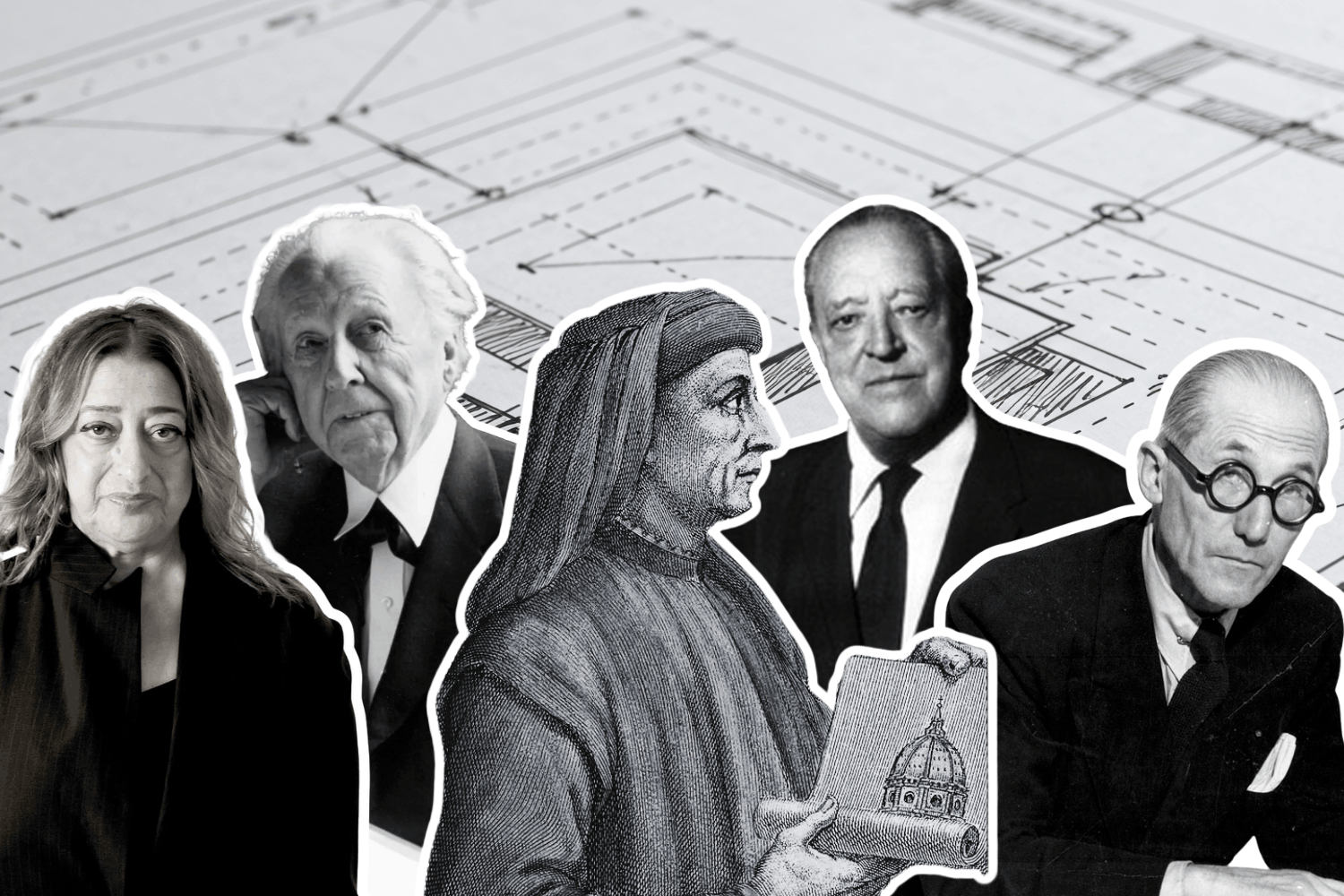
Table of Contents Show
Architecture has always reflected the values, technologies, and ambitions of its time, but certain famous architects in history have gone beyond reflection to fundamentally reshape how societies build, inhabit, and understand space. These figures did not simply design influential buildings; they transformed architectural language, challenged cultural and technical limitations, and introduced ideas that continue to shape cities and landscapes today. Through new materials, spatial concepts, and philosophical approaches, they altered the trajectory of architectural history itself. The following five architects stand as pivotal figures, widely considered some of the most famous architects of all time, whose work redefined the discipline on a global scale and continues to influence how architecture is taught, practiced, and experienced. Whether you are exploring the minds of famous architects or searching for the best famous architects to study, these five names belong at the top of every list.
Who Is the Most Famous Architect? Understanding Architectural Legacy
The question “who is the most famous architect” sparks passionate debate among architecture enthusiasts and scholars alike. Fame in architecture can be measured by influence on the profession, the enduring relevance of built works, or the introduction of ideas that permanently changed how we conceive space. The five architects profiled below each meet all three criteria. From Renaissance Italy to twentieth-century America and beyond, their contributions represent some of the most significant turning points in the history of the built environment. Studying their work is essential for anyone interested in architectural inspirations from around the world and the famous buildings and architects behind them.
| Architect | Lifespan | Nationality | Movement / Style | Signature Philosophy | Most Iconic Work |
|---|---|---|---|---|---|
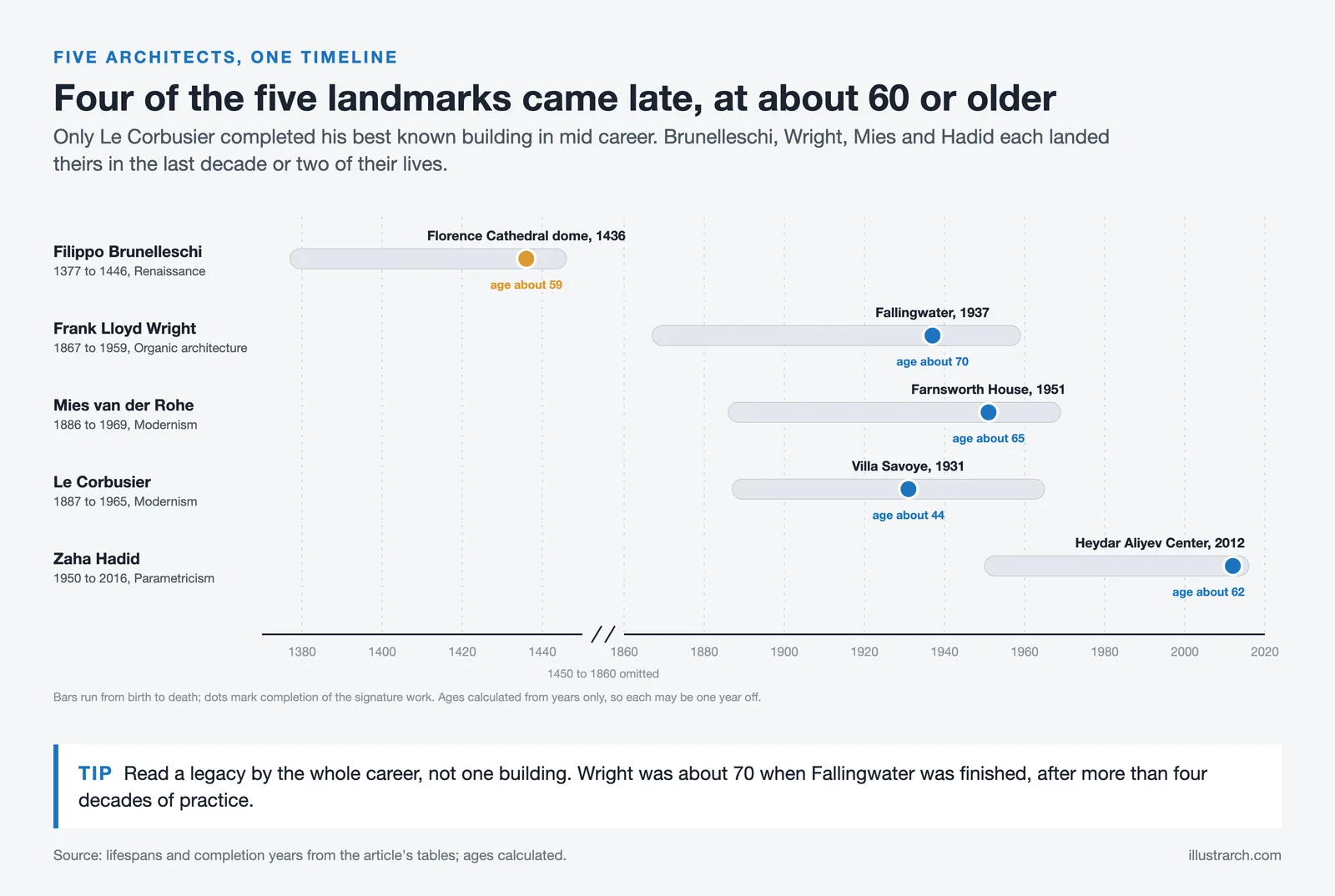
| Filippo Brunelleschi | 1377-1446 | Italian | Renaissance Architecture | Classical proportion, geometry & humanist reason | Dome of Florence Cathedral |
| Le Corbusier | 1887-1965 | Swiss-French | Modernism / International Style | “Machine for living” efficiency & standardization | Villa Savoye |
| Frank Lloyd Wright | 1867-1959 | American | Organic Architecture / Prairie Style | Harmony between structure & nature | Fallingwater |
| Mies van der Rohe | 1886-1969 | German-American | Modernism / Minimalism | “Less is more” structural clarity & restraint | Farnsworth House |
| Zaha Hadid | 1950-2016 | Iraqi-British | Deconstructivism / Parametricism | Fluid geometry, digital form & spatial fluidity | Heydar Aliyev Center |
1. Filippo Brunelleschi
Filippo Brunelleschi is widely regarded as the founding figure of Renaissance architecture and a turning point between medieval and modern ways of thinking about space. His most celebrated achievement, the dome of Florence Cathedral, solved an engineering challenge that had remained unresolved for decades. Without the use of traditional wooden centering, Brunelleschi devised a revolutionary double-shell structure, herringbone brick pattern, and innovative lifting machines that allowed the dome to be constructed safely and efficiently. As one of the earliest famous architects of the world, his engineering ingenuity set a standard that resonated for centuries.
Beyond its technical brilliance, the dome symbolized a broader intellectual shift. Brunelleschi reintroduced classical principles of proportion, geometry, and perspective, grounding architecture in mathematical logic and human scale. His rediscovery of linear perspective also transformed architectural representation, changing how space was conceived and drawn. Through these innovations, Brunelleschi established architecture as a discipline rooted in reason, observation, and humanist philosophy, marking a decisive break from medieval traditions and laying the foundations of Western architectural thought. His integration of mathematical harmony into design later inspired architects who embraced the Golden Ratio as a guiding principle.

2. Le Corbusier
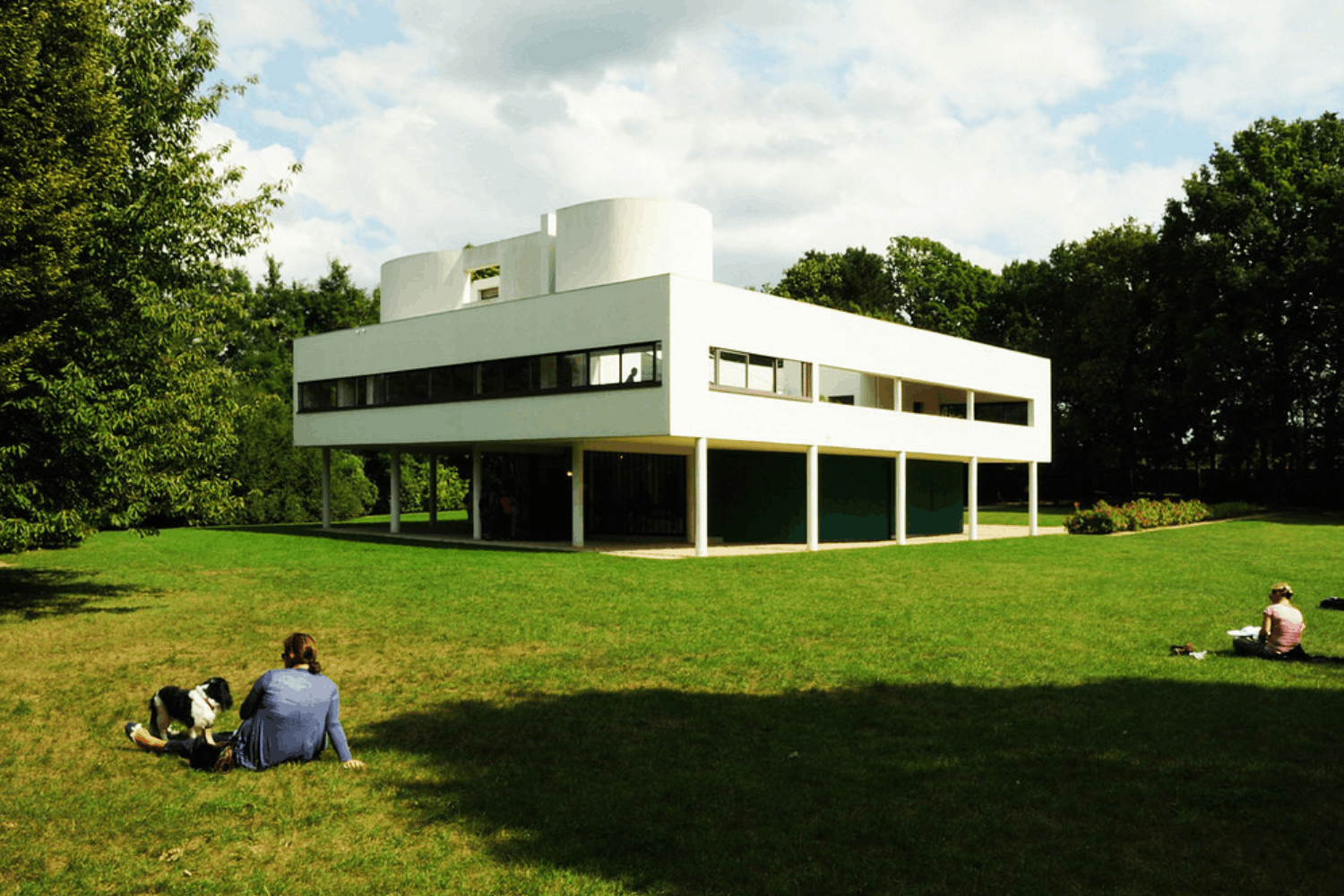
Le Corbusier reshaped 20th-century architecture by redefining how buildings could respond to modern life, industrialization, and rapid urban growth. Through his writings, manifestos, and built works, he introduced a radically new architectural vocabulary centered on efficiency, standardization, and functional clarity. Concepts such as the open plan, pilotis, roof gardens, horizontal windows, and free façades became cornerstones of modernist design. As one of the most influential famous modern architects, his impact extended across Europe, Asia, and the Americas.
His idea of architecture as a “machine for living” reflected a belief that buildings should support modern lifestyles through rational planning and technological innovation. Beyond individual buildings, Le Corbusier’s influence extended into urban planning, where his visions for high-density housing and organized cities profoundly shaped post-war development worldwide. While often controversial for their rigidity and scale, his ideas fundamentally transformed architectural education and practice, establishing modernism as a dominant global movement. His Five Points of Architecture remain required reading in schools around the world, making him a central figure among famous architects today studied in every curriculum.
3. Frank Lloyd Wright
Frank Lloyd Wright introduced a uniquely American architectural philosophy rooted in the concept of organic architecture. Rejecting historical imitation and rigid modernism alike, Wright believed that buildings should grow naturally from their environment, forming a seamless relationship between structure, material, and landscape. His designs emphasized horizontality, natural materials, and strong connections between interior and exterior spaces. Often cited as the answer when people ask “who is the most famous architect,” Wright is routinely recognized as one of the greatest famous American architects and famous US architects of all time.
Projects such as Fallingwater demonstrated how architecture could coexist with nature rather than dominate it, integrating water, rock, and forest into the spatial experience. Wright also revolutionized domestic architecture through open floor plans, fluid spatial sequences, and innovative structural systems. His influence extended far beyond aesthetics, shaping ideas about sustainability, environmental responsiveness, and human-centered design that remain central to contemporary architectural discourse. Many of his famous buildings are now protected as cultural landmarks.
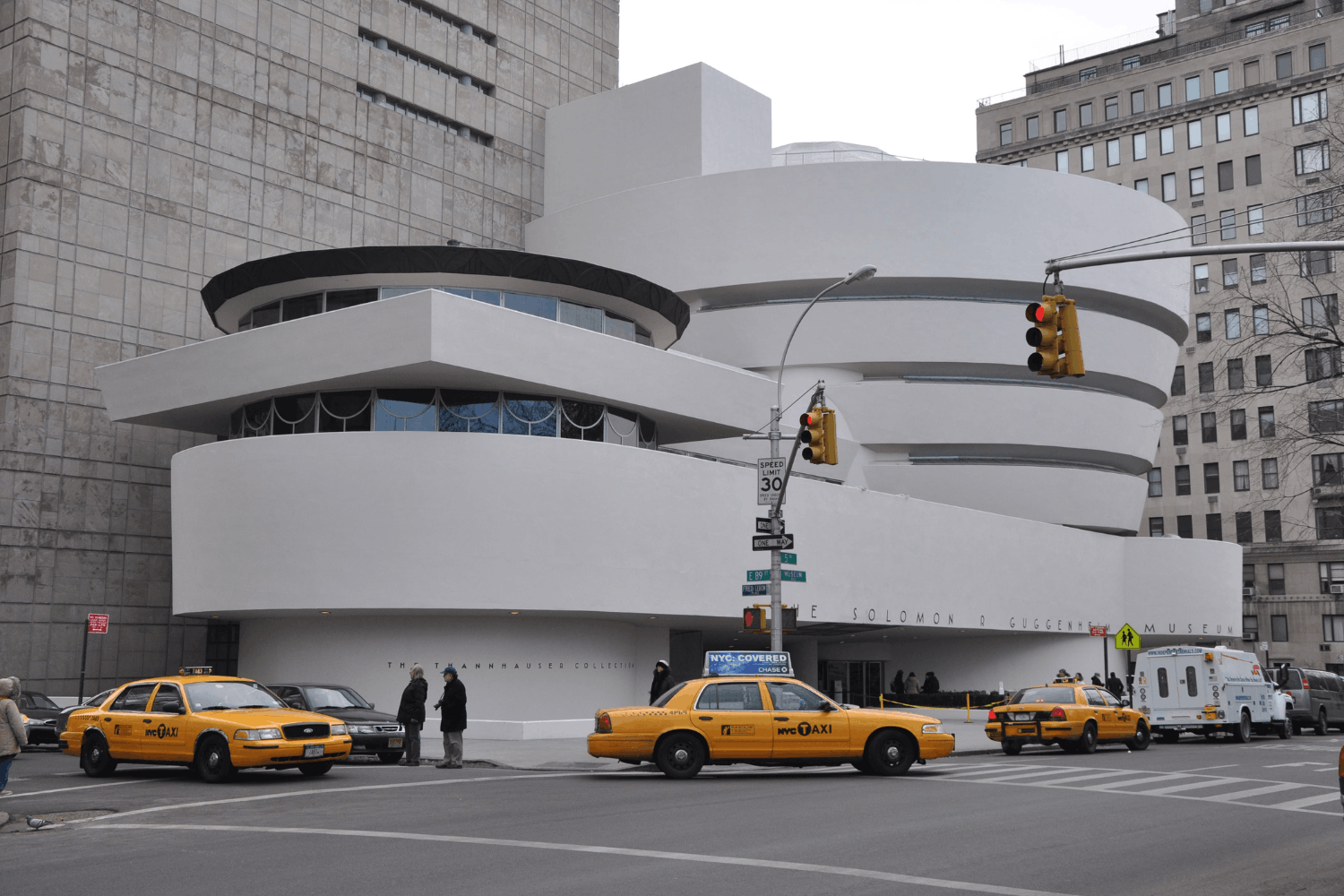
Wright’s career in Chicago established him as one of the most celebrated famous Chicago architects, known for the Prairie Style. His contributions to American architecture include the Robie House, Unity Temple, and the Solomon R. Guggenheim Museum in New York. As a leading figure among famous architects in USA, Wright’s legacy is overseen today by the Frank Lloyd Wright Foundation, which preserves his archives and promotes organic architecture worldwide.
4. Mies van der Rohe
Mies van der Rohe transformed architecture through radical simplicity, structural clarity, and material precision. His famous principle, “less is more,” captured a design philosophy that emphasized reduction rather than excess. By stripping architecture down to its essential elements, Mies revealed the expressive potential of structure, proportion, and detail. His work places him firmly among the most famous architects who defined the visual language of the twentieth century.
Embracing steel and glass, he helped define the visual language of modern skyscrapers, corporate buildings, and institutional architecture. His open, flexible spaces redefined how buildings could be occupied and adapted over time. Mies demonstrated that restraint could be powerful, elevating modern architecture into a disciplined, elegant language that continues to influence contemporary minimalism and high-rise design across the globe. As a German-born architect who became one of the most prominent famous Chicago architects, Mies served as head of the architecture department at the Illinois Institute of Technology, where his campus design became a masterclass in modernist planning.
5. Zaha Hadid
Zaha Hadid fundamentally changed architectural history by challenging traditional notions of form, structure, and spatial order. Her work embraced fluid geometries, dynamic movement, and complex surfaces made possible through digital design and advanced engineering. Rather than static compositions, her buildings appear in motion, reshaping how space is perceived and experienced. Among famous architects today, Hadid’s influence on parametric architecture remains unmatched.
As the first woman to receive the Pritzker Architecture Prize, Hadid also transformed perceptions of leadership and authorship within the profession. Her influence extends beyond iconic buildings to the widespread adoption of parametric design thinking in contemporary practice. By pushing the boundaries of what architecture could be, technically, visually, and culturally, Hadid inspired a new generation of architects to explore innovation without compromise. Her legacy continues through Zaha Hadid Architects, which remains one of the largest architectural firms in the world.
Famous Buildings by These Architects: Key Works Compared
| Building | Architect | Year Completed | Location | Key Materials | Defining Innovation | UNESCO Status |
|---|---|---|---|---|---|---|
| Dome of Florence Cathedral | Filippo Brunelleschi | 1436 | Florence, Italy | Stone, brick (herringbone), marble | Self-supporting double-shell dome; 45.5 m diameter, still the largest masonry dome ever built | ✅ World Heritage Site (1982) |
| Villa Savoye | Le Corbusier | 1931 | Poissy, France | Reinforced concrete, glass, steel | Full realization of the Five Points of Architecture, pilotis, free plan, free façade, ribbon windows, roof garden | ✅ World Heritage Site (2016) |
| Fallingwater | Frank Lloyd Wright | 1937 | Mill Run, Pennsylvania, USA | Reinforced concrete, native sandstone, glass | Cantilevered structure built over a waterfall; organic integration of building and nature | ✅ World Heritage Site (2019) |
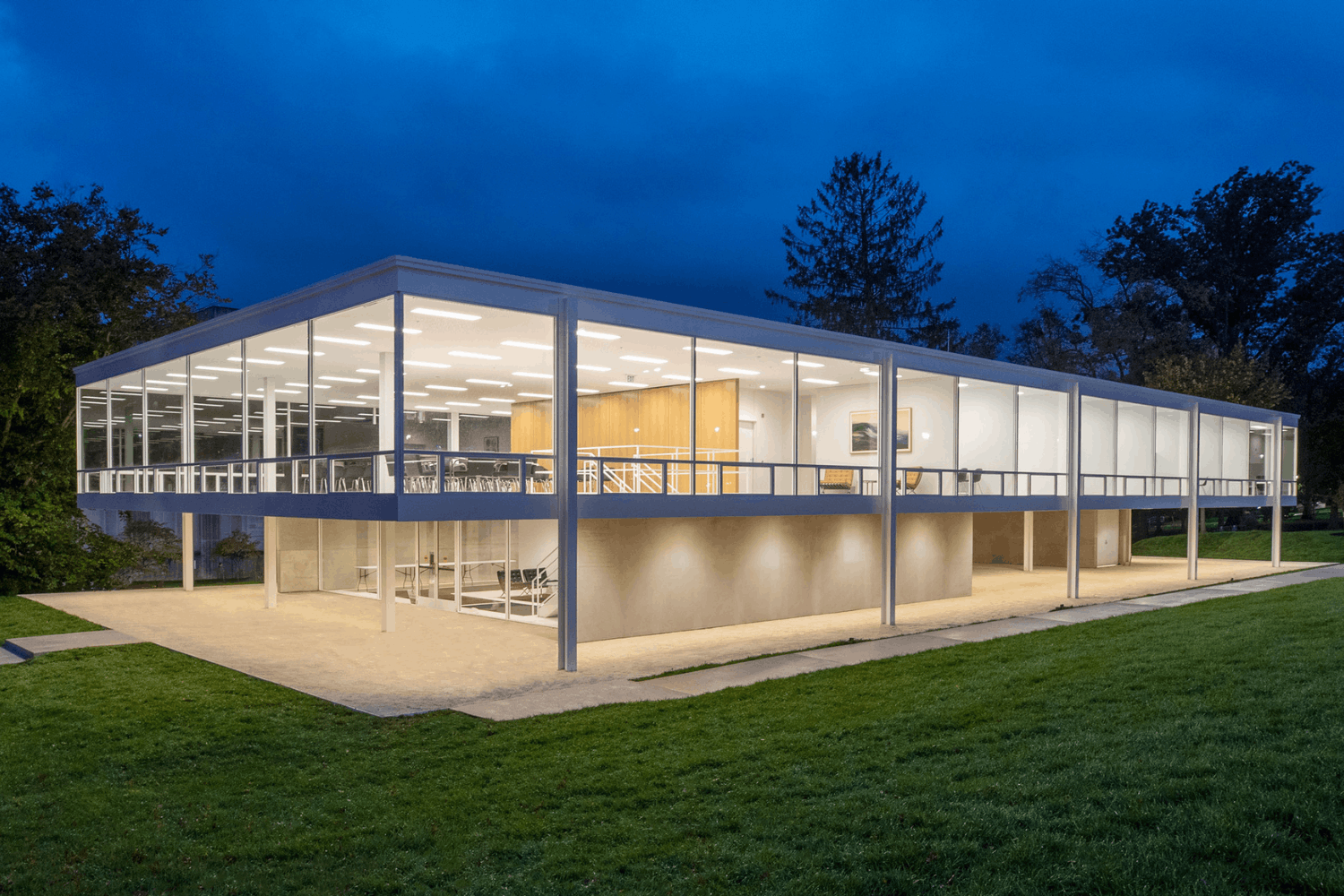
| Farnsworth House | Mies van der Rohe | 1951 | Plano, Illinois, USA | Steel, floor-to-ceiling glass, travertine | Ultimate expression of “less is more” transparent, open-plan glass pavilion elevated on steel columns | National Historic Landmark |
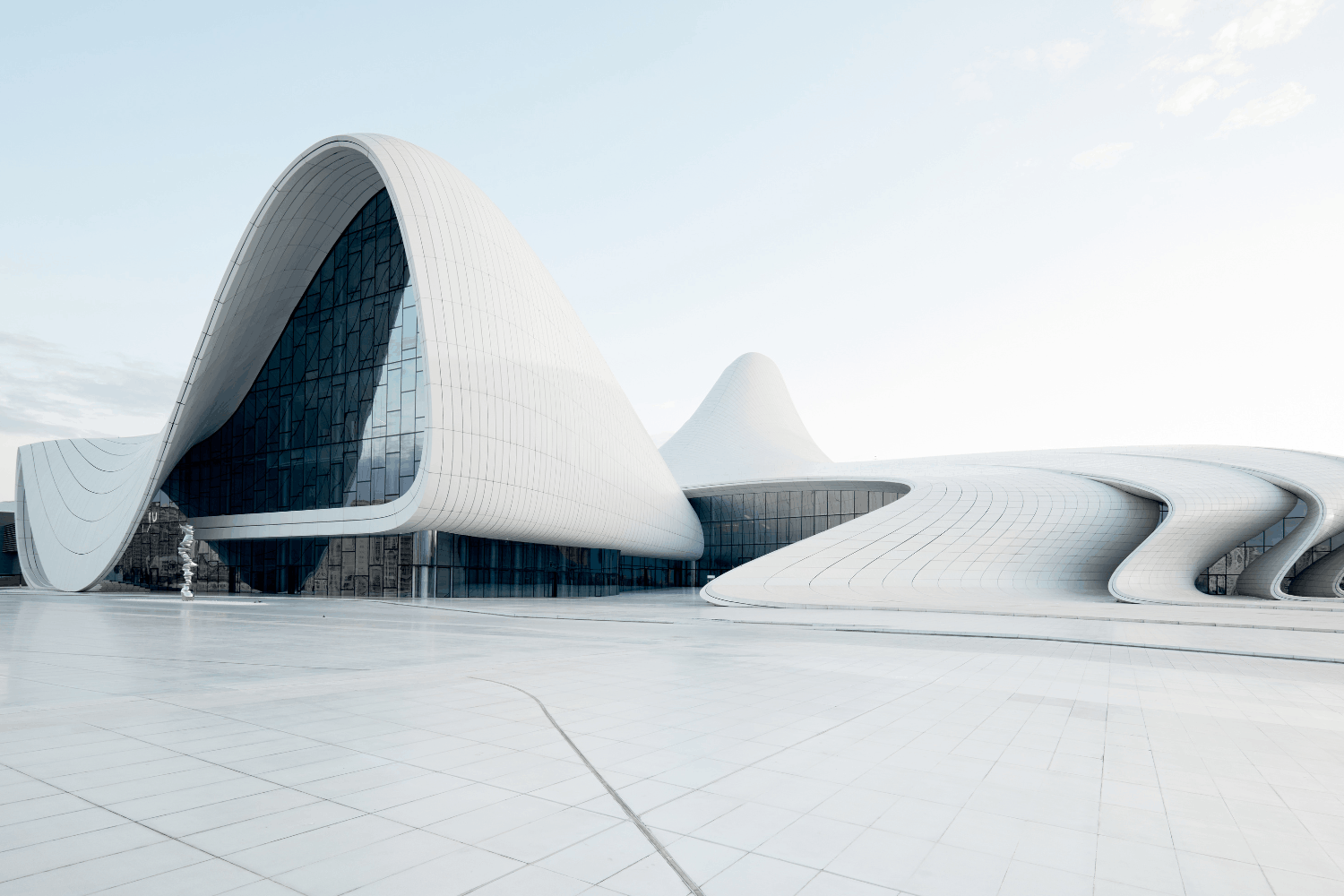
| Heydar Aliyev Center | Zaha Hadid | 2012 | Baku, Azerbaijan | Concrete, steel, GFRC panels, GFRP | 57,500 m² of floor area under a continuous curved surface with no sharp angles; parametric design at urban scale | Design Museum Award (2014) |
| Aspect | Brunelleschi | Le Corbusier | Wright | Mies van der Rohe | Hadid |
|---|---|---|---|---|---|
| Guiding Motto | “Measure & Proportion” | “A machine for living” | “Organic Architecture” | “Less is more” | “There are 360 degrees, so why stick to one?” |
| Relationship to Nature | Nature understood through mathematical laws | Building raised above nature (pilotis) | Building merges with nature | Nature viewed through transparent glass | Building mimics natural landscape & flow |
| Form Language | Classical symmetry & geometry | Pure geometric volumes | Horizontal planes & flowing spaces | Rectilinear minimalism | Fluid curves & parametric complexity |
| Structural Innovation | Self-supporting masonry dome | Reinforced concrete frame (Dom-Ino) | Cantilevered reinforced concrete | Steel-and-glass curtain wall | Digitally fabricated complex surfaces |
| Preferred Materials | Stone, brick, marble | Reinforced concrete, glass | Sandstone, wood, concrete | Steel, glass, travertine | Concrete, GFRC, steel, GFRP |
| Legacy Impact | Founded Renaissance architecture & linear perspective | Defined Modernism & modern urban planning | Pioneered sustainable, nature-centered design | Shaped the modern skyscraper & minimalism | Established parametric & computational design |
Beyond the Five: Other Famous Architects of the World Worth Studying
While these five figures represent pivotal turning points, the full panorama of famous architects of the world extends much further. Famous Japanese architects like Tadao Ando and Kengo Kuma have redefined the relationship between architecture, nature, and light. Famous Spanish architects such as Antoni Gaudí pushed the boundaries of organic form over a century ago, while Santiago Calatrava continues that tradition with kinetic structural design. Famous Russian architects of the Constructivist era, including Konstantin Melnikov and the Vesnin brothers, pioneered radical new forms that influenced the entire modernist movement.
The contributions of famous Black architects have also been critical to the profession’s evolution. Figures like Robert Robinson Taylor, the first accredited African American architect, and David Adjaye, whose Smithsonian National Museum of African American History and Culture stands as a landmark of twenty-first-century design, remind us that architectural history is enriched by diversity. Meanwhile, famous landscape architects like Frederick Law Olmsted transformed urban living by creating public parks and green spaces that remain vital to cities today.
For those searching for the best famous architects to study, consider how each figure on this broader list responded to the social and technological conditions of their time. Famous female architects from Marion Mahony Griffin to Kazuyo Sejima have advanced the profession in ways that parallel the breakthroughs of the five architects above. Studying this expanded roster offers a more complete understanding of how architecture evolves through bold vision, cultural dialogue, and relentless experimentation.
| Architect | Nationality | Era / Movement | Notable Work | Key Contribution |
|---|---|---|---|---|
| Antoni Gaudí | Spanish | Art Nouveau / Catalan Modernism | Sagrada Família, Barcelona | Nature-inspired organic forms & structural experimentation |
| Tadao Ando | Japanese | Critical Regionalism | Church of the Light, Osaka | Poetic use of bare concrete, light, and silence |
| Kengo Kuma | Japanese | Contemporary / Material-driven | Japan National Stadium, Tokyo | Architecture that “disappears” into nature through timber & layered materials |
| David Adjaye | Ghanaian-British | Contemporary | Smithsonian NMAAHC, Washington D.C. | Architecture as cultural storytelling & identity |
| Santiago Calatrava | Spanish | Neo-Futurism / Structural Expressionism | City of Arts and Sciences, Valencia | Kinetic structures and engineering as sculptural art |
| Konstantin Melnikov | Russian | Constructivism | Melnikov House, Moscow | Radical geometric form in service of social ideals |
| Kazuyo Sejima | Japanese | Minimalism / Transparency | 21st Century Museum, Kanazawa | Ultra-thin structures, transparency, and democratic spatial flow |
| Frederick Law Olmsted | American | Landscape Architecture | Central Park, New York City | Founded American landscape architecture & public park movement |
Famous Buildings by Architects: Why Built Works Define Legacies
Architecture, unlike many art forms, is experienced physically and communally. The reason certain architects achieve lasting fame often comes down to the famous buildings by architects that millions of people visit, photograph, and inhabit. The Florence Cathedral dome, Villa Savoye, Fallingwater, the Farnsworth House, and the Heydar Aliyev Center are not merely beautiful objects, they are spatial arguments that changed how entire generations thought about design, construction, and the relationship between people and their environment. To explore more famous buildings and architects, browse illustrarch’s coverage of parametric architecture projects around the world.
| Architect | Major Awards & Honors | UNESCO World Heritage Works | Estimated Built Projects | Active Legacy / Institution |
|---|---|---|---|---|
| Filippo Brunelleschi | Buried in Florence Cathedral crypt (rare honor for his era) | Florence Cathedral (Historic Centre of Florence, 1982) | ~12 major works | Opera di Santa Maria del Fiore; Museo dell’Opera del Duomo |
| Le Corbusier | AIA Gold Medal (1961); Legion of Honour (France) | 17 works across 7 countries (2016) | ~75 built projects | Fondation Le Corbusier, Paris |
| Frank Lloyd Wright | AIA Gold Medal (1949); AIA “Greatest American Architect of All Time” | 8 buildings (2019) | 532+ completed structures | Frank Lloyd Wright Foundation; Taliesin & Taliesin West |
| Mies van der Rohe | AIA Gold Medal (1960); RIBA Royal Gold Medal (1959) | Barcelona Pavilion (tentative list); Tugendhat Villa (2001) | ~60 built projects | Mies van der Rohe Society; IIT Campus, Chicago |
| Zaha Hadid | Pritzker Prize (2004, first woman); RIBA Stirling Prize (2010, 2011); RIBA Royal Gold Medal (2016) | – | 900+ projects in 44 countries | Zaha Hadid Architects (ZHA), London |
These five famous architects in history changed the course of architectural development not through isolated masterpieces alone, but through ideas that fundamentally reshaped how buildings are imagined, constructed, and experienced. From Brunelleschi’s revival of classical logic and humanist proportion to Hadid’s exploration of digital form and spatial fluidity, each figure responded to the challenges of their time while redefining the future of the discipline. Together, their legacies demonstrate that architecture evolves through bold thinking, technical innovation, and a willingness to challenge convention, qualities that continue to drive architectural progress in the modern world. For more on pioneering designers, explore our article on young architects every architect should follow.


1 Comment




Futuro House Production Revived in Finland After Decades-Long Hiatus
A Facebook listing for abandoned moulds led to the first new Futuro...
 illustrarch Editoral Team3 Mins read

Building Your Dream Home in NSW: What You Should Know About Montgomery Homes
Montgomery Homes has been building across Sydney, Newcastle, the Hunter, Wollongong and...
illustrarch Editoral Team4 Mins read

Designing a Home Theater: Where Drapery Fits Into the Plan
In a media room the curtains are a performance layer, not decoration....
illustrarch Editoral Team3 Mins read
Oscar Niemeyer’s Cathedral of Brasília: The Hyperboloid Concrete Hymn
The Cathedral of Brasília reads as a single gesture, yet it stood...
 Furkan Sen7 Mins read


The article talks about important architects and their contributions. It seems like they did a lot for architecture. I learned some new things, but it’s a bit complicated.