

Peter Zumthor’s LACMA: David Geffen Galleries Open April 2026
Peter Zumthor's David Geffen Galleries at LACMA will open on April 19, 2026, concluding a two-decade campus transformation. This article explores the Swiss architect's design philosophy, the building's sustainability features, its 110,000 sq ft of gallery space, and what it means for Los Angeles and museum architecture worldwide.
 Elif Ayse Sen11 February 20268 Mins read303


Table of Contents Show
After more than two decades of planning, redesigns, and construction, the Peter Zumthor-designed David Geffen Galleries at the Los Angeles County Museum of Art (LACMA) will officially open its doors on April 19, 2026. This landmark project represents the largest and most ambitious undertaking in Peter Zumthor’s career and marks a transformative moment for one of America’s most important cultural institutions. Spanning Wilshire Boulevard with a sinuous, 900-foot-long elevated structure, the building promises to redefine how visitors experience art, architecture, and the city of Los Angeles itself.
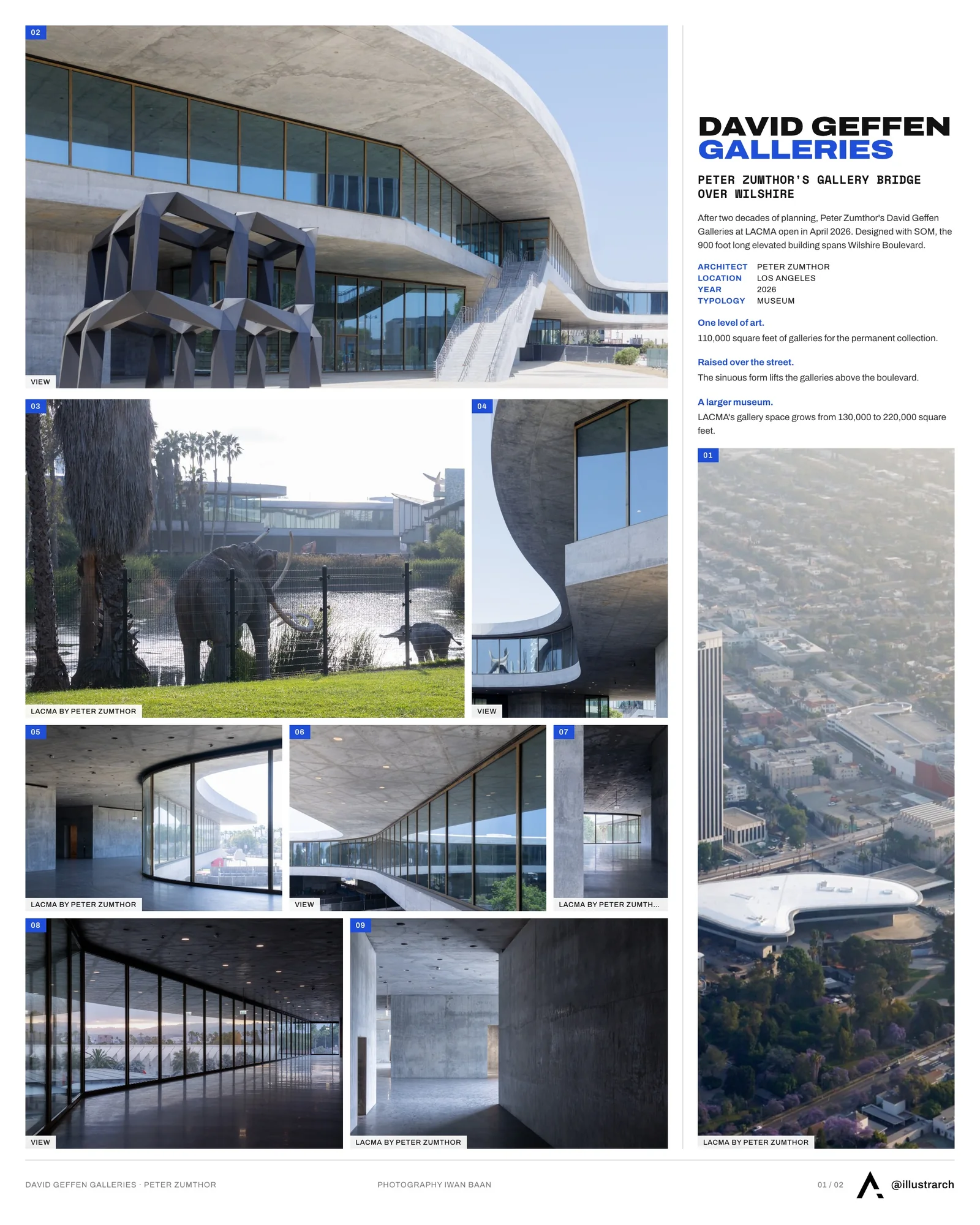
The LACMA Peter Zumthor project has been one of the most closely watched developments in the architecture world. Designed by the Pritzker Prize, winning Swiss architect Peter Zumthor, in collaboration with Skidmore, Owings & Merrill (SOM), the David Geffen Galleries will house the museum’s permanent collection across 110,000 square feet of exhibition space. With its completion, LACMA’s total gallery footprint will grow from 130,000 to 220,000 square feet, a dramatic increase that positions the museum as a major force in global arts and culture.
Who Is Peter Zumthor? The Swiss Architect Behind LACMA’s Transformation
Peter Zumthor was born in Basel, Switzerland, in 1943, the son of a cabinet maker. This early exposure to craftsmanship would profoundly shape his approach to architecture and design. He trained as a cabinet maker before studying at the Kunstgewerbeschule in Basel and later at the Pratt Institute in New York. In 1979, he founded his own practice in Haldenstein, Switzerland, where he continues to work with a deliberately small team.
The architecture of Peter Zumthor is defined by a deep sensitivity to materials, light, and the sensory experience of space. Unlike many of his contemporaries who pursue spectacle or theoretical complexity, architect Peter Zumthor focuses on creating buildings that feel rooted in their specific place and context. His philosophy, articulated in his influential book Thinking Architecture, centers on the belief that every building should respond to its unique site, culture, and purpose. In 2009, the Pritzker Architecture Prize jury described him as “a master architect” whose work is “focused, uncompromising and exceptionally determined.”
His most celebrated projects demonstrate this approach with remarkable consistency. The Therme Vals (1996) in Switzerland, carved into an Alpine hillside using locally quarried quartzite, remains one of the most admired Peter Zumthor buildings ever realized. The Kunsthaus Bregenz (1997) in Austria, with its translucent glass façade that transforms natural light into a luminous interior atmosphere, is another masterwork. Other notable Peter Zumthor projects include the Kolumba Museum in Cologne (2007), the Bruder Klaus Field Chapel (2007), and the Steilneset Memorial in Norway (2011). In recognition of this body of work, Zumthor received the Pritzker Architecture Prize in 2009 and the RIBA Royal Gold Medal in 2013.
Peter Zumthor’s LACMA Design: A Building That Bridges a Boulevard
The David Geffen Galleries represent a radical departure from conventional museum design. Rather than a monolithic box or a collection of discrete wings, Peter Zumthor’s architecture for LACMA takes the form of an undulating, horizontal structure that bridges Wilshire Boulevard, connecting the north and south sides of the campus. Elevated nearly 30 feet above street level, the exhibition floor rests atop seven interconnected concrete and glass pavilions, creating a continuous gallery experience unlike anything else in the museum world.
This singular, flowing layout is central to the building’s curatorial ambition. LACMA CEO Michael Govan has long championed a non-hierarchical approach to displaying art, presenting works from all cultures and eras on a single level without prescribed pathways. Zumthor’s design makes this vision physically possible, allowing visitors to move freely through interconnected galleries and discover unexpected relationships between artworks from different periods and geographies.
The building’s perimeter features floor-to-ceiling glass panels that open many galleries to natural light while framing panoramic views of Los Angeles. This interplay between sheltered interior spaces and light-filled terrace galleries creates a dynamic experience that changes with the time of day, season, and weather. The solidity of the architectural concrete, chosen for both its structural and aesthetic properties, provides a grounding contrast to the transparency of the glass, recalling the material sensibility that defines Zumthor’s approach to emotional space.
Peter Zumthor Buildings: How LACMA Fits Into a Legendary Body of Work
To understand the significance of the David Geffen Galleries, it helps to consider how LACMA Peter Zumthor relates to the broader trajectory of Zumthor’s career. Throughout his practice, Peter Zumthor Swiss architect has worked almost exclusively at an intimate scale, producing buildings that are celebrated for their material precision and atmospheric depth. The LACMA project is, by far, the largest and most complex commission he has ever undertaken.
Zumthor began initial studies for the east campus in 2009. The first design was released in 2013, followed by a significant redesign in 2014 to address concerns about the nearby La Brea Tar Pits. Updated renderings were released in 2017, and the final design was approved in 2019. Construction began that same year, following the demolition of several existing buildings on the LACMA campus. The process was not without controversy: critics questioned the loss of older structures, the project’s escalating costs (now reported at approximately $835 million), and the extended timeline.
Yet for Zumthor, this slow, deliberate process reflects his fundamental approach. Known for working methodically on a small number of Peter Zumthor projects at any given time, he resists the pressure to produce quickly. In an era of rapid-fire commissions and global mega-practices, this patience has become one of his defining characteristics. The LACMA building, with its polished concrete surfaces and curving forms, shows echoes of the spatial qualities that made the Therme Vals so widely admired, now applied at a monumental urban scale.
Key Milestones in the LACMA David Geffen Galleries Project
The following table outlines the major phases of this long-anticipated project:
| Year | Milestone | Details |
|---|---|---|
| 2009 | Initial Studies Begin | Zumthor starts site analysis of LACMA’s east campus |
| 2013 | First Design Released | Original concept unveiled to the public |
| 2014 | Major Redesign | Revised to protect La Brea Tar Pits |
| 2019 | Final Approval & Construction Start | Design approved; demolition and building begin |
| 2024 | Major Construction Completed | Scaffolding removed; 90% of work finished |
| 2025 | Partial Public Access | Ground-level amenities and outdoor spaces open |
| April 19, 2026 | Grand Opening | Galleries open to members; public access from May 2026 |
Sustainability and Innovation in Peter Zumthor Architecture
The David Geffen Galleries have been designed with sustainability as a core priority. The building targets LEED Gold certification and incorporates a range of environmentally responsible strategies that reflect the growing importance of ecological thinking in contemporary Peter Zumthor architecture.
Low-carbon concrete forms the structural backbone of the building, reducing the embodied carbon associated with one of architecture’s most carbon-intensive materials. Radiant heating and cooling systems, combined with natural ventilation and high-efficiency mechanical systems, significantly reduce operational energy consumption. The museum adopted the Bizot Green Protocol early in the planning process, balancing the strict environmental controls required for art conservation with broader sustainability goals through flexible climate zones suited to both sensitive and more resilient works.
Water use across the site has been minimized through climate-adapted vegetation and high-performance fixtures, while more than 95% of construction and demolition waste has been diverted from landfills. These measures demonstrate that even a building of this scale and complexity can be realized with genuine environmental responsibility, a principle that aligns with Zumthor’s longstanding respect for materials and their origins.
What the Opening Means for Los Angeles and Museum Architecture
The opening of the David Geffen Galleries on April 19, 2026, marks the culmination of a two-decade campus transformation at LACMA. Previous phases included the opening of the Broad Contemporary Art Museum (BCAM) in 2008 and the Lynda and Stewart Resnick Exhibition Pavilion in 2010, both designed by Renzo Piano. Together, these earlier additions provided 100,000 square feet of gallery space and, crucially, allowed LACMA to continue operating while the David Geffen Galleries were under construction.
The new building also opens 3.5 acres of park-like public space on both sides of Wilshire Boulevard, transforming the museum’s relationship with Hancock Park and the surrounding neighborhood. At street level, a series of pavilions house three restaurants and cafés, the LACMA Store, a 300-seat theater, and educational facilities. Public art installations by artists including Mariana Castillo Deball, Pedro Reyes, Sarah Rosalena, Diana Thater, and Jeff Koons will activate the outdoor spaces throughout the spring and summer of 2026.
The opening celebrations will begin with a ribbon-cutting on April 19, followed by two weeks of priority member access. Swiss architect Peter Zumthor himself will appear in conversation with Michael Govan on April 22 as part of The Genesis Talks series. Free public access for young people through the NexGenLA program is scheduled for May 3, and the galleries will fully open to the general public thereafter.
Peter Zumthor Projects: A Legacy Defined by Patience and Precision
The David Geffen Galleries will inevitably be measured against Zumthor’s earlier work, and by all indications, the building represents a powerful extension of his design philosophy into new territory. Where the Therme Vals demonstrated his mastery of material and atmosphere at an intimate scale, and the Kunsthaus Bregenz showed his ability to create transcendent spaces for art, the LACMA project does both at a scale that few thought possible from this resolutely small-practice architect.
Photographer Iwan Baan’s recently released images of the building in its raw architectural state, before the installation of artworks, reveal polished concrete surfaces, sinuous curves, and chambers that recall the spatial drama of Zumthor’s most celebrated interiors. Yet Zumthor himself has been characteristically candid about the realities of building at this scale, noting the inevitable compromises that come with the territory.
Still, the building’s ambition is undeniable. By placing art from all cultures on a single, continuous exhibition level, rejecting hierarchies and prescribed routes, the David Geffen Galleries propose a fundamentally different model of museum-going. This is a building designed not just to display art but to change how we think about the relationships between artworks, cultures, and the city beyond the gallery walls.
Visiting the David Geffen Galleries: What You Need to Know
For those planning a visit to the new LACMA Peter Zumthor building, here are the key details announced so far. The galleries open on April 19, 2026, with initial access reserved for LACMA members and donors through May 3. Member reservations are available through LACMA’s official website. The general public will gain access after the member preview period concludes.
The building’s ground-level amenities, including dining and retail spaces, have been partially accessible since summer 2025. The full campus experience, including outdoor sculpture installations and the revived presence of beloved LACMA artworks, will come together throughout the spring and summer. For architecture enthusiasts, the building itself is expected to become a destination on par with the art it contains, a living example of what happens when one of the world’s most thoughtful architects is given the resources and time to realize a singular vision.
The David Geffen Galleries stand as a testament to the enduring relevance of Peter Zumthor’s architecture, to the power of patience in a world that rewards speed, and to the belief that architecture and art can together create something far greater than either could achieve alone. As Los Angeles prepares to welcome this remarkable building, the global architecture community will be watching closely to see whether Zumthor’s most ambitious project lives up to the extraordinary promise of his legendary body of work.





A 2,500-Year-Old Solar Observatory in Puebla Is the First Group E Complex Found Outside the Maya Area
Archaeologists working for Mexico's INAH have confirmed that two platforms at Teteles...
 illustrarch Editoral Team2 Mins read
India Art, Architecture & Design Biennale 2026: Ministry of Culture Opens Delhi Monuments
Delhi's monuments, including Purana Quila and the Red Fort, will host the...
illustrarch Editoral Team2 Mins read
Allentown Art Museum Leaves Its Venturi, Scott Brown Addition for a New Studios Architecture Building
The Allentown Art Museum is moving to a new Studios Architecture building...
illustrarch Editoral Team2 Mins read

Donald Insall, the Conservation Architect Who Led Windsor Castle’s Restoration, Dies at 100
Donald Insall, the British architect who turned conservation into a planning discipline...
illustrarch Editoral Team2 Mins read


Leave a comment