

Top 10 Essential Websites for Architecture Students
A practical roundup of the ten best websites for architecture students, covering project databases, design news, professional bodies, learning platforms, and portfolio resources worth bookmarking.
 Bahattin Duran6 December 20255 Mins read1.3k
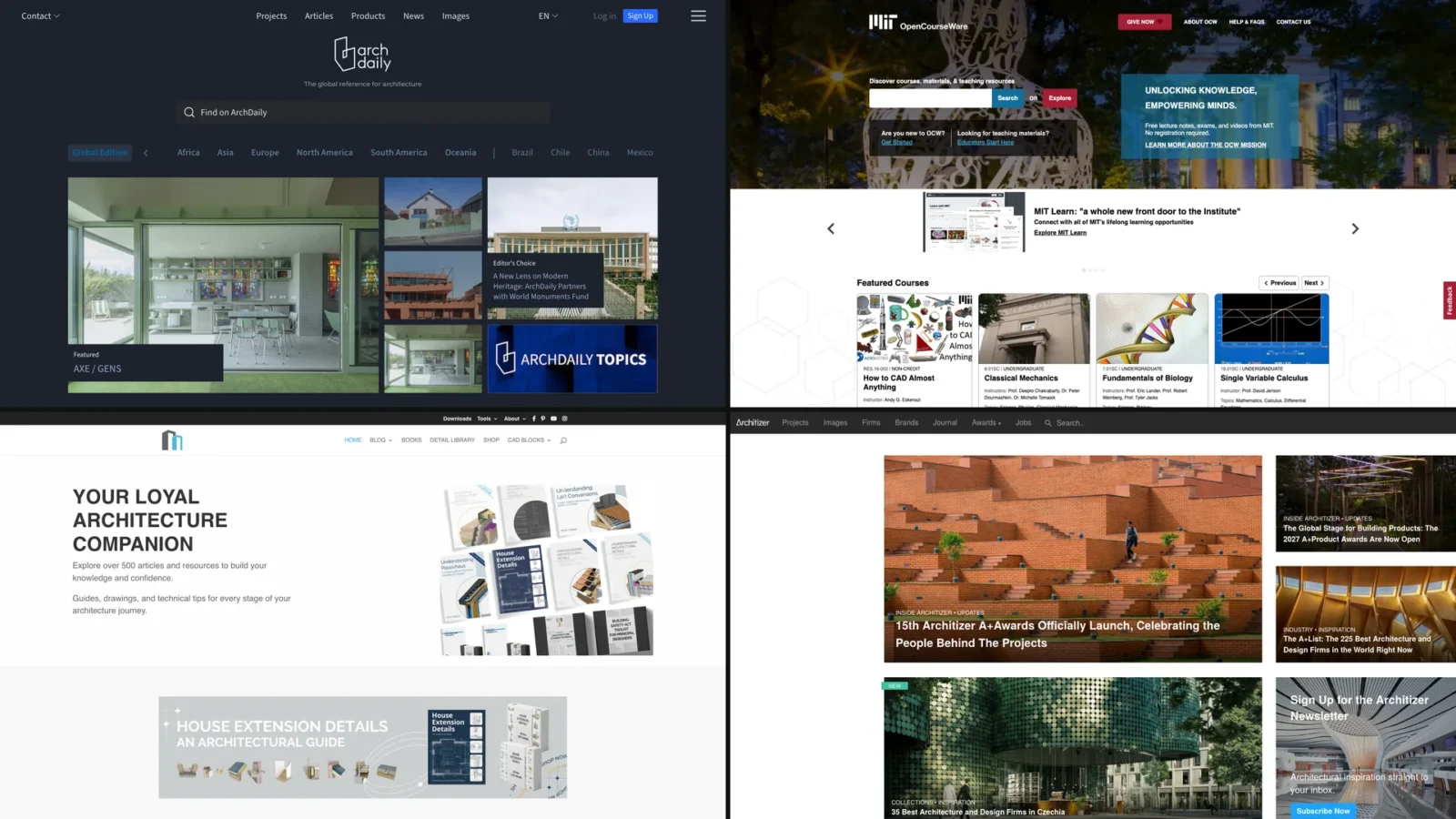
Table of Contents Show
The best websites for architecture students bring project databases, design news, professional standards, and free courses into one place. These platforms help you study built work, track current design debates, and build technical knowledge that studio classes alone rarely cover, all from your laptop or phone.
A smart set of bookmarks does more than kill time between deadlines. The right websites for architecture students turn idle scrolling into research, giving you reference projects for studio, precedent images for your presentations, and a clearer picture of how the profession actually works. Below are ten sites worth a permanent spot in your browser, chosen for their depth, reliability, and value at every stage of an architecture education. If you are also weighing tools for your workflow, our guide to the best architectural software for students pairs well with this list.
Why These Websites Belong in Your Bookmarks Bar
Studio teaches you how to think, but websites teach you what is being built right now. They fill the gap between the theory in your reading list and the real projects shaping cities, and they do it daily. For a student, that steady stream of case studies, detail drawings, and interviews builds the visual vocabulary that critics look for in a review.
These sites also work as free reference libraries. When you need a section detail, a material spec, or a precedent for a housing scheme, you can find it in minutes instead of hunting through the physical library. Used consistently, they sharpen both your design judgment and your technical fluency.

📌 Did You Know?
archINFORM began in the early 1990s as an academic project database at the Faculty of Architecture in Karlsruhe, Germany. It has since grown into one of the largest online catalogs of built and unbuilt architecture, listing tens of thousands of projects by architect, location, and period.
The 10 Best Websites at a Glance
Before the detailed reviews, here is a quick summary of what each site does best and the type of student it suits most.
| Website | What it offers | Best for |
|---|---|---|
| ArchDaily | Daily news, project archive, drawings | Precedent research and case studies |
| Dezeen | Design journalism, opinion, jobs board | Following current design debates |
| Architizer | Project database, building products | Materials and firm research |
| archINFORM | Historical project catalog by architect | History and theory coursework |
| RIBA | Standards, guidance, awards, library | Professional practice and UK study |
| AIA | Practice tools, contracts, scholarships | US students and career prep |
| Morpholio | Digital sketching and design apps | Concept sketching on an iPad |
| First In Architecture | Dimensions, guides, study downloads | Technical basics and space planning |
| Archisoup | Study guides, portfolio and workflow tips | Studio survival and skill building |
| MIT OpenCourseWare | Free university course materials | Self-directed academic study |
Top 10 Websites for Architecture Students Reviewed
1. ArchDaily
ArchDaily is the site most students open first, and for good reason. It publishes new projects every day, each with photographs, plans, sections, and a written description of the design intent. The searchable archive lets you filter by building type, country, or material, which makes it a fast way to gather precedents for a studio brief. Its news and interview sections keep you current on what leading practices are building.
2. Dezeen
Dezeen reads more like a design magazine, with a sharp editorial voice and strong opinion pieces alongside its project coverage. It ranges across architecture, interiors, and product design, so it is useful when you want to see how a building idea connects to broader design culture. The active jobs board and competition listings also help students look ahead to internships and placements.
3. Architizer
Architizer runs one of the largest project databases online and links firms directly with building product manufacturers. For students, the value is in the material and product detail attached to many projects, which helps you understand how a design is actually assembled. Browsing firm profiles is also a practical way to research potential employers before you start applying.
4. archINFORM
archINFORM is a research tool rather than a news site. It catalogs built and unbuilt works organized by architect, location, and period, which makes it ideal for history and theory assignments. If you need to trace an architect’s full body of work or find lesser-known projects, this database often turns up references that mainstream sites miss.

💡 Pro Tip
When you save a reference project, do not just screenshot the render. Note the architect, the structural system, and the key materials in a personal spreadsheet or Notion page. By final review, that habit gives you a searchable precedent library you can cite in critiques, while classmates are still scrolling to find that one project they half remember.
5. RIBA
The Royal Institute of British Architects runs architecture.com, a strong reference point for standards, guidance, and awards. Students in the UK route will find its study and career pages especially relevant, but the design guidance and RIBA Journal content are useful anywhere. Its awards coverage, including the Stirling Prize, is a reliable read on what the profession considers exemplary work.
6. The American Institute of Architects (AIA)
The AIA is the equivalent professional body in the United States. Its site offers practice resources, contract documents, continuing education, and information on scholarships and student membership. For anyone planning to practice in the US, getting familiar with AIA guidance early makes the later transition from school to office far smoother.
🔢 Quick Numbers
- The RIBA has represented architects since its founding in 1834, according to the Royal Institute of British Architects.
- The AIA counts more than 98,000 members across its network, per the American Institute of Architects.
- MIT OpenCourseWare has published free materials from more than 2,500 MIT courses since it launched in 2001, according to MIT OpenCourseWare.
7. Morpholio
Morpholio is a set of design apps rather than a reading site, and its tools have become popular for concept work on the iPad. Trace lets you sketch over site photos and imported plans with a smart pen, which is handy for quick studies and diagrams. For students who think best by drawing, it bridges freehand sketching and digital precision.
8. First In Architecture
First In Architecture focuses on the practical basics that studio sometimes skips. Its human dimension and space planning guides, furniture sizing references, and downloadable cheat sheets answer the everyday questions that come up while you draw. When you are unsure how wide a corridor should be or how to lay out a kitchen, this is a quick, trustworthy check.
9. Archisoup
Archisoup is built specifically around student needs, with study guides on everything from concept development to portfolio building and time management. Its articles are direct and practical, aimed at helping you survive the studio grind without burning out. It pairs well with your own effort to develop a strong architecture portfolio.
10. MIT OpenCourseWare
MIT OpenCourseWare gives you free access to real course materials from one of the world’s leading architecture programs. You can read lecture notes, assignments, and reading lists covering design, building technology, computation, and urban studies. There are no enrollment barriers, so it is a serious option for self-directed learners who want university-level depth. It also pairs neatly with other online study tools for architecture students.
How to Get the Most Out of These Websites
Bookmarking a site does nothing on its own. The students who benefit most build a short weekly routine, setting aside time to browse project galleries, read one case study in depth, and save anything useful to an organized folder. Newsletters from ArchDaily and Dezeen can bring the best of each week straight to your inbox, so you stay current without extra effort.
Treat these sites as active research during projects, not just passive reading. Cite ArchDaily case studies in your design rationale, reference RIBA or AIA standards in your technical drawings, and pull material data from Architizer when you specify a facade. Work like that reads as informed and well grounded in a review. As you move toward graduation, the same sites support your career in architecture, and combining them with the right essential tools for architecture students gives you a solid academic base.

Where to Go From Here
Your Next Step: Pick three sites from this list that match your current project, open an account or newsletter for each today, and start a single precedent folder you add to every week. A small, consistent habit now beats a frantic search the night before your next review.



1 Comment



Interior Design for Commercial Spaces: Enhancing Functionality and Brand Identity
Commercial interior design has to serve brand, function and regulation at once....
 Begum Gumusel4 Mins read

What Architecture Students Should Know About Structural Glass and Guardrail Code
Glass guards look minimal, but structural behavior, safety glazing, connections and guardrail...
 illustrarch Editoral Team6 Mins read

Futuro House Production Revived in Finland After Decades-Long Hiatus
A Facebook listing for abandoned moulds led to the first new Futuro...
illustrarch Editoral Team3 Mins read

Building Your Dream Home in NSW: What You Should Know About Montgomery Homes
Montgomery Homes has been building across Sydney, Newcastle, the Hunter, Wollongong and...
illustrarch Editoral Team4 Mins read


This article lists some useful websites for architecture students. I think they can help in learning more about design and projects.