

SEO for Architecture Firms: A Practical Guide to Winning More Clients Online
Learn how SEO for architecture firms can turn a portfolio-heavy website into a reliable lead channel. This guide covers keyword research, local SEO, technical foundations, content strategy, and link building tailored for architectural companies in 2026.
 Sinan Ozen8 May 202610 Mins read216

Table of Contents Show
SEO for architecture firms is the practice of optimizing a studio’s website, content, and local presence so that high-intent clients find it first when they search Google. For architectural companies, strong SEO turns a portfolio-heavy website into a steady lead channel, reduces dependence on referrals, and positions the firm as a recognizable authority in its market.
Architecture is built on trust, referrals, and strong portfolios. Yet in 2026, the firms winning the best projects are not only the ones with the prettiest renderings. They are the ones potential clients can actually find. When a homeowner, developer, or institution needs a designer, they open Google before they open their contacts list. If your studio is not on the first page for the keywords that matter, a competitor wins that project before you ever hear about it.
This guide gives you a focused, practical breakdown of SEO for architectural firms: what to prioritize, what to skip, and how to build a real competitive edge that compounds over time.

Why SEO for Architecture Firms Matters in 2026
Client behavior has shifted permanently. According to the AIA 2024 Firm Survey Report, there are more than 19,000 architecture firms in the United States, and roughly 75% have fewer than 10 employees. That fragmentation means visibility, not size, often decides who gets the inquiry.
Meanwhile, many architecture firms are increasing their investment in marketing and business development. The firms increasing spend are overwhelmingly shifting those dollars toward digital channels because that is where qualified clients now begin their search.
SEO matters for four concrete reasons:
- Compounding returns. A page that ranks keeps earning traffic for years with minimal upkeep, unlike paid ads that stop the day you stop paying.
- Higher intent traffic. Someone searching “residential architect Chicago” is ready to hire; a social follower may never be.
- Credibility signal. Clients evaluate firms online before calling. Strong search presence reinforces trust the moment they vet you.
- Geographic flexibility. A studio in one city can rank for project types across regions, opening markets that word-of-mouth cannot reach.
💡 Pro Tip
Before writing a single new blog post, audit how prospective clients actually describe your services. Watch a few sales calls or read your last 20 inquiry emails. The exact phrases clients use are the keywords you should be targeting, not the ones that sound most impressive in a pitch deck.

What Is SEO for Architectural Firms and How Is It Different?
SEO for architecture firm websites is different from SEO in most other industries for three reasons: the content is image-heavy, the decision cycle is long, and trust signals matter more than volume. A dental clinic might need hundreds of keywords. An architectural practice often wins or loses based on ranking for 20 to 40 highly specific phrases.
At its core, SEO for architecture company websites combines three layers: technical health (can Google crawl and render your portfolio), content relevance (do your pages answer what clients are searching for), and authority (do other trusted sites reference you). When all three align, your firm shows up at the moment of intent.
Top SEO Keywords for Architectural Design Firms
The top SEO keywords for architectural design firms fall into four clear groups. Each group serves a different stage of the client journey, and strong SEO strategy covers all four rather than focusing only on one.

1. Direct Service Keywords (High Intent)
These are the terms clients type when they are close to hiring. They typically include a service plus a location.
- residential architect [city]
- commercial architect for [building type]
- architecture firm near me
- interior architecture firm [city]
- sustainable architect [region]
2. Informational Keywords (Research Phase)
These capture people earlier in the journey who are gathering information. They convert more slowly but build topical authority and trust.
- how much does an architect cost
- do I need an architect for a home extension
- architect vs designer differences
- how long does an architect take to design a house

3. Specialization Keywords (Niche Authority)
These are narrower phrases that attract premium project types and face less competition than broad terms.
- passive house certified architect
- adaptive reuse architecture firm
- hospitality design architect
- historic preservation architect [state]
4. Top SEO Searches for Architecture (Branded and Industry Terms)
These include firm names, software, and professional terminology. Showing up for adjacent industry terms positions your studio within the broader conversation.
📌 Did You Know?
According to Think with Google, 76% of people who conduct a local search on their smartphone visit a related business within 24 hours. For architecture firms, that means a strong local SEO presence can convert a phone-based search into a real inquiry the same day.
How to Build a Foundation: Technical SEO and Website Structure
No content strategy survives a broken foundation. Architecture websites are visually ambitious, which often means they are also slow, heavy, and hard for search engines to interpret. Before scaling content, fix the structural basics.

Page Speed and Core Web Vitals
Large rendering images and video backgrounds routinely push load times past five seconds. Aim for a Largest Contentful Paint (LCP) under 2.5 seconds. Compress images with modern formats like WebP, serve responsive image sizes, and lazy-load anything below the fold.
Mobile-First Design
Google indexes the mobile version of your site first. If your project gallery breaks on a phone, your desktop rankings suffer too. Test every template at a 375px viewport width and make sure typography, navigation, and images behave properly.
Clear Information Architecture
A strong architecture firm website typically needs: a homepage, dedicated service pages (residential, commercial, renovation, interiors), a project portfolio with individual project pages, service-area pages, an about page, a blog, and clear contact information. Each page should target one primary keyword and link logically to related pages.
📐 Technical Note
Implement structured data (schema.org) for your firm: Organization schema on the homepage, LocalBusiness schema on the contact page, and CreativeWork or Project schema on portfolio pages. You can test your markup with Schema.org’s validator and Google’s Rich Results Test. Proper schema helps Google understand your services and can qualify you for richer search results.
Local SEO: Where Most Architecture Firms Win or Lose
For most architectural companies, local SEO drives more qualified inquiries than any other channel. When someone searches “architect near me” or “modern home architect [city],” Google displays a Local Pack of three map-linked firms. Appearing there is often more valuable than ranking first in the organic results below.

Google Business Profile (GBP)
Your Google Business Profile is the single most important local asset. Claim it, verify it, and complete every field: services, detailed description, exact hours, 20+ high-quality project photos, and the Q&A section. Post updates at least twice a month so Google sees activity.
NAP Consistency
Your firm’s Name, Address, and Phone number must match exactly across your website, GBP, Houzz, Yelp, The Architect Directory, and every other listing. Even small differences like “St.” versus “Street” can dilute local authority.
Reviews and Reputation
BrightLocal’s 2026 Local Consumer Review Survey found that consumers increasingly expect higher star ratings and fresh reviews, and that AI tools like ChatGPT have become the third most popular source for local business recommendations. For architecture firms, this means reviews now serve double duty: they influence human trust and shape how AI systems describe your practice.
Build a simple system. Send every completed client a short, personalized email with a direct link to your Google review page. Respond to every review, positive or negative, within a few days.
🎓 Expert Insight
“Architecture should speak of its time and of its place, but yearn for timelessness.” (Frank Gehry)
The principle applies to digital presence as well. Content optimized purely for this month’s algorithm tends to age badly. Pages built around lasting client questions, evergreen design principles, and a firm’s genuine point of view continue to attract traffic and inquiries for years after publication.
Content Strategy That Compounds
Content is how architecture firms earn authority on the topics that matter to clients. The goal is not to publish constantly. It is to publish the right pages that rank for high-intent keywords and support your portfolio.

Service Pages as the Core
Every service you offer deserves its own optimized page. A single “Services” page listing five offerings will never outrank five dedicated pages, each targeting a specific keyword. Each service page should answer: what you do, who it’s for, typical process, representative projects, and a clear next step.
Portfolio Pages With SEO Context
Most firms treat project pages as galleries. Add 300 to 500 words of text for each: what the client needed, design challenges, materials, square footage, location, and outcomes. This transforms silent images into ranking assets. For deeper guidance on structuring project pages and online presence, see our guide to SEO for architects and the companion breakdown on architecture website benefits.
Blog Topics That Attract Real Clients
Most architecture blogs publish trend pieces that generate inspiration traffic but not inquiries. The highest-converting topics answer practical client questions.
- “How Much Does It Cost to Hire an Architect in [City]?”
- “Architect vs. Designer vs. Draftsperson: What’s the Difference?”
- “Do You Need Planning Permission for a [Type] Extension?”
- “What to Expect in Your First Meeting With an Architect”
For a broader view of how to approach editorial content and voice, our guide to blogging for architects covers structure, topic selection, and SEO integration in depth.
YouTube and Video: An Underused Channel
Video content helps architecture firms in two ways: it ranks directly on YouTube (often called the second-largest search engine) and it keeps visitors on your site longer, which Google reads as a positive engagement signal.
Video: Introductory SEO Concepts for Architects
The following AIA East Bay webinar walks through core SEO principles for architecture firms, covering why most portfolio websites fail to attract new clients and how search optimization fits into a firm’s broader marketing strategy. It’s a useful primer before committing to a full SEO program.
Link Building for Architecture Firms
Backlinks remain a primary ranking signal. For architectural practices, low-effort link schemes are not only ineffective but can actively damage your search visibility. Focus on a small number of high-authority, relevant sources instead.
Directories and Listings That Matter
- Houzz: industry-specific and trusted by homeowners searching for design professionals.
- Architizer: project directory used by clients, editors, and competition organizers.
- The Architect Directory and AIA firm directory: professional citations that reinforce credibility.
- Local chambers of commerce and city business directories: useful for geographic relevance.
Editorial and Press Coverage
A single mention in ArchDaily, Dezeen, or Architect Magazine can outweigh dozens of low-quality directory links. Submit completed projects with professional photography, a clean written narrative, and full credits. Editors receive hundreds of submissions weekly; your package needs to be press-ready.

Guest Contributions
Writing thoughtful articles for design publications and local business journals earns both links and exposure to qualified audiences. Aim for depth rather than quantity.
⚠️ Common Mistake to Avoid
Many firms buy large packages of directory submissions or pay for bulk backlinks expecting faster results. Google’s algorithms have become highly effective at detecting these patterns, and sites caught in low-quality link networks can see rankings drop sharply. A slower approach, built on genuinely relevant citations and earned editorial mentions, produces durable results and avoids recovery work that can take months.
SEO and SEM for Architecture Firms: How They Work Together
SEO and SEM for architecture firms serve different purposes. SEO (search engine optimization) builds organic rankings over months and generates traffic at no per-click cost. SEM (search engine marketing) uses paid ads, primarily Google Ads, to appear at the top of results instantly.
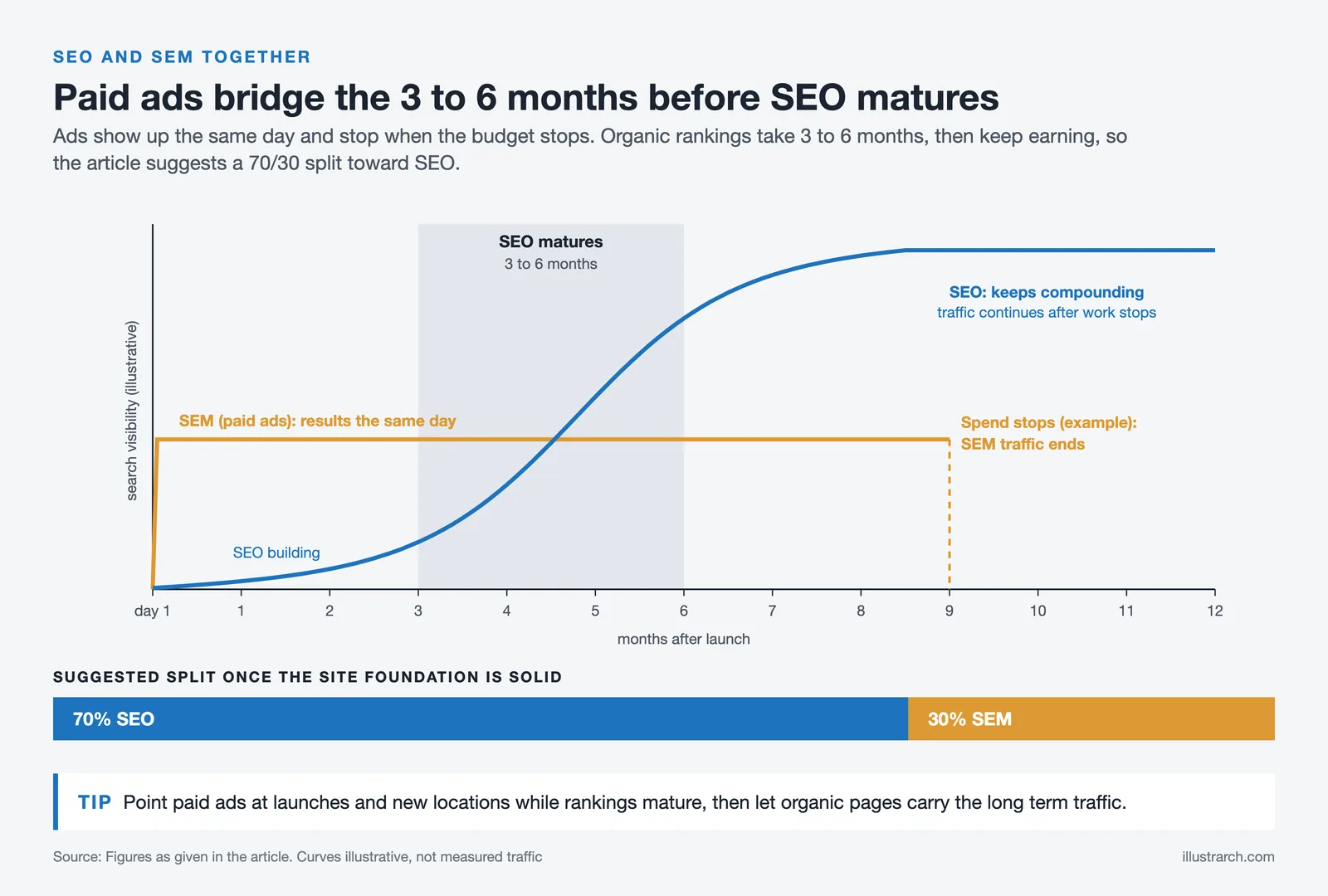
A balanced approach uses each where it performs best:
Comparison: SEO vs. SEM for Architecture Firms
| Factor | SEO | SEM (Paid Ads) |
|---|---|---|
| Time to results | 3 to 6 months | Same day |
| Cost per lead over time | Decreases as rankings compound | Stays flat or rises with competition |
| Longevity | Traffic continues after work stops | Traffic ends when spend ends |
| Best use case | Authority building, long-term growth | Launches, geographic expansion, specific projects |
| Trust signal to clients | Higher (earned credibility) | Lower (clearly marked as ad) |
For most architectural firms, a 70/30 split toward SEO makes sense once the site foundation is solid. Paid ads can fill the gap during the 3 to 6 month window before organic rankings mature.
Measuring What Matters
Tracking the wrong metrics wastes time. Traffic volume is less important than qualified inquiries. For architecture firm SEO, focus on:
- Qualified inquiries per month: form submissions, calls, and emails from real prospects, segmented by source.
- Rankings for target keywords: track 20 to 40 priority terms monthly.
- Local Pack visibility: how often you appear in the three-map results for your core service-city combinations.
- Conversion rate: the percentage of visitors who take a meaningful action. A 1 to 3% conversion rate is typical for well-built architecture sites.
Tools like Google Search Console, Google Analytics 4, and Google Business Profile Insights cover the basics at no cost. Paid platforms such as Ahrefs or Semrush add competitor and keyword depth once you need it.
💡 Pro Tip
Set up goal tracking in Google Analytics 4 for every contact form, phone click, and email click on your site before spending anything on SEO. Without conversion tracking, you cannot tell the difference between traffic that wastes time and traffic that books projects. Most firms skip this step and end up with six months of data that cannot answer a single business question.
Building a 90-Day SEO Plan for Your Firm
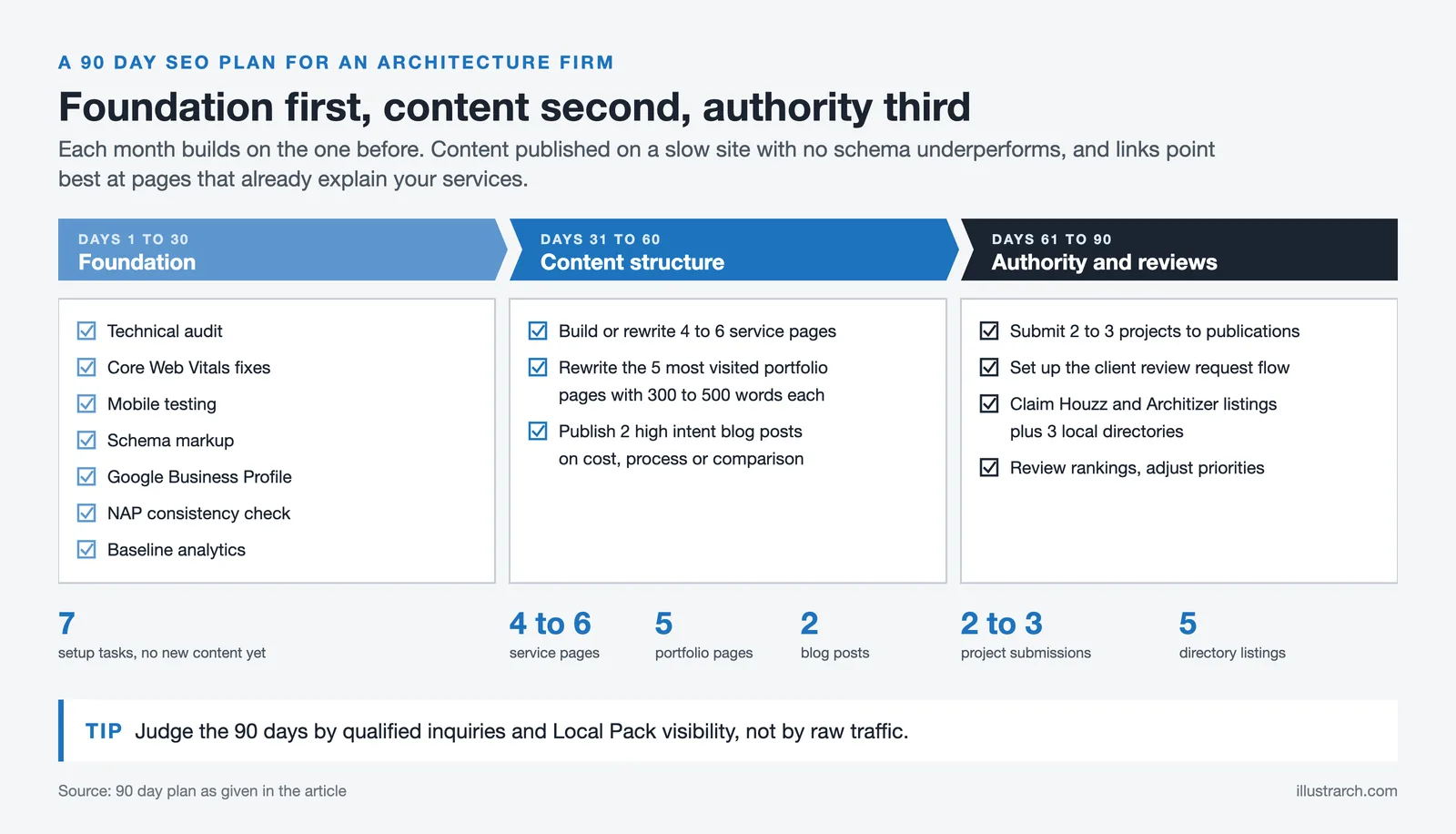
A realistic starting plan for most architectural companies looks like this:
Days 1 to 30, Foundation. Technical audit, Core Web Vitals fixes, mobile testing, schema markup, Google Business Profile optimization, NAP consistency check, and baseline analytics setup.
Days 31 to 60, Content structure. Build or rewrite the four to six primary service pages. Rewrite the five most visited portfolio pages with 300 to 500 words of context. Publish two high-intent blog posts targeting cost, process, or comparison keywords.
Days 61 to 90, Authority and review systems. Submit two to three completed projects to relevant publications. Set up the client review request workflow. Claim listings on Houzz, Architizer, and three local directories. Review keyword rankings and adjust priorities.
For a structured look at how to integrate this work with your broader firm identity, our article on effective marketing for architects connects SEO to brand, portfolio, and social strategy.
✅ Key Takeaways
- SEO for architecture firms turns a portfolio website into a reliable lead channel, reducing dependence on referrals.
- Local SEO, especially a fully optimized Google Business Profile, drives more qualified inquiries than any other single tactic.
- Target four keyword groups: direct service, informational, specialization, and branded industry terms.
- Technical health (speed, mobile, schema) must come before content scaling, or content efforts will underperform.
- Earned editorial links from trusted architecture publications outweigh dozens of low-quality directory submissions.
- Track qualified inquiries and Local Pack visibility, not raw traffic, to measure real business impact.
Final Thoughts
SEO for architecture firms is not a marketing trend. It is the new baseline for how clients discover, evaluate, and choose design professionals. The studios building systematic SEO programs in 2026 are compounding visibility, reputation, and inbound project flow month after month, while firms relying only on referrals stay exposed to market cycles they cannot control.
The work is not glamorous. Speed audits, schema markup, review request emails, and service page rewrites will never be the highlight of a studio’s year. But these are the habits that quietly decide which firms keep winning the projects they want, and which ones keep waiting for the phone to ring.
The strategies in this article are general guidance. Actual results depend on market competition, existing website authority, and execution quality, and may vary significantly by region and firm specialization.





Interior Design for Commercial Spaces: Enhancing Functionality and Brand Identity
Commercial interior design has to serve brand, function and regulation at once....
 Begum Gumusel4 Mins read

Futuro House Production Revived in Finland After Decades-Long Hiatus
A Facebook listing for abandoned moulds led to the first new Futuro...
 illustrarch Editoral Team3 Mins read

How to Choose BIR-Compliant e-Invoicing Software: A CFO’s Evaluation Framework
Under the current Bureau of Internal Revenue (BIR) framework, the market for...
illustrarch Editoral Team5 Mins read
Building Your Dream Home in NSW: What You Should Know About Montgomery Homes
Montgomery Homes has been building across Sydney, Newcastle, the Hunter, Wollongong and...
illustrarch Editoral Team4 Mins read


Leave a comment