

Circulation Flow Diagrams: How to Read & Use Them in Architecture
Circulation flow diagrams communicate spatial movement logic before a single wall is drawn. This guide explains how to read path hierarchies, decode color conventions, identify bottlenecks, and apply flow diagram principles across residential, commercial, and landscape contexts.
 Sinan Ozen8 April 20269 Mins read302

Table of Contents Show
Circulation flow diagrams are graphic tools that map how people move through a building or site, using arrows, color-coded paths, and symbols to communicate spatial logic before floor plans are finalized. Rather than showing walls or dimensions, these diagrams focus on one question: who goes where, and how? Knowing how to read and produce them is one of the most transferable skills in architectural design practice.

What Is a Circulation Flow Diagram in Architecture?
A circulation diagram in architecture captures movement as a design decision, not just a byproduct of layout. Every entry point, corridor junction, staircase, and transition zone reflects choices the architect made about how the building would be used. When you read a flow diagram carefully, you are reading those decisions.
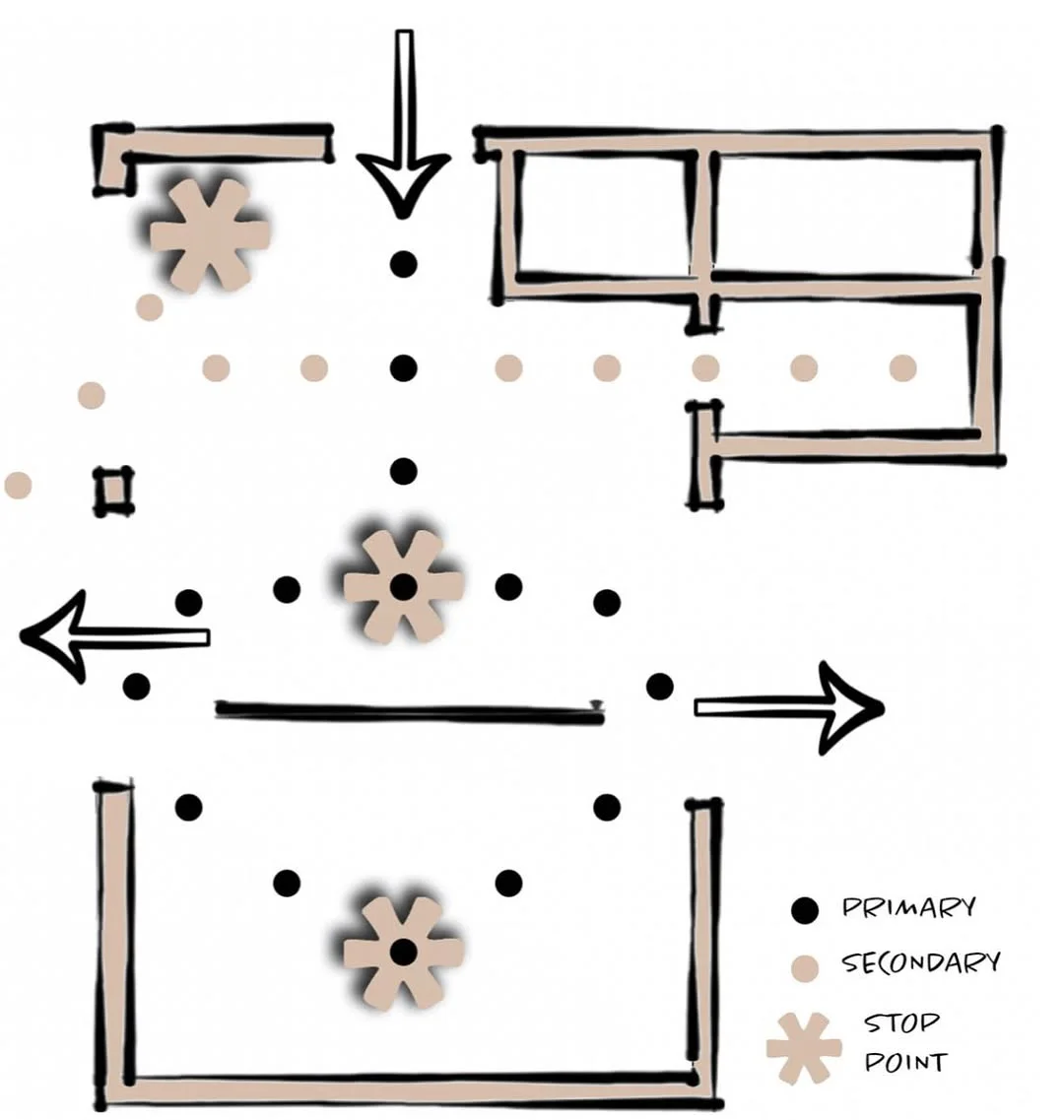
The term “flow” matters here. Architectural circulation diagrams borrow the same logic as fluid dynamics: movement should travel through a building with minimal resistance, predictable direction, and clear hierarchy. Primary paths carry the highest volume of people, secondary paths branch off toward individual spaces, and service routes run parallel to, but separate from, public movement.
Francis D.K. Ching’s Architecture: Form, Space, and Order, one of the most widely used architectural references in design education globally, identifies five path configurations that circulation diagrams express: linear, radial, spiral, grid, and network. Each produces a fundamentally different spatial experience for the people using the building. Circulation is one of several diagram types in architecture that every designer works with, but it is the one most directly tied to how a building actually functions for its users.
💡 Pro Tip
See also our guide to architectural diagram types.
When reading an unfamiliar circulation diagram in a presentation or portfolio, start at the entry points rather than the center. Entry logic tells you the architect’s priority hierarchy immediately: which users are welcomed directly, which are redirected, and which arrive through a secondary route. That single observation usually explains every other decision in the diagram.

How to Read Architectural Circulation Diagrams: Key Elements
Reading circulation diagrams architecture professionals produce requires understanding a shared visual language. While individual architects and firms develop their own graphic conventions, most flow diagrams rely on the same core elements.
Path Weight and Hierarchy
Line thickness is the most immediate signal in a circulation diagram. Thick lines or wide arrows represent primary circulation, corridors and paths that carry the bulk of daily movement. Thinner lines indicate secondary routes connecting primary paths to individual rooms or zones. The thinnest lines, often dashed, represent service or maintenance access that users rarely see.
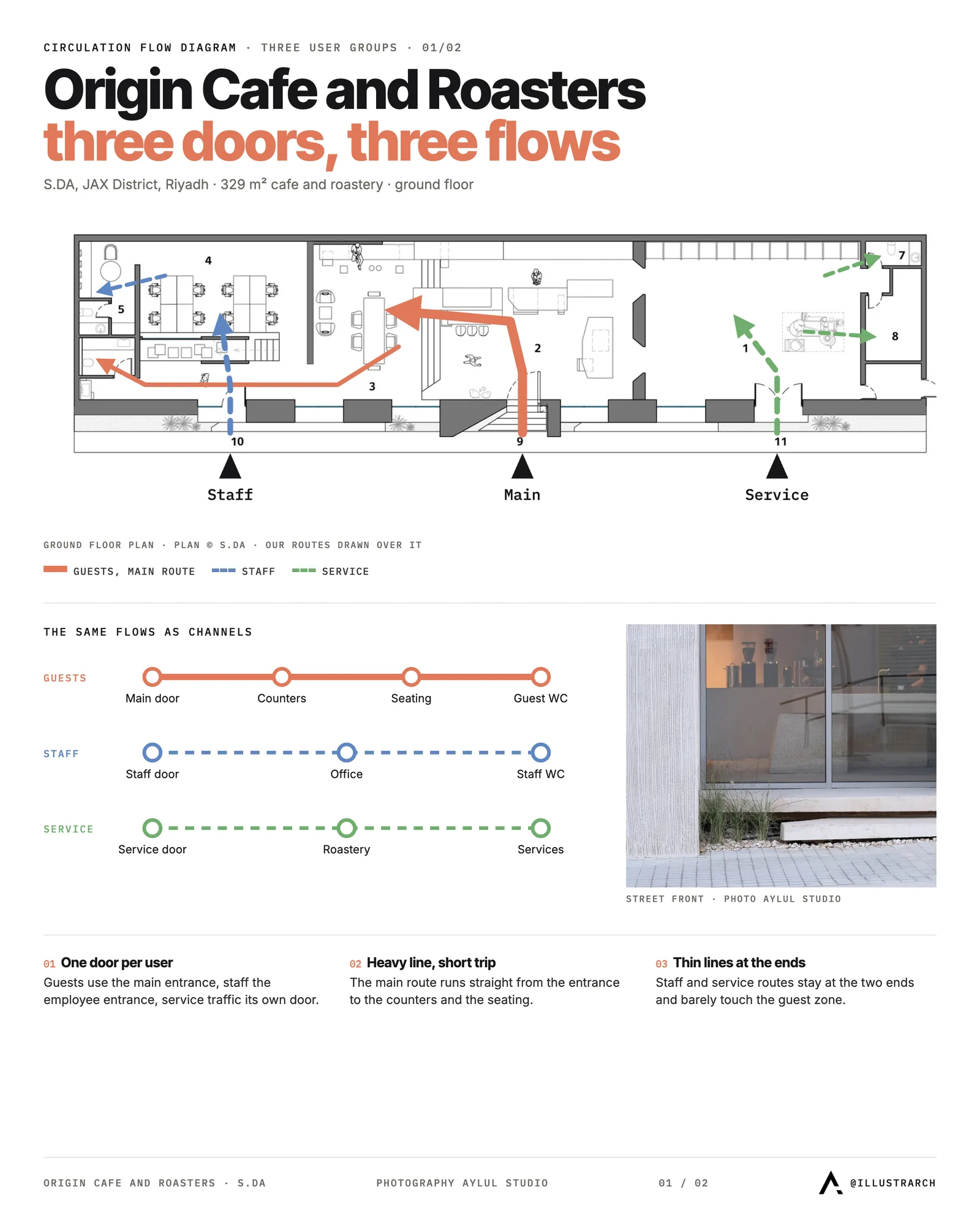
In a well-drawn architecture circulation diagram, the hierarchy reads at a glance without needing a legend. If every line is the same weight, the diagram is telling you the building has no clear movement logic, which is itself useful information during design review.
Color Conventions Across User Groups
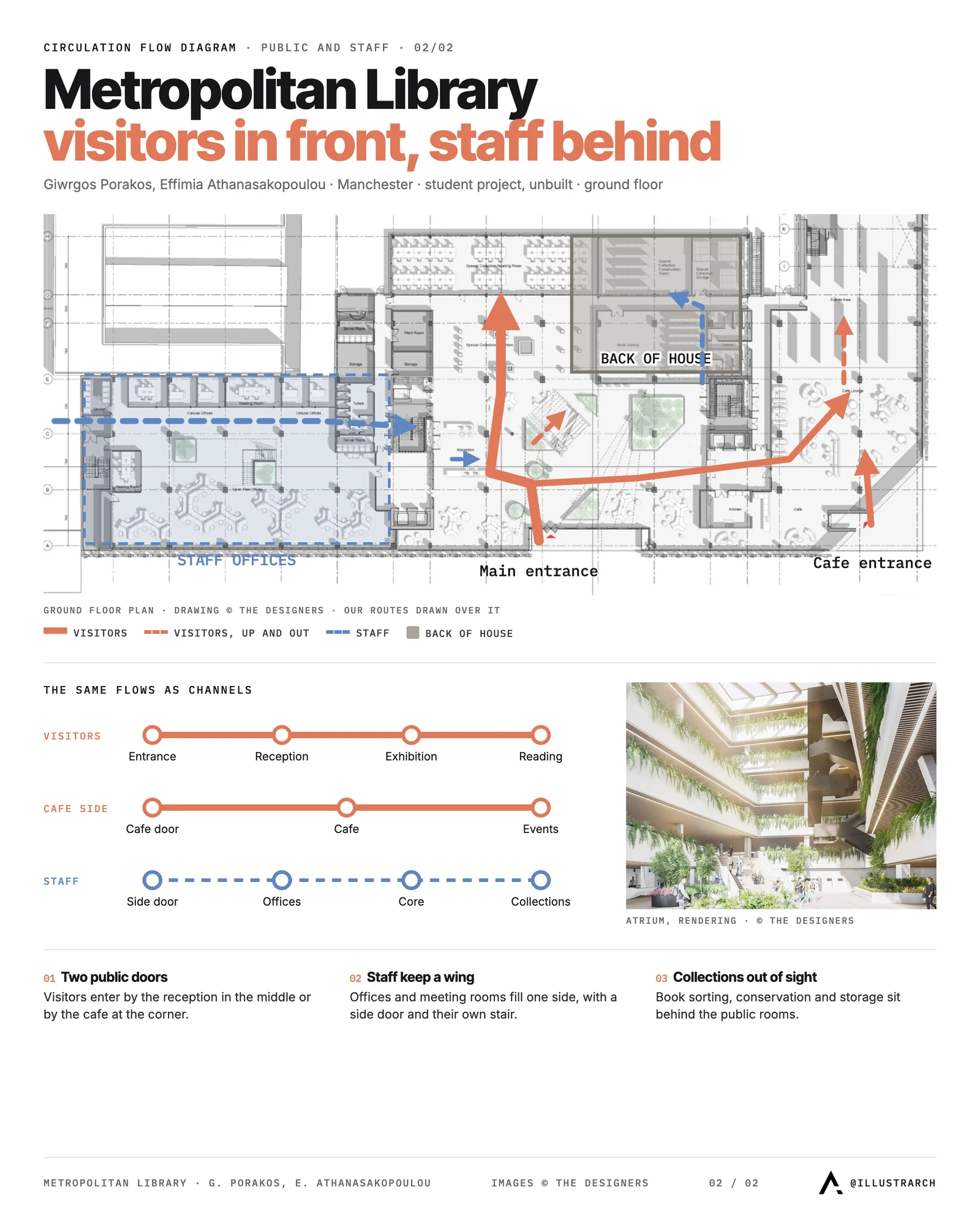
Color in architectural circulation diagrams almost always denotes user type or access level. In a hospital, clinical staff circulation might appear in blue, patient routes in orange, and visitor paths in green. In a school, student circulation and teacher-only areas use different colors. In a mixed-use building, residents, retail customers, and service vehicles each receive a distinct color channel. This convention is covered extensively in the circulation diagrams published by leading firms on ArchDaily, where color coding is the most consistent graphic feature across thousands of project submissions.
This layering reveals conflicts before construction: places where two user types converge unexpectedly, dead-end corridors that serve one group but block another, or service routes that cut through public zones.
📌 Did You Know?
The concept of separating circulation by user type in architectural diagrams gained formal traction in the mid-20th century through the work of Louis Kahn, who distinguished between “served” and “servant” spaces in his designs. Kahn’s Richards Medical Research Laboratories (Philadelphia, 1965) was one of the first projects where this separation was drawn explicitly into the scheme’s diagrams, influencing how architects diagram movement to this day.

Nodes, Transition Zones, and Bottleneck Signals
Nodes are the points where multiple paths intersect. A node at a lobby, atrium, or corridor junction represents a decision point for users. When a diagram shows three or more major paths converging on a single node without a distribution space, that is typically a bottleneck signal worth addressing in the floor plan.
Transition zones appear where circulation moves between different access levels: from public lobby to semi-public office floor, from staff corridor to operating suite, from retail floor to residential lift lobby. A clear circulation diagram marks these transitions explicitly, often with a threshold symbol or a color fade.
Horizontal vs. Vertical Circulation in Flow Diagrams
Architecture circulation diagrams address movement in two dimensions. Horizontal circulation covers movement on a single floor: corridors, open passages, ramps, and lobby areas. Vertical circulation covers movement between floors: staircases, lifts, escalators, and ramps that span levels.
Most circulation diagrams are produced per floor (plan view), with vertical elements indicated as symbols showing lift cores, stair locations, and the connections they make. A complete set of architectural circulation diagrams for a multi-storey building includes both plan diagrams per floor and at least one section diagram showing how vertical elements link the horizontal paths across levels. If you are new to reading these diagram types as a student, the architectural diagrams explained for students guide covers how horizontal and vertical circulation relate to each other within a full studio workflow.
The most revealing section diagrams come from projects where vertical movement is the main spatial idea. The Pompidou Centre in Paris (Piano and Rogers, 1977) made its vertical circulation the primary architectural gesture by placing escalators on the building’s exterior facade. The section diagram for that project is inseparable from the conceptual diagram.
🎓 Expert Insight
“Movement through a building should be understood as a sequence of spatial experiences, not simply as a functional necessity.”
Francis D.K. Ching, Architecture: Form, Space, and Order
This framing shifts how designers approach flow diagrams. Instead of drawing the shortest path between two points, the diagram becomes a tool for choreographing spatial experience, compression and expansion, light and dark, narrow and wide, all of which communicate through the movement sequence the diagram proposes.

Circulation Diagram Landscape Architecture: Flow Beyond Buildings
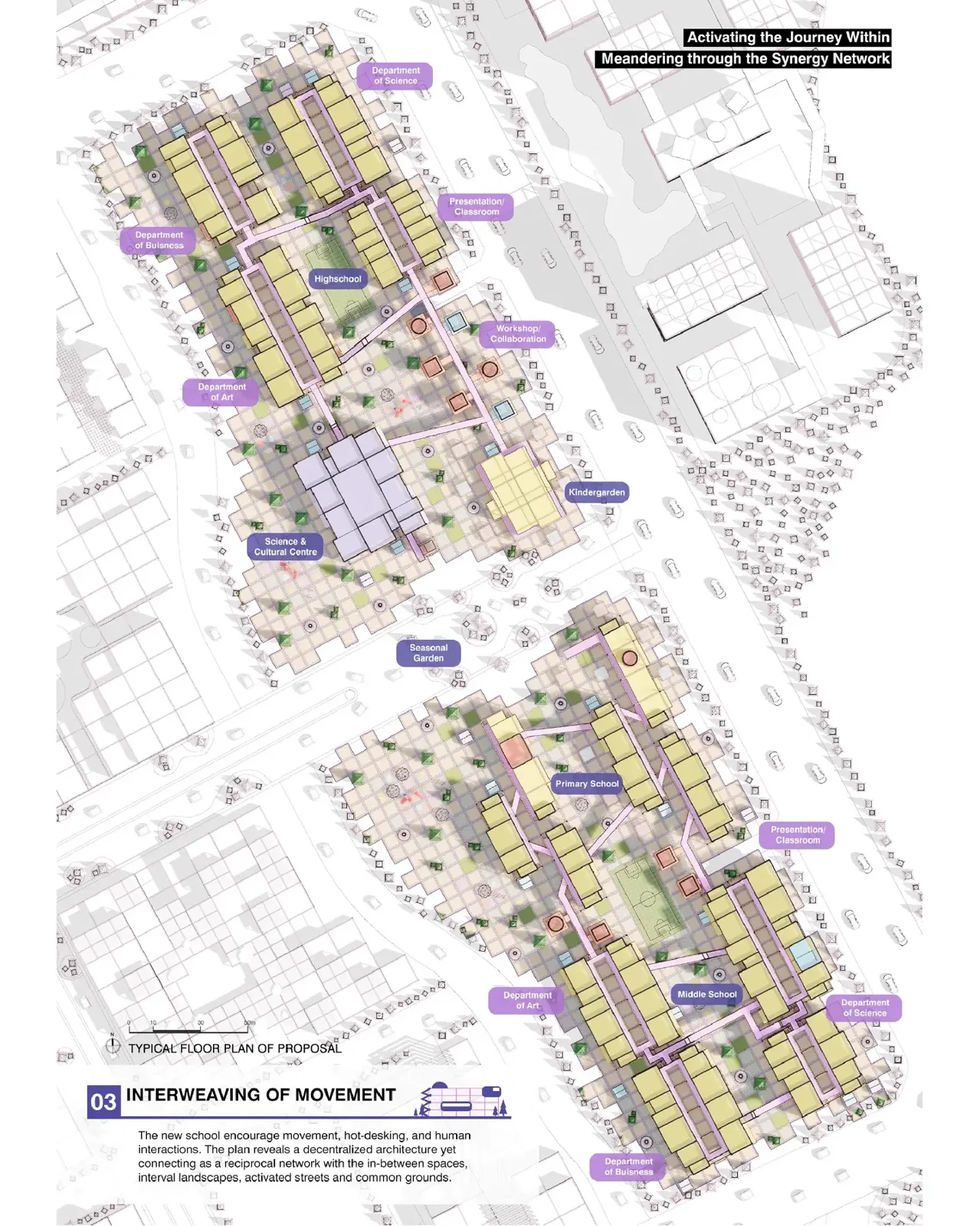
Circulation diagram landscape architecture applies the same principles to outdoor environments: parks, plazas, university campuses, transit precincts, and urban streetscapes. The key differences lie in scale, the absence of walls as movement constraints, and the greater role of desire lines, the informal paths people actually take rather than the ones a designer intended.
In landscape diagrams, primary paths are typically paved or clearly defined routes between major attractors: entrances, landmarks, transit stops, and amenity hubs. Secondary paths branch through planted areas or seating zones. The informal desire-line layer is often shown as a dashed overlay to indicate where landscape elements may need adjustment to align designed paths with actual behavior.
A circulation flow diagram for an urban plaza must also address vehicle and cyclist routes alongside pedestrian movement, which makes the color separation of user types even more critical than in building diagrams. Where cycles and pedestrians share paths, the diagram should show the conflict zone clearly so the landscape architect can address it with physical design elements. The American Society of Landscape Architects (ASLA) maintains resources on pedestrian flow analysis and site circulation planning that are particularly useful for campus and urban-scale projects. Landscape circulation diagrams also work closely alongside programmatic diagrams, which map the functional zones that circulation paths must connect.
⚠️ Common Mistake to Avoid
A frequent error in early-stage circulation diagrams is treating all users as a single undifferentiated mass moving in one direction. Real buildings serve multiple user groups simultaneously, often with conflicting routing needs. Drawing a single flow arrow from entry to destination may satisfy the brief visually but misses the operational complexity. Always map at least two distinct user types, even in a small residential project, residents and service/delivery routes behave differently and should be shown separately.
How Circulation Diagrams Differ Across Building Types
The graphic conventions of circulation diagrams stay largely consistent, but the priorities they reveal differ significantly by program type.

Residential Buildings
In residential circulation diagrams, the primary concern is the separation between private and communal zones. A well-drawn residential architecture circulation diagram shows where residents transition from shared lobby to private floor to individual unit threshold. The diagram should make clear that service deliveries, maintenance staff, and residents never share the same circulation path unnecessarily.
Healthcare Facilities
Healthcare buildings require the most complex circulation diagrams of any building type. Clean and dirty service routes must never cross. Patient, visitor, and clinical staff paths are separated rigorously, and emergency egress routes overlay all other movement systems. The diagram becomes a compliance tool as much as a design one, since building codes in most jurisdictions regulate infection-control zoning directly. The American Institute of Architects (AIA) publishes detailed practice guidelines on healthcare facility circulation that are widely used as a reference standard in this building type.
Cultural and Public Buildings
Museums, galleries, and civic buildings use circulation flow diagrams to manage visitor experience and crowd flow simultaneously. The diagram here often incorporates narrative logic, the sequence in which a visitor should ideally encounter spaces, alongside the purely functional routing. The Guggenheim Museum in New York (Wright, 1959) is perhaps the most cited example of a building where the circulation diagram and the architectural concept are the same thing: a single spiral ramp that dictates the entire visitor sequence.
🏗️ Real-World Example
Rolex Learning Center, EPFL (Lausanne, 2010): Designed by SANAA, this building eliminates traditional corridors entirely. The circulation diagram for the project is a continuous, undulating floor plane with no walls separating movement from occupation. Students, researchers, and visitors navigate by spatial cues, light, level change, view, rather than prescribed paths. The project demonstrates that a building’s architectural circulation diagram can itself become the primary spatial concept, and that “flow” need not mean “corridor.”
What Makes a Circulation Diagram Effective in Practice
A circulation diagram that reads clearly in a presentation does not automatically translate to a building that works well. Several practical tests help evaluate whether the diagram represents a genuinely sound spatial strategy.
The first test is legibility without a legend. If someone unfamiliar with the project can understand the primary movement logic within thirty seconds, the diagram is communicating effectively. If it requires extensive explanation, the spatial hierarchy probably needs simplification.
The second test is the bottleneck check. Trace every user group’s path from entry to their most frequent destination. Count how many times paths converge on the same node. More than three major paths converging on a single undifferentiated space is a common source of congestion in completed buildings.
The third test is the egress overlay. Place the required fire egress routes over the diagram. If service paths or secondary circulation significantly overlap with required egress, the diagram flags a code compliance issue before the floor plan is drawn.
💡 Pro Tip
When presenting architectural circulation diagrams to non-architect clients, overlay the movement paths on a simplified massing plan rather than an abstract diagram alone. Clients consistently find the abstract arrow diagram confusing, but the moment movement is shown relative to recognizable building volume, the spatial logic becomes immediately clear. This one adjustment tends to generate more productive client feedback than any other presentation change.

Tools for Creating Circulation Diagrams in Architecture
The choice of tool depends on the stage of design and the level of detail required. In early concept stages, hand sketching or simple overlay trace paper remains the fastest method, quick enough to test three or four circulation alternatives in a single design session.
For presentation-quality diagrams, Adobe Illustrator offers the most graphic control for color coding, line weights, and arrow styling. Architects working in AutoCAD or Revit often produce circulation diagrams as overlay sheets within the same file as floor plans, using separate layers for each user type. Rhino and SketchUp support three-dimensional circulation diagrams that show vertical movement in context with spatial volume.
For larger projects where pedestrian simulation matters, airports, transit hubs, stadia, tools like Pathfinder and PedSim generate data-driven circulation diagrams based on occupant behavior modeling, allowing architects to test crowd flow scenarios before construction begins. Research on these simulation methods is regularly published in Building and Environment (Elsevier), which covers pedestrian flow modeling and spatial optimization in built environments. For a deeper technical grounding in path configurations and the spatial theory behind circulation, Francis D.K. Ching’s Architecture: Form, Space, and Order remains the most referenced starting point in both education and practice.
For a full breakdown of software options and building code considerations within circulation design, the architecture circulation diagram guide on illustrarch covers both topics in detail.
✅ Key Takeaways
- Circulation flow diagrams communicate movement logic through path weight, color coding, and node placement, not through walls or dimensions.
- Reading a diagram from its entry points outward reveals the architect’s user hierarchy faster than any other approach.
- Separate user groups in every diagram: undifferentiated single-path diagrams miss operational complexity even in small projects.
- The most effective circulation diagrams pass three tests: legibility without a legend, a bottleneck check, and an egress overlay.
- Landscape circulation diagrams extend the same principles outdoors, with desire lines and vehicle/cyclist separation as additional considerations.
- Tool choice should match the design stage: hand sketches for concept testing, Illustrator or AutoCAD for presentation, simulation software for large public projects.





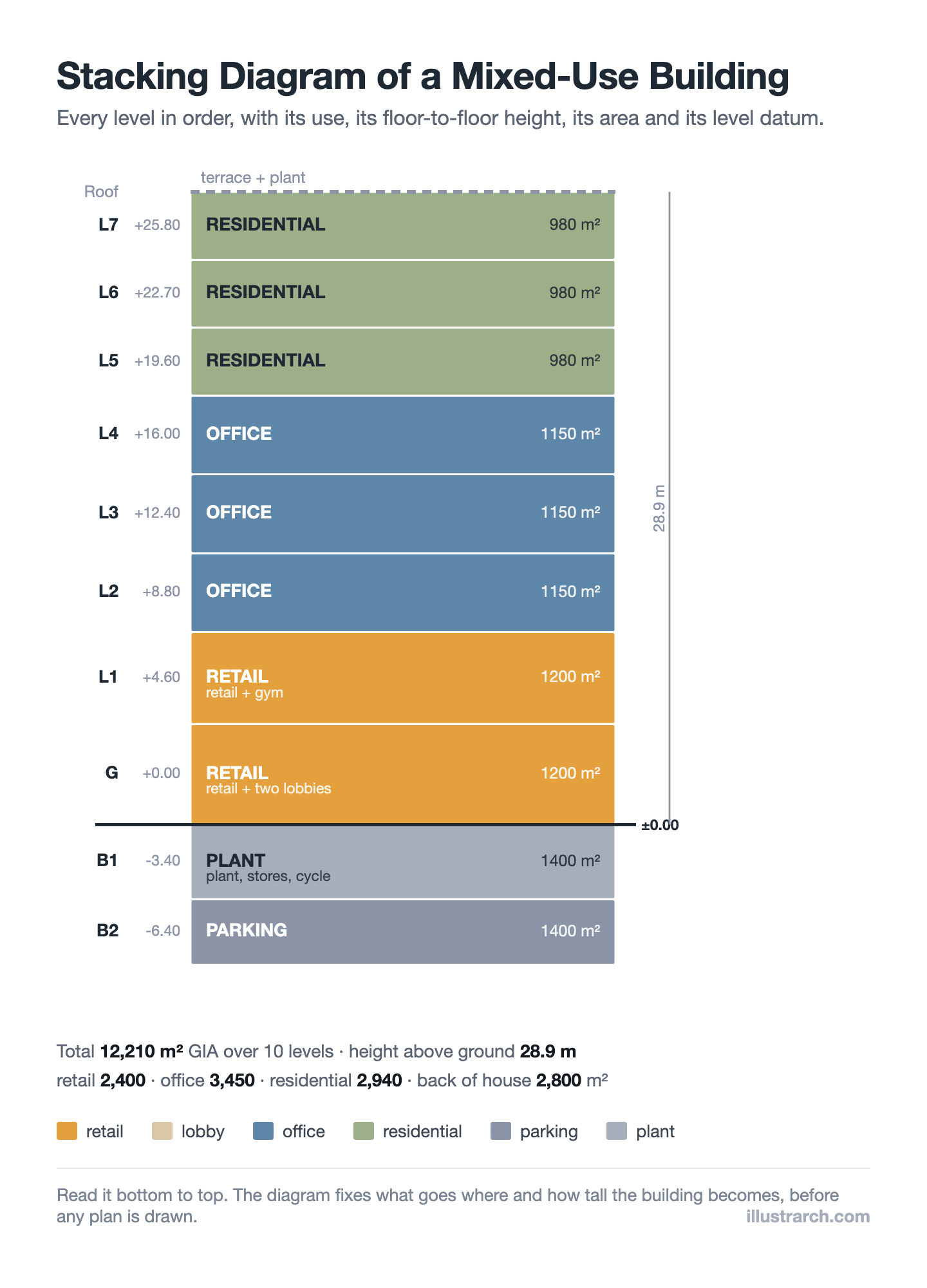
Stacking Diagram: How to Allocate Uses Floor by Floor
A stacking diagram assigns each use in a brief to a level,...
Sinan Ozen7 Mins read
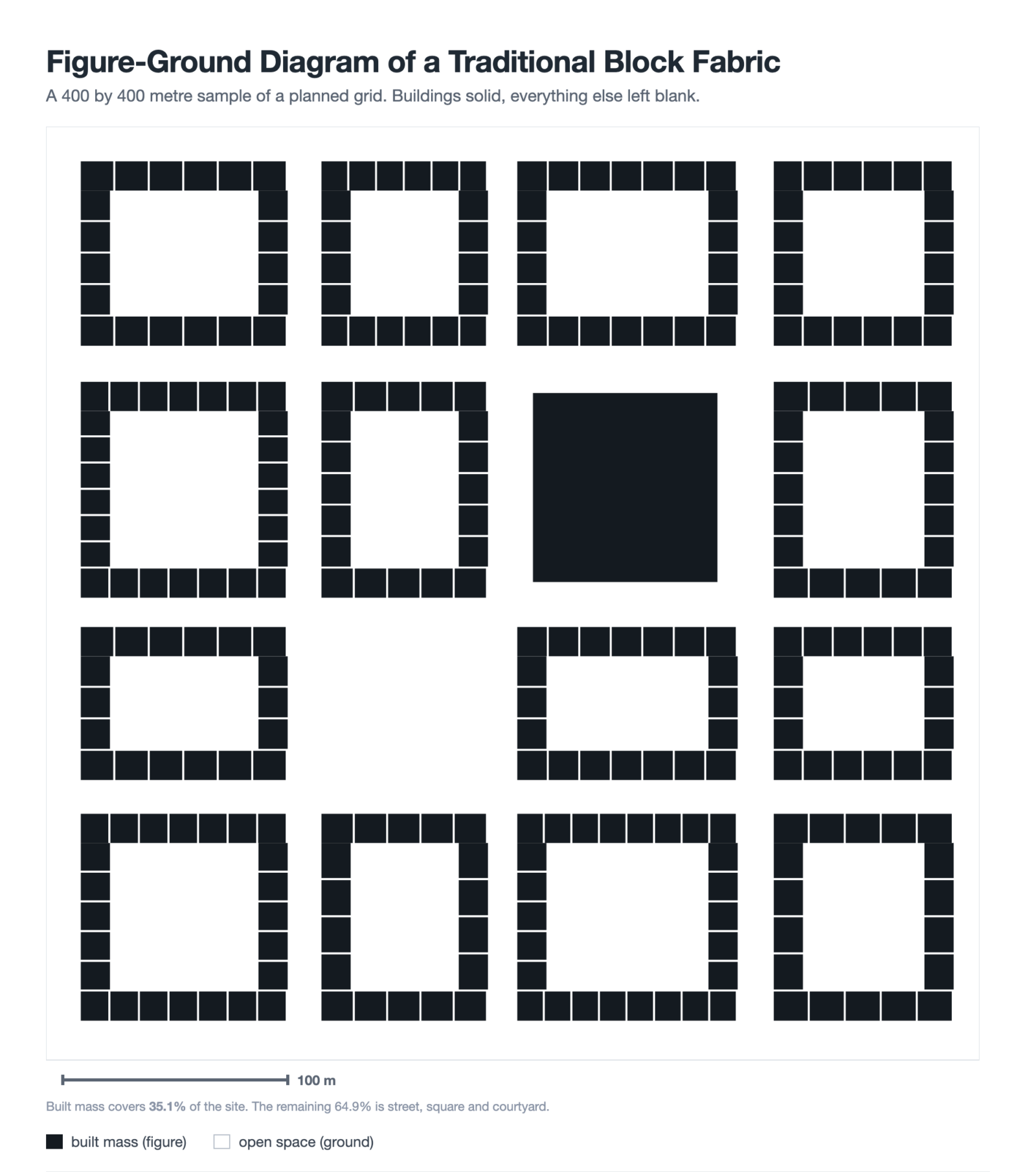
Figure-Ground Diagram: How to Draw and Read Urban Fabric
A figure-ground diagram reduces a city to built mass against open space....
Sinan Ozen7 Mins read
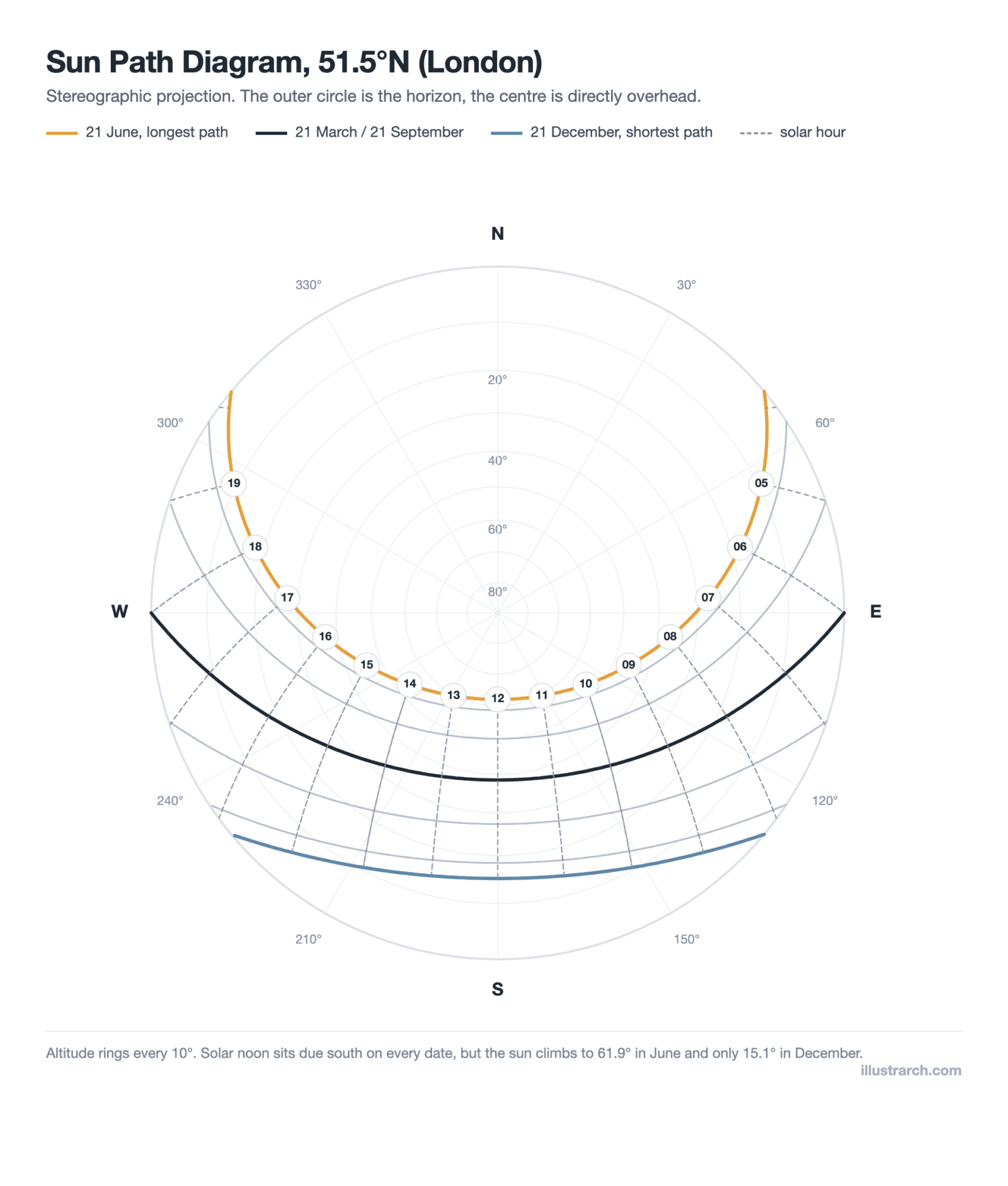
Sun Path Diagram: How to Read One and Use It in Design
A sun path diagram shows where the sun sits all year for...
Sinan Ozen8 Mins read
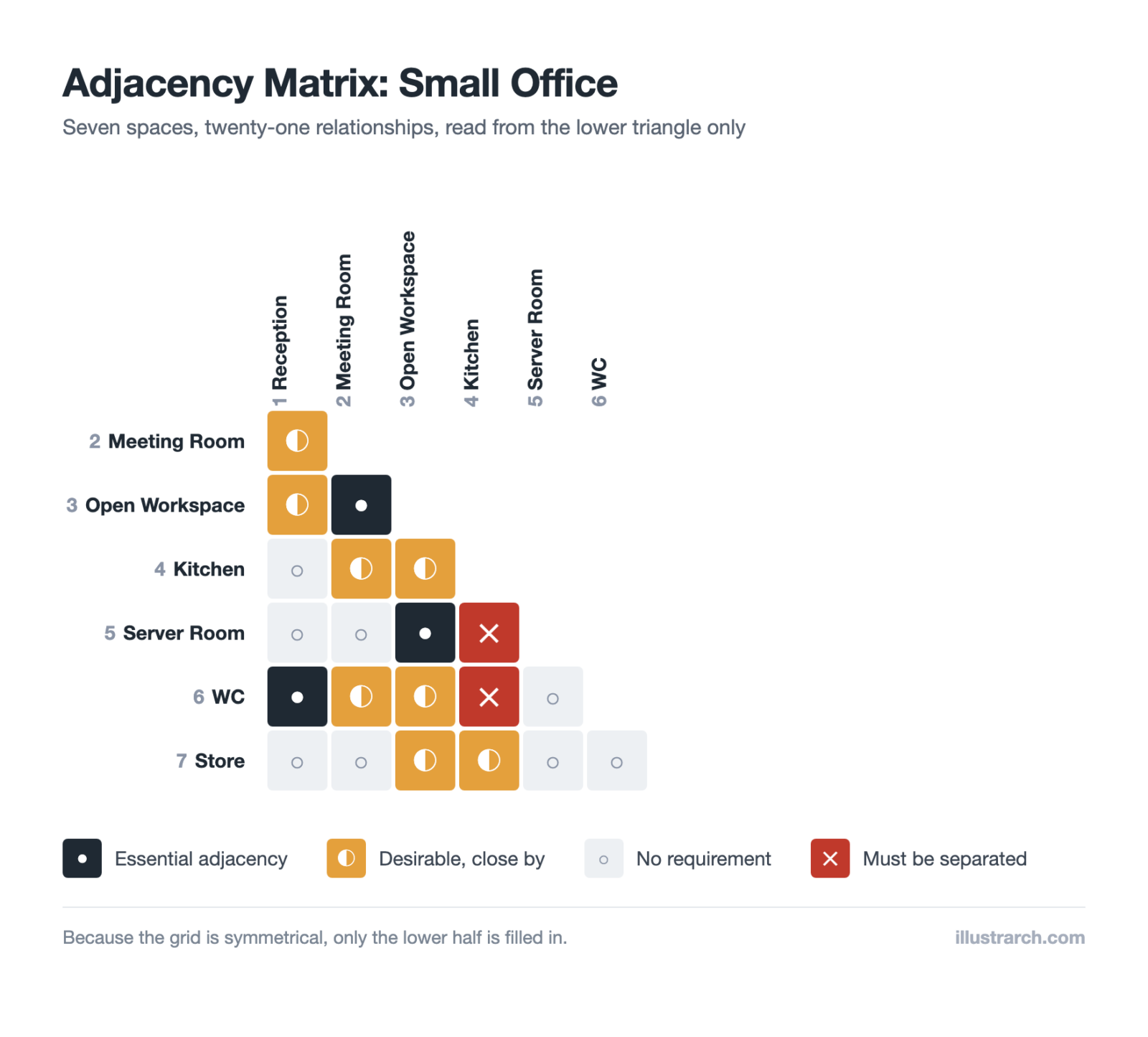
Matrix Diagram in Architecture: How to Map Space Adjacencies
A matrix diagram, or adjacency matrix, maps how every space in a...
Sinan Ozen8 Mins read


Leave a comment