

Inspiring Architectural Sketches Ideas and Examples to Elevate Your Creativity
Explore the art of architectural sketches with inspiring examples, styles, and practical tips. From freehand concepts to detailed perspectives, learn how sketches bridge creativity and precision, bringing ideas to life. Dive into iconic works, enhance your skills, and discover techniques that empower designers to visualize and communicate groundbreaking designs effectively.
 Bahattin Duran22 January 202512 Mins read715
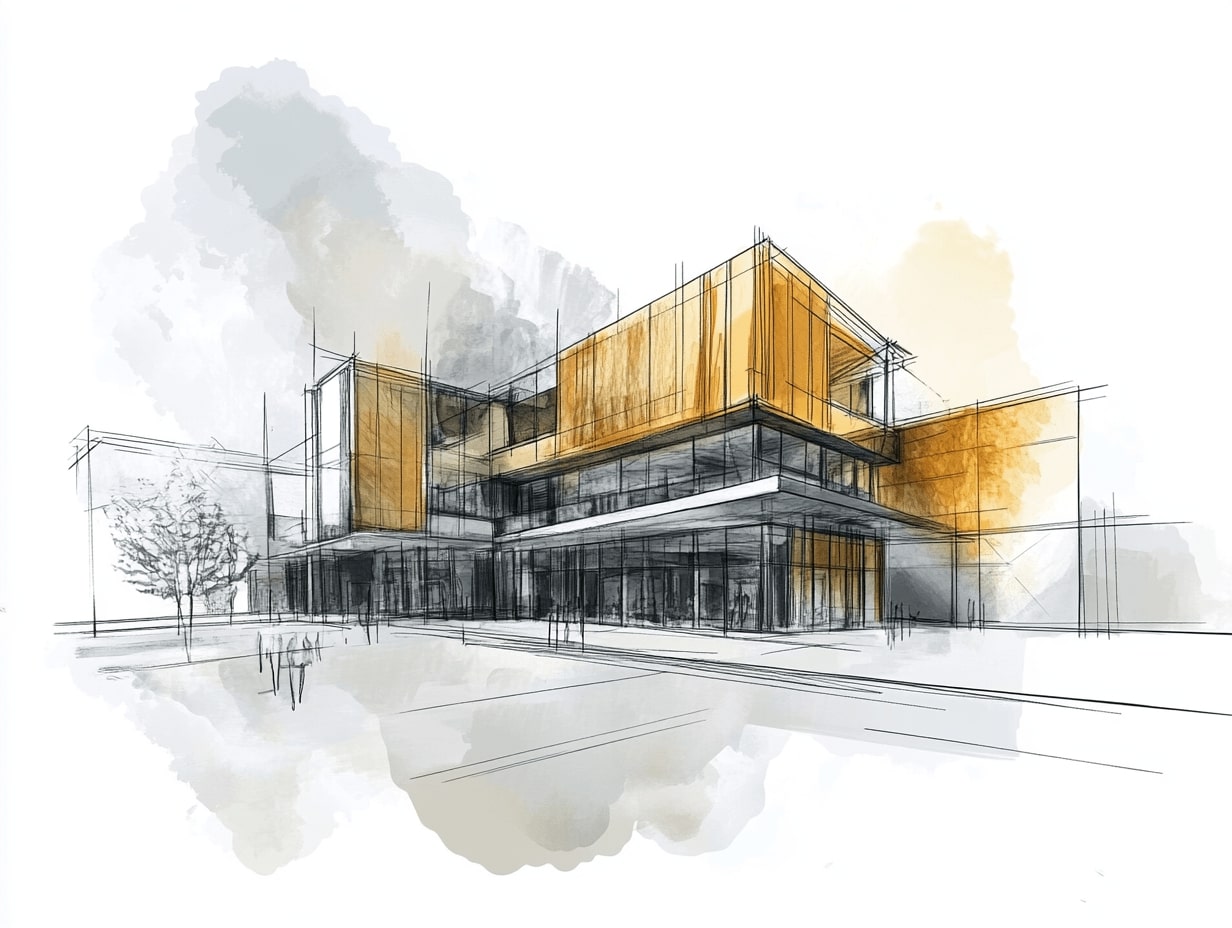
Table of Contents Show
Architectural sketches are hand-drawn or freehand visual representations that translate spatial ideas into form before any technical drafting begins. They capture proportions, materials, and atmosphere in seconds, helping architects test concepts, communicate intent, and refine designs from rough thumbnails to polished presentation drawings.
Architectural sketches are where creativity meets precision, offering a glimpse into the mind of a designer before the first brick is laid. They are more than just drawings; they are the foundation of influential structures and innovative spaces. Whether it is a rough pencil sketch or a detailed ink rendering, these visual concepts spark inspiration and set the tone for architectural masterpieces.
A well-crafted sketch captures ideas, communicates visions, and often becomes a work of art in its own right. Exploring different styles and techniques, from minimalist outlines to detailed compositions, can sharpen your imagination and refine your skills. The sections below cover inspiring sketch ideas, real examples from famous architects, the tools you actually need, and practical tips that will help you draw with more confidence.

What Are Architectural Sketches?
Architectural sketches are quick, hand-drawn studies that architects use to think through space, test forms, and communicate design intent. Unlike technical CAD drawings, they prioritize speed and idea generation over precision, making them ideal for the earliest stages of design when concepts are still fluid.
Architectural sketches typically include scales and keys for cross-referencing information, often show buildings from unusual angles such as plans (viewed from above) or sections (cut through the middle), and serve as a visual language to discuss architecture in ways that words alone cannot. They appear throughout the design process: from the first napkin sketch to refined elevation studies that guide construction.
Why Are Architectural Sketches Important in Design?
Architectural sketches act as the bridge between imagination and reality. They provide a tangible medium to translate abstract ideas into structured concepts. These sketches serve as the first step in visualizing spaces, forms, and materials before refining them with technical tools like Revit or AutoCAD.
Designers rely on sketches to analyze proportions and spatial relationships. Quick hand-drawn studies often reveal solutions that might not emerge through digital modeling alone. For example, perspective drawings help assess depth and scale, while elevation sketches highlight structural alignment. A two-minute thumbnail can reveal a circulation problem that would take an hour to find in a 3D model.
Sketches also improve collaboration among teams. When complex structures are involved, diagrams and annotated drawings clarify intentions faster than verbal explanations. Team members can align their goals by interpreting these visual guides, and clients often grasp a freehand sketch more readily than a polished render because it invites discussion rather than presenting a fixed answer.
The process of sketching builds creativity while reinforcing technical rigor. Experimenting with shading, line weight, and composition often inspires solutions you would not find on a screen. Using tools like pencil, marker, or ink allows different artistic expressions to enrich designs. For a deeper introduction to the fundamentals, see our guide to architectural sketching for beginners.
Historical significance amplifies the value of sketching. Architects like Le Corbusier and Frank Gehry relied on conceptual sketches to design transformative buildings. The Fondation Le Corbusier alone holds over 8,000 original drawings, studies, and plans, showing just how foundational sketching was to one of the 20th century’s most influential architectural careers.
📌 Did You Know?
The earliest known architectural plan dates back to approximately 2200 BCE, engraved on a statue of Gudea, a ruler of ancient Mesopotamia. The plan shows a temple floor layout with walls, doorways, and measurements, proving that architectural sketching has been part of building design for over 4,000 years.
Inspiring Architectural Sketches Ideas to Explore
Architectural sketches show the fusion of creativity and structural understanding. Exploring different styles can open up unique ways to visualize and communicate design concepts. The five categories below cover the most useful sketch types for both students and practicing architects.
Freehand Concept Sketches
Freehand sketches simplify complex ideas into quick, expressive representations. These sketches focus on form and spatial relationships without rigid technical constraints. Designers often use loose lines to outline structures, as seen in early studies by Zaha Hadid. Experimenting with pencil shading or ink techniques can add depth and movement in these drawings.
The Architectural Association Diploma Unit 9, where Hadid trained from 1975 to 1977, encouraged this kind of abstract concept work, and her freehand sketches from that period are now archived at Zaha Hadid Architects and the Zaha Hadid Foundation. Studying these early works shows how a few confident strokes can carry enormous design intent.
Detailed Perspective Drawings
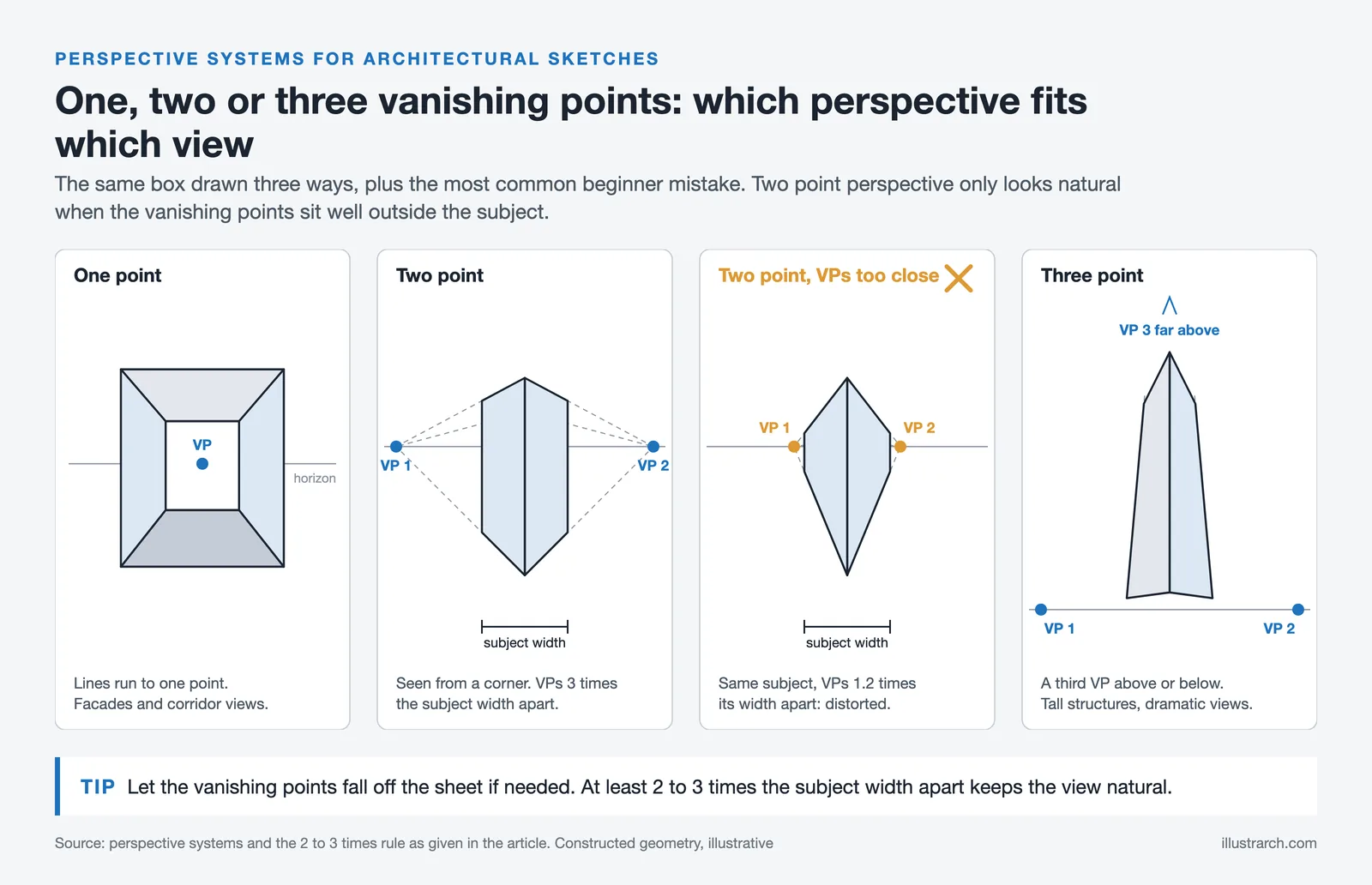
Perspective drawings use precision to depict architecture realistically. These sketches illustrate depth, scale, and materiality, making designs more relatable. Examples include urban streetscapes or interior layouts with detailed textures. Incorporating vanishing points and consistent line thickness can refine accuracy and improve the visual impact.
The three perspective systems every architect should master are one-point (lines converge to a single point on the horizon, useful for facades and corridor views), two-point (two vanishing points on the horizon, ideal for buildings seen from a corner), and three-point (adds a third vanishing point above or below for tall structures viewed dramatically). Practicing all three builds spatial confidence quickly.
⚠️ Common Mistake to Avoid
Many beginners place vanishing points too close together in two-point perspective drawings, which creates a distorted, fish-eye effect. Keep your vanishing points well beyond the edges of your drawing area: a good rule is to position them at least 2 to 3 times wider apart than the width of your subject for a natural, realistic view.
Abstract and Conceptual Sketches
Abstract sketches emphasize mood and thematic exploration over direct representation. They use bold lines, geometric forms, and unique layouts to communicate ideas. Designers like Daniel Libeskind often rely on these sketches to inspire avant-garde works. Adding color splashes or layering materials opens new creative possibilities for unexpected architectural solutions.

Section and Elevation Sketches
Section sketches cut through a building vertically, revealing interior spaces, structural relationships, and how floors stack together. Elevation sketches show flat exterior views from one side, focusing on facade composition and material patterns. Both are essential for explaining how a building actually works, beyond its silhouette.
For a deeper look at how leading architects approach this drawing type, see our roundup of 10 successful architectural section drawings by architects, which covers everything from minimal black-and-white graphics to richly colored collage sections.
Plan View and Axonometric Sketches
Plan views look down at a building from above, showing layout, circulation, and spatial organization. Axonometric and isometric sketches offer a 3D-like view without true perspective distortion, which makes them ideal for explaining geometry, structure, and how spaces connect. They are especially common in early massing studies and student portfolios.
Examples of Stunning Architectural Sketches
Architectural sketches captivate with their ability to transform concepts into visually compelling designs. The examples below show a range of approaches and creative techniques used in real projects.
Iconic Landmark Sketches
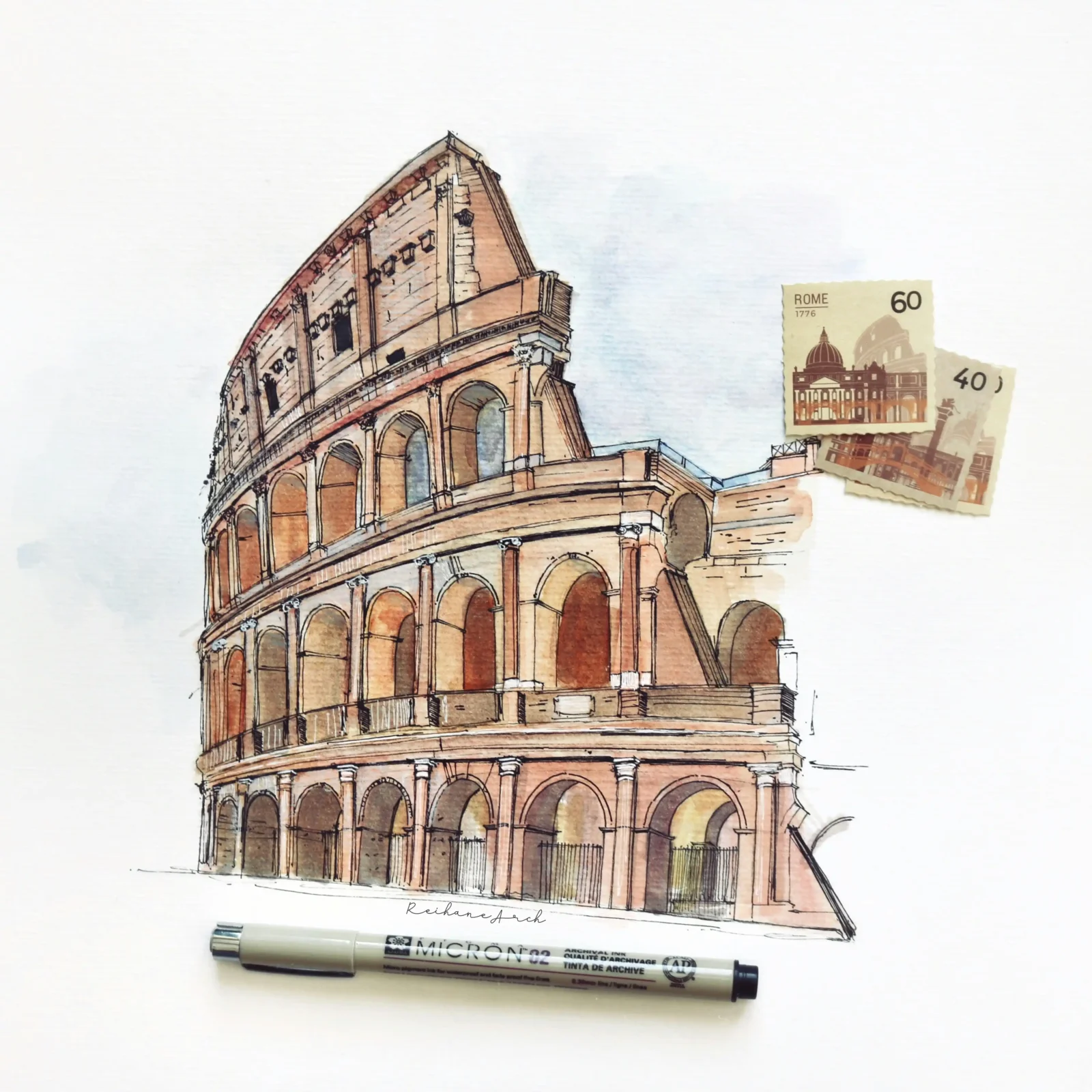
Sketches of landmarks show how architects interpret monumental structures. Le Corbusier’s pencil and coloured pencil sketches for the Governor’s Palace in Chandigarh, drawn between 24 and 28 May 1953, capture the simplicity and modernism of post-colonial India in less than a week of focused work. Similarly, the Eiffel Tower rendered in quick ink drawings highlights its detailed lattice structure. Freehand sketching of landmarks focuses on essential elements like silhouette and iconic form, keeping their recognizable essence intact.
Modern Residential Space Concepts
Residential sketches often emphasize function paired with aesthetic appeal. Frank Lloyd Wright’s rough pencil sketches for Usonian homes reflect harmony with the environment while keeping a minimalist design. Contemporary concept sketches for open-plan spaces use clean linework to represent flexibility and brightness. Such designs often highlight practical aspects like natural light flow and spatial balance, which are critical for livable modern homes.
Urban Landscape Visualizations
Urban planning sketches capture the complexity of cityscapes and public spaces. For instance, Santiago Calatrava’s works depict fluid pedestrian bridges connecting dense urban zones while integrating surrounding environments. Detailed street-level perspectives with layered shading can depict vibrant community spaces, tree-lined avenues, or towering skyscrapers. Urban visualization sketches often use exaggerated textures or bold line contrasts to bring out dynamic and livable urban atmospheres.
Sketches by Famous Architects
Studying sketches by renowned architects reveals how distinct visual languages develop over time. Frank Lloyd Wright’s drawings often feature organic forms and natural elements, with line weight and perspective creating depth and realism that integrates buildings with their surroundings. Le Corbusier’s sketches are characterized by clean lines, geometric shapes, and a focus on function, with shading and hatching adding dimension. Zaha Hadid’s drawings are fluid and dynamic, reflecting her signature style of futuristic and flowing designs.
🏗️ Real-World Example
MAXXI Museum, Rome (2010): Zaha Hadid’s preliminary sketch for MAXXI in Rome, drawn during early design development, shows how a single drawing can carry the conceptual logic of an entire building. The looping, overlapping lines became the museum’s signature curving galleries, demonstrating how an abstract architectural sketch can directly shape a built work about a decade later.
🎓 Expert Insight
“The early sketches are very important; it was a composite of these that produced the plan.” — Zaha Hadid, on her Irish Prime Minister’s Residence project (1979)
Hadid’s reflection, documented by the Zaha Hadid Foundation, captures a truth that most architects discover the hard way: the rough pages at the start of a project often contain the design DNA of everything that follows.
Tools and Materials for Architectural Sketching
The right toolkit makes a real difference in how confidently you can sketch. You do not need expensive supplies to start, but a few well-chosen pencils, pens, and a decent sketchbook will improve your line quality faster than any tutorial. For a deeper breakdown, see our guide to essential tools for architectural sketching.
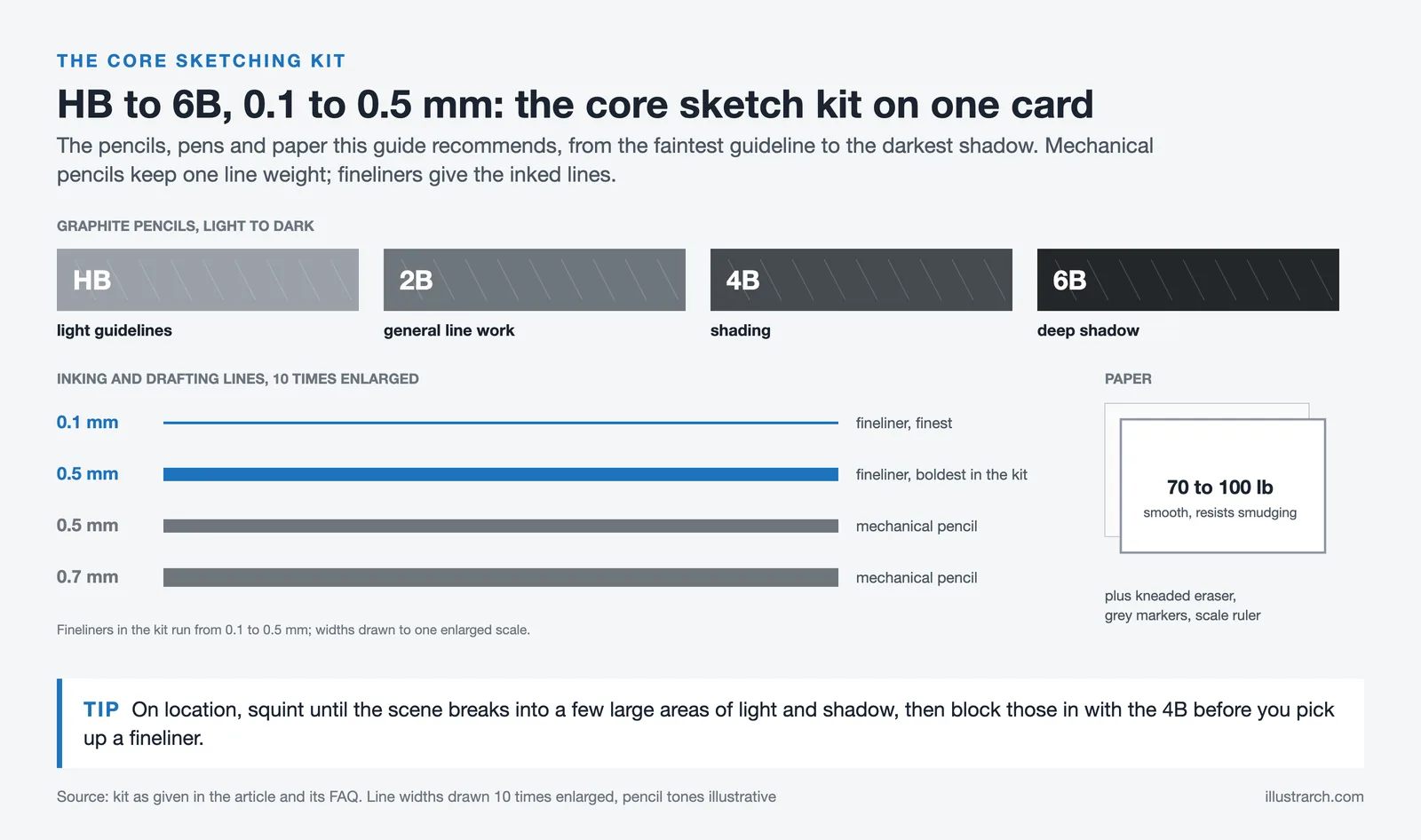
A core kit usually includes graphite pencils ranging from HB for light guidelines to 4B or 6B for shading, mechanical pencils in 0.5mm and 0.7mm for consistent line weights, waterproof fineliners from 0.1mm to 0.5mm for inking, a kneaded eraser for clean lifts, and a smooth sketchbook with paper between 70 and 100 lb to prevent smudging. Many architects also carry alcohol-based grey markers for quick tonal studies and a small scale ruler for proportion checks.
💡 Pro Tip
When sketching outdoors on location, squint your eyes to simplify the scene into large areas of light and shadow before you start drawing. This trick, used by experienced urban sketchers, helps you identify the most important tonal relationships first, leading to more dynamic and readable sketches than chasing every small detail upfront.
How to Improve Your Architectural Sketches: Practical Tips
Focus On Understanding Proportions
Mastering proportions forms the foundation of any architectural sketch. Building proportions enable accurate depictions of space, structure, and balance. Observing real-world examples, like historical landmarks or contemporary buildings, helps refine this skill. Practicing with grids or reference lines improves accuracy, and adding a small human figure next to your building early on anchors the overall scale before you invest time in details.
Experiment With Line Work
Varying line weight adds depth and dimension. Bold lines emphasize structural elements, while lighter strokes describe finer details. Practicing hatching, cross-hatching, and contour lines builds versatility. Using clean, deliberate strokes keeps your drawings clear, and as Francis D.K. Ching describes in his book Architectural Graphics, controlling profile lines (the thickest lines that define a building’s outermost silhouette) is one of the most impactful skills for sketch clarity.
Emphasize Composition
Strong composition guides the viewer’s eye through the sketch. Treat the layout as a structured guide, balancing elements like symmetry and focal points. Placing dominant elements, such as facades or towers, strategically within the frame creates impact. Dividing the canvas into thirds and positioning key elements along the lines or intersections (the rule of thirds) is a reliable starting point for stronger compositions.
Incorporate Shading And Textures
Shading and textural techniques bring sketches to life. Gradual shading defines light and shadow, adding realism to spatial forms. Textures, like brick patterns, wood grain, or foliage, communicate materials or settings. Identify a single light source and apply shading consistently with hatching, cross-hatching, or stippling to keep the lighting believable.

Use Annotated Details
Including labeled annotations clarifies technical elements or design intentions. Adding notes on materials, dimensions, or functional elements adds communicative value. For instance, annotating window heights, ceiling clearances, or material types makes ideas accessible to collaborators or clients without requiring a separate explanation.
Practice Freehand Sketching
Freehand sketches improve fluidity and creativity. Avoid relying on rulers or templates to develop hand-eye coordination. Take time drawing irregular forms like organic structures or spontaneous urban layouts. Timed exercises, such as one-minute, five-minute, and fifteen-minute studies of the same subject, train both observation and economy of line. For a structured approach, our step-by-step guide to mastering architectural sketching walks through each stage in order.
💡 Pro Tip
Set a daily 15 to 30 minute sketching window and focus each session on one skill: proportions one day, edge control the next, then quick value studies. Short, focused practice beats long, unfocused sessions, and tracking your sketchbook progress month by month is the clearest way to see real improvement.
Study From Great Architects
Analyzing sketches by renowned architects builds inspiration and learning. Works by professionals like Frank Gehry or Renzo Piano demonstrate diverse techniques and creative problem-solving. Observing how they use lines, shapes, and perspectives shapes your approach to architectural visualization. Public archives like Drawing Matter and the Serpentine Galleries’ Zaha Hadid exhibition archive offer high-resolution access to original sketches that you can study and learn from. For more techniques, see our guide on essential techniques for stunning architectural sketches.
Architectural Sketches: Comparison of Styles
Different sketch types serve different purposes. The table below compares the most common styles based on what they communicate, the typical tools used, and when they work best in the design process.
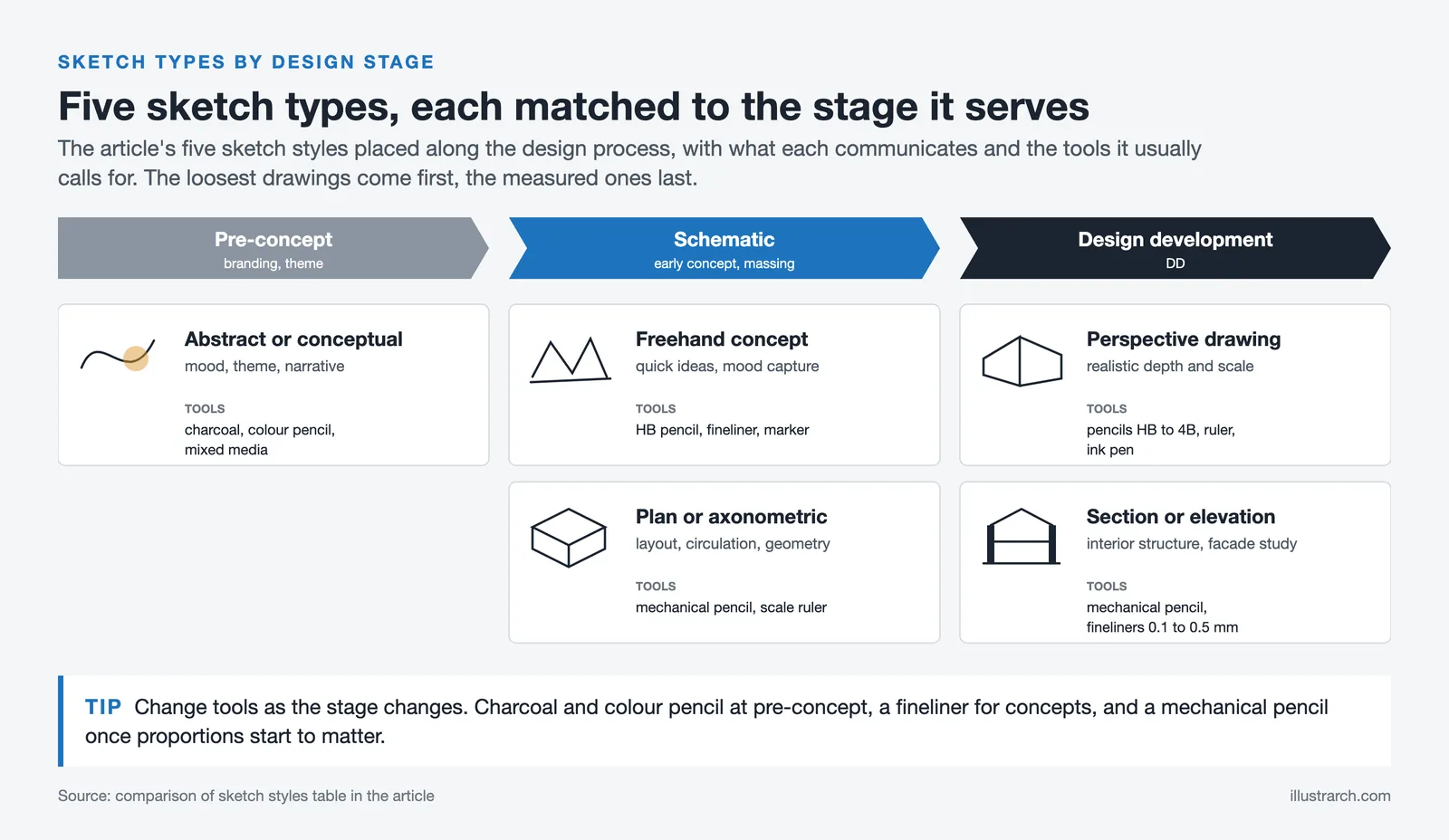
| Sketch Style | Best For | Typical Tools | Design Stage |
|---|---|---|---|
| Freehand Concept | Quick idea exploration, mood capture | HB pencil, fineliner, marker | Schematic / early concept |
| Perspective Drawing | Realistic depth and scale | Pencils HB-4B, ruler, ink pen | Design development |
| Abstract / Conceptual | Mood, theme, narrative | Charcoal, color pencil, mixed media | Pre-concept / branding |
| Section / Elevation | Interior structure, facade study | Mechanical pencil, fineliners 0.1-0.5mm | Design development / DD |
| Plan / Axonometric | Layout, circulation, geometry | Mechanical pencil, scale ruler | Schematic / massing |
Frequently Asked Questions About Architectural Sketches
What is the purpose of architectural sketches?
The main purpose of architectural sketches is to communicate ideas quickly, whether to a colleague, client, contractor, or the public. They help architects think through space, test forms, and refine concepts before committing to detailed plans or digital models, making them a fundamental tool throughout the entire design process.
Do architects still sketch by hand in 2026?
Yes. Even with widespread CAD, BIM, and AI-assisted tools, hand sketching remains a core skill for most architects. Living legends like Frank Gehry still begin designing new buildings with freehand drawings, and many practices use hand sketches in early concept work because they offer a directness and speed that software cannot match. Hand and digital sketching are complementary, not competing.
What pencils are best for architectural sketches?
A small range of graphite grades covers most needs: HB for light guidelines, 2B for general line work, and 4B or 6B for shading and shadow areas. Mechanical pencils in 0.5mm and 0.7mm produce consistent, repeatable lines that are ideal for dimensioned sketches and annotations.
How long does it take to learn architectural sketching?
Most beginners can produce confident, readable sketches within three to six months of consistent daily practice (15 to 30 minutes per day). Mastering perspective, proportion, and personal style usually takes one to three years, but visible progress shows up within the first few weeks if you sketch regularly and study real buildings.
What is the difference between a sketch and a technical drawing?
A sketch is fast, exploratory, and usually freehand, focused on communicating ideas rather than precise measurements. A technical drawing is dimensionally accurate, drafted with rulers or CAD software, and used for construction documentation. Sketches start the design process; technical drawings finish it.
✅ Key Takeaways
- Architectural sketches translate abstract ideas into spatial form, bridging imagination and built reality.
- The five core sketch types are freehand concept, perspective, abstract, section/elevation, and plan/axonometric, each suited to a different stage of design.
- A simple toolkit (HB-4B pencils, mechanical pencil, fineliners, smooth sketchbook) is enough to start; quality of practice matters more than expensive tools.
- Studying sketches by Le Corbusier, Zaha Hadid, and Frank Lloyd Wright through public archives builds visual vocabulary faster than tutorials alone.
- Daily 15-30 minute focused sessions on one skill at a time produce visible progress within weeks, not years.
Conclusion
Architectural sketches embody the fusion of creativity and precision, offering a foundation for influential designs. They serve as a vital tool for visualizing abstract concepts, refining spatial relationships, and supporting collaboration. Through styles like freehand sketches, perspective drawings, section drawings, and abstract explorations, designers can communicate their visions in ways that words and rendered models cannot.
By examining iconic sketches from Le Corbusier to Zaha Hadid, the timeless value these drawings hold in shaping architectural innovation becomes clear. Practical techniques, including mastery of proportions, shading, and annotated details, help any designer craft impactful and expressive work. The pencil and the sketchbook still belong on every architect’s desk in 2026, right next to the laptop.
- architect drawing tools
- architectural rendering tools
- architectural sketching guides
- architectural visualization tools
- architecture sketching kit
- high-precision sketch tools
- innovative tools for architectural sketching
- precision sketching equipment
- professional architectural sketch tools
- tools for architectural creativity







Architectural Drawings: A Student’s Guide to 8 Essential Types
A clear introduction to the eight architectural drawing types every student meets...
 Sinan Ozen6 Mins read
How to Draw Architectural Plans by Hand: A Step-by-Step Guide
A practical, step-by-step breakdown of drawing architectural plans by hand, from choosing...
 Elif Ayse Sen14 Mins read
Best Stylus and Pen for Architectural Sketching: Top Picks for 2026
A tested breakdown of the top stylus pens and traditional pens for...
Elif Ayse Sen11 Mins read
Architecture Sketch: Essential Techniques and Modern Practices
Architectural sketching is a vital technique that facilitates rapid idea development, communication,...
Bahattin Duran5 Mins read


Leave a comment