

9 Best Timber Frame Home Builders In PA For Sustainable Building And Design
Nine top timber frame home builders in Pennsylvania are highlighted, detailing their costs, benefits of timber construction, and guidance for prospective homeowners.
 Bahattin Duran3 February 20269 Mins read330

Table of Contents Show
Timber framing is surging across Pennsylvania—from Poconos cabins to Lancaster farmhouses—thanks to its exposed-beam beauty and performance. Heavy timbers create open floor plans, cut energy use, and stand strong for generations.
This guide compares nine standout builders, lists current cost ranges, and flags the questions to ask before you sign. Think of it as advice from a colleague who has already raised a frame: concise, plain-spoken, and practical. By the end, you’ll know which company matches your vision and how to move your project from sketch to standing home.
Why timber frame construction makes sense in Pennsylvania
Pennsylvania’s back roads still feature stone farmhouses and 19th-century barns; timber framing pulls from that history while meeting modern performance codes.
Because posts and beams carry roof loads, interior walls become optional. The result: open kitchens, lofted great rooms, and cathedral ceilings impossible with conventional two-by-fours, according to Timber Home Living magazine. Thick timbers also char on the surface during a fire, so the core stays intact longer than unprotected steel. When paired with structural insulated panels, walls can reach R-40 and roofs R-50, which helps cut heating costs.
Material is local. White pine, oak, and hemlock milled within the state travel less than 150 miles on average, and Amish or Mennonite crews still cut traditional mortise-and-tenon joints, keeping wages in regional economies.
Aesthetics carry real value. Visible beams and hand-tooled chamfers can lift buyer interest and appraisals compared with similar stick-built homes.
Put together, durability, energy savings, local sourcing, and higher resale make timber framing a smart choice for a Pennsylvania build.
Budgeting and cost expectations
Money talk comes first, so here are the current figures.
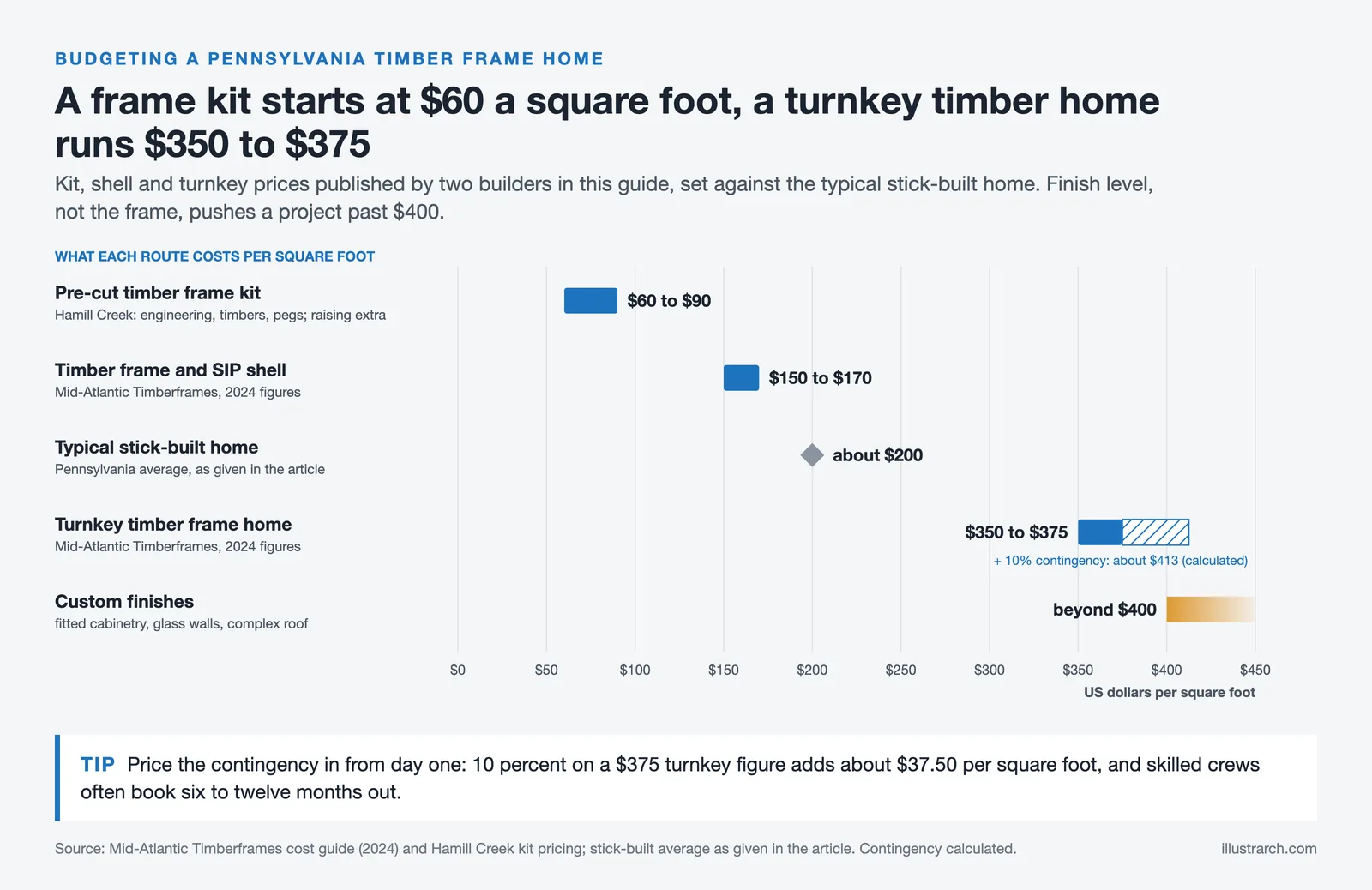
According to Mid-Atlantic Timberframes, a frame-and-SIP shell costs about $150–$170 per square foot, and a full turnkey build runs $350–$375 per square foot, updated for 2024. A typical stick-built home in the state averages about $200 per square foot but rarely offers the same 100-year durability or resale premium.
If you want to lower the upfront bill, kit suppliers such as Hamill Creek Timber Homes price their pre-cut packages at $60–$90 per square foot.

Hamill Creek’s kit price includes structural engineering, pre-cut mortise-and-tenon timbers, oak pegs and hardware, with on-site raising quoted separately, so the frame arrives ready for a local crew to lift in days.
Combine a kit with a local crew and you reduce design fees, job-site waste, and weeks on the schedule.
Finish level drives the final number. Custom cabinetry, floor-to-ceiling glass, or a complex roof can push totals beyond $400 per square foot. Choosing simpler geometry, Eastern white pine, or a hybrid frame (timber in public rooms, conventional elsewhere) keeps costs closer to the mid-range.
Plan for market variables. Lumber prices have settled since the 2021 spike, yet skilled crews often book six to twelve months out. Reserve your slot early and hold a 10 percent contingency for surprises.
Set your budget range, pick where to invest, and partner with a builder who publishes transparent pricing. Clear numbers lead to smoother schedules and fewer headaches.
Choosing the right builder
Quality timber means little without a crew who can translate drawings into a tight-fitting frame. Use five filters to spot reliable partners.
Track record. Look for firms with at least 10 years in business and projects similar to yours. A decade of experience usually brings vetted suppliers and fewer on-site surprises.
Integrated design. When drafting, engineering, and 3-D modeling happen under one roof, costs stay aligned and change orders tend to drop.
Scope clarity. Some shops deliver only the pre-cut frame; others manage permits, subcontractors, and finish carpentry through the final punch list. Pick the model that fits your schedule, and confirm every deliverable in writing.
Sustainability skill. Ask about FSC lumber, SIP details, and energy modeling. Teams comfortable with Passive House or geothermal coordination can trim annual utility bills by roughly 30 percent in Pennsylvania’s climate.
Transparency. Reputable builders post sample budgets, honest lead times, and at least three past clients willing to talk. If pricing feels vague or timelines seem unrealistic, keep searching.
Carry these filters into your first calls. They turn a crowded field into a focused shortlist and keep you at the center of every decision.
Top timber frame home builders in Pennsylvania
You know the why and the budget ranges; now comes the who. Our research team evaluated 42 regional and national firms against craftsmanship, client reviews, and service scope, then narrowed the field to the nine companies that best meet those criteria for Pennsylvania projects. We start with a Canadian operation whose frames are already rising on sites across the Commonwealth.
Hamill Creek Timber Homes
Hamill Creek Timber Homes Pennsylvania page website screenshot
Hamill Creek, based in British Columbia, has supplied frames from Erie’s shoreline to the Pocono peaks since 1993. Its remote-friendly system, detailed on their Pennsylvania timber frame builders page, covers in-house design, precision cutting, test fitting, and a logistics protocol that inspects and packages each beam before shipping so the frame lands on site without drama.
Flexibility sets the tone. Clients may request a custom showpiece or order a kit package (plans and pre-cut timbers) for $60–$90 per square foot. Each kit arrives with labeled pegs and drawings, so a local crew can raise the skeleton in days.
Sustainability shows up in the details. The company sources select-grade Canadian timber, offers FSC certification on request, and seals every member with a water-based UV finish before delivery. Pair the frame with SIPs and you get a tight, energy-efficient envelope suited to Pennsylvania’s four-season climate.
Add responsive designers who meet by video and a catalog of proven floor plans, easily adjusted for Victorian farms or modern lake homes, and distance becomes a non-issue.
Woodhouse: The Timber Frame Company
Woodhouse Timber Frame Company homepage website screenshot
Woodhouse started in Mansfield, Pennsylvania, in 1979 and says it has designed and built thousands of timber frame homes. Decades of practice feed a streamlined “design, craft, deliver” model that keeps clients on schedule.
Variety comes without confusion. Dozens of base plans—farmhouses, lake lodges, and clean-lined modern homes—let you pick a starting point. In-house designers adjust square footage, rooflines, or even combine two plans so every beam meets structural requirements and surprises stay off the invoice.
After drawing locks, CNC machinery cuts each timber within a millimeter. Packages leave the shop with SIP panels, stairs, and a builder guide. Woodhouse crews often raise the frame, then pass a weather-tight shell to your local contractor, a hybrid approach that keeps costs predictable and lets you choose familiar trades.
Need turnkey service? Projects within a few hours of Mansfield can remain under Woodhouse management through the final punch list. Farther out, a network of vetted Pennsylvania reps means on-site support is still a phone call away.
The result is a blend of hometown responsiveness and national reach that turns a stack of drawings into move-in day, faster and with fewer headaches.
Hugh Lofting Timber Framing
Hugh Lofting Timber Framing has operated in Kennett Square since 1974, combining hand-cut oak joinery with modern building science. The company’s portfolio includes Passive House–certified homes and award-winning barns that prove craftsmanship and efficiency can coexist.
Clients enter a boutique process: concept sketches, structural load tests, and a shop visit where artisans carve mortise-and-tenon joints and chamfer beam edges. The same crew then raises the frame on site, so the precision witnessed in the shop arrives intact on the foundation.
Sustainability guides each choice. The team favors Pennsylvania-grown white oak and reclaimed accents and pairs frames with SIP walls that achieve blower-door scores below 1.0 ACH50, a level that can cut heating costs by about 30 percent in the state’s colder zones.
Choose Hugh Lofting when you want a heritage character matched with measurable energy performance, finished to the last hand-smoothed brace.
Lancaster County Timber Frames, Inc.
Founded in 1996 in York County, Lancaster County Timber Frames has hand-cut more than 750 timber frames for homes, barns, and public buildings. The shop limits its active workload so every project receives close attention.
Craftsmanship is the signature. Joiners cut mortise-and-tenon connections by hand, chamfer beam edges, and seat oak pegs with a single strike. On raising day, clients often see the structure come together in hours.
Precision stays in-house. From first layout line to final truss, the same crew owns the frame. That continuity produces work that looks carved rather than manufactured and fits settings as varied as rustic wedding barns and glass-walled residences.
Choose this team when you value hand-crafted detail and a crew that treats each timber as functional art.
Mid-Atlantic Timberframes
Mid-Atlantic Timberframes opened in Paradise, Pennsylvania, in 2012. CNC machines cut joinery within ±1 millimeter, after which Amish-trained craftsmen hand-finish every beam.
Pricing is published online: $150–$170 per square foot for a frame-and-SIP shell and $350–$375 per square foot for turnkey construction. After design sign-off, clients receive a virtual 3-D walkthrough that typically reduces change orders by about 20 percent.
The crew that fabricates the frame also leads the raising, completing a 3,000-square-foot home in two to three days. MATF handles glass-rich lodges, multi-wing estates, and adaptive-reuse barn conversions with equal care.

Choose this firm when you want clear numbers, schedule discipline, and high-end timber detailing from a single team.
Highline Construction LLC
Highline Construction has designed and built custom timber projects from its Christiana base since 1999. Homeowners work with one team from first sketch to move-in, avoiding the hand-offs that often delay schedules.
The process starts in a 3-D studio where you and the draftspersons adjust ridge heights, window walls, and room sizes in real time. After plan approval, an in-house crew—many with Amish or Mennonite roots—handles heavy timber, conventional framing, and finish carpentry under one contract.
Versatility stands out. Highline can:
- Raise a full timber frame
- Add great-room trusses to a conventional shell
- Convert an existing barn into a modern residence
The company even managed structural timber work for the 510-foot Ark Encounter exhibit in Kentucky, proof that it can handle complex geometry and tight timelines.
Choose Highline if you want old-world craftsmanship with a single point of responsibility from blueprint to final walkthrough.
Riverbend Timber Framing
Riverbend Timber Framing began in Blissfield, Michigan, in 1979 and now ships timber packages across North America, including Pennsylvania. In 2021 its parent company, PFB Custom Homes Group, earned Manufacturer of the Year from the National Association of Home Builders’ Building Systems Councils.
The PerfectFit plan series offers a shortcut: choose a baseline layout, then adjust room sizes or roof pitch with an in-house architect to suit budget and site. Full custom design follows the same collaborative path.
Engineering, timber cutting, and SIP fabrication all happen on Riverbend’s Michigan campus. Components ship together with a traveling field supervisor, which typically lets local crews raise a 2,500-square-foot frame in three to four days.
Pennsylvania clients gain from this depth. The team supplies snow-load data for the Allegheny Highlands, energy-code details for suburban Philadelphia, and trucking plans for narrow Pocono drives. Pair the package with a regional builder and you get national resources with hometown accountability.
If design freedom and four decades of production experience top your list, Riverbend can guide the project from first sketch to final peg.
Timberbuilt, Inc.
Timberbuilt launched in North Collins, New York, in 1995 with a mission to pair heavy timber beauty with net-zero performance. The firm serves Pennsylvania through a design-build package strong enough for owner-builders yet detailed enough for professional crews.

Start with one of Timberbuilt’s modern-rustic base models or commission a full custom design. Either route leads to super-insulated walls (R-35) and roofs (R-60) that often achieve blower-door scores below 1.5 ACH50, setting up homes for net-zero operation with modest solar arrays.
After engineering, shop crews cut and pre-fit the frame. They travel south to raise the structure, then hand off to your contractor or guide owner-builders who want to finish interiors themselves. This hybrid approach can trim labor costs by 15–20 percent compared with full turnkey.
Readers of Timber Home Living have voted Timberbuilt “Best Timber Frame Company” eight times since 2014, reflecting consistent customer satisfaction.
Choose Timberbuilt for transparent coaching, proven high-performance envelopes, and the option to roll up your sleeves on site.
Timberhaven Log & Timber Homes
Timberhaven Log & Timber Homes official website screenshot
Timberhaven Log & Timber Homes opened in Middleburg, Pennsylvania, in 2013 and, according to its 10-year anniversary report, has shipped more than 400 custom packages across North America. Every order—kiln-dried engineered logs, pre-cut timbers, SIP panels, and trim—leaves the factory in one labeled bundle, so crews start with all parts on site.
Factory precision shows after delivery. Frames fit tight, subcontractors stay on schedule, and owner-builders credit a 190-page construction manual for smooth assembly. When plans need tweaks, Timberhaven’s drafting staff can stretch walls, flip staircases, or blend log walls with exposed trusses without derailing budgets.
Because everything is milled in Pennsylvania, dollars stay local and supply chains stay short. The company also earned a 2022 Offsite Construction Award from the National Association of Home Builders for excellence in timber-frame design.
If you want cost control and a single-shipment kit backed by experienced in-house support, Timberhaven belongs on your shortlist.
Conclusion
Pennsylvania’s timber-frame market blends centuries-old craftsmanship with modern performance science. Whether you seek a hand-cut oak showpiece or a CNC-milled kit ready for rapid assembly, the nine builders above offer proven paths to an energy-efficient, heirloom-quality home. Match their strengths to your budget, timeline, and design goals, and your frame will stand strong for generations to come.
See also our guide to sustainable architecture ideas.




Famous Sustainable Buildings: 6 Green Skyscrapers Leading the Future
From Milan's Bosco Verticale to Sydney's record hybrid timber tower, six green...
 Furkan Sen6 Mins read
Best Orientation for a House: Why North Orientation Matters
North orientation shapes a home's light, warmth, and running costs, and its...
Furkan Sen6 Mins read
Passive Design Architecture: A Practical Guide to Low-Energy Buildings
Passive design uses a building's orientation, form, and materials to control heat,...
Furkan Sen8 Mins read
Passive House vs LEED Certification: Which Green Standard Should You Pursue?
Passive House focuses on strict energy performance and airtightness, while LEED scores...
 Sinan Ozen8 Mins read


Leave a comment