

Architect vs Engineer: Roles, Salary & Key Differences
Architects and engineers both shape the built environment, but their education, daily responsibilities, and career trajectories look very different. This guide breaks down architect vs engineer roles, salary data from the Bureau of Labor Statistics, licensing requirements, and how these two professions collaborate on construction projects.
 Furkan Sen21 May 20268 Mins read256

Table of Contents Show
An architect vs engineer comparison comes down to focus: architects design buildings for aesthetics, function, and human experience, while engineers ensure those designs are structurally safe and technically feasible. Both professions require separate degrees, distinct licensing paths, and different skill sets, yet they collaborate closely on nearly every construction project.
What Does an Architect Do?

Architects are responsible for the design and planning of buildings, from the earliest concept sketches through construction documentation. Their work centers on how a space looks, feels, and functions for the people who use it. A typical day might involve meeting with a client to discuss project goals, developing floor plans in software like Revit or AutoCAD, and reviewing material samples for a facade. Architects also coordinate with consultants, visit construction sites, and prepare permit application packages.
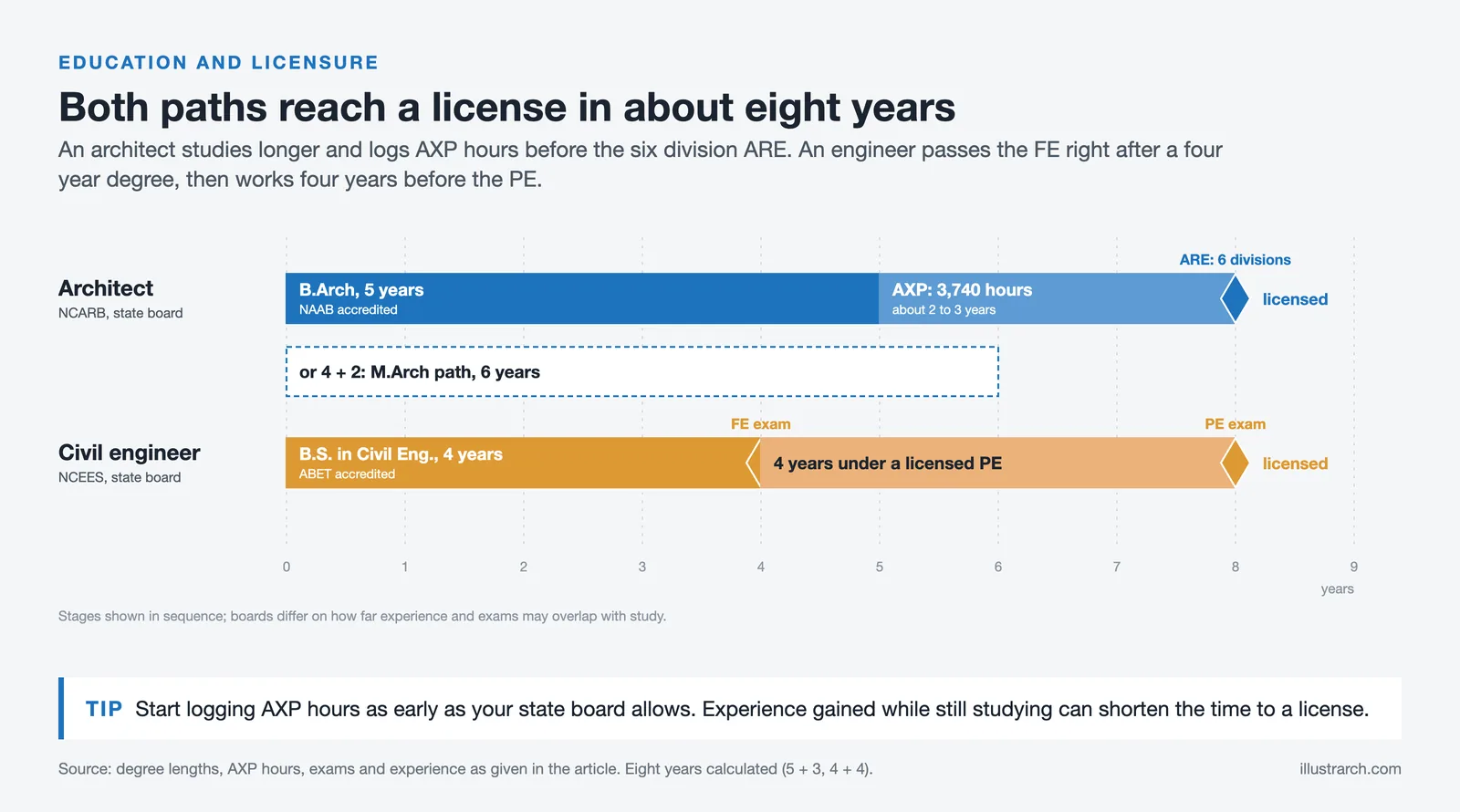
To practice as a licensed architect in the United States, you need a degree from a program accredited by the National Architectural Accrediting Board (NAAB), completion of the Architectural Experience Program (AXP) administered by NCARB, and a passing score on the Architect Registration Examination (ARE). The most common paths are a five-year Bachelor of Architecture (B.Arch) or a four-year undergraduate degree followed by a two-year Master of Architecture (M.Arch). If you are weighing your education options, our guide to best schools for architecture covers accredited programs across the country.
Architects focus on spatial design, building codes, zoning regulations, and client communication. Creativity drives the profession, but it is always balanced against budget constraints, site conditions, and regulatory requirements. The American Institute of Architects (AIA) describes the architect as the primary link between a client’s vision and the construction team’s execution.
💡 Pro Tip For the full picture including education paths, licensure and career progression, see our detailed architect vs engineer guide.
If you are deciding between architecture and engineering, spend a day shadowing professionals in each field. The daily experience is very different: architects often split time between client meetings, design reviews, and site visits, while engineers spend more hours on calculations, simulations, and technical coordination. Seeing the rhythm of each job firsthand will tell you more than any salary chart.
What Does an Engineer Do in Construction?

Engineers in the building industry fall into several disciplines, including civil, structural, mechanical, and electrical engineering. A civil engineer plans and supervises infrastructure projects like roads, bridges, drainage systems, and site grading. A structural engineer calculates load paths, sizes beams and columns, and ensures the building can safely resist gravity, wind, and seismic forces. Mechanical engineers handle HVAC, plumbing, and fire protection systems, while electrical engineers design power distribution, lighting, and low-voltage systems.
The engineering path typically starts with a four-year Bachelor of Science in a specific engineering discipline. After graduation, engineers pass the Fundamentals of Engineering (FE) exam to become an Engineer in Training (EIT). With four years of progressive experience, they sit for the Principles and Practice of Engineering (PE) exam to earn a Professional Engineer license. The National Society of Professional Engineers (NSPE) oversees ethical standards and advocacy for the profession.
Engineers divide their time between analytical desk work and field inspections. A structural engineer might spend the morning running load calculations, then visit a construction site in the afternoon to verify that foundations match specifications. Communication with architects, project managers, and contractors is constant, because technical details must align with the overall design intent.
🎓 Expert Insight
“The engineer’s first problem in any design situation is to discover what the problem really is.”
Henry Petroski, Professor of Civil Engineering, Duke University
Petroski’s observation highlights a core difference between the two professions. While architects start with a vision, engineers start with a constraint. Their job is to identify risks and solve technical problems before construction begins, not after.
Architect vs Civil Engineer: Education Compared
The architect vs civil engineering comparison often starts with education, and for good reason. The two tracks diverge early and stay separate throughout a career. Architecture programs emphasize design studios, building history, theory, and visual communication. Engineering programs focus on physics, calculus, mechanics of materials, fluid dynamics, and systems analysis.
An architecture degree takes five to seven years depending on the path (B.Arch or 4+2 M.Arch), plus roughly two to three years of supervised experience through AXP. Engineering degrees take four years, with an additional four years of work before the PE exam. Both paths require passing a multi-division licensing exam, though the specific exams differ completely.
One question that comes up frequently is whether an architect can also be an engineer. The answer is rarely in practice. While architectural engineering exists as a distinct discipline (blending building systems design with architectural knowledge), very few professionals hold both an architecture license and a PE license. If you are interested in how these two fields intersect, our article on the role of structural engineering in home construction explains the overlap.
Comparison of Architect vs Engineer Education and Licensing
The following table summarizes the key differences in education, experience, and licensing requirements:
| Category | Architect | Civil Engineer |
|---|---|---|
| Typical Degree | B.Arch (5 years) or M.Arch (4+2 years) | B.S. in Civil Engineering (4 years) |
| Accrediting Body | NAAB | ABET |
| Experience Requirement | AXP (3,740 hours, approx. 2-3 years) | 4 years under a licensed PE |
| Licensing Exam | ARE (6 divisions) | FE + PE exams |
| Core Focus | Design, aesthetics, spatial planning | Structural safety, site engineering, infrastructure |
| Key Software | Revit, AutoCAD, SketchUp, Rhino | AutoCAD Civil 3D, SAP2000, ETABS, STAAD |
| Regulatory Body (US) | NCARB / State Boards | NCEES / State Boards |
⚠️ Common Mistake to Avoid
Many people assume that architects and civil engineers are interchangeable on a building project. They are not. In most US jurisdictions, only a licensed architect can sign and seal architectural drawings for buildings intended for human occupancy, and only a licensed Professional Engineer can stamp structural, mechanical, or electrical engineering documents. Hiring the wrong professional for the wrong scope can create legal liability and code compliance problems.
Architect Salary vs Engineer: How Pay Compares

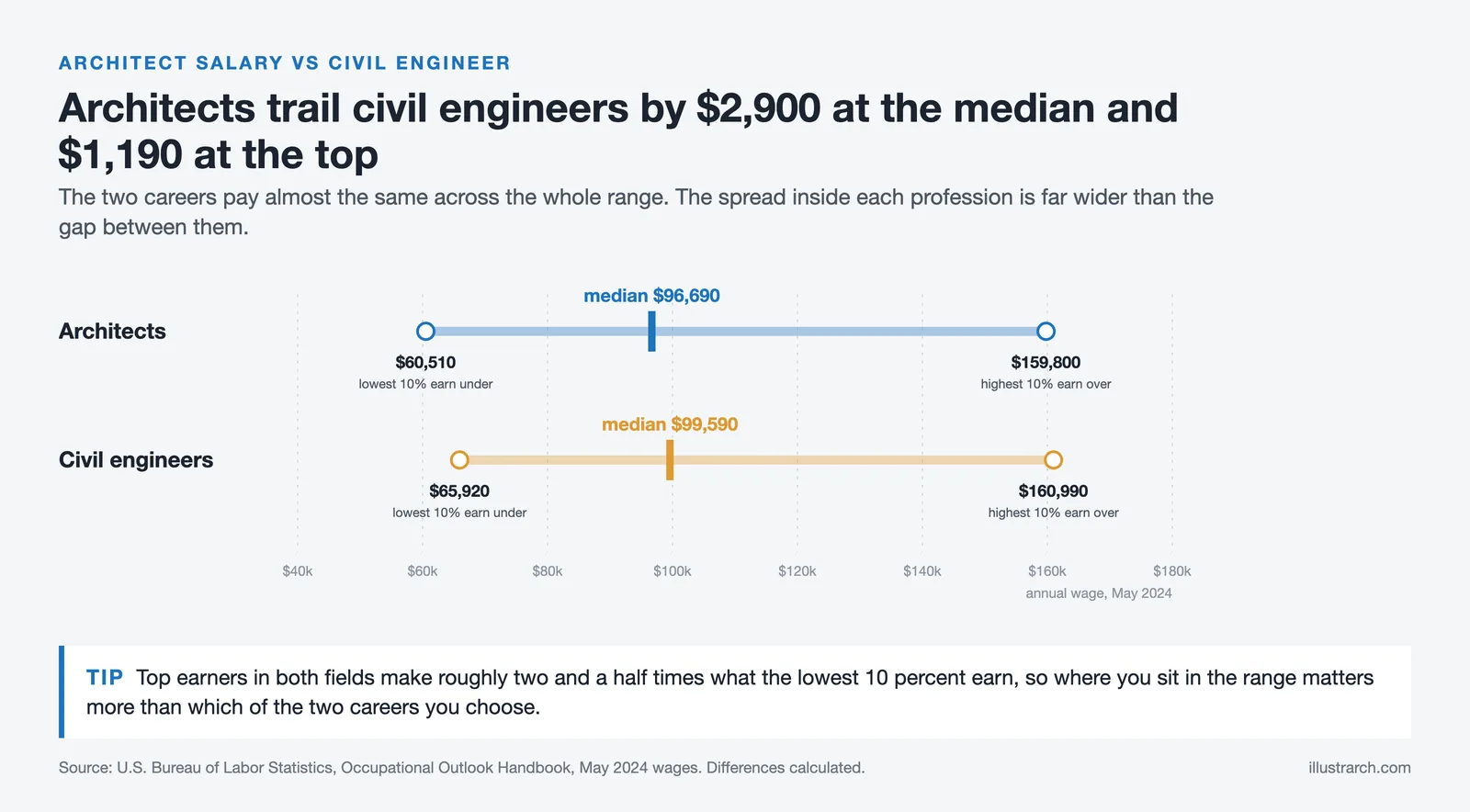
The architect salary vs engineer comparison is one of the most searched topics for students choosing between these two careers. According to the U.S. Bureau of Labor Statistics (BLS) data for May 2024, the median annual wage for architects was $96,690. Civil engineers earned a median of $99,590 in the same period. The difference is relatively small at the median, but it widens at the extremes: the top 10% of architects earned over $159,800, while the top 10% of civil engineers exceeded $160,990.
When you compare architect vs engineering salaries across all engineering disciplines, the picture shifts further. Mechanical engineers earned a median of $102,320 (BLS, May 2024), electrical engineers earned $111,910, and petroleum engineers topped the list at $141,280. Architecture salaries tend to sit below most engineering specializations, partly because architecture firms operate on tighter fee margins than engineering consultancies.
Location also plays a major role. Architects in California earn the highest mean wages nationally at $120,780, while architects in lower-cost states may earn closer to $80,000. For a deeper breakdown by career stage, our architecture career salaries guide covers entry-level through principal-level compensation.
🔢 Quick Numbers
- Median architect salary: $96,690 per year (U.S. Bureau of Labor Statistics, May 2024)
- Median civil engineer salary: $99,590 per year (U.S. Bureau of Labor Statistics, May 2024)
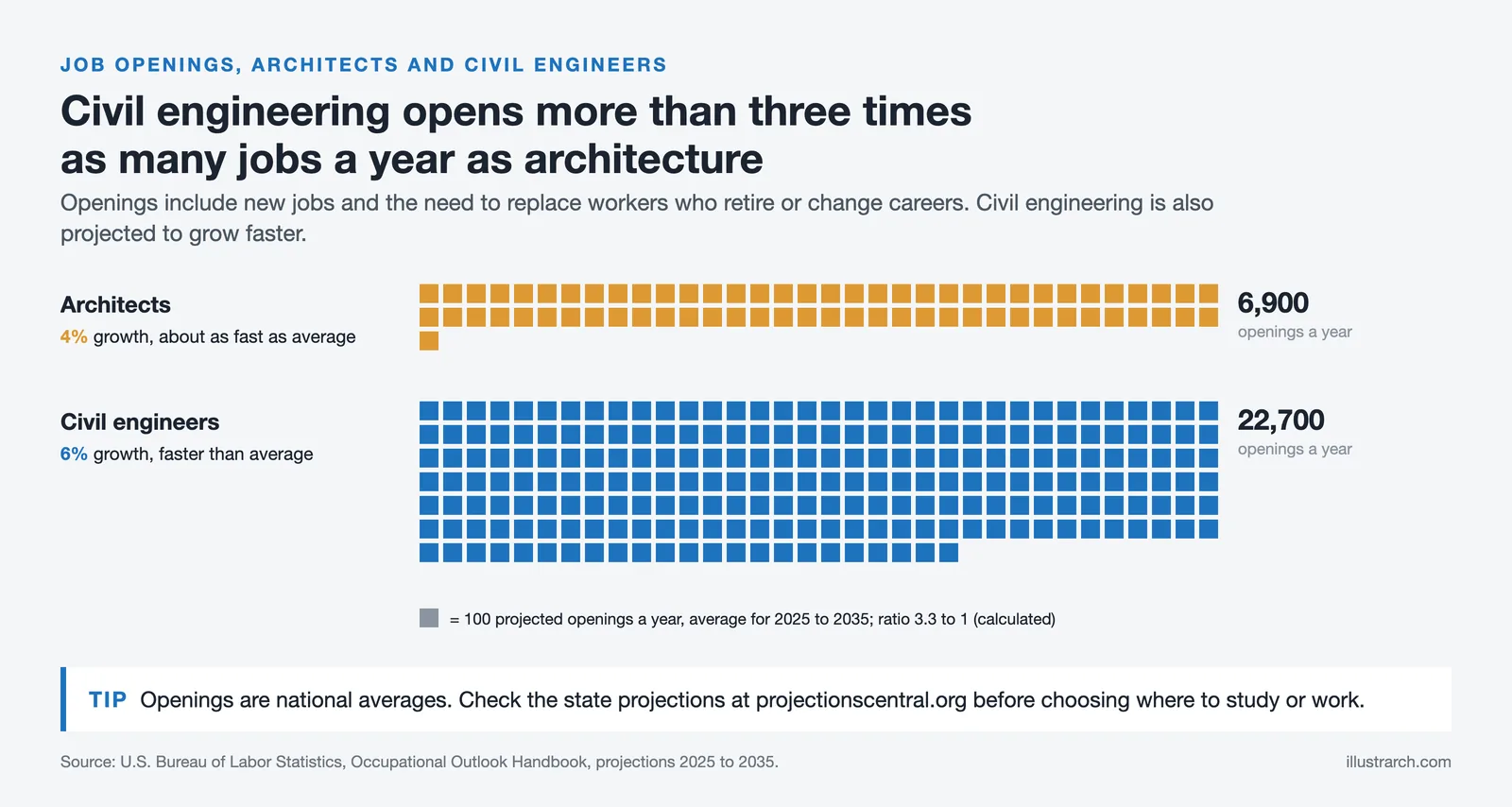
- Projected architect job growth: 4% from 2025 to 2035, with approx. 6,900 annual openings (BLS)
- Projected civil engineer job growth: 6% from 2025 to 2035, with approx. 22,700 annual openings (BLS)
How Do Architects and Engineers Work Together?
On any building project larger than a simple single-family home, architects and engineers work as a team. The architect typically serves as the lead designer and primary client contact. Once the architectural design reaches a certain stage, structural, mechanical, electrical, and civil engineers review the plans and develop their own discipline-specific documents.
This collaboration is iterative. An architect might propose a large cantilevered roof, and the structural engineer will determine the steel or concrete framing required to make it work. If the structural solution is too costly or physically impossible, the architect adjusts the design. The same back-and-forth happens with mechanical engineers (can the HVAC system fit in the ceiling plenum?) and civil engineers (does the site grading direct stormwater away from the building?). For more on how structural engineers contribute to this process, see our article on structural expression in architecture, which examines how Gustave Eiffel’s engineering shaped one of the world’s most iconic structures.
Building Information Modeling (BIM) has made this collaboration more efficient. When all disciplines work in a shared digital model, conflicts between systems, such as a duct running through a beam, can be caught before construction begins. Our article on combining AI, BIM, and advanced simulation tools covers how these technologies are changing the engineer vs architect workflow.
Video: Architect vs Engineer Differences Explained
Architect Andrew Mikhael breaks down how architects and engineers differ in their roles, and how to get the most value from working with both professionals on a building project.
💡 Pro Tip
When hiring for a residential project, many homeowners ask whether they need an architect, an engineer, or both. A good rule of thumb: if the project involves changing the appearance, layout, or use of a space, start with an architect. If it involves structural modifications like removing a load-bearing wall, adding a second story, or fixing a foundation issue, you need a structural engineer. For most renovations and new builds, you will need both.
Architect vs Engineer Difference: Which Career Is Right for You?

Choosing between an architect and engineer career depends on what motivates you. If you are drawn to visual thinking, client interaction, and shaping how people experience a space, architecture is likely a better fit. If you prefer solving math-heavy problems, working with physical forces, and ensuring safety through analysis, engineering will feel more natural.
From a practical standpoint, engineering offers a wider range of specializations and slightly higher median pay. The engineering job market is also larger: the BLS projects about 22,700 annual openings for civil engineers alone, compared to roughly 6,900 for architects. Architecture, on the other hand, offers more creative autonomy and a direct relationship with the final built product. Many architects describe the satisfaction of walking through a building they designed as the most rewarding part of the job.
There is also the question of career flexibility. Architects who want to shift direction can move into urban planning, interior design, real estate development, or construction management. Engineers have equally broad options, including project management, forensic engineering, code consulting, and academic research. Our careers in architecture guide covers paths beyond traditional practice, and our article on alternative jobs for architects lists 15 options outside conventional firm work.
🏗️ Real-World Example
Apple Park (Cupertino, 2017): The design of Apple’s headquarters required architect Foster + Partners and engineering firm Arup to work in lockstep for over five years. The 2.8-million-square-foot ring-shaped building features the world’s largest panels of curved glass, each requiring custom structural engineering to meet California’s seismic codes. The project demonstrates that large-scale architecture is impossible without deep architect-engineer collaboration from day one.
Final Thoughts
✅ Key Takeaways
- Architects focus on design, aesthetics, and spatial experience. Engineers focus on structural safety, technical systems, and material performance.
- Education paths diverge early: architecture requires a NAAB-accredited degree and the ARE, while engineering requires an ABET-accredited degree, the FE exam, and the PE exam.
- Median salaries are close (architects at $96,690 vs. civil engineers at $99,590, BLS May 2024), but engineering specializations like electrical and petroleum engineering pay significantly more.
- Both professions are growing, though engineering offers a larger overall job market with more annual openings projected through 2035.
- On real projects, architects and engineers work as a team. Neither profession can deliver a finished building alone.
The architect vs engineer debate is not about which profession is better. Each one solves a different part of the same problem: creating buildings that are safe, functional, and worth inhabiting. If you are at the start of your career, the best move is to learn what each profession actually does on a daily basis, because the work itself, not the job title, is what will keep you engaged for decades. For students still exploring, our guide to the cost of becoming an architect breaks down tuition, exam fees, and the full financial picture.
Salary figures cited in this article are approximate and vary by region, employer, and individual qualifications. Data sources include the U.S. Bureau of Labor Statistics Occupational Employment and Wage Statistics (May 2024). Always consult multiple sources and consider your local market conditions when evaluating compensation.









Can You Become a Licensed Architect Through Experience Only?
Twenty-one US jurisdictions let candidates qualify for licensure with documented experience instead...
 Sinan Ozen5 Mins read

InDesign Alternatives for Architects: 6 Tools That Handle Portfolios and Boards
Adobe InDesign is still the default layout tool in architecture, but the...
Furkan Sen7 Mins read

How to Get Work Experience in Architecture Before Graduation
Waiting on one summer internship is the slowest way into practice. This...
Sinan Ozen6 Mins read

What It’s Like Working as an Architect: 5 Things Architecture School Doesn’t Teach You
Architecture school teaches design. Practice runs on construction documents, fee phases, consultant...
Furkan Sen7 Mins read


Leave a comment