

Greek and Roman Classical Architecture
Greek and Roman classical architecture shaped the foundations of Western design through two contrasting yet complementary approaches. Greek builders perfected the post-and-lintel system, creating temples of mathematical precision adorned with Doric, Ionic, and Corinthian columns. Roman architects pushed beyond these limits, introducing concrete, the true semicircular arch, and monumental domes that transformed interior space. From the Parthenon's sculptural exterior to the Pantheon's breathtaking rotunda, Greco-Roman architecture represents over a millennium of innovation.
 Elif Ayse Sen26 January 202618 Mins read1.6k

Table of Contents Show
Greek and Roman Classical Architecture: Origins, Key Differences, and Lasting Legacy
Greek and Roman classical architecture refers to the building traditions of ancient Greece (c. 600-146 BC) and Rome (c. 509 BC, 476 AD) that established the foundational design vocabulary of Western construction: columnar orders, symmetrical plans, stone and marble construction, and mathematically derived proportions. These Greco-Roman architecture traditions continue to shape civic, religious, and institutional buildings worldwide.
Greek and Roman architecture represents one of humanity’s most enduring contributions to the built environment. These ancient civilizations, classical architecture pioneers, established design principles centered on symmetry, columns, rectangular windows, and marble construction that continue to shape architectural practice today. From the ancient Greek architecture of Athens to the ancient Roman architecture of the Imperial era, Greco-Roman architecture created a vocabulary of proportion, structural innovation, and artistic expression that architects still reference. Throughout the ages, designers have drawn inspiration from these traditions and incorporated classical values into subsequent architectural movements, from the Renaissance to modern neoclassical buildings worldwide. In the broadest sense, any architecture descended from the ancient Greeks and Romans can be considered classical.
In the continuation of this article, you will find detailed information on the characteristics of classical architecture, how it emerged historically, the key differences between Greek architecture vs Roman architecture, the three orders of Greek columns, famous ancient Greek and Roman buildings, and the profound effects these ancient traditions have had on modern building design worldwide. Whether you are comparing Greek or Roman architecture for academic study or seeking design inspiration, the Greco-Roman architectural tradition offers timeless lessons in proportion, engineering, and artistic expression.

The Emergence of Classical Architecture in History
Classical architecture emerged in the 5th century BC in Greece and continued to flourish through the 3rd century AD in Rome. This classical architecture period shaped the foundations of Western design for over two millennia. Over time, these architectural styles underwent numerous revivals. During the Italian Renaissance, architects devoted themselves to restoring and reinterpreting ancient Roman architecture; this is how Renaissance architects learned Greco-Roman building techniques, studying surviving ruins and ancient texts like Vitruvius’s De Architectura. Centuries later, the excavations at Pompeii reignited interest in Greek architecture across Europe, giving rise to the Greek Revival movement, an architectural style that emphasized Greek proportion and structural soundness.

For a remarkably long period, roughly from the Renaissance until the rise of modernism, classical architectural styles dominated Western architecture. During this significant portion of modern history, architectural endeavors in the West were primarily inspired by ancient antiquity, at least in theory. This enduring influence demonstrates the timeless appeal of ancient Greek and Roman design principles. The Mediterranean architectural heritage that both civilizations shaped became a template for civic and religious buildings across multiple continents and centuries. Today, classicism architecture characteristics, including symmetry, ordered proportions, and column-based facades, remain the default visual language for institutions seeking permanence and authority.
📌 Did You Know?
For the full picture, see our complete guide to architectural styles that shaped history.
The Roman architect Vitruvius wrote De Architectura around 30 to 15 BC, making it the only major architectural treatise to survive from classical antiquity. Rediscovered in 1414 by Florentine humanist Poggio Bracciolini, the text directly inspired Renaissance masters like Brunelleschi, Alberti, and Palladio, and remains a reference for architects studying classical proportion today (Source: Britannica).

Ancient Greek Architecture: Characteristics, Buildings, and Facts
Architecture stands among the greatest artistic disciplines that ancient Greece contributed to the world. Ancient Greek architecture introduced the first standardized norms in building design, which later profoundly influenced Roman architecture and, through it, modern architecture across the globe. Ancient Greek architecture characteristics include strict mathematical proportions, post-and-lintel construction, exterior-focused sculptural programs, and the use of locally sourced limestone and marble.
Ancient Athens architecture reached its peak during the 5th century BC, when legendary ancient Greek architects such as Ictinus and Callicrates designed the Parthenon. The Athenian Acropolis remains the most famous collection of ancient Greek buildings, structures that demonstrate how the Greeks designed their buildings using optical refinements like entasis (a subtle column curvature) to correct visual distortions. Other notable ancient Greece structures include the Temple of Hephaestus, the Theatre of Epidaurus, and temples at Delphi and Olympia.
Among the most important ancient Greek architecture facts: early Greek wooden art and architecture gradually transitioned to stone during the Archaic period (c. 600 BC), and this shift from temporary materials to permanent ones defined the evolution of Hellenic architecture. Ancient Greek homes and architecture beyond temples were comparatively modest; residential structures used mudbrick and timber, while public buildings received the finest marble and limestone. The Greeks also pioneered the concept of the agora, an open public space surrounded by colonnades that served as the social and commercial heart of the city, an urban planning idea that influenced Roman forum design and modern civic squares alike.

💡 Pro Tip
When studying ancient Greek temples on site or through measured drawings, pay close attention to entasis and the slight inward lean of corner columns. These optical corrections are invisible in photographs but become apparent in person or through precise surveys. Understanding them helps you appreciate how Greek architects prioritized the human perceptual experience over strict geometric regularity.

What Are the 3 Greek Orders of Architecture?
During the Classical period, ancient Greek architecture developed three distinctive architectural orders: the Doric, the Ionic, and the Corinthian. These 3 types of columns in ancient Greece each feature unique characteristics that made them stand out in formal public structures such as temples, stadiums, and theaters. Understanding these three orders of Greek architecture is essential for anyone studying classical orders architecture and Greco-Roman column styles.

The Doric order was the earliest of the three kinds of Greek columns, marking a significant turning point in Mediterranean architecture. It represents the transition of monumental construction from temporary materials such as wood to permanent ones, namely stone. Doric columns are characterized by their plain, undecorated capitals and fluted shafts, standing directly on the temple floor without a base. The Parthenon is the most famous example of the Doric order. Doric columns typically have a height-to-diameter ratio of about 6:1, giving them a stocky, powerful appearance compared with the more slender Ionic and Corinthian orders.
The Ionic order introduced more elegant ornamentation, featuring scroll-like volutes on its capitals and more slender proportions than the Doric. The Erechtheion on the Acropolis is a celebrated Ionic example. The Corinthian order, the most ornate of the three types of Greek columns, displays elaborate acanthus leaf designs. While it originated in Greece, this decorative column style became the preferred choice for Roman architects seeking sophistication. According to Vitruvius, the Corinthian capital was first conceived by the sculptor Callimachus, who was inspired by an acanthus plant growing around a basket placed on a young girl’s grave in Corinth.

Greek Column Proportions: A Comparison Table
| Feature | Doric | Ionic | Corinthian |
|---|---|---|---|
| Origin Period | 7th century BC | 6th century BC | 5th century BC |
| Column Base | None (rests on stylobate) | Profiled base with torus | Profiled base, similar to Ionic |
| Capital Design | Plain, circular echinus | Scroll-like volutes | Acanthus leaf basket |
| Height-to-Diameter Ratio | Approx. 6:1 | Approx. 8:1 | Approx. 10:1 |
| Number of Flutes | 20 (shallow) | 24 (deeper, with fillets) | 24 (deeper, with fillets) |
| Famous Example | Parthenon, Athens | Erechtheion, Athens | Temple of Olympian Zeus, Athens |
| Visual Character | Sturdy, masculine | Elegant, refined | Ornate, decorative |
Classical Roman Architecture: Characteristics, Style, and Engineering
For the practical needs of ancient Roman society, Roman architecture borrowed the external language of classical Greek architecture while developing into a distinctly new architectural style. Although Greek and Roman buildings are frequently regarded as one body of classical architecture, Roman innovations in engineering and spatial design set their work apart. Ancient Roman architecture characteristics include concrete construction, semicircular arches, massive domes, barrel and groin vaults, and a preference for monumental interior spaces.

Roman Engineering Innovations: Arches, Domes, and Concrete
Roman architecture flourished throughout the Roman Republic and achieved even greater heights during the Roman Empire, when the vast majority of surviving ancient Roman structures were built. Ancient Roman buildings were typically robust and well-engineered, thanks to innovative materials like Roman concrete and advanced techniques including the arch and the dome. These elements of Roman architecture enabled unprecedented scale in public construction.
After combining elements from Etruscan architecture with Greek influences, including the majority of what we now call classical architecture, the Romans achieved significant architectural originality around the beginning of the Imperial period. Famous Roman architects and engineers transitioned from the trabeated structure focused primarily on columns and lintels to one based on thick walls interrupted by arches, and subsequently domes, both of which underwent remarkable development under Roman engineering. Roman civilization architecture ultimately produced buildings of a scale and complexity unmatched in the ancient world.
Roman concrete, known as opus caementicium, was a mixture of volcanic ash (pozzolana), lime, and aggregate. Modern researchers at MIT and the University of Utah have found that this material actually grows stronger over time as seawater interacts with the volcanic ash, producing mineral crystals that reinforce micro-cracks. This discovery helps explain why structures like the Pantheon dome have survived nearly 2,000 years while modern concrete structures typically require replacement after 50 to 100 years.

🏗️ Real-World Example
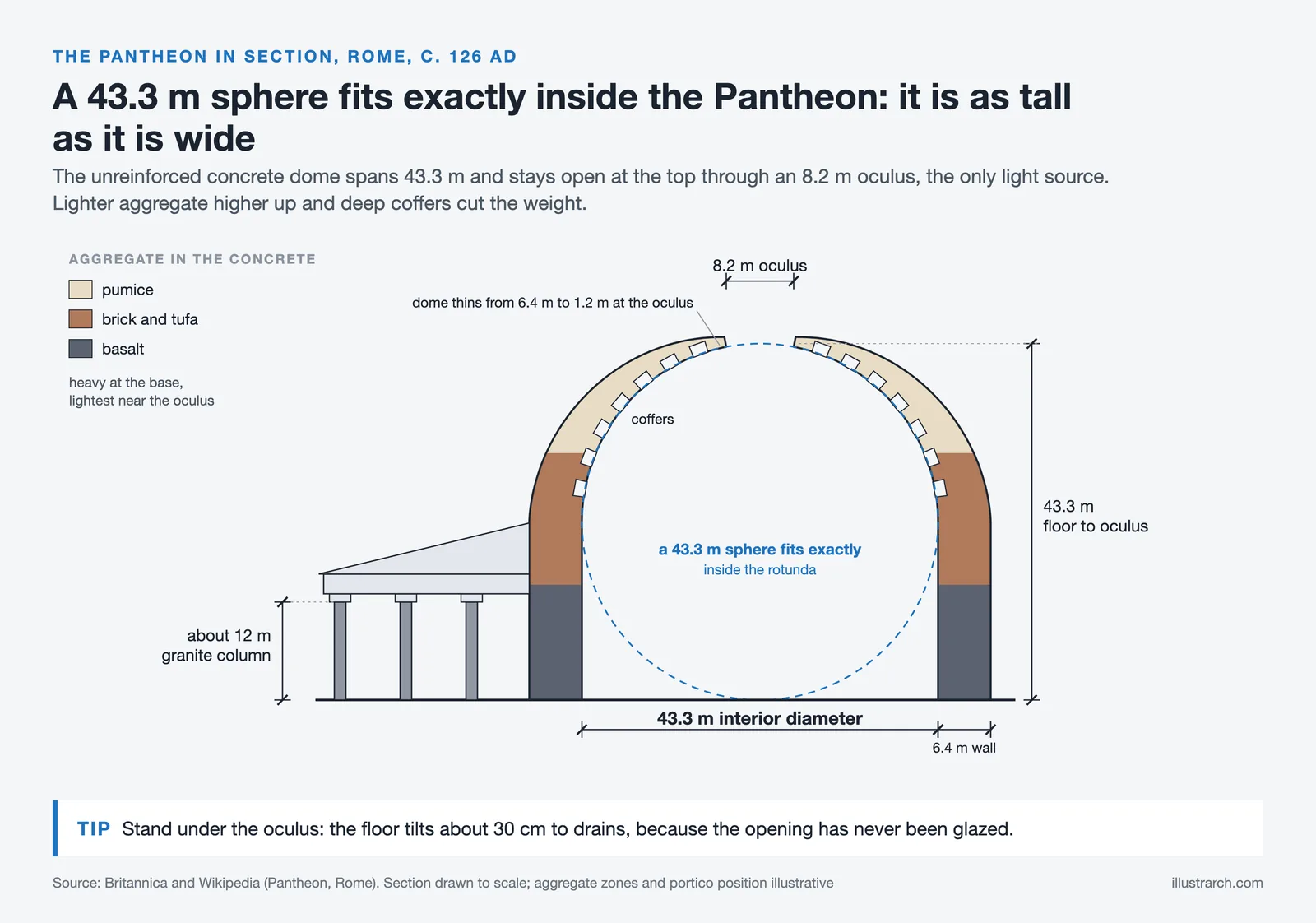
The Pantheon Dome (Rome, 126 AD): At 43.3 meters in diameter, the Pantheon’s unreinforced concrete dome remained the world’s largest for nearly 1,300 years. Roman engineers reduced the dome’s weight by using progressively lighter aggregate (from heavy basalt at the base to lightweight pumice near the oculus) and by incorporating deep coffers into the interior surface. The 8.2-meter oculus at the top is framed by a compression ring of brick and bronze and serves as the building’s sole light source.
Roman Columns: Types and the Adaptation of Greek Orders
With the exception of colonnades, the ancient orders became primarily aesthetic rather than structural elements in Roman architecture. While Greeks favored the Doric and Ionic orders, Romans showed a distinct preference for the more ornate Corinthian order; the Pantheon uses the Corinthian architectural order for its columns, one of the finest surviving examples. The Romans also developed two additional types of Roman columns: the Tuscan (a simplified Doric) and the Composite (combining Ionic and Corinthian elements), expanding the classical vocabulary to five total orders. When comparing Roman columns vs Greek columns, the key difference is that Roman columns served increasingly decorative purposes while Greek columns remained primarily structural.
The five orders were later codified during the Renaissance by architects like Giacomo Barozzi da Vignola in his 1562 treatise Regola delli cinque ordini d’architettura, which standardized the proportional ratios for each order. This treatise, along with Palladio’s The Four Books of Architecture (1570), became essential reference texts for architects through the 18th century and beyond.

Greek vs Roman Architecture: Key Differences in Style and Structure
While ancient Roman and Greek architecture share common foundations, several fundamental differences distinguish these two traditions. Understanding the difference between Greek and Roman architecture helps architects and enthusiasts appreciate how each civilization contributed unique innovations to classical design. The comparison of Roman architecture vs Greek architecture reveals contrasting philosophies about space, structure, and artistic purpose. Here is how Roman architecture differs from Greek architecture across key dimensions:
Construction Methods, Materials, and the Greek Arch vs Roman Arch
Greek architecture relied primarily on post-and-lintel construction, where horizontal beams rest on vertical columns. This trabeated system created the characteristic rectangular forms seen in Greek temples. In contrast, Roman architecture revolutionized building techniques through the invention of concrete and the extensive use of arches. The structural engineering behind the Roman arch allowed builders to span wider openings and distribute weight more efficiently than any Greek method.
The ancient Greek arch existed in limited forms, primarily as corbelled arches in Mycenaean structures like the Lion Gate at Mycenae, but Greeks never adopted the true semicircular arch as a primary structural element. Romans, by contrast, embraced the arch as the foundation of their engineering philosophy. The Roman semicircular arch enabled the construction of aqueducts, triumphal arches, and vast interior vaults. This single innovation allowed Roman and Greek buildings to diverge dramatically in scale and spatial complexity.
Regarding materials, Greeks primarily used locally sourced limestone and marble (marble for decorative elements and limestone for structural components). Romans used a much wider variety of materials including concrete, brick, and stone, often importing marble from across their vast empire for grand architectural projects. The Roman use of opus reticulatum (a diamond-pattern facing for concrete walls) and opus testaceum (brick-faced concrete) allowed them to build quickly and at scale while maintaining a finished appearance.

⚠️ Common Mistake to Avoid
Many students assume that Greek temples were always white marble. In reality, ancient Greeks painted their temples in vivid colors: reds, blues, golds, and greens adorned column capitals, friezes, and pediment sculptures. Traces of this polychromy have been confirmed through ultraviolet fluorescence analysis and pigment residue studies. The all-white appearance we associate with classical Greek architecture is actually the result of centuries of weathering, not an intentional design choice.
Architectural Focus: Exterior Grandeur vs Interior Ambition
Greek buildings honored their gods and emphasized exterior grandeur, with relatively simple interiors. The Parthenon exemplifies this approach: a temple dedicated to the goddess Athena that showcased artistic mastery on its exterior while maintaining a straightforward interior space. Roman structures, meanwhile, represented cultural indulgence and civic pride, with equal attention given to both interior and exterior design. The Pantheon demonstrates this Roman philosophy with its breathtaking interior dome and sophisticated spatial experience. This describes Roman improvements to Greek architecture most clearly: Romans expanded the very concept of what enclosed space could achieve.
Greek vs Roman Architecture: Side-by-Side Comparison
| Aspect | Greek Architecture | Roman Architecture |
|---|---|---|
| Primary Structural System | Post-and-lintel (trabeated) | Arches, vaults, and domes (arcuated) |
| Main Building Material | Limestone, marble | Concrete, brick, stone, imported marble |
| Column Orders Used | Doric, Ionic, Corinthian | All Greek orders plus Tuscan and Composite |
| Role of Columns | Structural (load-bearing) | Mostly decorative (applied to walls) |
| Design Emphasis | Exterior sculptural program | Both interior and exterior |
| Building Types | Temples, theaters, stoas | Temples, baths, amphitheaters, aqueducts, basilicas |
| Spatial Philosophy | Idealized mathematical perfection | Pragmatic engineering for public function |
| Cultural Purpose | Religious devotion, civic identity | Imperial power, public entertainment, infrastructure |
Famous Ancient Greek and Roman Buildings
Several masterpieces exemplify the achievements of Greco-Roman architecture. The Parthenon, built between 447-432 BC on the Athenian Acropolis, showcases Greek emphasis on mathematical proportion and exterior sculptural decoration; it remains the most famous ancient Greek structure. The Pantheon, completed around 126-128 AD, represents the pinnacle of ancient Roman architecture with its massive unreinforced concrete dome, the largest in the world for nearly 1,300 years. The Colosseum (80 AD) demonstrates Roman arch construction innovation, seating 50,000 spectators beneath an exterior displaying all three Greek orders stacked in tiers.
Other notable buildings include the Temple of Hephaestus in Athens, one of the best-preserved ancient Greek buildings, and the Maison Carrée in Nîmes, France, a remarkably intact classical Roman building that inspired neoclassical architects for centuries. The Roman aqueduct system, including the Pont du Gard, further demonstrates how ancient Roman structures served both monumental and practical purposes. The Baths of Caracalla and Roman Forum are additional examples of Roman architecture buildings that defined the ancient built environment. The Theatre of Epidaurus in Greece, designed around 340 BC, remains celebrated for its extraordinary acoustics: a coin dropped at the center of the orchestra floor can be heard clearly from the top row, 60 meters away, a feat that modern acoustic engineers attribute to the limestone seats filtering out low-frequency background noise. If you want to see these buildings in person, start with this guide on where to find the best examples of Greek and Roman architecture.
💡 Pro Tip
If you visit the Colosseum in Rome, look closely at the exterior facade to see how the Romans stacked different column orders by floor: Doric (also called Tuscan) on the ground level, Ionic on the second, Corinthian on the third, and flat Corinthian pilasters on the fourth (attic) level. This “superimposed order” arrangement became a standard Roman technique and was later revived in Renaissance palace design, appearing in buildings like the Palazzo Rucellai by Leon Battista Alberti.
How Greek and Roman Architecture Influences Us Today
Greek and Roman classical architecture established principles that continue to guide contemporary architects. The emphasis on proportion, symmetry, and harmony, codified by Roman architect Vitruvius, remains central to architectural education. Government buildings, museums, and cultural institutions worldwide incorporate classical elements to convey authority and cultural continuity. The New Classical architecture movement demonstrates these principles continue to evolve in contemporary practice.
Greek and Roman architectural styles convey a powerful set of cultural values: authority, permanence, democratic ideals, and intellectual sophistication. This is precisely why figures like George Washington and Thomas Jefferson admired the Greek and Roman architecture style; they saw in these classical forms a visual vocabulary that embodied republican virtue and democratic governance, influencing the design of early American government buildings such as the U.S. Capitol, the White House, and state courthouses. Thomas Jefferson’s own home, Monticello, directly drew on Palladio’s reinterpretation of Roman temple architecture, featuring a Doric portico and a dome inspired by the Pantheon.
Ancient Greek Architecture in America and Modern Roman Style Architecture
The influence of ancient Greek architecture in the United States is visible in buildings from coast to coast. The Lincoln Memorial, the Supreme Court Building, and countless banks and universities feature Greek columns and pediments. Roman architecture in the United States is equally present, seen in domed capitols and grand train stations. Modern buildings influenced by Roman architecture include the National Gallery of Art in Washington, D.C., and Union Station. From the British Museum in London to modern Roman style architecture developments worldwide, Greco-Roman architecture remains the dominant visual language for institutions that seek to project stability.
The features that Greek and Roman architectural styles make possible in modern contexts are extensive. Contemporary architects draw on classical precedent when designing proportional systems, entrance porticos, colonnaded facades, and domed public spaces, architectural works that are directly influenced by Greco-Roman architecture. The ongoing global spread of Western architectural styles owes much to the universal appeal of Greek and Roman design grammar, which continues to evolve through the neoclassical and New Classical movements.
Contemporary practitioners like Robert A.M. Stern and firms associated with the Institute of Classical Architecture & Art (ICAA) demonstrate that classical Greek and Roman design principles remain viable for 21st-century projects. Stern’s residential and institutional work consistently applies Greco-Roman proportions, column orders, and symmetrical plans to modern functional requirements, proving that these ancient traditions are far from museum pieces.

The Vitruvian Legacy: Firmitas, Utilitas, Venustas
No discussion of Greek and Roman classical architecture is complete without addressing the theoretical framework that Vitruvius established in De Architectura. Written around 30-15 BC and dedicated to Emperor Augustus, this ten-volume treatise codified the principles that Greek builders had practiced for centuries and that Roman architects were expanding upon. Vitruvius argued that every building must achieve three qualities: firmitas (structural soundness), utilitas (functional purpose), and venustas (beauty through proportion). This triad remains a cornerstone of architectural design principles taught in schools worldwide.
Vitruvius also documented the proportional systems behind each Greek order and described the ideal architect as someone trained in drawing, geometry, history, philosophy, music, medicine, and law. His emphasis on the relationship between human body proportions and architectural form inspired Leonardo da Vinci’s famous Vitruvian Man drawing and continues to inform mathematical approaches to architectural design.
🎓 Expert Insight
“Architecture depends on Order, Arrangement, Eurythmy, Symmetry, Propriety, and Economy.”
Vitruvius, De Architectura, Book I
These six principles, outlined nearly two thousand years ago, represent the earliest known formal design framework in Western architecture. Vitruvius’s insistence that architects balance aesthetic ambition with structural discipline and economic reality continues to anchor professional practice.
Frequently Asked Questions About Greek and Roman Architecture
What is the main difference between Greek and Roman architecture?
Greek architecture used post-and-lintel construction with exterior emphasis, while Roman architecture introduced concrete, arches, and domes for sophisticated interior spaces. Romans preferred the Corinthian order; Greeks favored Doric and Ionic styles. This core distinction in Greek architecture vs Roman architecture reflects their differing cultural priorities: Greek idealism versus Roman pragmatism.
What are the 3 types of ancient Greek columns?
The three types of columns in ancient Greece are Doric (simplest, no base), Ionic (scroll-like volutes), and Corinthian (acanthus leaf decorations). Each order is distinguished by its column capital design and proportions. Romans later added the Tuscan and Composite orders, expanding the Greek and Roman architecture vocabulary to five classical orders.

How did Roman architecture improve upon Greek designs?
Romans advanced engineering through concrete invention and arch/dome development, enabling larger interior spaces and complex structures like aqueducts and amphitheaters impossible with Greek methods. Roman architecture also introduced vaulted ceilings and multi-story construction techniques that allowed buildings like the Colosseum to seat 50,000 spectators across four levels.
Why is classical architecture still relevant today?
Classical architecture established timeless principles of proportion, symmetry, and harmony. Its visual language conveys authority, making it popular for government buildings and institutions worldwide. Classical elements continue to appear in both traditional and contemporary designs, and organizations like the Institute of Classical Architecture & Art actively promote the tradition.
What features do Greek and Roman architectural styles portray?
Greek and Roman architectural styles portray values of civic order, intellectual refinement, and permanence. Greek ornamentation emphasizes mathematical harmony and human-scaled beauty, while Roman structures convey imperial power and engineering ambition. Together, these Greco-Roman architecture traditions communicate a visual language of stability that governments and cultural institutions continue to adopt.
What were common parts of Greco-Roman architecture?
Common elements of Greco-Roman architecture include columns (Doric, Ionic, Corinthian), pediments, entablatures, friezes, cornices, and symmetrical floor plans. Roman additions include arches, vaults, domes, and concrete foundations. These shared and distinct architectural elements define the classical building style that persists across Western architecture.
Which architectural order does the Pantheon use for its columns?
The Pantheon uses the Corinthian architectural order for its columns. The front portico features massive Corinthian granite columns, each standing approximately 12 meters tall, among the finest examples of Roman adaptation of Greek column styles. The columns were quarried in Egypt and transported by barge across the Mediterranean to Rome, a logistical feat that illustrates the engineering ambition of the Roman Empire.
How did ancient Greek architecture influence us today?
Ancient Greek architecture influences us today through the continued use of columned porticos, triangular pediments, and proportional systems in government buildings, universities, museums, and banks. The democratic associations of Greek design make it a preferred style for civic institutions, particularly in the United States, where buildings with Greek architecture are found in every state. The history of architecture shows a direct lineage from Greek temple facades to modern courthouses and libraries.
Were ancient Greek and Roman buildings originally colorful?
Yes. Both Greek and Roman buildings were painted in vivid polychromatic schemes. Greek temples featured brightly colored friezes, metopes, and pediment sculptures in reds, blues, and golds, while Roman buildings used painted stucco, colorful marble veneers (including purple porphyry and green serpentine), and elaborate mosaic floors. The “white marble” image of classical architecture is a misconception resulting from centuries of paint loss.
✅ Key Takeaways
- Greek architecture established three column orders (Doric, Ionic, Corinthian) and the post-and-lintel structural system, while Roman architects expanded the vocabulary to five orders and introduced arches, domes, and concrete.
- The key philosophical difference lies in spatial emphasis: Greek buildings prioritized exterior sculptural programs, while Roman buildings placed equal importance on interior spatial experience.
- Roman concrete (opus caementicium) was the ancient world’s most important material innovation, enabling structures of unprecedented scale and durability that still stand after nearly 2,000 years.
- Vitruvius’s De Architectura remains the only surviving architectural treatise from antiquity and continues to influence how proportion, symmetry, and function are taught in architectural education.
- Greco-Roman architecture directly inspired the Renaissance, Neoclassical, and New Classical movements, and its design principles are still applied in government buildings, museums, and civic institutions worldwide.
Last updated:
- ancient roman and greek architecture
- classical architecture characteristics
- Classical architecture elements
- classical architecture examples
- classical architecture period
- classical architecture style
- classical greek architecture
- classical roman architecture
- describe roman improvements to greek architecture
- how did roman architecture differ from greek architecture


1 Comment


Restorers Uncover 16th-Century Murals Hidden by Nuns in Villa Silvestri Rivaldi
Conservators in Rome are uncovering 16th-century murals hidden for 300 years inside...
 illustrarch Editoral Team3 Mins read

A 2,500-Year-Old Solar Observatory in Puebla Is the First Group E Complex Found Outside the Maya Area
Archaeologists working for Mexico's INAH have confirmed that two platforms at Teteles...
illustrarch Editoral Team2 Mins read

Donald Insall, the Conservation Architect Who Led Windsor Castle’s Restoration, Dies at 100
Donald Insall, the British architect who turned conservation into a planning discipline...
illustrarch Editoral Team2 Mins read
New Digging Season at the Mieza Gymnasium Uncovers Alexander’s School Complex
New digs at Mieza uncover teaching halls and mosaic banquet rooms at...
illustrarch Editoral Team2 Mins read


This article talks about Greek and Roman architecture. It mentions how these styles are still important today. I learned some differences between the two, like construction methods and styles. The pictures are nice too.