

Angkor Wat: How Khmer Architects Built a Stone Map of the Universe
Angkor Wat is more than the world's largest religious monument. The 12th-century Cambodian temple translates Hindu cosmology into stone, with measurements, alignments, and sculpted galleries that map the universe and mark the passage of solar and lunar time.
 Sinan Ozen30 April 20266 Mins read254
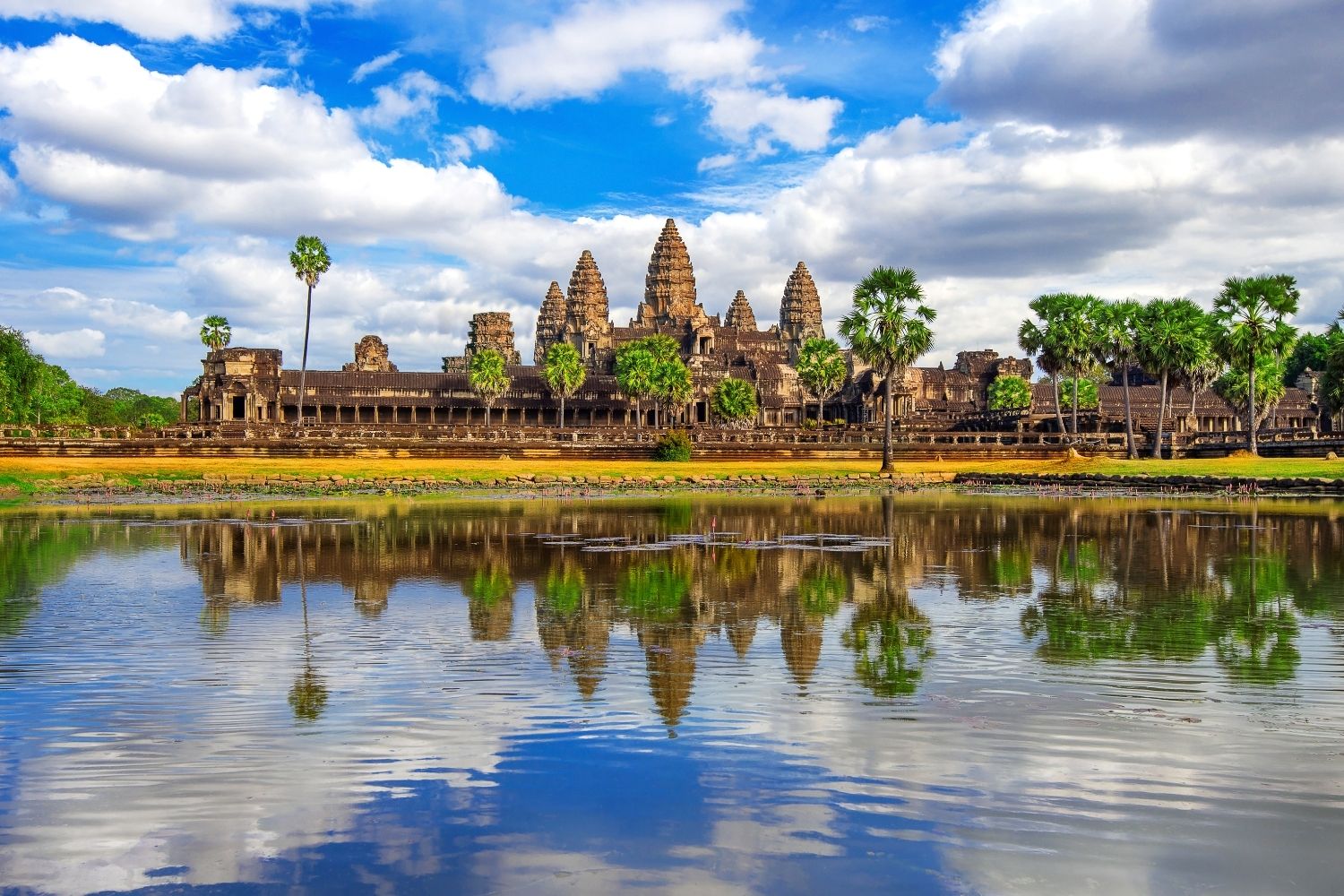
Table of Contents Show
Angkor Wat is a 12th-century Hindu temple in Siem Reap, Cambodia, built between 1113 and 1150 CE under King Suryavarman II. As the largest religious monument ever constructed, it spans over 162 hectares and translates Hindu cosmology into architecture, with central towers representing Mount Meru, a moat symbolizing the cosmic ocean, and measurements encoding the four ages of the universe.

What Is Angkor Wat and Where Is It Located?
Angkor Wat sits in the northern Cambodian province of Siem Reap, within the larger 400-square-kilometer Angkor Archaeological Park. The site was once the capital of the Khmer Empire, which dominated mainland Southeast Asia from the 9th to the 15th century. The temple appears on the Cambodian national flag, a rare honor that signals how deeply Angkor Wat is tied to national identity.
The Angkor Wat Hindu temple was originally dedicated to Vishnu before being converted to a Theravada Buddhist site in the late 12th century. Where is Angkor Wat situated within Khmer architectural history? It marks the high point of the classical “temple-mountain” tradition, combining a stepped pyramid form with extensive galleried enclosures, and stands alongside the foundational systems explored in our overview of eight ancient architectural styles that shaped our world.
💡 Pro Tip
When studying Angkor Wat’s architecture on site, enter from the eastern gate rather than the standard western causeway. The eastern approach is far less crowded and gives a clearer view of how the central five towers stack against the sky, which is the single most important formal move in the entire complex.

How Khmer Architects Translated Cosmology into Stone
The design logic of Angkor Wat begins with a simple idea drawn from Hindu cosmology: the universe is centered on Mount Meru, a sacred mountain surrounded by continents and oceans. Khmer architects built that idea at scale, creating one of the defining moments in the broader history of architecture from ancient to modern. The five central towers form a quincunx representing Meru’s five peaks, the surrounding galleries stand in for mountain ranges, and the 190-meter-wide moat reads as the cosmic ocean.
This is not a loose metaphor. Research published in the academic journal Buildings (MDPI, 2025) shows the complex follows a Hindu grid system based on the Vāstu Śāstra. Architects used a unit called the Khmer cubit, and the lengths of causeways, galleries, and enclosures correspond to numerically significant cosmological cycles.
Mount Meru as the Central Architectural Idea
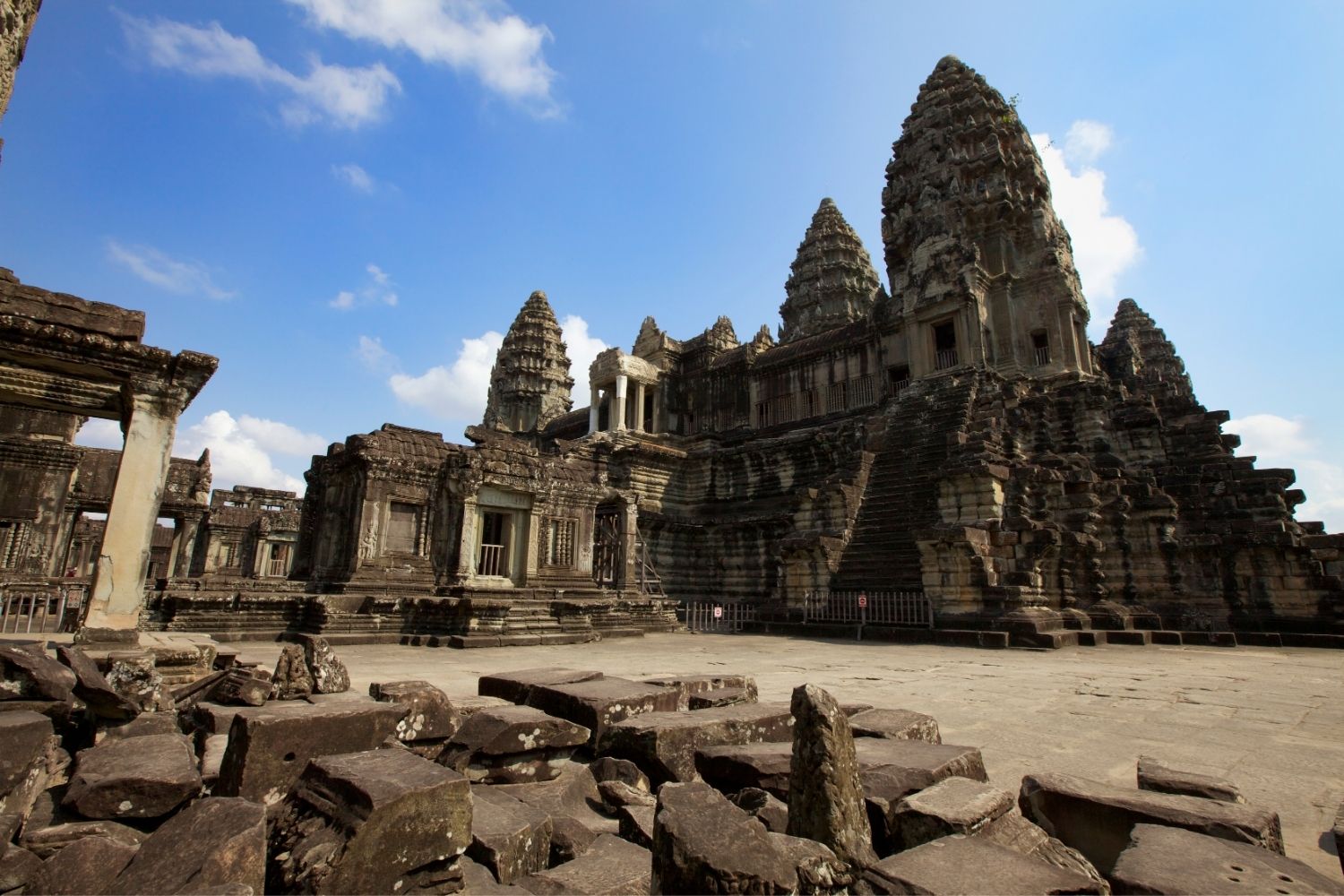
Walk toward the central sanctuary and the building reads as a vertical journey. Visitors cross the moat, pass through the outer enclosure, climb successive galleries, and reach the upper terrace, where the central tower rises more than 65 meters above the surrounding plain. Each level corresponds to a higher realm of existence in the Hindu cosmological model.
The orientation reinforces this. Most Khmer temples face east, but Angkor Wat faces west, an unusual choice linked to Vishnu (associated with the setting sun) and to the temple’s possible secondary function as the funerary monument of Suryavarman II.

Encoding Time in the Building’s Measurements
The temple is also a clock. Art historian Eleanor Mannikka, in Angkor Wat: Time, Space, and Kingship, demonstrated that key distances correspond to the lengths of the four yugas, the cosmological ages of Hindu thought. The width of the moat in cubits matches the Kali Yuga; the distance from the western causeway to the central tower matches the Treta Yuga. Walking inward is a physical journey backward through cosmic time.
🎓 Expert Insight
“In the central sanctuary, Vishnu is not only placed at the latitude of Angkor Wat, he is also placed along the axis of the earth.”, Eleanor Mannikka, art historian, University of Michigan
This observation captures the level of precision the Khmer builders worked at. The central image was positioned not just symbolically but geographically, locking the building into a specific point on the surface of the earth and on the celestial map above it.
The Architectural Layout of Angkor Wat in Cambodia
The plan of Angkor Wat is a series of concentric rectangles. From the outside in, a visitor passes the moat, the outer wall, two long galleries with bas-reliefs, an inner courtyard known as the preau cruciforme, and finally the central sanctuary on its raised pyramid platform. Each enclosure is smaller and higher than the last, producing a controlled compression of space toward the center.

The Moat, Causeway, and Outer Enclosure
The rectangular moat measures roughly 1.5 by 1.3 kilometers and was originally about 190 meters wide. It is one of the most ambitious water features in the ancient world, both a cosmological symbol and an engineering device that helped stabilize the sandy ground beneath the temple.
The Bas-Reliefs of the Third Gallery
The third gallery contains over 1,000 square meters of bas-reliefs. The southern gallery shows the Battle of Kurukshetra from the Mahabharata; the eastern gallery contains the famous Churning of the Sea of Milk, in which gods and demons rotate Mount Mandara to produce the elixir of immortality. The placement of these scenes is tied to the symbolic functions of each cardinal axis.
🏗️ Real-World Example
Churning of the Sea of Milk relief, Eastern Gallery (12th century): This bas-relief runs nearly 49 meters and depicts 92 demons and 88 gods pulling on the serpent Vasuki, wrapped around Mount Mandara. It works simultaneously as religious narrative, political allegory of the king’s role in maintaining cosmic order, and an architectural device that organizes movement along the gallery’s full length.
Astronomical Alignments at Angkor Wat Temple
Angkor Wat is also aligned to celestial events. The central tower is positioned so that, viewed from inside the western entrance, the sun rises directly above it on the spring equinox. Researchers have identified at least eighteen separate astronomical alignments in the temple’s geometry, including markers for the summer and winter solstices. Khmer architects were not only designing a stage for ritual but also a working observatory and calendar.
📌 Did You Know?
Angkor Wat was constructed using an estimated 5 to 10 million sandstone blocks, each weighing on average 1.5 tons. The stones were quarried from Mount Kulen roughly 50 kilometers away and floated to the site along a network of canals, a logistical operation only confirmed by satellite imagery in the 21st century.
From Hindu Temple to Buddhist Pilgrimage Site
The Angkor Wat Hindu temple did not stay Hindu. Within roughly a century of its construction, the Khmer Empire shifted toward Mahayana Buddhism under Jayavarman VII and later toward Theravada Buddhism, which remains Cambodia’s principal religion. Vishnu statues were replaced or supplemented by Buddha images, and the temple became a major Buddhist pilgrimage destination. This long sacred continuity is part of what makes Angkor Wat such a powerful case study in architectural heritage and its role in shaping the future. The APSARA National Authority documents 41 inscriptions on the pillars of Preah Poan recording pilgrimages between the 16th and 18th centuries.

Conservation and the Modern Status of Angkor Wat
The site was inscribed on the UNESCO World Heritage List in 1992 and simultaneously placed on the List of World Heritage in Danger. According to UNESCO’s official Angkor World Heritage Site listing, the broader park covers approximately 400 square kilometers and contains the remains of multiple Khmer capitals from the 9th to the 15th century. Angkor was removed from the in-danger list in 2004.
Conservation today is coordinated by the International Coordinating Committee for the Safeguarding and Development of the Historic Site of Angkor (ICC-Angkor), with technical work by teams from France, Japan, India, Germany, the United States, and others. The Cambodian government works through APSARA, established in 1995, which now employs around 4,000 people and manages the park alongside roughly 125,000 residents in 112 villages.
⚠️ Common Mistake to Avoid
Many guidebooks describe Angkor Wat as a Buddhist temple. This is only half right. It was built as a Hindu temple dedicated to Vishnu and only later converted to Buddhist use. Treating it as Buddhist from the start misses the entire Hindu cosmological program that gives the architecture its meaning.
Why Angkor Wat Still Matters to Architects Today
Angkor Wat is one of the clearest surviving examples of an architecture in which symbolic content, geometry, structure, and ritual movement were designed as a single integrated system. Modern architects rarely work this way; meaning is usually layered on top rather than built into the dimensions of the plan. The lessons are concrete: movement through space can be choreographed as narrative; site orientation can encode astronomical information; plan geometry can carry symbolic meaning that survives the original belief system. These principles continue to shape contemporary religious architecture and sacred spaces, and the temple still informs architectural inspirations drawn from around the world.
✅ Key Takeaways
- Angkor Wat in Siem Reap, Cambodia, is the largest religious monument ever built and was originally a Hindu temple to Vishnu.
- Its plan translates Hindu cosmology directly into architecture: central towers as Mount Meru, galleries as mountain ranges, moat as cosmic ocean.
- Key dimensions, measured in Khmer cubits, encode the four cosmological ages (yugas) of Hindu thought.
- The temple is aligned with at least eighteen astronomical events, including a sunrise alignment with the central spire on the spring equinox.
- It was converted to a Buddhist site in the late 12th century and has functioned continuously as a sacred space ever since.
- Angkor Wat is a UNESCO World Heritage Site, managed by APSARA and conserved through the international ICC-Angkor framework.






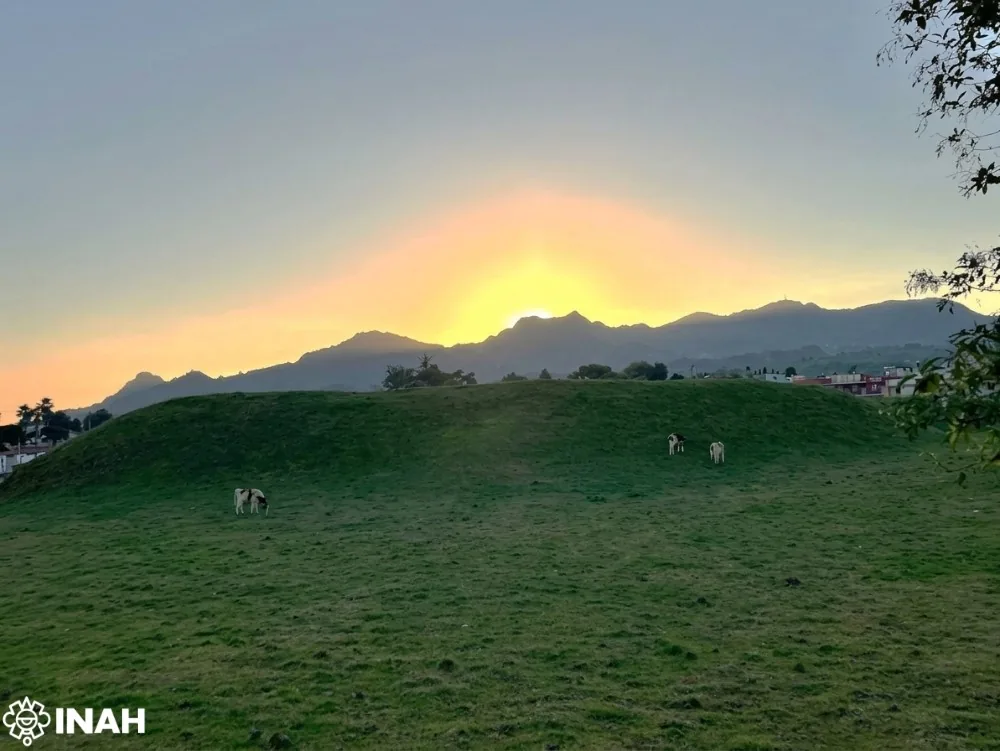
A 2,500-Year-Old Solar Observatory in Puebla Is the First Group E Complex Found Outside the Maya Area
Archaeologists working for Mexico's INAH have confirmed that two platforms at Teteles...
 illustrarch Editoral Team2 Mins read

Donald Insall, the Conservation Architect Who Led Windsor Castle’s Restoration, Dies at 100
Donald Insall, the British architect who turned conservation into a planning discipline...
illustrarch Editoral Team2 Mins read
New Digging Season at the Mieza Gymnasium Uncovers Alexander’s School Complex
New digs at Mieza uncover teaching halls and mosaic banquet rooms at...
illustrarch Editoral Team2 Mins read
A Record El Niño Threatens More Than 10,000 Adobe Heritage Sites on Peru’s Coast
With a possibly record-breaking El Niño under way, Peru's coastal adobe heritage...
illustrarch Editoral Team2 Mins read


Leave a comment