

The Gond School
The Gond School in Maharashtra integrates formal education with tribal culture, serving as a multifunctional space for 200 students and the local community.
 illustrarch Editoral Team24 June 20192 Mins read499


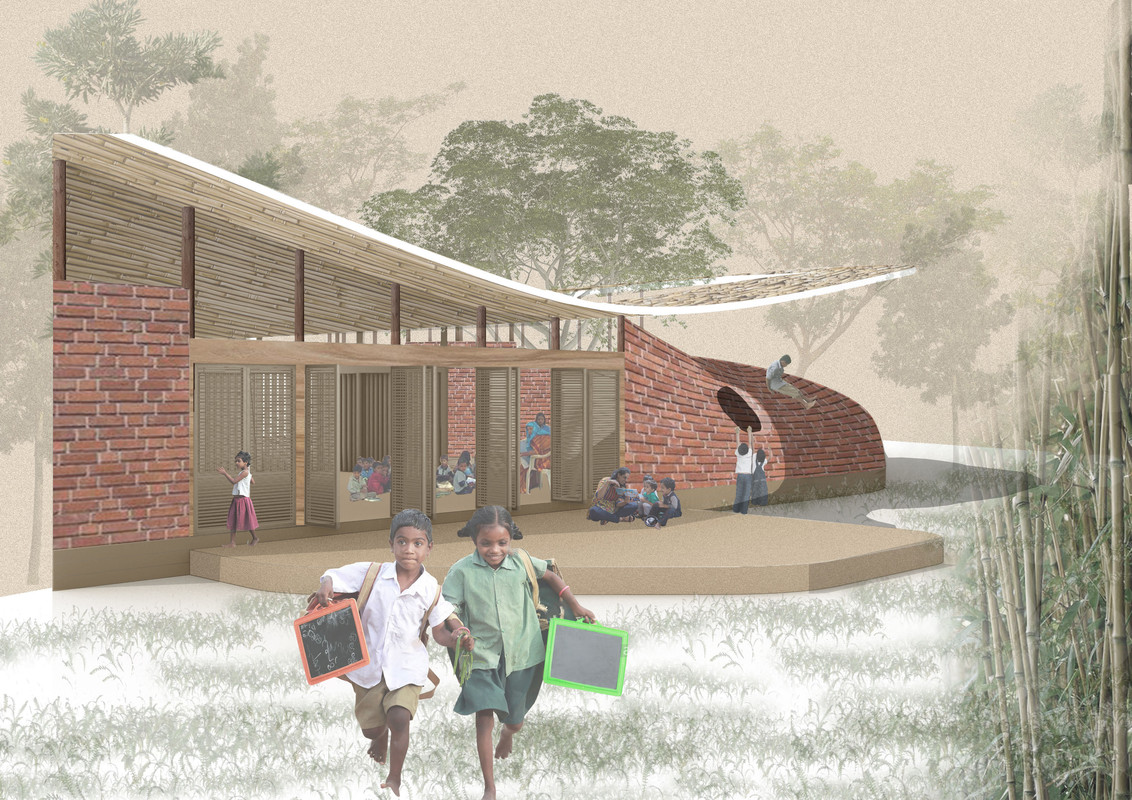


The Gond School in the Gadchiroli District of Maharashtra, India, reimagines a rural school as a place where formal education and living tribal culture share the same roof. Designed by STaND Design – Architecture + Design Studio, the project answers a brief for a multi-functional educational space serving 200 students aged 5 to 11, while doubling as an interactive venue for the local community after school hours. The site was chosen in a region where education is hard to reach, and the architecture treats access itself as a design problem rather than an afterthought.
Central India holds roughly 75% of the country’s tribal population, and Maharashtra alone counts over 10.5 million. The Gond, concentrated in this state, live in hilly and difficult terrain that keeps schooling out of reach, with literacy rates around 4%. Their art and crafts are renowned worldwide and their way of life is distinct. STaND Design’s vision rejects a hard boundary between education and culture, proposing instead a continuum where children absorb native values and gain mastery over local arts and crafts, so a rich heritage continues alongside conventional learning.
A school without boundaries
The plan houses two primary functions: a workshop for unconventional, hands-on learning and classrooms for conventional study. Shared spaces fold the wider community into daily school life, exposing children to the local panchayat for civics, the bazaar for trade and commerce, folklore for performance and communication, and cultivation, where paints are extracted from nature. Taking cues from Gond households and their lifestyle, the structure balances enclosed rooms with open shared areas and is built using locally available materials, an approach that keeps construction affordable and rooted in place.
School design for young children tends to favor daylight, durable low-maintenance surfaces, and a legible plan that small children can move through safely, and a rural project of this kind leans heavily on vernacular building traditions and local labor. Sited on the cusp of two villages, the school pulls the axes of approach through the building to form a street within, which finally opens out toward the river. That gesture turns circulation into a public space and frames the river as the project’s shared horizon. For more on the people and place behind it, see the Gond community and the broader idea of primary education in underserved regions. By weaving school, market, and assembly into one structure, the Gond School argues that a building can teach long after the lessons end.



Herzog & de Meuron Builds Amherst College Student Center Atop Old Foundations
Herzog & de Meuron built a mass-timber student center at Amherst College...
illustrarch Editoral Team2 Mins read
MIT Architecture School Moves Into DS+R-Converted Metropolitan Storage Warehouse
MIT's architecture school has moved into a DS+R-converted 1894 warehouse in Cambridge,...
illustrarch Editoral Team3 Mins read

SENA Tunja Training Center by TAP Arquitectura
TAP Arquitectura's unbuilt competition proposal for SENA in Tunja wraps a 4,400...
illustrarch Editoral Team2 Mins read
Best Software in Architecture School and What to Learn First
A practical look at the best software to learn in architecture school,...
 Elif Ayse Sen6 Mins read


Leave a comment