

ESPERANTO
Esperanto is a thesis project that proposes an inclusive, off-grid architectural design for the Aboriginal community of Culpra Station to foster cultural exchange.
 illustrarch Editoral Team1 August 20192 Mins read470


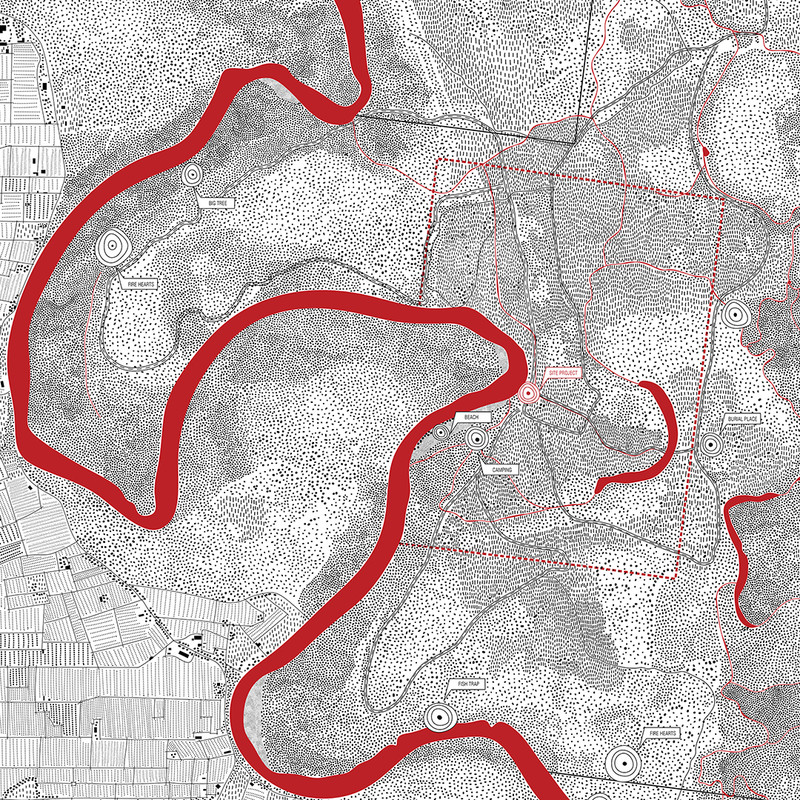

Esperanto is a thesis project by Alessia Macchiavello and Heidi Corti that asks what role architecture can play when a community faces complex cultural and linguistic barriers. Set in the remote Aboriginal community of Culpra Station in New South Wales, Australia, the proposal treats design as a tool for cooperation rather than imposition. The work is framed as a cause for reflection: it studies an environment shaped not only by global-south conditions but by the difficult coexistence of Aboriginal and Western cultures, and the social scar left by the invasion.
The community of Culpra Station was looking for a way to share Aboriginal culture through activities on Country, but it needed facilities to host visitors and draw people in. Esperanto answers that need with an inclusive design approach that tries to connect two different cultures through shared work. It is conceived as a completely off-grid project that the Aboriginal community can build itself using local materials, so that authorship and ownership stay with the people who live there.
Housing as cultural infrastructure
Building in remote settlements raises challenges that mainstream housing models rarely address. Distance from supply chains makes imported materials costly and slow, which is why locally sourced construction and self-build methods carry real weight. An off-grid strategy, where water, power and waste are handled on site, responds to the absence of dense municipal networks and reduces long-term running costs for the community. These are the practical questions any architect must answer when a site sits far from infrastructure.
Just as important is the cultural dimension. The relationship between Aboriginal Australians and their land, often described through the idea of Country, means that buildings are not neutral objects dropped onto a site. Designing alongside the community, rather than for it, lets local knowledge guide how spaces are used, who gathers in them and how visitors are welcomed. The name Esperanto, borrowed from the constructed language meant to bridge peoples, signals this ambition to create a common ground.
By pairing a low-impact, off-grid construction logic with a participatory process, Macchiavello and Corti present housing and gathering space as a form of cultural infrastructure. The project shows how careful, locally rooted design can give a remote community both the facilities it asked for and a renewed platform to share its heritage. You can read more about the wider context of Indigenous Australians and their enduring connection to the land.




Living Typologies by Stela Boldur
Living Typologies by Stela Boldur is a student masterplan for the former...
illustrarch Editoral Team2 Mins read

Residential Architecture Face-Off: Co-Living vs Traditional Apartment for Urban Housing
Co-living and traditional apartments represent two distinct approaches to residential architecture in...
 Furkan Sen8 Mins read

Designing a Liminal Space Where Urban Meets Coastal
The Liminal House by Mcleod Bovell Modern Houses in West Vancouver is...
 Elif Ayse Sen5 Mins read
House in Nakano: A 96 m² Tokyo Architecture Marvel by HOAA
House in Nakano, designed by HOAA, creatively addresses urban density challenges by...
 Bahattin Duran6 Mins read


Leave a comment