

Pixel Effect
Pixel Effect presents a modular approach to urban apartment design in Vienna, emphasizing individuality and sustainability through stackable living units and green spaces.
 illustrarch Editoral Team29 August 20191 Mins read389
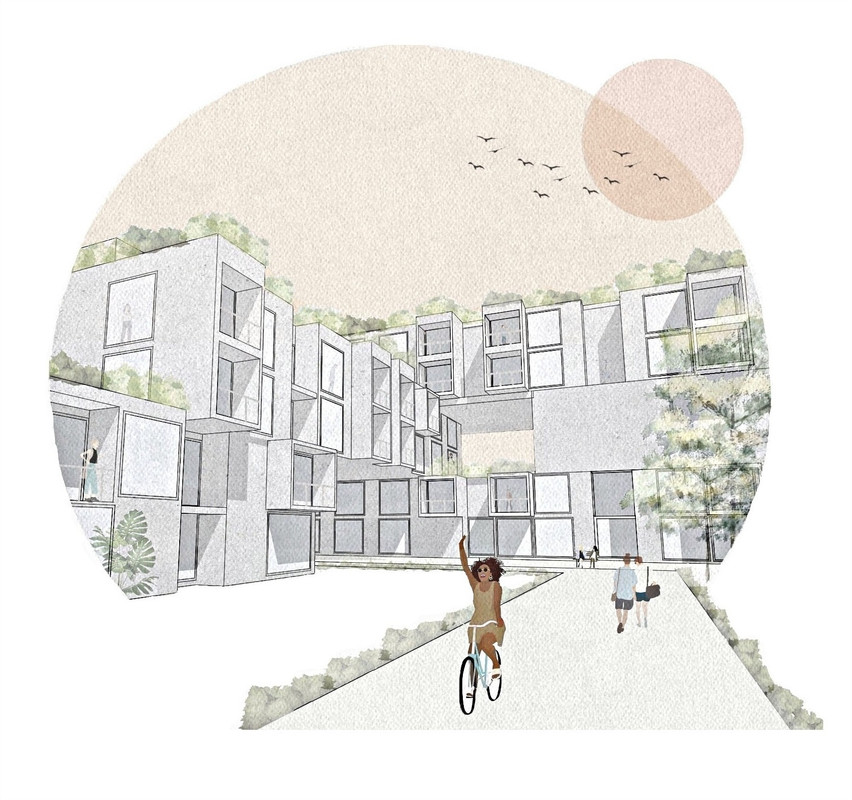


Pixel Effect reimagines the urban apartment block as a stack of living modules in Vienna, Austria, where architect Sinem Firat pursued a concept built around the idea of “living plus.” The study began as a group exercise with four people defining a shared concept, after which each participant designed an individual residential building. The starting move was the dissolution of the massive block of flats, breaking a heavy form into smaller, legible parts that read as a community rather than a monolith.
The overall composition stacks a 16-module field, measuring 16m x 40m, in both vertical and horizontal directions. This stacking sets up a deliberate contrast between outside and inside, above and below, and gives the complex a varied silhouette instead of a flat repetitive facade. The walk-in roofs and the principle of “green instead of gray” carry the main themes, turning surfaces that are usually dead space into active terraces. The aim is a residential complex that offers much more than just a place to sleep.
From grid to pixel
The individual work proceeds in two steps. Step one develops the module for stacking, organized on a 1.5 x 1.5 m grid that also fixes the position of the stairs and elevator. Working from this grid, Firat created prototypes for the kitchen, the toilet, and private zones such as the balcony or loggia, which gives residents more freedom to shape their own living spaces. Step two treats these prototypes as pixels on the floor plan and on the roof, where vertical extrusion turns a pixel into a seat, a railing, or a planter box.
This modular logic responds to challenges that define contemporary apartment design: density, repetition, and the loss of private outdoor space. Approaches grounded in modular building let a project balance standardized construction with individual variation, while integrating planted roofs supports goals shared with sustainable architecture, from cooler microclimates to usable green at every level. Vienna’s long tradition of ambitious social housing makes it a fitting setting for a scheme that treats the roof as ground and the grid as a tool for personal freedom.
By letting a single small unit grow into homes, terraces, and furniture, Pixel Effect shows how a strict system can still leave room for everyday life to differ from one household to the next.


2 Comments




Living Typologies by Stela Boldur
Living Typologies by Stela Boldur is a student masterplan for the former...
illustrarch Editoral Team2 Mins read
Residential Architecture Face-Off: Co-Living vs Traditional Apartment for Urban Housing
Co-living and traditional apartments represent two distinct approaches to residential architecture in...
 Furkan Sen8 Mins read

Designing a Liminal Space Where Urban Meets Coastal
The Liminal House by Mcleod Bovell Modern Houses in West Vancouver is...
 Elif Ayse Sen5 Mins read
House in Nakano: A 96 m² Tokyo Architecture Marvel by HOAA
House in Nakano, designed by HOAA, creatively addresses urban density challenges by...
 Bahattin Duran6 Mins read


what program did you use for the show stopper?
Adobe Photoshop.