

Villaggio Di Sale: The Revival of the Abandoned Settlement
Villaggio Di Sale is a redesign project that revitalizes the abandoned settlement of Kariotes and the Alexander saltworks in Lefkada, Greece, through a new cultural museum.
 illustrarch Editoral Team30 August 20212 Mins read373


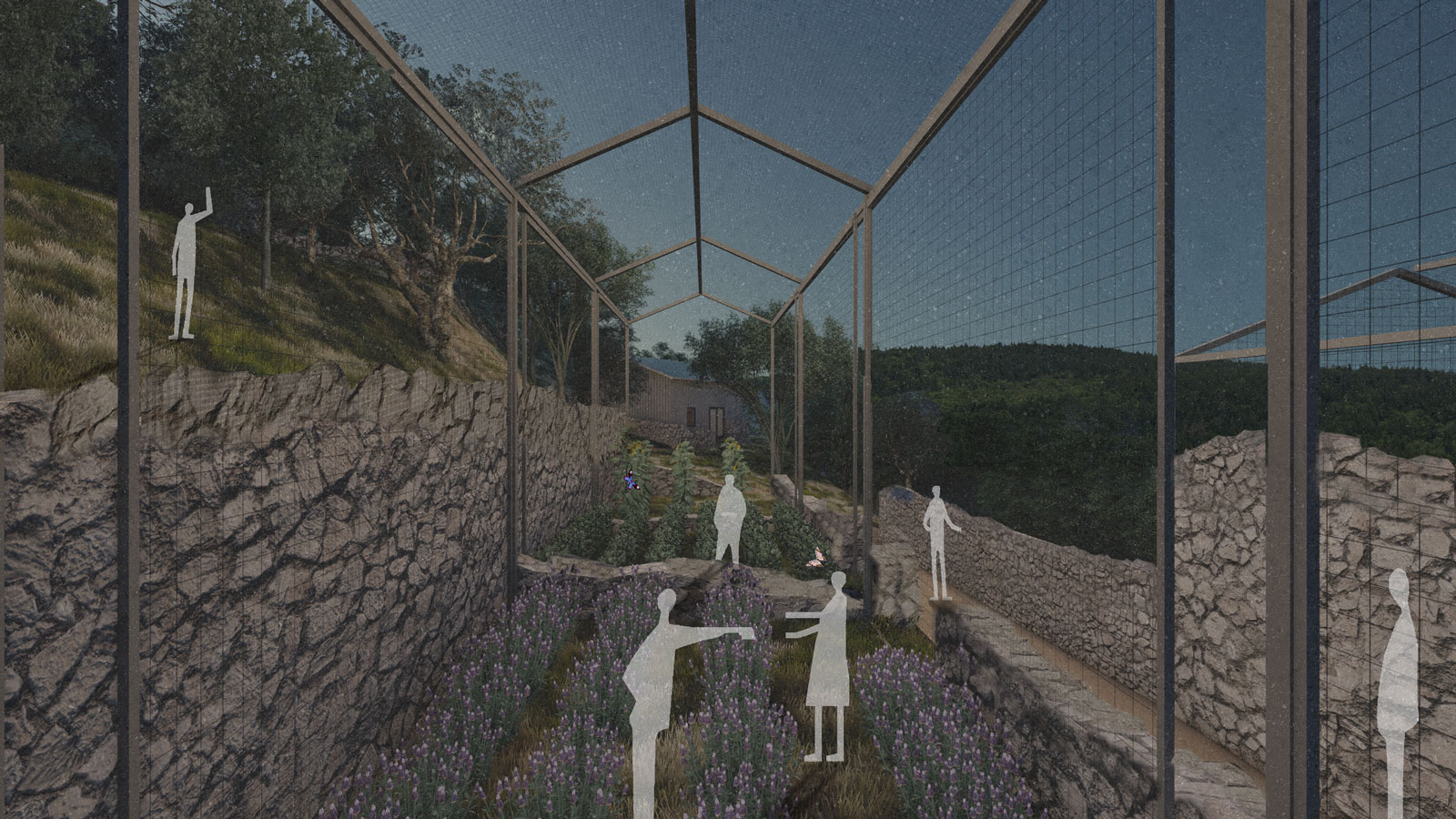

Villaggio Di Sale is a diploma thesis by Sofia Mikroni, Aristea Koukounouri and Evangelia Koukounouri that redesigns the abandoned settlement of old Kariotes and the decommissioned Alexander saltworks in Lefkada, Greece. The two places, about ten minutes apart by car, are programmatically connected through a Museum built around salt: its collection, its processing and its use. The old settlement of Kariotes was abandoned by its inhabitants in 1957, while the Alexander saltworks stopped functioning in 1988 and stand today completely abandoned, despite being designated as a Protected Industrial Museum and a site of the Natura 2000 Network.
The aim of the Museum is to contribute to the promotion of the cultural heritage of Lefkada, and of Greece more broadly, to the extent that it is connected with the not so old operational period of the saltworks. To that end, the proposal displays both tangible and intangible exhibits in order to enhance the local cultural identity. Through experiential workshops, the new Museum offers the visitor the opportunity to get acquainted with traditional techniques and practices, to try the local cuisine and to learn about the life of the inhabitants who once lived in the village.
Reuse and reappropriation of an industrial landscape
Working with an abandoned settlement asks the architect to read what is already there before adding anything new. Housing-led revival projects of this kind sit between conservation and contemporary need, where existing walls, plots and footpaths set the rules for any intervention. The challenge is to give old structures a fresh public purpose without erasing the marks of the time that has passed. By pairing the residential fabric of Lefkada with the industrial remains of the saltworks, the scheme treats the whole area as a single cultural route rather than two isolated ruins.
Salt production, or salt harvesting in evaporation ponds, has shaped coastal communities around the Mediterranean for centuries, so the saltworks here carry both economic memory and a distinctive flat, reflective landscape. A museum that explains this craft helps keep alive folklore, customs and working knowledge that might otherwise disappear with the last generation who practised it. Linking that story to adaptive reuse of the village gives visitors a reason to walk, look and stay rather than simply pass through. Villaggio Di Sale shows how a careful reading of an abandoned place can return it to public life while honouring the people and the labour that defined it.



Living Typologies by Stela Boldur
Living Typologies by Stela Boldur is a student masterplan for the former...
illustrarch Editoral Team2 Mins read
Residential Architecture Face-Off: Co-Living vs Traditional Apartment for Urban Housing
Co-living and traditional apartments represent two distinct approaches to residential architecture in...
 Furkan Sen8 Mins read

Designing a Liminal Space Where Urban Meets Coastal
The Liminal House by Mcleod Bovell Modern Houses in West Vancouver is...
 Elif Ayse Sen5 Mins read
House in Nakano: A 96 m² Tokyo Architecture Marvel by HOAA
House in Nakano, designed by HOAA, creatively addresses urban density challenges by...
 Bahattin Duran6 Mins read


Leave a comment