

The Art of AI Urban Planning: Designing Livable and Sustainable Cities
I urban planning is moving from research labs into city halls, helping planners design livable, sustainable cities through predictive analytics, digital twins, generative design, and data-driven zoning. This guide covers the core principles, real applications, ethical risks, and practical tools shaping the profession today.
 Furkan Sen30 April 202611 Mins read171

Table of Contents Show
AI urban planning uses machine learning, predictive analytics, and digital twin technology to help planners design cities that are more livable, equitable, and sustainable. It augments traditional planning with data-driven tools for zoning, transportation, housing demand, and environmental resilience, while keeping human judgment at the center of public-interest decisions.
Cities generate more data today than any planning office can analyze by hand. Traffic sensors, satellite imagery, building permits, census records, air-quality monitors, and mobility apps all produce continuous streams of information about how urban systems actually behave. For decades, planners had to work with snapshots: a decennial census, a one-time origin-destination survey, a zoning map updated every ten years. AI changes that rhythm. Machine learning models can read satellite imagery to detect informal settlements, neural networks can forecast housing demand at the neighborhood scale, and generative tools can produce dozens of zoning scenarios in the time it once took to draft one. The question is no longer whether algorithms will enter the planning office, but how planners will shape that integration so it serves livability and sustainability rather than quietly erode them.
What Is AI Urban Planning?

AI urban planning is the practical use of artificial intelligence methods, including machine learning, deep learning, natural language processing, and computer vision, to support how cities are analyzed, designed, governed, and monitored. It sits at the intersection of traditional planning disciplines (land use, transportation, housing, environmental planning) and modern data science, and it relies on the same foundations as any good plan: clear goals, reliable data, public legitimacy, and ethical judgment.
A 2023 systematic review of algorithmic urban planning published in Sustainable Cities and Society found that machine learning accounts for roughly 84 percent of AI applications in the field, followed by deep learning at 51 percent and neural networks at 34 percent, with reviewed papers often citing more than one method per study. The top application areas were urban and infrastructure management, environmental and disaster management, and urban monitoring and development control. In other words, AI is not replacing planners; it is plugging into the tasks planners already do.
💡 Pro Tip
When piloting AI tools in a planning department, start with a bounded, low-stakes task such as automating land-cover classification from satellite imagery or summarizing public comments, rather than decisions that directly allocate housing or resources. This gives your team a chance to catch data quality issues and bias before algorithmic outputs shape people’s lives.
How AI Urban Planning Differs From Traditional Planning
Traditional urban planning relies on periodic surveys, formal zoning codes, and long consultation cycles. It is strong on legitimacy but slow to respond to change. AI-assisted planning inverts several of those characteristics. Data is continuous rather than periodic, analysis is scalable rather than labor-bound, and scenario testing becomes almost instantaneous, which means planners can explore many more options before committing to one.
That speed has a cost. When a zoning decision comes out of a neural network, it is harder to audit than one produced by a human staff report. The American Planning Association’s 2022 white paper AI in Planning: Opportunities and Challenges and How to Prepare warned that if deployed irresponsibly, AI could exacerbate existing inequalities, which makes the design of the human-AI workflow just as important as the algorithm itself.
Why Does AI Urban Planning Matter for Livable and Sustainable Cities?
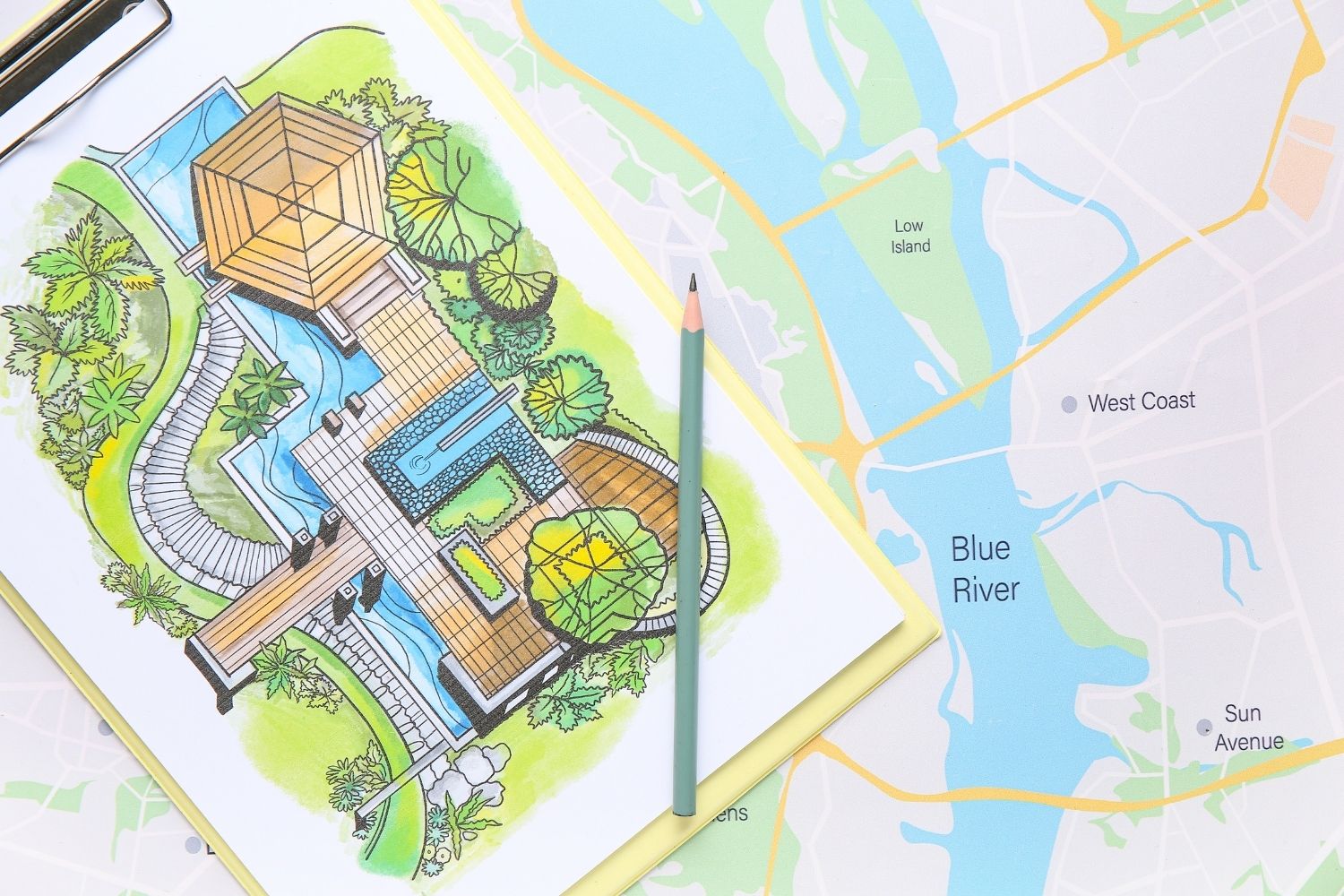
AI urban planning matters because the scale and speed of urbanization now exceed what conventional planning tools can handle. The UN projects that about 68 percent of the global population will live in urban areas by 2050, and cities already account for a significant share of global greenhouse gas emissions. Planning livable, sustainable cities at that scale requires tools that can analyze millions of data points and simulate outcomes before decisions are locked in.
The Core Principles of Livable Cities
Livability is not a slogan; it is a measurable set of conditions. Access to affordable housing, reliable transit, safe streets, green space, clean air, and public services shapes whether a city feels like home or like a trap. AI tools can help diagnose gaps in these conditions by mapping, for example, which neighborhoods sit more than a ten-minute walk from a grocery store or how heat-island effects concentrate in specific blocks.
The classic principles of livable urban design still apply: mixed-use development, pedestrian priority, transit-oriented density, and context-sensitive architecture. AI simply sharpens how planners identify where these principles are succeeding or failing. For a broader treatment of these design concepts, our guide on the best architecture concepts for urban design covers the built-environment strategies that sit beneath every good plan.
The Sustainability Dimension
Sustainable urban planning asks cities to reduce emissions, protect biodiversity, manage water, and adapt to climate risk. AI contributes in three ways: by improving measurement, by enabling predictive modeling, and by supporting resource optimization. Satellite imagery fed into computer vision models can track vegetation loss, land-use change, and informal growth at resolutions that were impractical a decade ago.
Explore how the future of cities is also being reshaped by broader technology trends in our analysis of the future of cities through technology and modern architecture, which looks at renewable-energy integration, mixed-use design, and digital twins working together.
🔢 Quick Numbers
- The AI market is projected to grow more than 20 percent annually in the coming years, affecting the built environment alongside most other sectors (American Planning Association, 2022)
- U.S. investment in AI reached $67.2 billion in 2023, reinforcing the need for AI literacy in planning practice (Stanford University AI Index Report, 2024)
- UN-Habitat’s 2024 Global Assessment of Responsible AI in Cities drew on more than 70 case studies and a global survey to map benefits and risks of AI adoption in urban governance (UN-Habitat, 2024)
Key Applications of AI in Urban Planning
AI shows up across the full planning workflow, from early site analysis through long-term monitoring. Different architecture and urban planning teams will adopt different tools depending on their scale and priorities, but several applications are now common enough to be considered core practice.
Predictive Analytics for Housing and Land Use
Predictive models use historical data on permits, demographics, prices, and infrastructure investment to forecast where housing demand, land-use conflicts, or displacement pressure will emerge. Cities like New York, Los Angeles, and Seattle already use AI to analyze population data and predict housing needs, to manage traffic, and to improve energy efficiency, as documented in a 2025 article in the APA’s Planning magazine.
Digital Twins for Scenario Testing
A digital twin is a virtual replica of a physical city that updates with real-time data. Planners use digital twins to test policies before deploying them in the real world. Singapore’s Virtual Singapore project is the most cited example, simulating everything from flood response to traffic rerouting. Digital twins reduce the risk of costly policy mistakes and give residents a way to see proposed changes before they appear on the street.
Computer Vision for Site Analysis
Computer vision models read satellite and drone imagery to detect urban expansion, vegetation change, building footprints, and even the quality of pedestrian infrastructure. UN-Habitat has used AI-processed Copernicus Sentinel-2 satellite imagery at 10-meter resolution to create land-cover layers for territorial planning in contexts where ground-truth data is sparse, a method described in detail on the AI for Good platform run by UN-Habitat and ITU.
Natural Language Processing for Public Engagement
Public comments on plans arrive in the thousands. Natural language processing can group comments by theme, identify concerns that repeat across neighborhoods, and surface voices that might otherwise get lost in the volume. The risk is that summarization flattens nuance, so planners need to read the original material, not just the AI-generated brief.
Generative Design for Urban Form
Generative design tools analyze site parameters such as sunlight, airflow, density targets, and circulation, then produce dozens of design alternatives that meet the constraints. For planners working on master plans or large-scale urban design competitions, generative workflows shift the conversation from “can we fit this in?” to “which of these ten scenarios best serves the neighborhood?”
🏗️ Real-World Example
Gangnam Superblocks Smart Design Framework (Seoul): A peer-reviewed 2025 review of AI in urban planning governance published in Landscape and Urban Planning highlighted the Smart Design framework applied to Seoul’s Gangnam superblocks as a case where AI-aided design shifted planning from traditional master-plan drafting to a more dynamic, data-driven workflow integrating land use, mobility, and environmental factors in a single modeling environment.
How to Design Livable and Sustainable Cities With AI: Best Tips for Urban Planning Practice
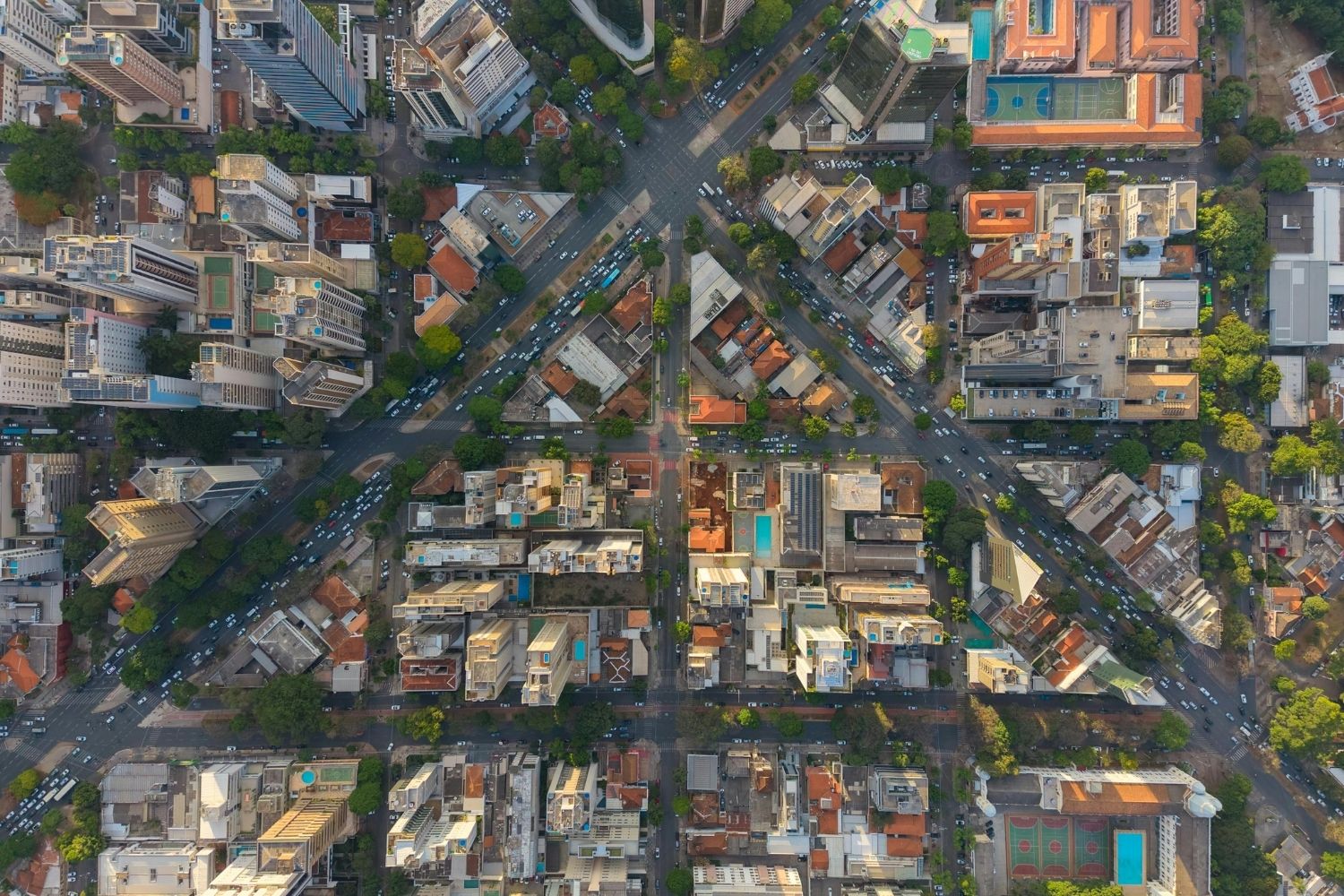
Practical adoption looks less like a single AI transformation and more like a series of small, testable integrations. The planners who have moved farthest are not the ones chasing the newest model; they are the ones who started with a specific problem and worked backward to the tool.
Start With the Problem, Not the Algorithm
The most common failure mode in AI urban planning is tool-first thinking: a vendor demos a dashboard, the city buys it, and only later does the staff try to figure out what problem it solves. The inverse is far more productive. Identify a concrete planning challenge (for example, unequal tree canopy coverage, delayed permit reviews, or under-served transit corridors), then ask which data and which method would actually help.
Invest in Data Infrastructure Before Models
Every AI method depends on data quality. Cities that skip the foundational work of cleaning, structuring, and governing their data tend to produce models that confidently reproduce old errors. UN-Habitat’s 2024 work on people-centred smart cities emphasizes that digital urban infrastructure should be inclusive, accessible, and governed with public trust at the center, which starts with the data layer.
Keep Humans in the Decision Loop
The American Planning Association’s PAS Report on Planning With Artificial Intelligence, authored by Thomas W. Sanchez, frames AI as a tool that enhances rather than replaces planners. A human-in-the-loop approach means a planner reviews AI outputs before they become policy, can override recommendations, and documents the reasoning. This is both an ethical and a legal safeguard.
Audit for Bias Continuously
AI models trained on historical data can inherit the biases of past decisions, which in many cities included redlining, exclusionary zoning, or uneven infrastructure investment. Without active auditing, predictive tools can simply reproduce those patterns at higher speed. Diverse training data, algorithmic transparency, and regular equity audits are becoming standard expectations, not optional extras.
⚠️ Common Mistake to Avoid
Treating AI outputs as objective because they come from a machine. An algorithm trained on decades of exclusionary zoning records will recommend patterns that look statistically sound and remain ethically harmful. Planners are still accountable for the decisions, regardless of which tool generated the recommendation.
Engage the Public in the Tool, Not Just the Outcome
Communities often find out about AI-driven planning tools after they are already shaping decisions. Co-creation, where residents help define the problem, review the data sources, and evaluate outputs, produces more legitimate results. It also catches blind spots that technical teams miss, because lived experience often reveals what a dataset omits.
Risks and Ethical Challenges in AI Urban Planning

Every technology carries tradeoffs, and the risks here are not abstract. They touch housing costs, civil liberties, and the distribution of public investment.
Bias and Inequity
A 2024 article in the Journal of the American Planning Association on the ethical concerns of AI in urban planning cataloged how biases in training data and model design can produce outcomes that disadvantage marginalized communities, from predictive policing artifacts bleeding into siting decisions to property-value models accelerating displacement.
Privacy and Surveillance
AI-enabled urban systems often collect granular data about people’s movements, habits, and social interactions. Without clear rules on retention, access, and purpose, smart-city infrastructure can tip into surveillance infrastructure. The UN-Habitat Global Assessment of Responsible AI in Cities flags data privacy as one of the critical challenges cities face as AI adoption accelerates.
Transparency and Accountability
When an algorithm recommends where to upzone or which neighborhoods should receive infrastructure investment first, residents have a right to know how that decision was reached. Black-box models make that accountability harder. Explainable AI methods and public documentation of model inputs, assumptions, and known limitations are becoming baseline expectations for responsible deployment.
Displacement of Professional Judgment
There is a quieter risk, which is that planners stop questioning outputs because the models make life easier. A 2024 bibliometric analysis of AI in urban planning published in Urban Science, which reviewed 744 research publications, noted that AI adoption is diffusing across every stage of the planning process, which raises the stakes for planners to maintain critical judgment rather than defer to algorithmic outputs.
Tools and Resources for AI-Driven Architecture and Urban Planning

Planners do not need to build their own models. A growing stack of platforms now integrates AI into workflows that planning teams already use, from GIS to BIM to public engagement portals. For a deeper look at the data-and-mapping side of the toolset, see our guide to the best urban mapping tools every urban planner needs and the updated 2025 overview of architecture mapping and GIS tools.
AI-Enhanced GIS
ArcGIS Pro and QGIS now include machine learning extensions for classification, prediction, and clustering. These are the entry point for most planning departments because they build on skills staff already have.
Digital Twin Platforms
Tools from Bentley, Esri, and Siemens let cities build living models of their infrastructure. Adoption is still concentrated in large cities with data maturity, but mid-sized cities are catching up through regional consortia.
Generative and Visualization Tools
Generative design platforms and AI-assisted rendering tools are moving from architectural firms into urban design practice, shortening the loop between concept and community review. For planners moving between city-scale analysis and project-scale visualization, the evolving skill sets described in our look at architecture and planning careers capture how the toolkit is shifting.
Video: Principles That Make Cities Livable
Before any tool choice, it helps to anchor the work in what good cities actually do for people. Architect and planner Peter Calthorpe’s TED talk lays out seven universal principles for building smarter, more sustainable cities, which map cleanly onto the goals AI tools are now asked to serve.
Preparing for a Career That Combines Architecture, Urban Planning, and AI
The skills needed to practice AI urban planning are not purely technical. A bachelor of urban planning still grounds the profession in law, theory, and public process, but graduates now enter a field where data literacy, basic Python, and familiarity with GIS automation are as common as knowing zoning codes. MIT’s joint urban science and computer science degree program 11-6 captures the direction of travel, pairing urban studies with machine learning and spatial analysis so graduates can move fluently between policy and code.
🎓 Expert Insight
“The allure of AI’s data processing capabilities, although tempting, should not overshadow the intrinsic human touch, characterized by context and empathy, which has been central to effective urban planning.” Thomas W. Sanchez, Marc Brenman, and Xinyue Ye, Journal of the American Planning Association, 2024
The point is not to reject AI but to keep professional judgment, community context, and lived experience at the center of decisions that shape how people live. Tools augment planners; they do not replace the responsibility planners hold to the public.
For students choosing programs or professionals planning next steps, it helps to think in layers. A strong foundation in design urban planning and policy remains essential. On top of that, practical data skills (SQL, Python, a working understanding of machine learning) open the door to the most interesting current work. Ethics, equity, and community engagement are not soft add-ons; they are the parts of the job that cannot be automated and that determine whether AI makes cities better or worse.
✅ Key Takeaways
- AI urban planning augments traditional planning with machine learning, predictive analytics, digital twins, and generative design, rather than replacing human judgment.
- Livability and sustainability remain the goals; AI is valuable only when it improves measurement, scenario testing, or equitable resource allocation.
- Bias, privacy, and transparency are the central risks, and responsible adoption requires active auditing, explainable models, and public engagement.
- The most successful integrations start with a specific planning problem, invest in data quality first, and keep humans in the decision loop.
- The next generation of planners will need both design and policy fundamentals and practical data literacy to work effectively alongside AI tools.
Final Thoughts on AI Urban Planning
AI urban planning is not a replacement for the careful, political, human work of designing cities. It is a new layer of capability that, used well, gives planners sharper eyes, faster scenario testing, and better ways to hear communities. Used poorly, it can scale old injustices and hide decisions inside opaque models. Which version becomes the norm depends on choices being made right now in planning schools, city halls, and software companies.
The cities that will get this right are the ones that treat AI as a tool in service of livability and sustainability, not as a goal in itself. They will invest in data, in ethics, and in their own people. And they will remember that the purpose of urban planning, whether supported by algorithms or not, is still the same: shaping places where people can live well together.
Technical AI specifications and policy frameworks in this field evolve quickly. Planners should verify current regulations, ethical guidelines, and tool capabilities with local authorities and professional organizations before applying them to specific projects.








Neom Stadium, the Elevated 2034 World Cup Venue, Reportedly Shelved by Saudi Arabia
Two sources told Reuters that Saudi Arabia has put the 46,000 seat...
 illustrarch Editoral Team2 Mins read

Danish Architecture Center Marks Jan Gehl’s 90th Birthday with Cities for People Exhibition
DAC in Copenhagen celebrates Jan Gehl's 90th birthday with Cities for People,...
illustrarch Editoral Team2 Mins read

ZHA-Led Consortium Presents Benghazi 2050 City Planning Framework
A seven-firm consortium including ZHA presented a spatial plan and digital twin...
illustrarch Editoral Team2 Mins read

Ahmedabad Civic Body Plans 3D Digital Twin of Entire City
AMC plans a 625 sq km GIS survey giving 25 lakh properties...
illustrarch Editoral Team2 Mins read


Leave a comment