

Space Habitat Design: 7 Innovations for Moon and Mars
Space habitat design merges art, architecture, and engineering to create livable structures on the Moon and Mars. This guide covers ISRU construction, 3D-printed regolith habitats, modular self-assembling systems like TESSERAE, and the psychological design principles keeping future crews healthy in extreme environments.
 Bahattin Duran30 December 202414 Mins read1k

Table of Contents Show
Space habitat design is the practice of creating livable structures for the Moon, Mars, and orbital environments, combining advanced engineering, 3D printing, and human-centered architecture to protect astronauts from radiation, extreme temperatures, and resource scarcity while supporting long-term psychological well-being. These habitats represent the architectural foundation of humanity’s expansion beyond Earth.
Space habitat design sits at the intersection of art, architecture, and survival engineering. As agencies and private companies set their sights on the Moon and Mars, the need for innovative habitats has moved from speculative fiction to active development. These structures go far beyond basic shelters. They represent the foundations of sustainable living in some of the harshest environments humanity has ever faced.
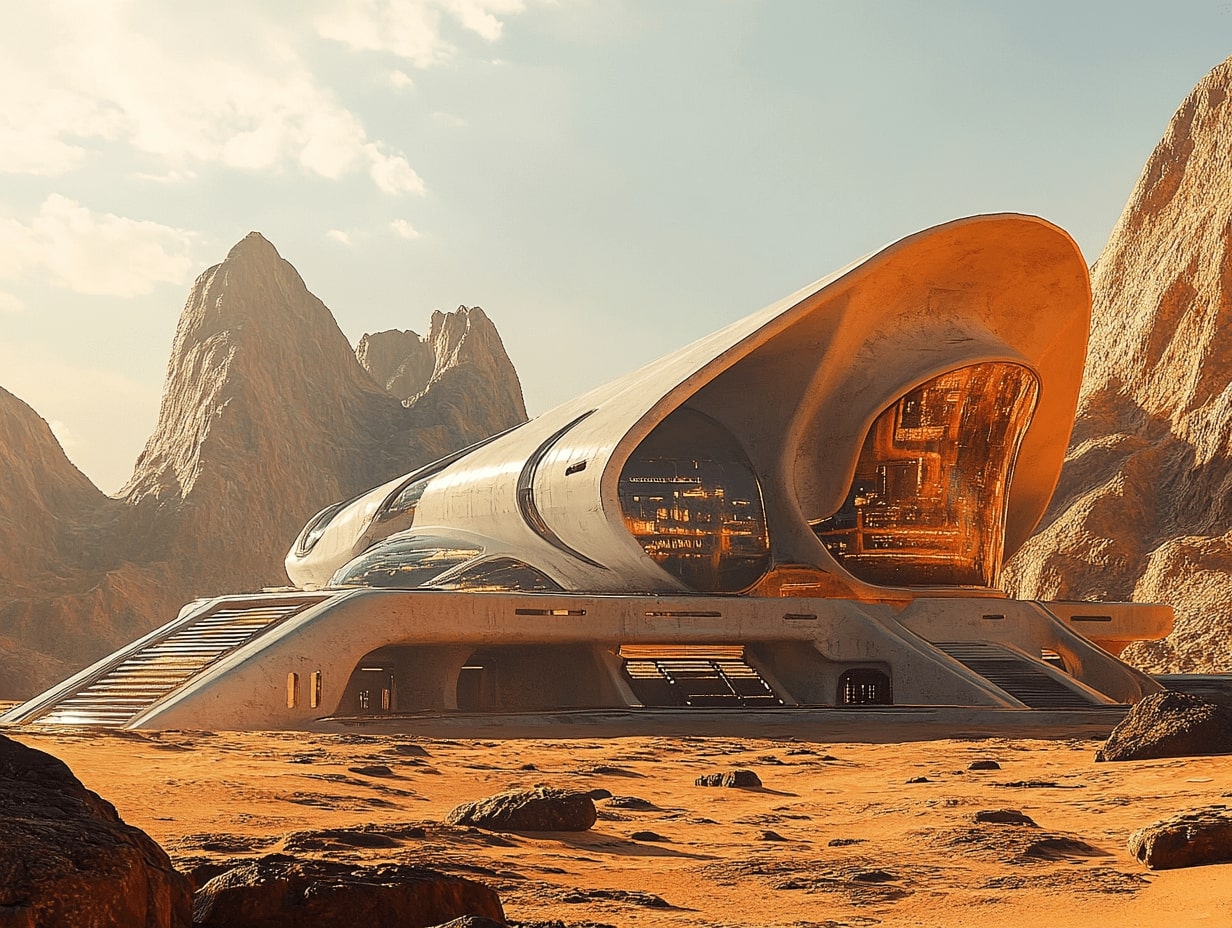
Designing these habitats means tackling extreme temperatures, radiation, and limited resources head-on. It is not just about survival; it is about creating spaces where astronauts and future settlers can thrive, explore, and push the boundaries of human potential. The fusion of architecture, engineering, and technology is redefining what it means to call a place “home” in space. For architects and designers, space habitat design art has become a new frontier where creativity meets extreme constraint.
Building these habitats is not just about science. It is about preparing for a future where humanity expands its footprint across the cosmos. The Moon and Mars might just be the first steps in a much larger adventure, and the architectural decisions made today will shape how millions experience extraterrestrial life in decades to come.
Understanding Space Architecture Habitats
Space architecture habitats are critical for long-term human survival and exploration on the Moon and Mars. These structures combine innovative engineering and advanced technologies to address environmental challenges while ensuring functionality and habitability. According to NASA’s Center for Design and Space Architecture (CDSA), habitability design in space focuses on human factors as a primary design tool, keeping crew needs at the center of every decision.
Definition and Purpose
Space architecture habitats are specialized living and working structures designed for extraterrestrial environments. Their purpose is to support human survival by providing protection from extreme temperatures, radiation, and micrometeorites. They also facilitate resource utilization, maintaining life support systems and enabling scientific advancements. On the Moon, such habitats may focus on short-term missions, while on Mars, designs aim to support extended stays or permanent settlements. The concept of space habitats traces back to visionaries like Konstantin Tsiolkovsky and Gerard K. O’Neill, whose 1970s proposals for self-sustaining colonies influenced a generation of space architects.
What Are the Main Challenges of Designing Habitats for the Moon and Mars?
Designing habitats for the Moon and Mars involves overcoming harsh environmental conditions and limited resources. The Moon’s surface endures temperature variations from -173°C to 127°C, and lacks an atmosphere, exposing habitats to radiation and micrometeorite impacts. Martian conditions include thin atmosphere, frequent dust storms, and average temperatures around -63°C. Both environments demand advanced solutions in material durability, thermal regulation, and sustainable energy use. Designs must also adapt to gravity differences, with the Moon’s gravity at 16.5% and Mars’ at 37.6% of Earth’s, impacting structural stability and human health over time.
The following table compares the key environmental parameters architects must consider when designing for each destination:
Moon vs. Mars: Key Environmental Design Factors
| Factor | Moon | Mars |
|---|---|---|
| Surface Temperature Range | -173°C to 127°C | -143°C to 35°C (avg. -63°C) |
| Atmosphere | None (vacuum) | Thin CO2 (~1% of Earth’s pressure) |
| Gravity (% of Earth) | 16.5% | 37.6% |
| Radiation Exposure | High (no magnetic field) | High (thin atmosphere, no global field) |
| Dust Hazard | Abrasive, electrostatically charged regolith | Fine iron-oxide dust, planet-wide storms |
| Travel Time from Earth | ~3 days | 6 to 9 months |
| Primary Habitat Strategy | Surface modules, polar locations | Buried/shielded structures, ISRU-based |
📐 Technical Note
Radiation dose on the lunar surface averages approximately 1.369 millisieverts per day, according to measurements taken by China’s Chang’e 4 lander in 2020 (published in Science Advances). That is roughly 2.6 times the dose measured aboard the International Space Station, making radiation shielding one of the most critical design parameters for any lunar habitat.

The Art and Aesthetics of Space Habitat Design
Space habitat design art merges functionality with visual expression in ways terrestrial architecture rarely demands. When every cubic meter must serve a purpose, and when psychological well-being depends on the quality of enclosed spaces, aesthetics become a survival tool rather than a luxury. Architects working on space habitats draw from disciplines spanning industrial design, biophilic principles, and fine art to create interiors that reduce stress and promote crew cohesion.
NASA’s 1975 Summer Study, led by physicist Gerard K. O’Neill, produced some of the most iconic space habitat concept art in history. Painters Don Davis and Rick Guidice created renderings of orbital habitats large enough to hold entire landscapes, blending counterculture idealism with engineering precision. These illustrations, depicting the Stanford Torus and O’Neill Cylinders, remain touchstones for space habitat design art and continue to inspire architects and concept artists today.
Modern space habitat visualization goes further. Projects like the Aurelia Institute’s TESSERAE concept combine self-assembling modular tiles with human-centered interiors featuring algae-filled light panels, hand-knotted navigation nets, and biomorphic storage solutions. The result blurs the line between engineering prototype and art installation, proving that space habitat design art is not merely decorative but integral to how humans will live beyond Earth.
🎓 Expert Insight
“We’re moving beyond early space stations’ confined, utilitarian spaces.” — Ariel Ekblaw, CEO and Co-Founder, Aurelia Institute
Ekblaw’s remarks, made during the Museum of Flight’s Home Beyond Earth exhibition (2024), reflect a broader industry shift toward treating space habitat interiors as designed environments rather than purely functional containers. This human-centered approach directly influences crew morale and mission success on long-duration flights.
💡 Pro Tip
Experienced space architects recommend integrating circadian lighting systems early in the design phase. On the Moon, where a “day” lasts roughly 29 Earth days, and on Mars with its 24.6-hour sol, programmable LED arrays that simulate sunrise, daylight, and dusk cycles are essential for crew health and morale. Research from the ISS Lighting Effects study (NASA, 2016-2020) confirmed that tunable LED lighting improved sleep quality by up to 20% among crew members.
How Are Space Habitats Built? Innovations in Construction and Materials
Space habitat design integrates advanced technologies to address environmental challenges and ensure long-term human habitation. Engineers and architects have developed innovative solutions to optimize materials, energy systems, and sustainability for lunar and Martian environments.
Materials and Construction Techniques
Architects and engineers focus on lightweight, durable materials like high-strength alloys and composites to withstand harsh space environments. Regolith, the loose soil present on the Moon and Mars, is repurposed through in-situ resource utilization (ISRU) to create structural components using 3D printing. Printed regolith bricks enhance radiation shielding and structural integrity while dramatically reducing the mass that must be launched from Earth. Inflatable modules provide flexible interiors, reducing initial payload mass. The technology behind 3D-printed architecture on Earth directly informs how these techniques scale for extraterrestrial construction.
Foster + Partners’ Project GAMMA, developed for NASA’s 3D-Printed Habitat Challenge, demonstrated how autonomous robots could excavate, transport, and fuse Martian regolith into habitable structures without any human intervention. The winning team, SEArch+/Apis Cor, proved that additively manufactured shells could pass hydrostatic leak testing, a milestone for construction viability off-world.
ICON, a Texas-based construction technology company, is advancing this approach through Project Olympus, a NASA-funded system that uses high-powered lasers to melt and fuse lunar regolith into ceramic-like building material. In February 2025, ICON launched its Duneflow experiment aboard a Blue Origin rocket to test how regolith behaves in lunar gravity conditions, bringing the technology one step closer to actual off-world construction.
🏗️ Real-World Example
Mars Dune Alpha (Houston, TX, 2022-present): ICON 3D-printed a 1,700-square-foot simulated Martian habitat at NASA’s Johnson Space Center using its Vulcan construction system. The habitat hosted CHAPEA Mission 1 (June 2023 to July 2024) with a four-person crew living in isolation for 378 days, and CHAPEA Mission 2 began in October 2025 with a second crew. The structure validated that large-scale additive manufacturing can produce sealed, habitable spaces for extended missions.
Energy and Resource Management
Effective power generation and resource recycling systems ensure habitat functionality. Solar panels, reinforced for dust resistance, serve as primary energy sources on Mars and the Moon. Regenerative life-support systems recycle air, water, and waste, minimizing reliance on resupply missions. Electrolyzers split water molecules, producing breathable oxygen and hydrogen for energy storage. NASA’s MOXIE instrument, tested during the Perseverance rover mission, successfully demonstrated oxygen production from Martian CO2, validating a core technology for future habitat life-support. Over 16 experimental runs between April 2021 and August 2023, MOXIE produced a total of approximately 122 grams of oxygen at purities exceeding 98%, according to NASA’s Jet Propulsion Laboratory.
Safety and Sustainability
Habitat designs prioritize radiation protection, stable structural geometry, and ecological balance. Layers of regolith or polyethylene-based shielding reduce cosmic ray exposure, enhancing crew safety. Closed-loop systems optimize resource reuse, supporting sustainable operations over extended mission timescales. Modular designs enable habitat expansion or reconfiguration, adapting to mission needs and population growth. The principle is straightforward: build systems that can grow, repair themselves, and operate with minimal input from Earth.

Moon Habitats: Case Studies and Concepts
Designing Moon habitats involves applying innovative ideas and technologies to address the Moon’s unique environmental challenges. Multiple case studies and concepts help define strategies for sustainable human presence.
Major Projects and Proposals
Several projects explore the feasibility of long-term Moon habitation. NASA’s Artemis program includes plans for the Lunar Gateway, a modular space station orbiting the Moon that supports surface missions. In its 2024 Architecture Concept Review, NASA added two new elements to its Moon to Mars architecture: an initial lunar surface habitat and a dedicated cargo lander. For surface habitats, concepts such as NASA’s BEAM (Bigelow Expandable Activity Module) demonstrate the potential of lightweight, inflatable structures offering radiation shielding and thermal insulation.
The European Space Agency (ESA) investigates 3D-printed habitat models using lunar regolith. Their Moon Village Vision proposes international collaboration to build shared infrastructure for research and exploration. Private entities like ICON and Blue Origin propose modular, scalable habitats incorporating in-situ resource utilization (ISRU) and advanced construction technologies. Vast, a California-based company, announced plans to launch the Haven-1 space station, which will provide microgravity and lunar-strength artificial gravity environments as a stepping stone toward deeper space habitation.
The American Institute of Aeronautics and Astronautics (AIAA) regularly publishes updated technical papers on space architecture standards, providing architects with baseline requirements for pressurized volume, crew circulation, and emergency egress in lunar habitats.
Unique Challenges of Lunar Environments
Moon habitats confront extreme conditions. Surface temperatures range from -280°F at night to 260°F during the day. Without an atmosphere, the Moon has no protection against solar radiation or micrometeorite impacts. Robust shielding and thermal regulation are non-negotiable for human safety.
The Moon’s low gravity, one-sixth that of Earth, affects structural integrity. Habitat designs consider both reduced material loads and potential impacts on human health. Dust from regolith, electrostatically charged and abrasive, poses risks to machinery, air quality, and astronauts. Habitat concepts focus on minimizing dust infiltration, using airlocks and specialized coatings.
Strategically locating habitats at lunar poles addresses some challenges. Permanent shadow regions may provide access to water ice, while consistent sunlight supports solar power generation. Combining advanced technologies with smart site selection enhances habitat viability. NASA’s planned Artemis Base Camp at the lunar South Pole will include a fixed habitat for up to four astronauts, a pressurized rover, and logistics systems designed for month-long surface stays.
⚠️ Common Mistake to Avoid
A frequent misconception in early lunar habitat proposals is treating regolith as interchangeable with terrestrial soil. Lunar regolith particles are jagged and glassy (never weathered by water or wind), making them highly abrasive to seals, bearings, and respiratory systems. Effective habitat design must account for regolith mitigation from the earliest planning stages, not as an afterthought.
Mars Habitats: Case Studies and Concepts
Mars habitats require innovative designs to address the planet’s unique environmental challenges and ensure sustainable human habitation. By examining case studies and concepts, we can explore adaptations for Martian conditions and strategies for long-term living.
Adaptations for Martian Conditions
Designing habitats for Mars involves addressing low atmospheric pressure, freezing temperatures averaging -81°F (-63°C), and heightened radiation exposure. Researchers focus on underground or partially buried structures, using Martian regolith for radiation shielding. Concepts like NASA‘s Mars Ice Home propose insulating habitats with frozen water layers, which also serve as radiation barriers.
The planet’s dust storms, which can last weeks, necessitate sealed and dust-resistant entry points integrated into habitat airlocks. Advanced materials like self-healing polymers are being examined for exterior layers to maintain structural integrity under repeated exposure to dust abrasion and temperature fluctuations. Resource utilization is a priority, with ISRU being used to process local materials for habitat construction and life support needs, reducing dependence on Earth-supplied materials.
NASA’s CHAPEA (Crew Health and Performance Exploration Analog) program completed its first year-long simulated Mars mission in July 2024. Four crew members lived inside Mars Dune Alpha, a 1,700-square-foot 3D-printed habitat at Johnson Space Center for 378 days, testing construction methods and life-support systems that could translate directly to Martian surface operations. The second CHAPEA mission began in October 2025 with a new four-person crew, and is scheduled to conclude in October 2026.
💡 Pro Tip
When evaluating Mars habitat proposals, experienced space architects prioritize “fail-operational” design over “fail-safe” approaches. In practical terms, this means every critical system (air, water, power) should continue operating at reduced capacity after a failure, rather than simply shutting down safely, because resupply or rescue on Mars could take over a year.
Long-Term Living Considerations
Sustaining human life on Mars requires habitats designed for autonomy and psychological well-being. Regenerative life-support systems, including closed-loop water recycling and oxygen generation from Martian CO2 via the MOXIE instrument, are being tested to enable long-term self-sufficiency. Food production is integrated into habitat designs, using vertical farming and hydroponics to reduce reliance on resupply missions.
To support mental health, architects emphasize natural light simulations, recreational spaces, and modular compartments allowing habitat expansion. Gravity on Mars, roughly 38% of Earth’s, influences structural design and the need for exercise facilities to mitigate muscle atrophy and bone density loss. Additionally, habitat layouts prioritize efficiency, designing living and working areas that adapt to evolving mission demands and population growth over time. Interior design choices, from color palettes to spatial flow, draw on research in architectural aesthetics and functionality, where visual quality directly affects inhabitant well-being.
The Role of Autonomous Robotics and AI in Habitat Construction
Building habitats on the Moon or Mars before human crews arrive requires autonomous construction systems. Robots must excavate, print, and assemble structures using local materials without real-time human guidance, since communication delays between Earth and Mars range from 4 to 24 minutes each way.
NASA’s 3D-Printed Habitat Challenge, completed in 2019, tested exactly this capability. Teams developed autonomous printers that could construct one-third-scale habitat models without human intervention. Foster + Partners’ Project GAMMA proposed three robot types for Mars: diggers to excavate foundations, transporters to process regolith into building material, and printers to fuse material into structural walls.
Artificial intelligence plays a growing role in habitat monitoring and resource allocation. AI-driven environmental control systems can predict equipment failures, optimize energy distribution between solar collection and battery storage, and adjust interior climate conditions based on crew activity patterns. These capabilities will be essential for habitats operating far from Earth-based support. The broader integration of technology into architectural practice is accelerating these developments. Recent advances in AI architecture design tools are directly informing how autonomous systems plan and execute construction sequences for off-world environments.
NASA’s Moon to Mars Planetary Autonomous Construction Technology (MMPACT) project, managed at Marshall Space Flight Center, is actively exploring large-scale robotic 3D printing for planetary surfaces. The program coordinates with ICON’s Olympus system and other commercial partners to advance regolith-based construction from laboratory demonstrations to flight-ready hardware.
Self-Assembling and Modular Habitat Concepts
One of the most promising directions in space habitat design art and engineering is the development of self-assembling structures. The Aurelia Institute’s TESSERAE (Tessellated Electromagnetic Space Structures for the Exploration of Reconfigurable, Adaptive Environments) concept uses hexagonal and pentagonal tiles connected by electromagnets. These tiles can be flat-packed for launch and autonomously assemble into spherical habitats in orbit.
TESSERAE represents a shift in thinking about how space structures are built. Rather than requiring dangerous extravehicular assembly by astronauts, the tiles snap together using magnetic forces in microgravity. The concept has been validated with small-scale tests aboard the International Space Station, including during Axiom Space’s Ax-1 mission in 2022, and NASA approved a follow-up experiment with approximately 32 tiles to construct a complete miniature sphere in orbit. The TESSERAE Space Habitat Pavilion, a full-scale mock-up, was exhibited publicly at Seattle’s Museum of Flight (September 2024 through January 2025) and later at TED 2025 in Vancouver.
Modular approaches also dominate surface habitat planning. The Starlab space station, developed jointly by Voyager Space and Airbus Defence and Space with crew suite design support from Hilton Hotels, aims for initial operational capability around 2028. On the lunar surface, ICON’s construction technology uses large-scale additive manufacturing to build structures from regolith, applying the same principles that are transforming 3D printing in terrestrial architecture.
📌 Did You Know?
Gerard K. O’Neill’s 1975 space habitat studies proposed rotating cylinders up to 32 km long that could house millions of people. The concept art painted by Don Davis and Rick Guidice for NASA is now held in the archives of the Ames Research Center and remains some of the most referenced space habitat design art in history, more than 50 years after its creation.
How Does Space Habitat Design Affect Astronaut Psychology?
Psychological well-being is one of the most underestimated factors in space habitat design. Confined, isolated environments with limited sensory stimulation can lead to depression, interpersonal conflict, and cognitive decline over multi-month missions. Data from analog studies, including CHAPEA and the ESA’s Mars500 program (which confined six participants for 520 days in 2010-2011), consistently show that habitat layout and interior quality directly influence crew performance.
Architects address these challenges through several design strategies. Variable lighting systems replicate natural daylight cycles. Private crew quarters provide essential personal space. Shared communal areas with soft textures, warm color palettes, and views (real or simulated) of natural landscapes reduce stress hormones and improve social cohesion. The inclusion of plant-growing areas, as tested in CHAPEA where crews grew tomatoes, peppers, and greens, provides both nutritional benefit and a psychological connection to living systems.
Window design is another critical factor. On the ISS, the Cupola observation module is consistently cited by astronauts as the most important space for mental restoration. Future lunar and Martian habitats may incorporate virtual windows displaying high-resolution exterior views, or transparent structural elements such as the frozen water walls proposed in NASA’s Mars Ice Home concept.
This intersection of human psychology and architectural design parallels trends in the future of architecture on Earth, where biophilic design, adaptive spaces, and occupant wellness are increasingly central to architectural practice.
Comparison of Leading Space Habitat Projects (2024-2026)
| Project | Organization | Destination | Key Technology | Status (2026) |
|---|---|---|---|---|
| Artemis Base Camp | NASA | Lunar South Pole | Fixed surface habitat, pressurized rover | Design phase |
| Project Olympus | ICON / NASA | Moon / Mars | Laser regolith sintering, robotic 3D printing | Suborbital testing (2025) |
| TESSERAE | Aurelia Institute / MIT | Low Earth Orbit | Electromagnetic self-assembly tiles | ISS prototype tests completed |
| CHAPEA (Mars Dune Alpha) | NASA / ICON | Mars (analog) | 3D-printed habitat, closed-loop life support | Mission 2 underway |
| Starlab | Voyager Space / Airbus | Low Earth Orbit | Modular station, Hilton-designed interiors | Targeting ~2028 launch |
| Moon Village | ESA | Lunar Surface | Regolith 3D printing, international collaboration | Concept development |
🔢 Quick Numbers
- $57.2 million: NASA contract awarded to ICON for Project Olympus lunar construction development (NASA, 2022)
- 378 days: Duration of CHAPEA Mission 1, the longest NASA Mars analog mission to date (NASA, 2024)
- 122 grams: Total oxygen produced by MOXIE across 16 runs on Mars, validating ISRU technology (NASA JPL, 2023)
- 1,700 sq ft: Interior area of Mars Dune Alpha, the first 3D-printed analog habitat in operation worldwide (ICON, 2022)
The Future of Space Habitat Design
Space architecture represents the intersection of innovation and necessity as we prepare for life beyond Earth. These habitats go beyond survival needs, addressing environmental, physical, and psychological factors critical for long-term habitation. By integrating advanced technologies such as in-situ resource utilization, 3D printing, and regenerative life-support systems, designers mitigate resource constraints and enhance sustainability.
Efforts in lunar habitat development, like NASA’s Artemis program and ESA’s Moon Village, showcase international collaboration and technological breakthroughs. Strategies include applying lunar regolith for construction, using polar regions for water accessibility, and employing modular, expandable designs to adapt to evolving needs.
On Mars, the focus shifts to addressing intense radiation, atmospheric challenges, and psychological well-being. Adaptations, including insulated regolith-based structures, dust-resistant systems, and biotechnological advancements for autonomous living, are key solutions for future habitats. Concepts like Mars Ice Home exemplify innovative designs for shielding and resource utilization.
Emerging tools like autonomous robotics, artificial intelligence, and advanced materials reshape the approach to extraterrestrial architecture. The convergence of space habitat design art and rigorous engineering will continue redefining sustainable living, enabling humanity to thrive in conditions that once seemed impossible. For architects and designers interested in where their profession is heading, space architecture offers perhaps the most ambitious design brief in history: build a home where no home has ever existed, and make it beautiful enough to keep people sane. The same principles of architectural technology and design driving terrestrial innovation are now being applied at the frontier of human civilization.
✅ Key Takeaways
- Space habitat design combines architecture, engineering, and art to create livable environments on the Moon, Mars, and in orbit
- In-situ resource utilization (ISRU) and 3D-printed regolith construction are the leading strategies for reducing Earth-launch dependency
- NASA’s CHAPEA program, with its 3D-printed Mars Dune Alpha habitat, is actively generating data on long-duration habitation and crew health
- Self-assembling concepts like TESSERAE could reduce the cost and danger of orbital construction by eliminating risky astronaut spacewalks
- Psychological design factors (lighting, private space, biophilic elements) are as critical to mission success as structural engineering
- Autonomous robotics and AI will build the first structures on the Moon and Mars before human crews arrive
Technical specifications and mission parameters referenced in this article are based on publicly available data from NASA, ESA, and affiliated research programs. Specific habitat designs remain in development, and final configurations may differ from current proposals.


1 Comment

Foster + Partners to Test Robot Swarms Building Timber from the Top Down
Foster + Partners wins €4m EU grant to build robot and drone...
 illustrarch Editoral Team2 Mins read
PLNAR Review: Does AR Measurement Hold Up on a Real Site Visit?
PLNAR began as a consumer AR tape measure and now runs as...
 Sinan Ozen5 Mins read
ArchiSnapper Review: Is This Field Report App Worth It for Architects?
A hands-on look at Deltek ArchiSnapper, the mobile app built for field...
Sinan Ozen5 Mins read

Gross Internal Area and Net Internal Area: What’s the Difference?
The difference between Gross Internal Area and Net Internal Area shapes how...
Sinan Ozen5 Mins read


This article really opened my eyes to how complex space habitats need to be! I didn’t know the Moon had such extreme temperature swings. It’s amazing that we’re considering using regolith for construction. It makes so much sense to use local materials instead of bringing everything from Earth!