

Frank Lloyd Wright Organic Architecture: Philosophy and the Revolution It Started
Frank Lloyd Wright's organic architecture philosophy reshaped American design by treating buildings as extensions of their natural surroundings. This piece examines the core principles behind his approach and traces them through five landmark structures, including Fallingwater, the Robie House, and the Guggenheim Museum.
 Furkan Sen20 April 20269 Mins read59
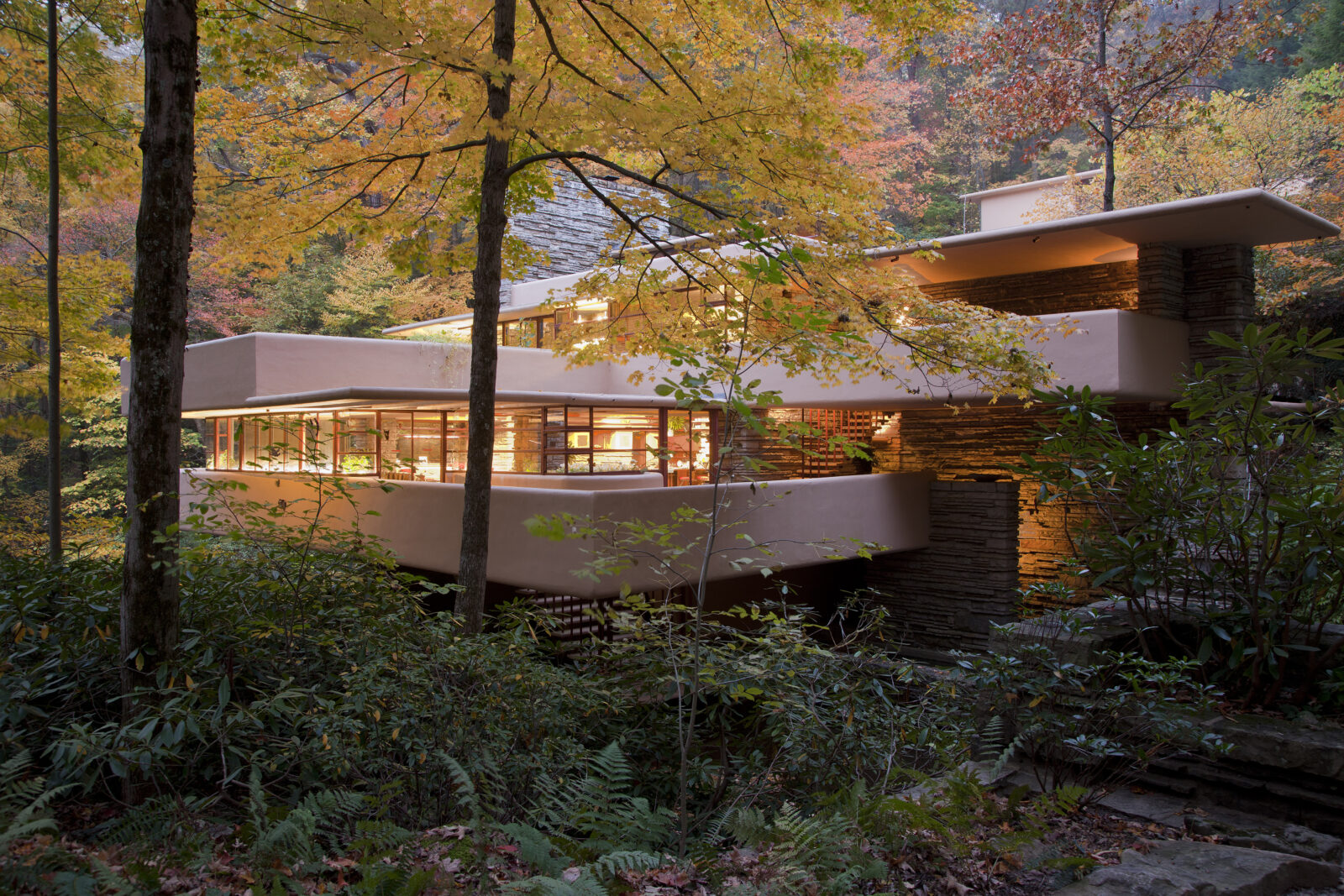
Table of Contents Show
Frank Lloyd Wright’s organic architecture is a design philosophy built on one central conviction: a building should grow from its site the way a plant grows from soil. Wright argued that structure, material, landscape, and human inhabitant are inseparable. Developed across a career spanning more than seven decades, this approach produced some of the most recognized buildings in American history and permanently altered how architects think about the relationship between construction and nature.
What Is Organic Architecture? Frank Lloyd Wright’s Core Principles
Wright first used the term “organic” to describe his work in a 1908 essay collection titled In the Cause of Architecture. He later refined the phrase into a guiding principle: “form and function are one,” consciously revising his mentor Louis Sullivan’s famous dictum that “form follows function.” To Wright, function and form were not cause and effect but a single unified expression.
The frank lloyd wright organic architecture philosophy rests on several interlocking ideas. A building should appear to belong to its specific site, not simply be placed upon it. Materials should be drawn from or respond to the immediate environment. Interior spaces should flow openly into one another and connect to the outdoors. Ornamentation, when present, should emerge from the structure itself rather than be applied as decoration. And the human scale should govern every decision, from ceiling height to window placement to the width of a corridor.
💡 Pro Tip
When studying Wright’s buildings for design inspiration, pay close attention to how he handled transitions between interior and exterior. He rarely used a single large window as a feature. Instead, bands of glass wrap corners, clerestories pull in indirect light from above, and covered terraces create ambiguous threshold zones that blur the boundary between inside and outside without sacrificing shelter. This spatial layering is far easier to adapt to contemporary projects than his specific stylistic gestures.
Wright also stressed that organic architecture was not about imitating nature visually. A building need not look like a leaf or a shell to be organic. The relationship is conceptual: the structure should respond to its particular climate, terrain, orientation, and the way its occupants actually live. Nature was his instructor for proportion, material honesty, and spatial sequence.
⚠️ Common Mistake to Avoid
Many students and practitioners confuse organic architecture with biomorphic design, assuming that curved walls or plant-like forms automatically qualify. Wright’s organic architecture is not about visual resemblance to nature. The Guggenheim’s spiral ramp is organic not because it looks like a nautilus shell, but because the entire spatial experience is derived from a single, coherent geometric idea that serves the act of viewing art. The philosophy is structural and spatial, not cosmetic.
Fallingwater, Pennsylvania: The Argument Made in Concrete
No single building makes the case for the organic architecture revolution more forcefully than Fallingwater. Completed in 1937 for the Kaufmann family of Pittsburgh on a wooded site in southwestern Pennsylvania’s Bear Run, the house is built directly over a waterfall rather than beside it. Wright reportedly told Edgar Kaufmann Sr. that he wanted the family to “live with the waterfall, as an integral part of their lives.”
The structure works through a series of reinforced concrete cantilevers that extend from a central stone core. Local Pottsville sandstone, quarried directly on the property, ties the building’s palette to the exposed rock formations in the stream bed below. The result is a building that reads as a continuation of the geological strata rather than an object placed in a landscape. The American Institute of Architects named Fallingwater the best all-time work of American architecture. In 2019, it was designated a UNESCO World Heritage Site as part of “The 20th-Century Architecture of Frank Lloyd Wright.”
📌 Did You Know?
Wright was 67 years old when he received the Fallingwater commission and had completed only two buildings in the preceding six years. He designed the entire house in roughly two hours on a single morning when Kaufmann called to announce an unexpected visit to Taliesin. Whether the story is entirely accurate is debated, but structural drawings produced that day closely matched the final built structure. Fallingwater’s opening in 1938 reversed Wright’s diminished reputation and triggered the most prolific decade of his career.
Fallingwater’s interior reinforces the same logic. A hatch in the living room floor opens directly to a suspended staircase descending to the stream. Built-in furniture keeps the rooms clear and directs attention outward. A boulder from the original site projects through the living room floor directly into the fireplace hearth because Wright refused to remove it during construction. That single gesture captures the philosophy in physical form: the building does not conquer its site, it collaborates with it.
In April 2026, Fallingwater reopened to the public following the completion of a three-year preservation campaign led by the Western Pennsylvania Conservancy, addressing structural movement in the cantilevers caused by decades of gravity and moisture. The building’s 90th anniversary year marks one of the most significant conservation milestones in modern American architectural history.
The Robie House, Chicago: Prairie Style as Proof of Concept
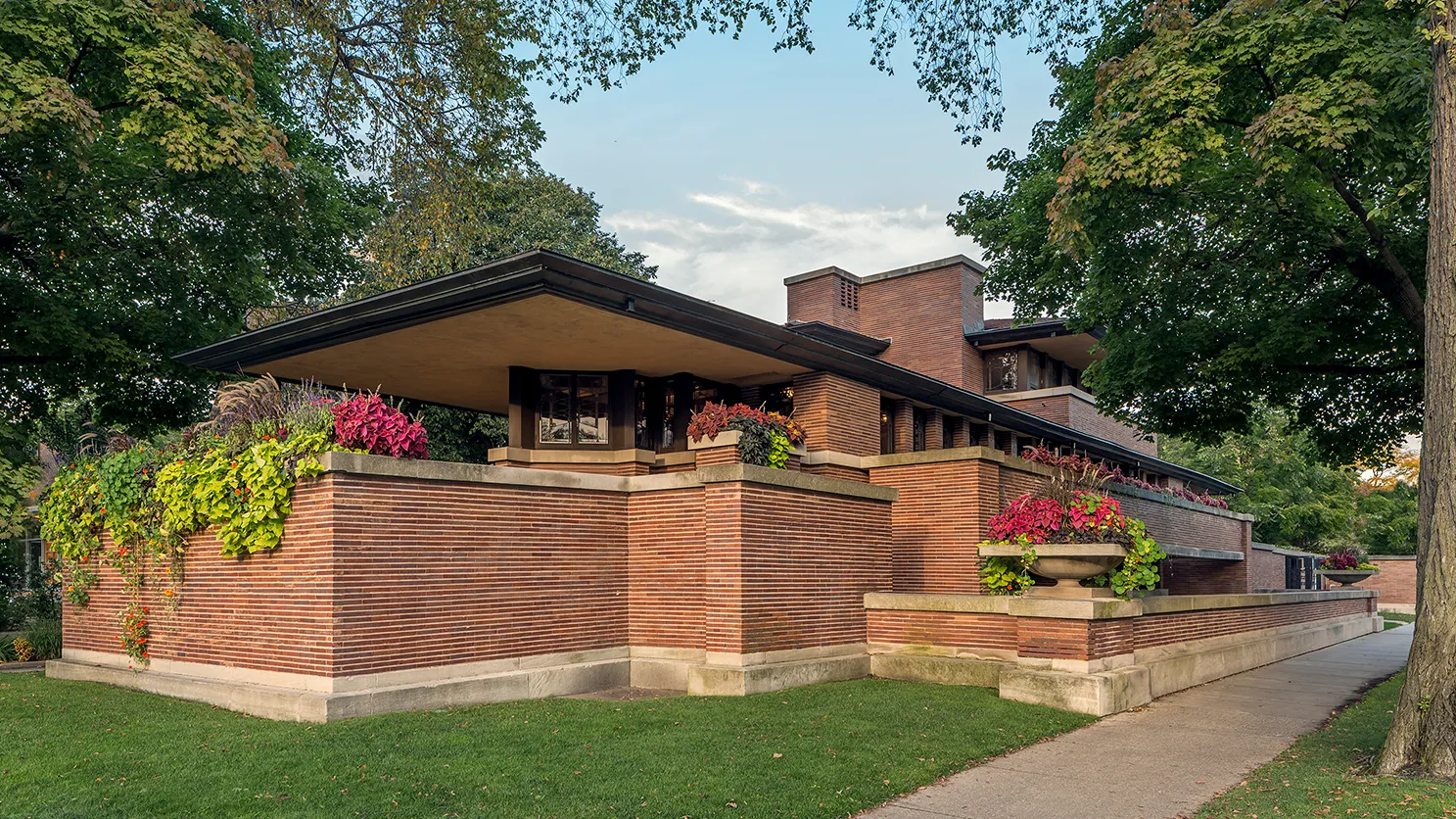
Wright completed the Robie House in Chicago in 1910, and it remains the definitive statement of his Prairie School period. The building’s long, horizontal profile responds directly to the flat Midwestern landscape: wide overhanging eaves, low-pitched rooflines, and bands of art glass windows running the full width of each facade emphasize the ground plane and tie the house visually to the horizon. Wright’s work for the Prairie School movement established the vocabulary he would refine over the next five decades.
The Robie House also introduced the open floor plan as a residential standard. Rather than dividing the main living level into a sequence of separate rooms, Wright organized the interior as a continuous space centered on a massive chimney block. Dining and living areas flow into each other, separated only by changes in ceiling height and the fireplace mass. This spatial approach later influenced mid-century modern residential design across North America and Europe.
How Did the Prairie Style Express Organic Architecture?
The Prairie house was organic in the specific sense that its form responded to its regional context. The Midwest landscape is characterized by wide horizons, flat terrain, and seasonal extremes. Wright’s horizontal lines mirrored the first, his wide roof overhangs addressed the second by providing shade and shelter, and his use of local brick tied the buildings materially to the soil they sat on. Each design decision had an environmental or site-specific rationale rather than a stylistic one.
Taliesin West, Arizona: Building from the Desert Itself
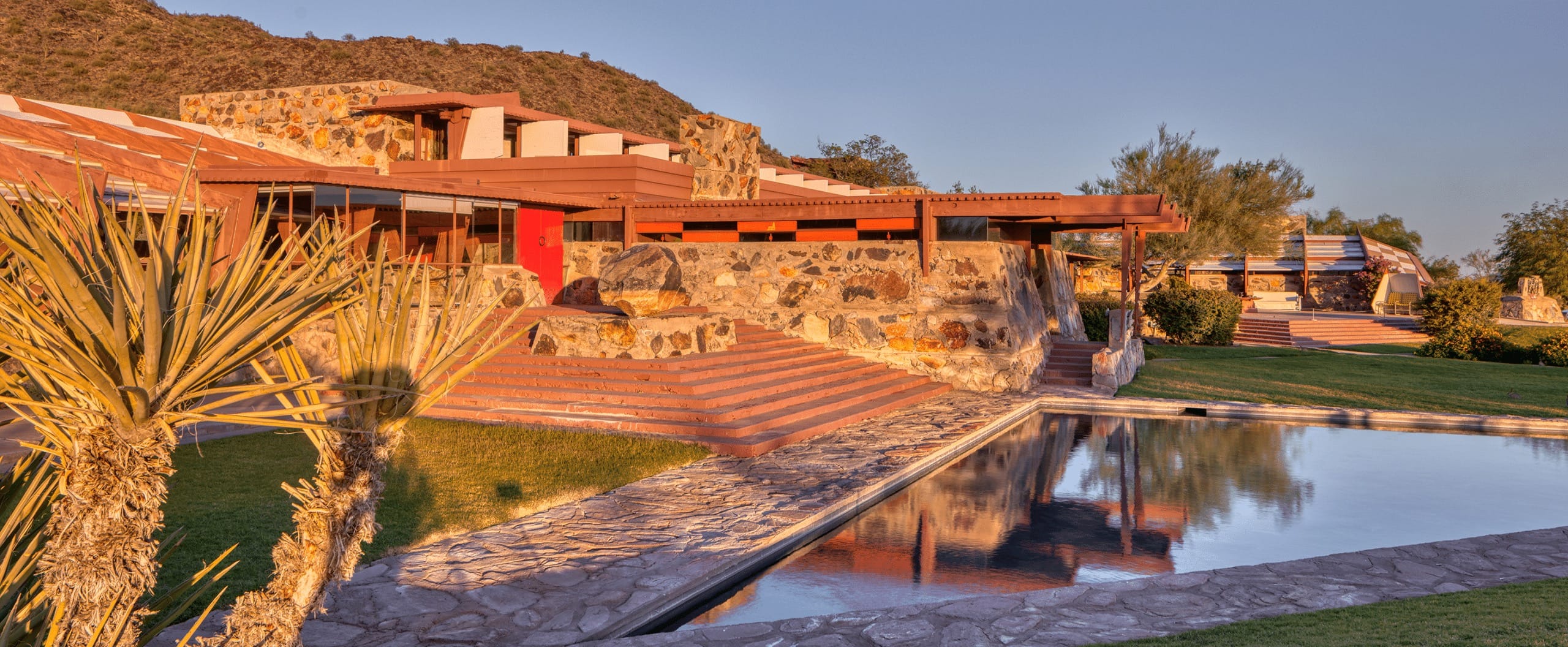
Wright began constructing his winter home and studio at Taliesin West in the Sonoran Desert near Scottsdale, Arizona in 1937, and continued to modify it until his death in 1959. The complex reads like an extension of the desert floor rather than a building placed upon it. Walls are built from desert rubble masonry, with local boulders and stones set directly into concrete, their rough surfaces left exposed. Colors throughout the complex echo the tawny reds, greys, and yellows of the surrounding landscape.
Taliesin West demonstrates the what is organic architecture frank lloyd wright question most directly for students: the site itself provides the building materials, determines the color palette, and informs the spatial organization. Roof structures are angled to respond to the intense Arizona sun. Drafting rooms open toward the northeast to bring in cool, diffuse light without direct solar gain. Covered walkways connect buildings and provide shade while maintaining the outdoor connection that the desert climate allows for much of the year.
🎓 Expert Insight
“I put a capital N on Nature and call it my Church.” — Frank Lloyd Wright
This statement, made by Wright in multiple interviews throughout his career, explains why Taliesin West reads less like a designed building and more like a discovered one. Wright genuinely treated the natural world as a primary source of formal and spatial authority. At Taliesin West, that conviction produced a complex whose built fabric is functionally indistinguishable from the landscape around it.
Johnson Wax Headquarters, Wisconsin: Organic Principles in an Urban Setting
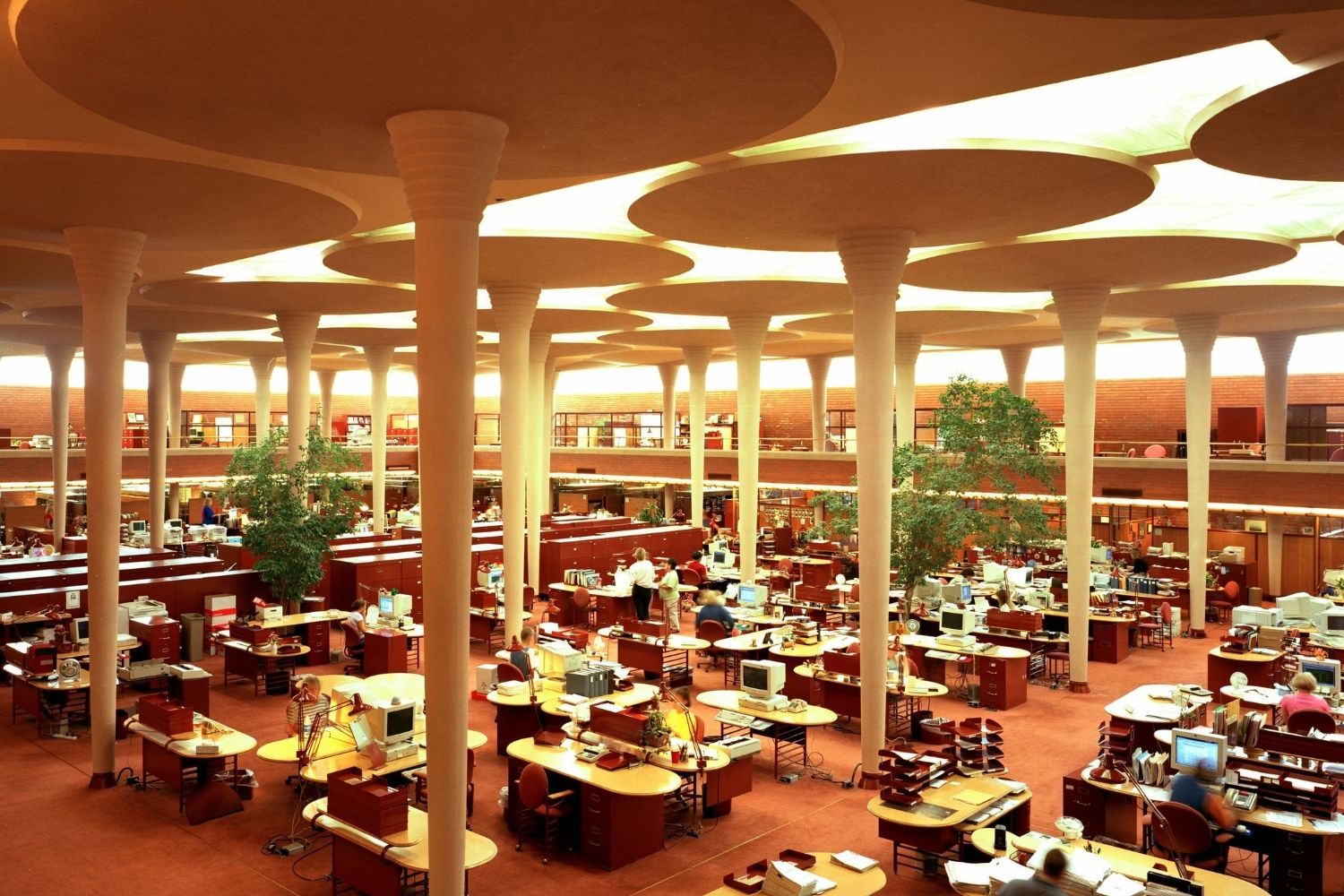
The Johnson Wax Headquarters in Racine, Wisconsin, completed in 1939, shows that the organic architecture revolution was not limited to rural or residential work. Wright designed the administration building to turn away from its industrial neighborhood by pulling all natural light from above. The defining element of the interior is a Great Workroom supported by tapered concrete columns Wright called “dendriform” columns, designed to resemble the tops of trees spreading upward to a glass and Pyrex tube ceiling.
The building has no conventional windows in its external walls. Light filters in through a continuous band of Pyrex glass tubing at the roofline and through the translucent ceiling of the workroom. The spatial effect is extraordinary: a large open-plan office that feels sheltered from the surrounding environment yet flooded with natural light, creating conditions more akin to working under a forest canopy than inside an office building. The Frank Lloyd Wright Foundation considers the Johnson Wax complex, including the Research Tower added in 1950, one of the architect’s most technically accomplished works.
🏗️ Real-World Example
Johnson Wax Administration Building (Racine, Wisconsin, 1939): When Wright submitted structural calculations for his dendriform columns to the Building Commission, they were rejected as inadequate. He proposed a test: load a single column to the required capacity of 12 tons. The tested column held 60 tons before the commission’s testing equipment ran out of weight. The columns were approved. This single episode captures how Wright’s organic forms derived their authority from structural performance, not from visual precedent.
Solomon R. Guggenheim Museum, New York: The Last Statement
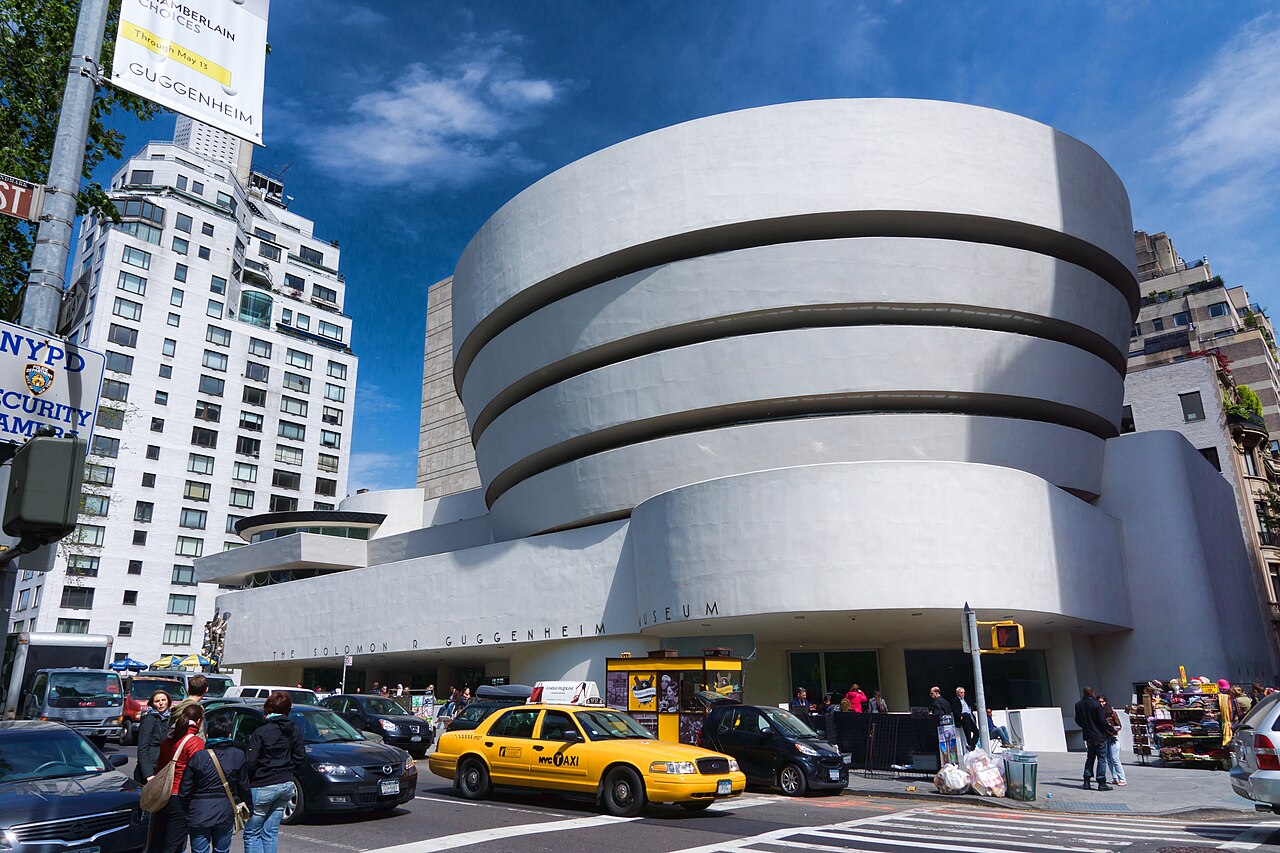
The Solomon R. Guggenheim Museum in New York, completed in 1959, the year Wright died, is his most radical departure from conventional building logic. Wright conceived the design in 1943 and spent 16 years refining it against objections from the city, the museum’s director, and a group of artists who signed an open letter protesting the building’s unusual interior. The result remains one of the most debated and visited buildings in the world.
The museum’s central feature is a continuous spiral ramp rising six stories around an open rotunda lit by a large skylight. Visitors take an elevator to the top and walk down, viewing art on the slightly sloping floors. Wright’s stated rationale was that this arrangement freed viewers from the conventional museum circuit, allowing them to move at their own pace through a single, continuous spatial experience. The Guggenheim’s own teaching materials describe the building as an expression of Wright’s organic philosophy: the entire structure is organized around one geometric idea, the spiral, drawn from natural form and developed consistently from the plan to the section to the elevation.
The building proved controversial among artists precisely because its sloping floors and curved walls complicated the display of rectangular canvases. This tension between the building’s spatial logic and the practical requirements of its program remains unresolved and is the subject of ongoing discussion in architectural criticism. Wright himself considered the completed building among his finest achievements.
The Lasting Influence of the Organic Architecture Revolution
Wright’s ideas entered mainstream architectural discourse gradually and unevenly. The European Modernists who dominated international practice during his lifetime, particularly Le Corbusier and Mies van der Rohe, pursued quite different ideals: abstraction, the machine aesthetic, and a universalism that deliberately avoided regional or site-specific responses. Wright’s counterargument, that architecture gains its authority from particularity rather than abstraction, took decades to receive full recognition.
Today, the organic architecture principles Wright articulated are central to the evolution of American architecture and increasingly mainstream globally. Biophilic design, which integrates natural materials, daylight, and views of nature into built environments, draws directly on Wright’s vocabulary. Passive house design and climate-responsive architecture apply his insistence that a building should respond to its specific site rather than operate as a generic object. The growing interest in vernacular materials and local construction techniques reflects his conviction that honest use of available materials produces better buildings than imported ones.
Wright designed more than 800 buildings over the course of his career, of which roughly 380 were built. He created an entirely new vocabulary for American residential design, demonstrated that civic and commercial buildings could operate by the same organic principles, and produced a body of theoretical writing that remains in active use in architecture schools. His influence on architects including Bruce Goff, Bart Prince, and the broader lineage of American regionalism is well documented. The organic architecture movement he founded continues to generate new work and new interpretations more than six decades after his death.
💡 Pro Tip
If you are incorporating organic architecture principles into a project, start with the site rather than the brief. Document the terrain, orientation, prevailing wind, natural drainage, existing vegetation, and visual connections before sketching a single line. Wright’s buildings work because the site analysis comes first. The floor plan and section are responses to specific conditions, not generic diagrams adjusted to fit a location.
✅ Key Takeaways
- Frank Lloyd Wright’s organic architecture philosophy treats buildings as extensions of their natural sites rather than objects placed upon them. Form and function are inseparable, not sequential.
- Fallingwater (1937) remains the most cited example of the philosophy in practice. Its cantilevers, site-quarried stone, and placement over a waterfall demonstrate every core principle simultaneously.
- The Robie House (1910) established the Prairie Style as a regionally specific response to the Midwestern landscape. Horizontal lines, open plans, and integration with the site were not stylistic preferences but environmental reasoning.
- The Guggenheim Museum (1959) shows that organic principles operate at an urban and institutional scale, not only in residential or natural settings.
- Contemporary biophilic design and passive house practice both draw on the vocabulary Wright developed, confirming that his ideas are not historically limited but actively generative.





The Shard London: How Renzo Piano’s Glass Tower Redefined the City Skyline
Standing at 309.6 metres in Southwark, the Shard is the United Kingdom's...
Furkan Sen6 Mins read
10 Best Pavers for Driveway (2026)
Table of Contents Show 1. Techo-Bloc: Blu 80mmWhy Choose Techo-Bloc Blu 80mm...
 illustrarch Editoral Team8 Mins read

Architecture Inside Out: How High-Tech Buildings Turned Structure Into Spectacle
From the Centre Pompidou in Paris to Norman Foster's HSBC tower in...
Furkan Sen6 Mins read
Best Examples of Modern Architecture: Steel and Glass Buildings That Shaped a Movement
Six buildings changed architecture forever by proving that steel and glass could...
Furkan Sen7 Mins read


Leave a comment