

Sydney Opera House and the World’s Greatest Opera Houses: Architecture That Performs
From Jørn Utzon's shell-form Sydney Opera House to Zaha Hadid's fluid Guangzhou Opera House, this article examines six landmark performance venues, covering their structural innovations, acoustic approaches, and lasting influence on how cities commission and experience architecture.
 Furkan Sen17 April 202611 Mins read224
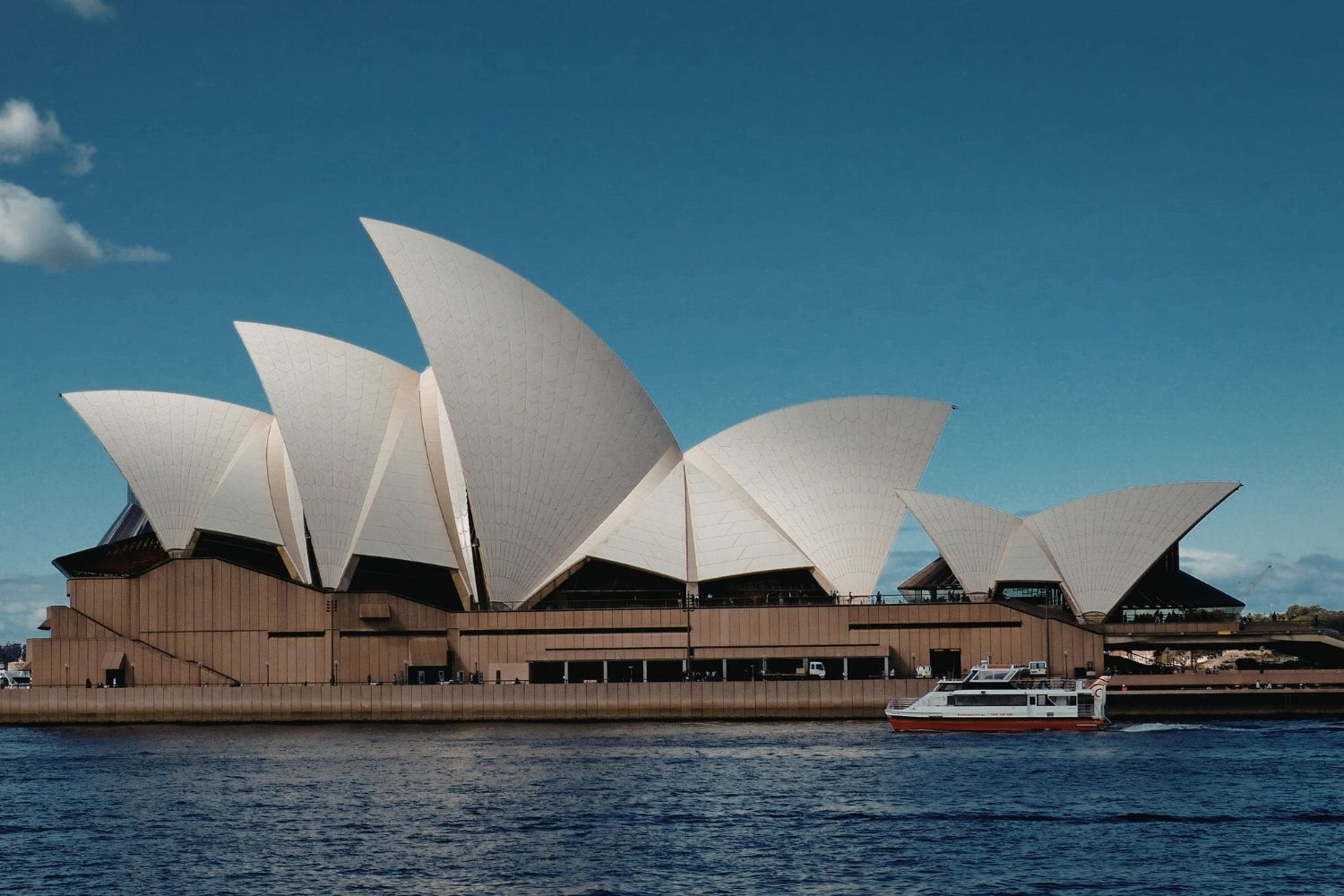
Table of Contents Show
The Sydney Opera House stands as one of the most recognizable structures ever built, a building where sculptural ambition and civic purpose meet on the edge of a harbor. Opera houses, more than almost any other building type, demand that architecture rise to the occasion: they must serve acoustics, stagecraft, public gathering, and symbolic representation all at once. Across six continents, these buildings reveal how each era, culture, and city has answered that challenge differently.
What Makes an Opera House Architecturally Significant?
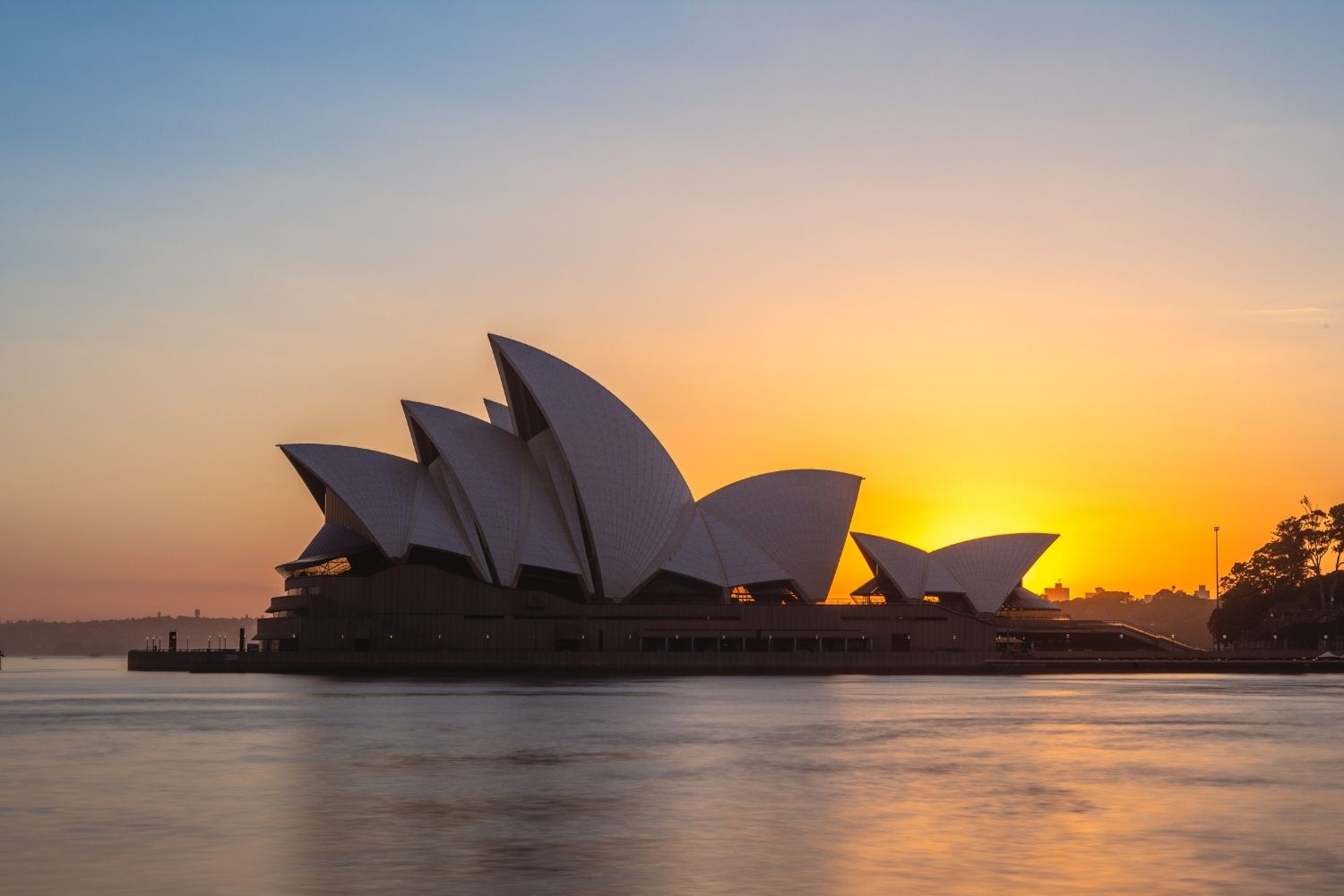
An opera house is not simply a large auditorium. The building type carries centuries of accumulated requirements: sightlines calibrated for thousands of seated audience members, backstage machinery for elaborate sets, circulation systems that move performers and patrons without collision, and an acoustic environment engineered to carry unamplified voices to the back row. All of this must be housed within a structure that also functions as a public monument.
The tension between these demands has produced some of the most inventive structural and spatial thinking in architectural history. When a city commissions an opera house, it is often commissioning a statement about cultural aspiration as much as a functional venue. That is why the buildings in this article were so fiercely debated during their design and construction phases, and why they remain reference points for architects studying the relationship between form, performance, and place.
💡 Pro Tip
When studying opera house architecture, pay close attention to the horseshoe auditorium plan. This shape, refined over centuries of European theater design, concentrates reflected sound energy toward the stage and wraps audiences in a shared acoustic field. Buildings that abandon it, as the Sydney Opera House partly did, typically invest heavily in electronic enhancement or acoustic panels to compensate.
Sydney Opera House: The Building That Changed Architecture
Few buildings have demanded as much from their architect, their engineers, and their city as the Sydney Opera House. Jørn Utzon won the 1956 international design competition with a proposal so radical that it could not yet be built. The famous shell-form roofs, which from different angles suggest sails, oyster shells, or slices of a sphere, required years of geometric research before a viable structural solution emerged. Utzon eventually solved the problem by deriving all shell surfaces from a single sphere of constant radius, a discovery that allowed precast concrete ribs to be manufactured from a single mold and assembled into vaults of varying size.
The building sits on Bennelong Point, a promontory in Sydney Harbour where it is visible from land, sea, and air. Utzon treated the platform base as a podium in the tradition of Mayan temple terraces, raising the performance venues above the city and creating a roof terrace that functions as a public civic space. The scale is deceptive: the Opera House contains not one auditorium but seven performance venues, along with rehearsal studios, restaurants, and bars spread across its 183,000 square meters.
📌 Did You Know?
The Sydney Opera House was originally budgeted at AUD 7 million and expected to open in 1963. The final cost reached AUD 102 million, funded largely through a dedicated state lottery, and the building opened in 1973, ten years behind schedule. UNESCO inscribed it as a World Heritage Site in 2007, only 34 years after completion, one of the fastest inclusions on record for a modern building.
Utzon himself never saw the completed building. Political conflict with the New South Wales government forced his resignation in 1966, before the interiors were finished, and he never returned to Australia. The Concert Hall and Opera Theatre were completed by a local team of architects working from Utzon’s incomplete drawings. The interiors have long been considered the weakest aspect of the building, a fact that prompted a major interior renewal program led by Utzon’s son Jan, conducted from 2003 until Utzon’s death in 2008. For a detailed exploration of Utzon’s design principles and structural solutions, see our dedicated guide on Sydney Opera House architecture.
Palais Garnier: Paris and the Theatre of Spectacle
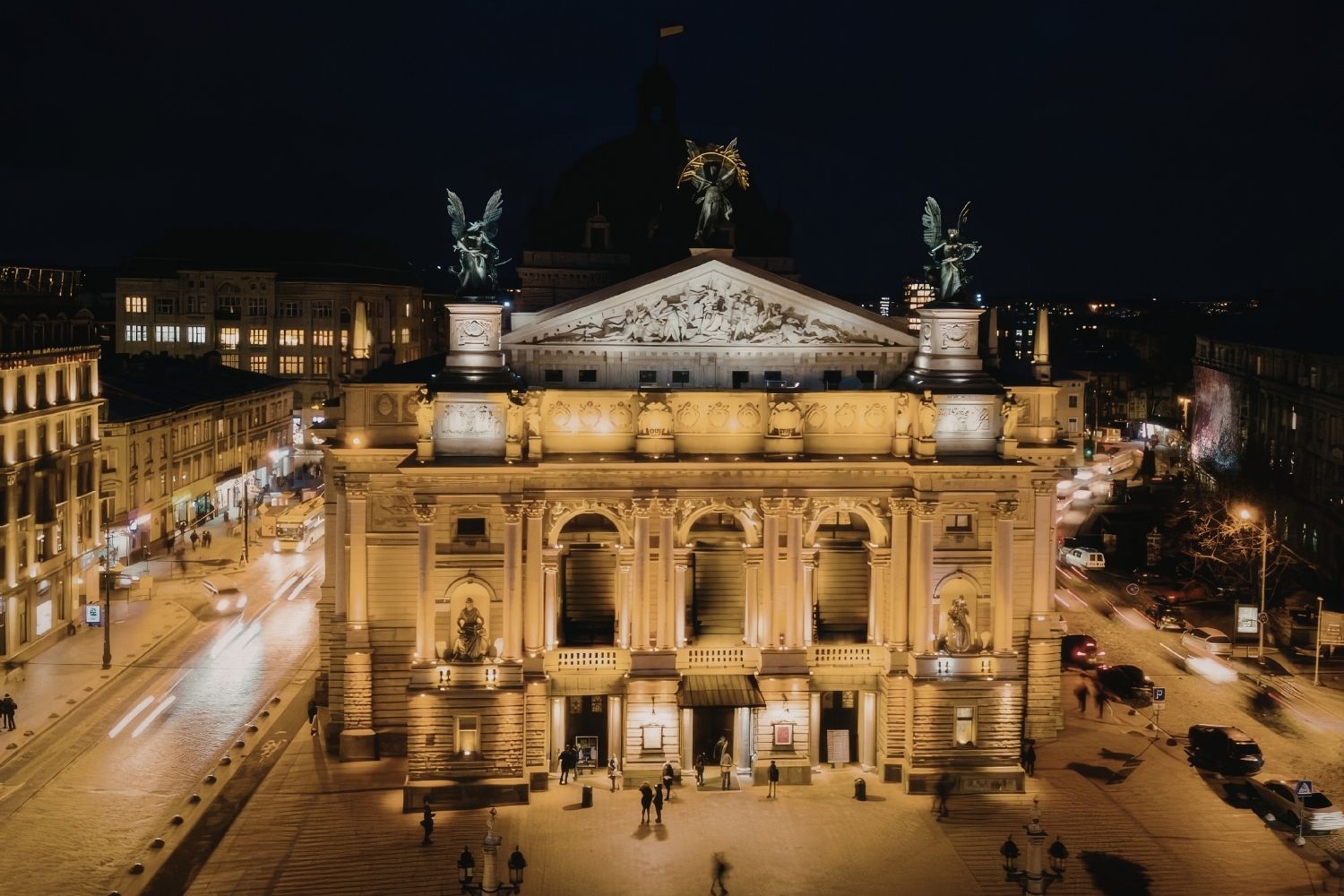
The Palais Garnier in Paris represents a fundamentally different idea about what an opera house should be. Completed in 1875 after fifteen years of construction, Charles Garnier’s building was conceived under Napoleon III’s transformation of Paris by Baron Haussmann. The opera house was not merely a venue but an instrument of urban order: its avenue, the Avenue de l’Opéra, was cut through old Paris to create a processional approach terminating at Garnier’s facade.
The exterior combines Neo-Baroque and Beaux-Arts vocabulary with sculptural programs of extraordinary richness: allegorical figures, busts of composers, gilded friezes, and polychrome marble columns crowd every surface. The famous grand staircase inside is arguably the most theatrical civic space in Europe, a hall designed as much for the audience to see and be seen by each other as for movement between floors. Garnier famously declared that his building belonged to no historical style, but was “style Napoleon III,” a deliberate synthesis rather than a revival.
🎓 Expert Insight
“The staircase is not a means of reaching the upper floors. It is the spectacle itself.”
Charles Garnier, architect
Garnier’s remark captures something essential about 19th-century opera house design: the social ritual of attendance was as architecturally scripted as the performance. The Palais Garnier remains the clearest built expression of this idea, and it continues to influence theater designers who want their lobbies and circulation spaces to function as destinations in themselves.
The auditorium seats approximately 1,900 people arranged around a horseshoe plan under a ceiling painted by Marc Chagall in 1964, a later addition that caused considerable controversy. The building still operates as a primary venue for the Paris Opera Ballet, while the larger Opéra Bastille, opened in 1989, handles most opera productions. The Paris Opera maintains both buildings as active performing arts venues.
Vienna State Opera: Imperial Authority and Living Tradition
The Vienna State Opera opened in 1869 as the Hofoper, the court opera of the Habsburg Empire, and immediately attracted criticism. Emperor Franz Joseph reportedly found it too low to the street grade after the Ringstrasse had been raised during construction, a remark that was said to have hastened the death of one of its architects, Eduard van der Nüll, who took his own life before the building opened. The story, possibly apocryphal, illustrates the intensity of public feeling that opera house architecture could generate in 19th-century Vienna.
Designed by van der Nüll and August Sicard von Sicardsburg in the Neo-Renaissance style, the building presents a colonnaded loggia and arched arcade toward the Ringstrasse, with figurative sculpture in the tympana of its arches. The original auditorium was destroyed by Allied bombing in March 1945, and the rebuilt interior, reopened in 1955 with Beethoven’s Fidelio, adopted a more restrained postwar aesthetic than the original. The 1,709-seat auditorium retains the horseshoe plan and five-tier gallery configuration of 19th-century opera house convention.
The Vienna State Opera is one of the world’s busiest opera companies, presenting more than 300 performances across approximately 60 productions each season. Its standing-room section, the Stehparterre and Stehgalerie, allows tickets to be purchased for a few euros on performance day, maintaining a tradition of broad public access that has defined Viennese opera culture for generations. The Wiener Staatsoper publishes its full schedule and streaming archive online.
⚠️ Common Mistake to Avoid
Many visitors conflate the Vienna State Opera with the Musikverein, Vienna’s famous concert hall. They are different buildings on different sites. The Musikverein, home of the Vienna Philharmonic and the annual New Year’s Concert, is a concert hall with no stage machinery or opera capabilities. The Vienna State Opera is the dedicated opera venue. Both are on the Ringstrasse, roughly 500 meters apart.
Royal Opera House: London’s Ongoing Reinvention
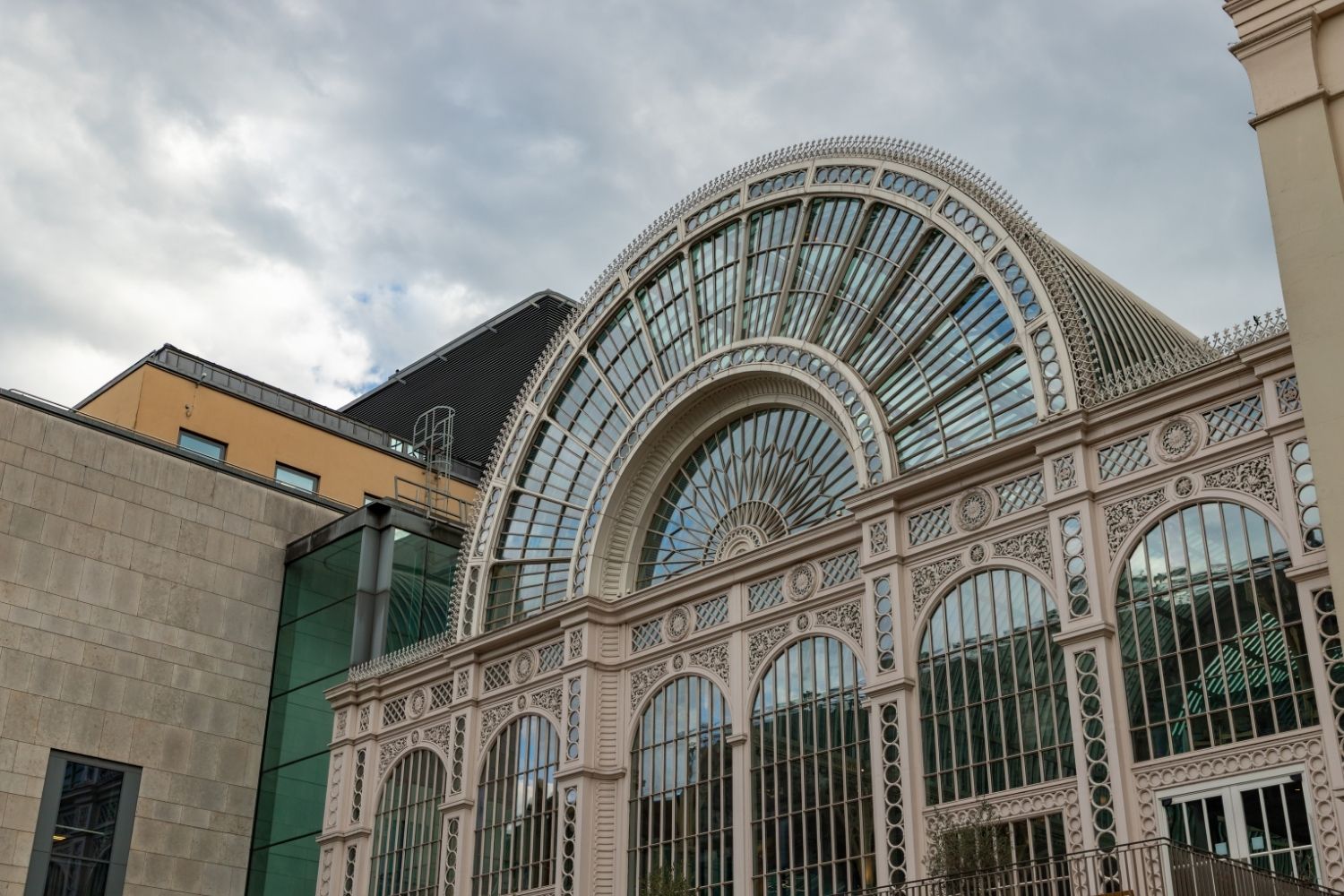
The Royal Opera House in Covent Garden is the third theater to occupy its site, following fires that destroyed predecessors in 1808 and 1856. The current building, designed by Edward Middleton Barry, opened in 1858 and has been substantially modified several times since. The most significant transformation came with the 1997 to 1999 redevelopment by architects Dixon Jones, which added the Floral Hall, a Victorian iron-and-glass market building that had been used as a banana warehouse, to the complex as a public foyer and bar. The result brought the previously inward-looking opera house into a visible, active relationship with the Covent Garden piazza for the first time.
The auditorium itself seats 2,256 people in a traditional horseshoe configuration with four tiers of balconies. Its acoustic character, warm and somewhat reverberant, suits the large-scale Italian and German opera repertoire that forms the core of the Royal Opera’s programming. The building also houses the Royal Ballet, and its stage is one of the largest in Britain, with a fly tower tall enough to store complete sets for multiple productions simultaneously.
The Royal Opera House has invested significantly in digital access, streaming productions and releasing filmed performances. Architecturally, the building’s relationship with the surrounding Covent Garden conservation area continues to shape debate about how historic performance venues can modernize without losing their connection to the urban fabric around them. For a broader look at how buildings interact with their cities, see our piece on iconic city views and the buildings behind them.
💡 Pro Tip
When visiting any historic opera house for architectural study, arrive well before curtain time and spend time in the public foyers and circulation spaces. These areas often reveal the building’s structural logic and its social ambitions more clearly than the auditorium itself. At the Royal Opera House, the Floral Hall atrium is the most architecturally legible space in the complex, showing the layered history of the building in a single room.
La Scala: Milan and the Architecture of Italian Opera
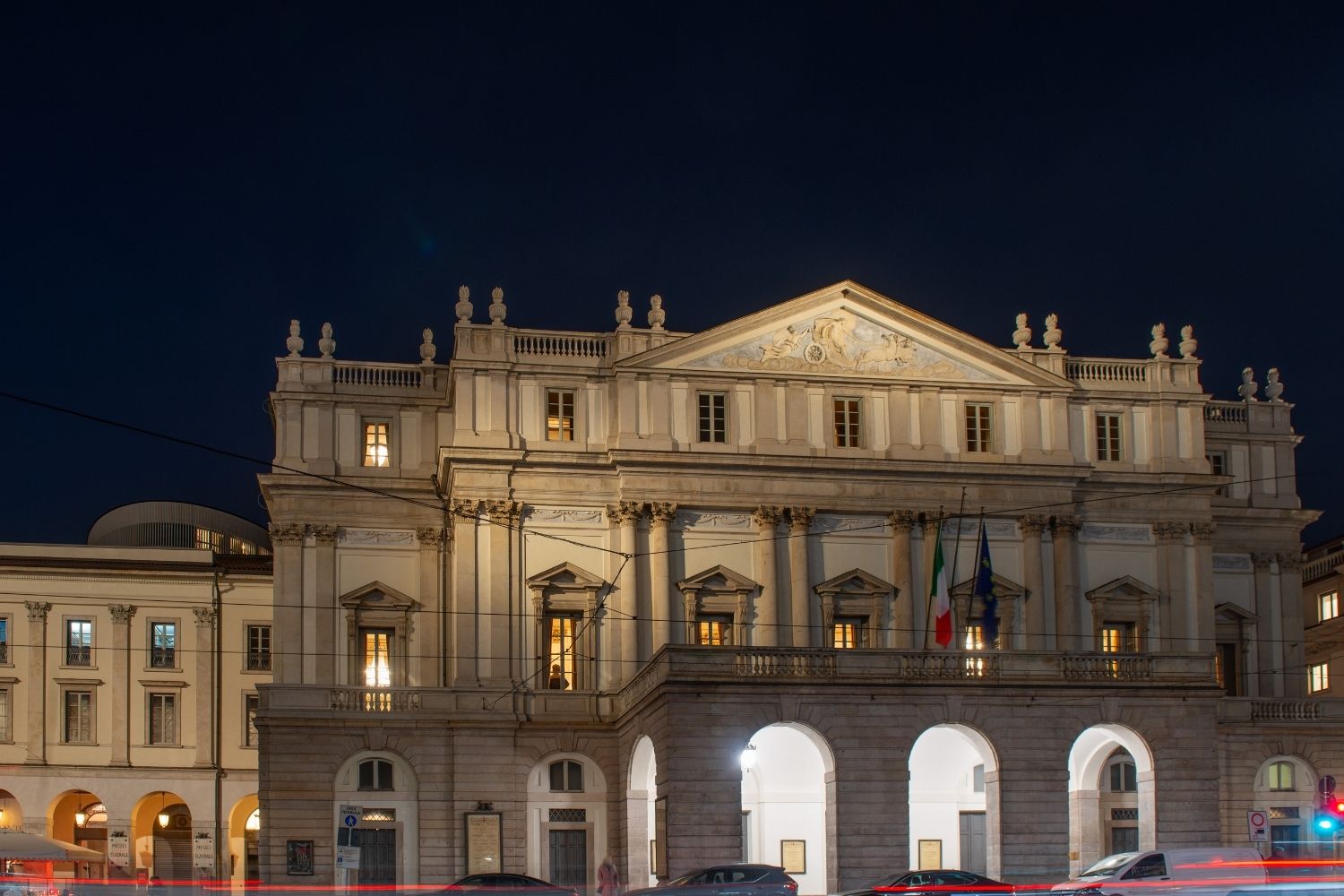
La Scala in Milan has been the benchmark for opera house acoustics since it opened in 1778. Designed by Giuseppe Piermarini in the Neoclassical style, the building replaced the Royal Ducal Theatre, which had burned down in 1776. The name comes from the church of Santa Maria alla Scala, which previously occupied the site. Piermarini’s exterior is relatively restrained by the standards of later opera houses: a pedimented central block flanked by two wings, with an arcade at street level. The real architecture is inside.
The auditorium follows the classic Italian horseshoe with six tiers of boxes rising to an open gallery, seating a total of approximately 2,030. This configuration, developed in Italian opera houses of the 17th and 18th centuries, produces a sound that wraps the audience from the sides as well as from the stage. The natural materials, wood and plaster rather than concrete or steel, contribute to an acoustic warmth that modern halls often struggle to replicate. La Scala was badly damaged by bombing in 1943 and rebuilt by 1946, reopening under the conductor Arturo Toscanini, who had been in voluntary exile from Italy during the Fascist period.
The Teatro alla Scala underwent a major structural renovation from 2002 to 2004, designed by Mario Botta. Botta added a new stage tower, rehearsal spaces, and a small museum while preserving the historic auditorium intact. The renovation was controversial, as most interventions in beloved cultural buildings are, but the building continues to operate as a reference point for both acoustic engineers and theater architects worldwide.
Guangzhou Opera House: Zaha Hadid and the New Opera House Typology
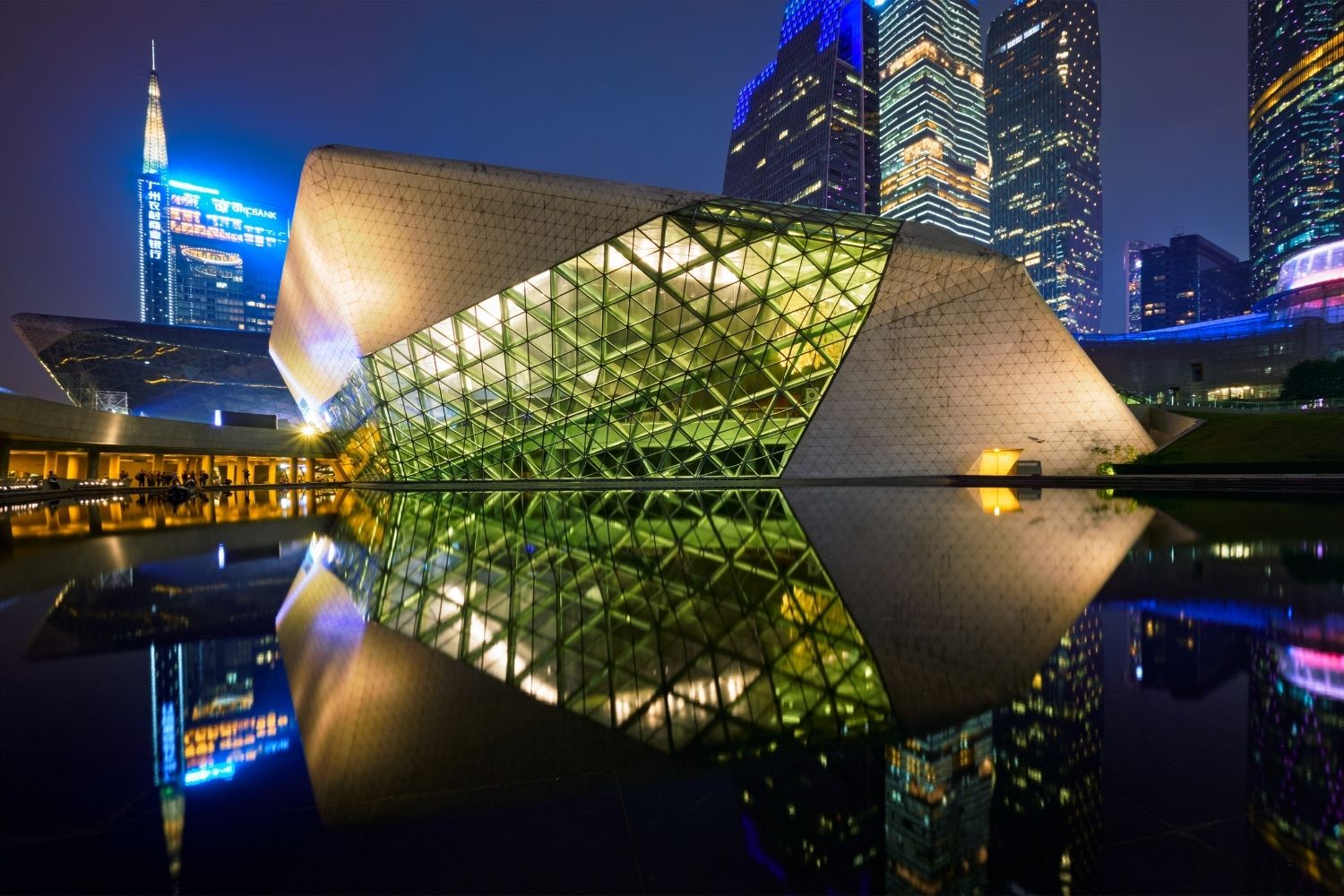
The Guangzhou Opera House, completed in 2010 and designed by Zaha Hadid Architects, represents a different approach to the building type from any of the preceding examples. Where Garnier and Barry worked within established historical conventions, and where Utzon broke from convention while still organizing his building around a clear formal idea, Hadid conceived the Guangzhou building as a fluid landscape object, shaped by principles drawn from geology and fluid dynamics rather than from theater tradition.
The building sits on the north bank of the Pearl River as part of a new cultural district, alongside a museum and a library. Its twin forms, described by Hadid as two pebbles worn smooth by a river, are clad in granite and glass panels whose angular facets read differently depending on angle and light. The main auditorium seats 1,800 people, with a second theater for 400. Internally, the building continues the external geometry: angled walls, non-parallel surfaces, and an absence of right angles throughout the public circulation spaces. This is architecture that rejects the perpendicular as a default condition.
🏗️ Real-World Example
Oslo Opera House (Oslo, 2008): Snøhetta’s Opera House for the Norwegian National Opera and Ballet introduced a new model for civic engagement that influenced subsequent opera house design globally. The building’s sloping white marble roof functions as a public plaza, accessible by foot from street level, integrating the building into the waterfront without fencing or barriers. More than 4 million people visit the exterior per year, the majority of whom never attend a performance. The Busan Opera House, currently under construction in South Korea, directly cites the Oslo model as an influence on its own publicly accessible rooftop design.
The Guangzhou Opera House attracted criticism during and after construction for the difficulty of building its complex geometry to the required tolerances, with visible gaps appearing between cladding panels in early years. These were subsequently repaired, and the building now operates as one of China’s premier performing arts venues. The Zaha Hadid Architects project page documents the design process and structural approach in detail. For a broader look at how Hadid and her contemporaries redefined architectural possibility, see our profile of the 20th century’s most influential architects.
How Opera Houses Shape Cities
Opera houses rarely stand alone. They tend to generate cultural districts around them, drawing museums, concert halls, hotels, and restaurants into proximity. The Ringstrasse in Vienna organized an entire urban boulevard around cultural institutions including the State Opera. Covent Garden exists as a destination in part because of the Royal Opera House’s gravity. Sydney’s Circular Quay and the area around Bennelong Point have been shaped by the Opera House’s presence for five decades.
This urban generative capacity means that opera house architecture is rarely assessed on purely aesthetic or acoustic grounds. The question of what a new opera house does to its neighborhood, and to the people who live there, is increasingly central to how these buildings are commissioned and designed. The trend toward publicly accessible rooftops and ground-level plazas, visible in Oslo and now being developed in Busan and Shanghai, reflects a deliberate attempt to counter the traditional image of the opera house as an exclusive institution. See our coverage of the Busan Opera House by Snøhetta for a detailed look at how this approach is being applied in one of the major opera house projects currently under construction.
🔢 Quick Numbers
- Palais Garnier took 15 years to build (1860-1875) and cost 36 million francs, equivalent to several hundred million euros today (Paris Opera archives)
- The Sydney Opera House contains over 1 million roof tiles, manufactured in Sweden and self-cleaning due to their glazed surface (Sydney Opera House Trust)
- La Scala has hosted world premieres of more than 450 operas since 1778, more than any other opera house in the world (Teatro alla Scala)
- The Royal Opera House’s 1997-1999 redevelopment cost £214 million and added 12,000 square meters of new public space to the complex (Dixon Jones architects)
Acoustic Design: The Hidden Architecture of Opera Houses
Every design decision in an opera house, from the angle of a balcony face to the texture of a plaster wall, affects how sound moves through the space. The acoustic brief is typically the most technically demanding constraint an opera house architect faces, and it is also the one that is hardest to verify until the building is complete and occupied. Getting it wrong means the difference between a venue that supports unamplified singing and one that requires electronic reinforcement, a distinction that matters enormously to opera companies and audiences alike.
The traditional horseshoe auditorium, with its curved balcony faces and modest volume relative to seat count, evolved not by acoustic theory but by pragmatic trial over centuries of Italian opera house building. The geometry concentrates lateral sound reflections toward the audience, producing the enveloping warmth that conductors and singers associate with historically successful venues. Modern acoustic consultants, firms like Arup Acoustics and Nagata Acoustics, use computational modeling to verify designs before construction and can specify materials, surfaces, and geometries with precision that was not available to Garnier or Piermarini. The Acoustical Society of America publishes peer-reviewed research on concert hall and opera house acoustic design for anyone wanting to go deeper into the technical literature.
For architects interested in how acoustic and structural requirements interact in major cultural buildings, the Sydney Opera House is the most studied case. Its Concert Hall, designed with fixed concrete shell geometry rather than an adjustable acoustic canopy, required extensive retrofitting after opening. A permanent acoustic upgrade completed in 2022 added a new reflector system above the stage and reoriented the organ, addressing problems that had persisted since the building opened in 1973.
✅ Key Takeaways
- The Sydney Opera House solved its shell geometry through a single-sphere derivation, allowing standardized precast components to form vaults of different sizes. Its acoustic shortcomings, however, required a major upgrade nearly 50 years after opening.
- The Palais Garnier and La Scala demonstrate that the horseshoe auditorium plan, refined over centuries of Italian theater building, remains a highly effective acoustic and spatial model that modern buildings still reference.
- The Vienna State Opera and Royal Opera House both underwent substantial post-war or late-20th-century modifications that added public space and updated facilities while preserving historic auditoriums.
- The Guangzhou Opera House represents the most radical formal departure from opera house convention, using geology-inspired geometry to produce a building that integrates performance and public landscape in a new way.
- Contemporary opera house design is increasingly evaluated on its contribution to public urban space, not only on acoustic and programmatic performance. Oslo, Busan, and Shanghai all demonstrate this shift toward civic integration.




Famous Buildings in Los Angeles: Icons of LA Architecture
Nine of the most famous buildings in Los Angeles profiled: architect, year,...
 illustrarch Editoral Team9 Mins read
Futuro House Production Revived in Finland After Decades-Long Hiatus
A Facebook listing for abandoned moulds led to the first new Futuro...
illustrarch Editoral Team3 Mins read
Building Your Dream Home in NSW: What You Should Know About Montgomery Homes
Montgomery Homes has been building across Sydney, Newcastle, the Hunter, Wollongong and...
illustrarch Editoral Team4 Mins read
Designing a Home Theater: Where Drapery Fits Into the Plan
In a media room the curtains are a performance layer, not decoration....
illustrarch Editoral Team3 Mins read


Leave a comment