

Imam Mosque of Isfahan: Symmetry, Color, and Sacred Urbanism
The imam mosque of isfahan, built between 1611 and 1630 under Shah Abbas I, stands as one of the most precisely engineered religious structures in Persian architectural history. Its double-shelled dome, seven-color tilework, and axial rotation toward Mecca make it an essential study in Islamic urban design and sacred geometry.
 Furkan Sen19 April 202610 Mins read212
Table of Contents Show
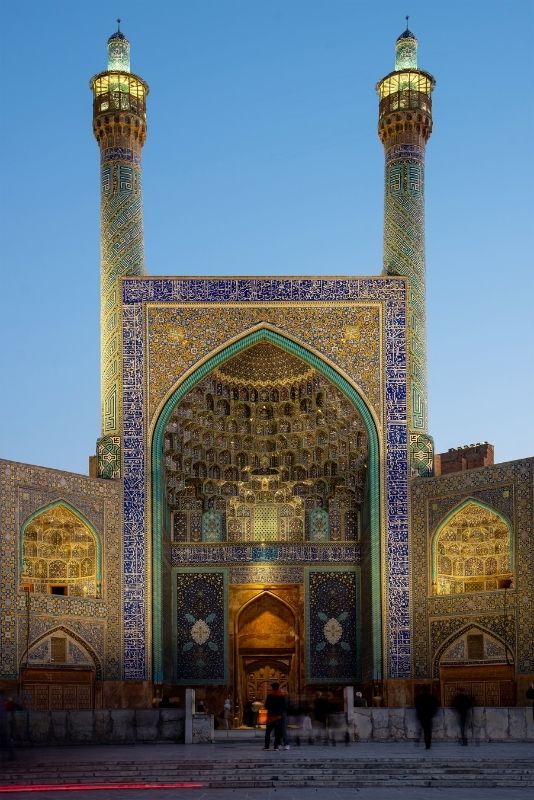
The imam mosque of isfahan is a 17th-century Safavid structure widely regarded as one of the finest examples of Persian Islamic architecture ever built. Commissioned by Shah Abbas I in 1611 and completed around 1630, it sits on the southern edge of Naqsh-e Jahan Square and resolves two competing spatial demands through a single, elegant geometric act: its entrance portal faces the civic square while the prayer hall rotates 45 degrees to align with Mecca.
Historical Context: Shah Abbas and the Transformation of Isfahan
When Shah Abbas moved the Safavid capital from Qazvin to Isfahan in 1598, he initiated one of the most ambitious urban planning programs in Persian history. The goal was clear: to build a city that could rival any capital in the Islamic world and, crucially, that could project Safavid authority against the Ottoman Empire to the west.
At the center of this vision was Naqsh-e Jahan Square, whose name translates roughly as “exemplar of the world.” Construction on the square began around 1590, though work on the shah mosque isfahan architecture itself, anchoring the square’s southern edge, did not start until 1611. The delay was partly practical: purchasing the necessary land took time. Construction was financed directly by Shah Abbas, and according to inscriptions inside the mosque, he dedicated it in honor of his ancestor Shah Tahmasb.
The primary architect named in the mosque’s foundation inscription is Ali Akbar Isfahani, with Badi al-Zaman-i Tuni credited for the building plans. Construction supervision fell to Muhibb Ali Beg Lala, who was also a major donor. The project cost a reported 60,000 tomans, a figure that reflects both its scale and the high standard of craftsmanship demanded. The mosque was substantially complete by around 1630, though decorative work continued under Abbas’s successors well into the 1630s and beyond, with inscriptions dating as late as 1095 AH indicating contributions from multiple Safavid reigns.
📌 Did You Know?
The imam mosque of isfahan is said to contain approximately 18 million bricks and 475,000 individual tiles. The construction cost of 60,000 tomans represented an enormous public investment for the period, reflecting Shah Abbas’s determination to make Isfahan’s central mosque the definitive statement of Safavid cultural power. The mosque is depicted on the reverse of Iran’s 20,000 rials banknote.
The Geometric Solution: Aligning Civic Space with Sacred Direction

Any serious study of isfahan architecture must address what is arguably the most instructive planning problem solved anywhere in the Islamic world: how to orient a congregational mosque toward Mecca when the square it faces points in a different direction.
Naqsh-e Jahan Square runs roughly north-south. Mecca, from Isfahan, lies to the southwest. The mosque’s architects resolved this by designing a bent entrance passage that subtly rotates visitors as they move from the portal into the main courtyard. The entrance iwan holds its civic alignment toward the square; the prayer hall and its celebrated dome turn approximately 45 degrees to face the qibla. From inside, the rotation is experienced as a natural, unhurried transition rather than an abrupt change of direction.
This solution has a practical bonus. Scholar Donald Wilber noted that by placing the prayer hall on a rotated axis, the mosque’s large dome remains prominently visible from the square. Had the hall been on the same axis as the entrance portal, the dome would have been partly obscured by the entrance itself. Geometry and visual urbanism align in one decision.
🎓 Expert Insight
“The handling of the qibla deviation in the Shah Mosque is perhaps the most instructive planning solution in Islamic architecture. The entrance portal holds its civic alignment, the prayer hall holds its sacred alignment, and the transition between them is resolved through geometry rather than forced.” — Robert Hillenbrand, Professor of Islamic Art, University of Edinburgh
Hillenbrand’s observation points to why the mosque continues to be studied in architectural education. It demonstrates that competing spatial obligations need not produce compromise; they can be the basis for sophisticated planning intelligence.
The plan itself follows the four-iwan configuration, a layout common to Iranian congregational mosques since the Seljuk period. Four vaulted halls open onto a central courtyard measuring roughly 70 by 70 meters. The courtyard holds a central reflecting pool, and two-story arcades line its perimeter. Two religious schools occupy the southwest and southeast corners, their domed chambers accessible through the eastern and western iwans. This arrangement echoes Timurid mosque design from Samarkand, an influence consciously drawn upon during the Safavid period. For a wider look at how Persian traditions shaped Islamic architecture across the region, see illustrarch’s analysis of the legacy of Ottoman architecture.
The Double-Shelled Dome: Structure, Acoustics, and Symbol
The mosque’s dome is its most celebrated single element, and for good reason. Rising 52 meters from the exterior and spanning roughly 25 meters in diameter, it is the largest dome in Isfahan and one of the tallest in Iran. Its double-shelled construction follows a Timurid structural model, with the inner and outer shells separated by a gap of 14 meters.
This gap is not merely a structural precaution. The engineer Sheikh Baha’i is credited with designing the dome’s acoustic properties so deliberately that a person speaking quietly beneath its center can be heard clearly throughout the prayer hall. The dome functions, in acoustic terms, like a focused reflector: sound travels up into the concave interior surface of the inner shell and is redirected back down and outward across the space. According to research published in the Turkish Online Journal of Design, Art and Communication (2016), the dome was designed to carry the imam’s voice to a congregation of up to 15,000 people without mechanical amplification.
📐 Technical Note
The imam mosque of isfahan’s main dome rests on a sixteen-sided base that transitions to the square prayer hall below, a structural sequence resolved through muqarnas squinches. The outer dome reaches 52 meters in height, the inner dome sits at approximately 38 meters, and the two shells are separated by a 14-meter gap. The portal minarets rise 33.5 meters; the entrance portal itself stands 27.5 meters tall. The main building block measures approximately 100 by 130 meters in plan.
The dome’s exterior is clad in vibrant turquoise tiles arranged in intricate arabesques and floral patterns, a reference to paradise gardens in Islamic tradition. By night, when Naqsh-e Jahan Square is illuminated, the dome’s silhouette becomes the most visible landmark in the city. Restoration work on the dome was completed in June 2024 following damage discovered in 2022, and a further phase targeting the middle portion of the dome’s tile decoration was announced in June 2025.
What Is the Haft Rangi Tilework of the Imam Mosque?

The shah mosque isfahan architecture made significant use of a technique called haft rangi, or “seven-color” tilework, which replaced the older, more time-consuming mosaic tile method. In traditional mosaic tilework, craftsmen cut individual pieces of single-color ceramic and assembled them into patterns on site. The haft rangi method painted multiple colors onto a single tile before firing, allowing complex decorative patterns to be produced far more quickly.
Shah Abbas required speed: he wanted to see the mosque completed within his own lifetime. The haft rangi approach made this possible. The seven colors used across the mosque’s surfaces are dark Persian blue, light Turkish blue, white, black, yellow, green, and a warm bisque tone. A broad band of religious inscriptions in white Thuluth script runs against a deep blue background around the main iwan, the work of calligrapher Alireza Abbasi. The covered halls received tiles in cooler yellowy-green hues, a deliberate tonal shift that distinguishes prayer spaces from transitional zones.
⚠️ Common Mistake to Avoid
Many visitors and students assume the imam mosque’s tilework was made using the same slow mosaic-cutting method seen in earlier Persian structures. In fact, Shah Abbas specifically adopted the haft rangi “seven-color” technique to accelerate production. The trade-off was subtle: haft rangi tiles are less durable in shadowed spaces where moisture collects, which is why most tile replacement since the 1930s has concentrated on the covered halls rather than the sun-exposed exterior surfaces.
The entrance portal carries the finest tile work in the entire complex. Muqarnas stalactite vaulting fills the recessed arch above the doorway, each honeycomb cell finished in mosaic tile rather than the faster haft rangi method. This deliberate choice signals the portal’s importance as the public face of the mosque and reflects a hierarchy of craftsmanship consistent across the architecture of isfahan.
Isfahan’s Urban Framework: The Mosque Within the Square
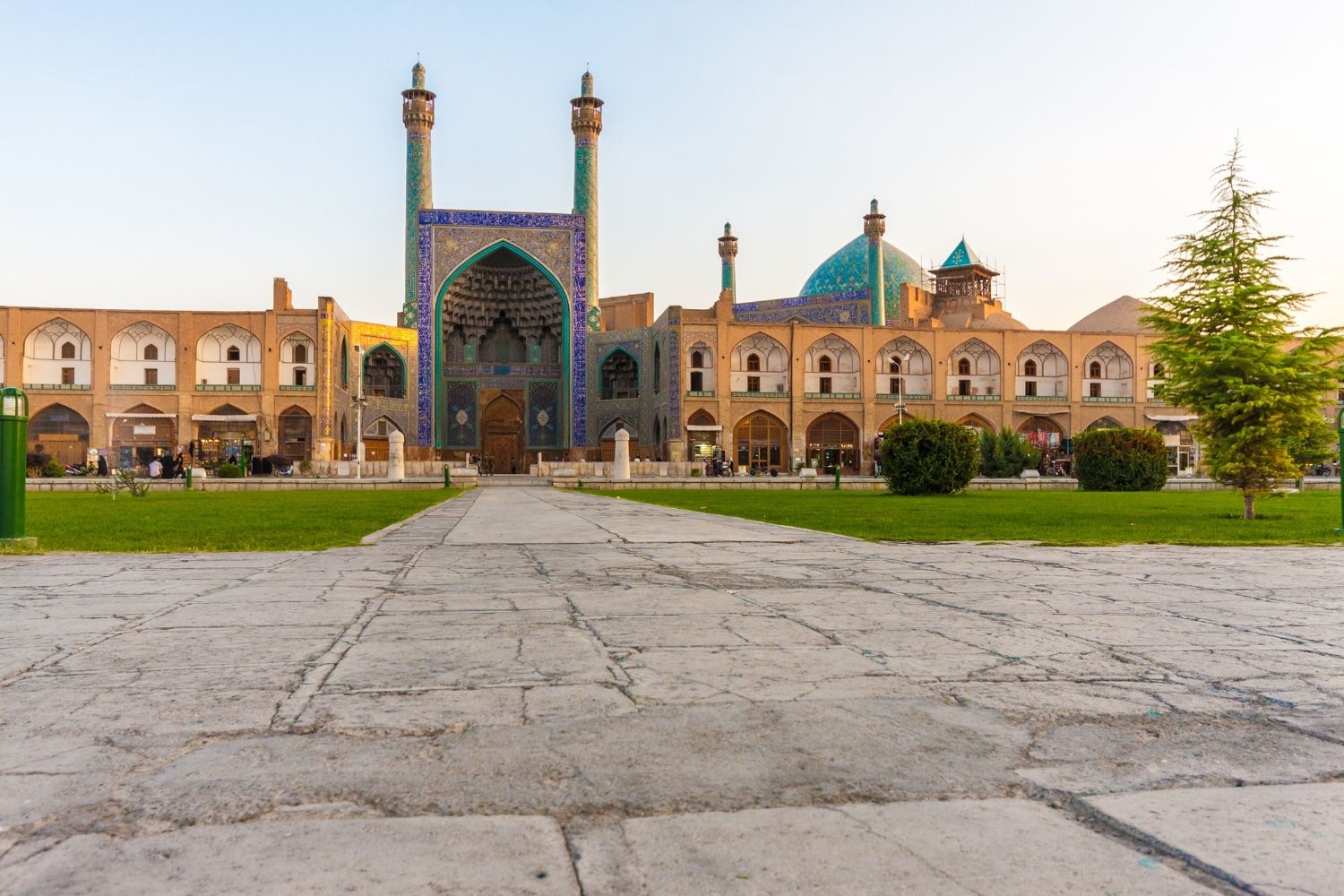
The imam mosque of isfahan cannot be understood in isolation from the urban system it anchors. Naqsh-e Jahan Square, a UNESCO World Heritage Site, measures approximately 512 by 159 meters and is one of the largest urban squares built anywhere in the pre-modern world. Along its four sides stand four major monuments: the Imam Mosque to the south, the Sheikh Lotfollah Mosque (a private royal mosque, without minarets) to the east, the Ali Qapu Palace to the west, and the northern gateway leading to Isfahan’s grand bazaar.
Each of these buildings represents a different facet of Safavid power: religious authority, royal ceremony, commercial wealth, and private devotion. The architecture of isfahan at this scale is essentially a diagram of how Shah Abbas organized the political and spiritual life of his empire into a single, unified public space. Where earlier Iranian capitals had distributed their power centers across different neighborhoods, Abbas concentrated everything around one square that could be seen, experienced, and controlled from the palace balcony.
The mosque’s monumental portal, oriented exactly opposite the bazaar gateway on the northern arcade, creates a clear visual axis across the full length of the square. Looking south from the bazaar entrance, the mosque portal frames the entire procession. This axial relationship between commerce and worship was intentional: it placed the mosque as the spiritual counterweight to the economic life of the city. For a broader perspective on how ancient Iranian cities used architecture to project political authority, see illustrarch’s piece on ancient Iran: cities, empires, and the foundations of urban life.
💡 Pro Tip
When studying the imam mosque of isfahan as an urban design case, approach it from the bazaar entrance at the north end of Naqsh-e Jahan Square first. This is the intended processional axis: the eye travels the full 512-meter length of the square before reaching the portal. Arriving directly at the mosque’s entrance skips the spatial sequence Shah Abbas designed and reduces one of architecture history’s great urban compositions to a close-up photograph.
Iran Architecture: The Safavid Legacy and Its Influence
The mosque’s influence on subsequent iran architecture and on mosque design more broadly has been substantial. Its four-iwan courtyard plan, its double-shelled dome engineering, and its systematic use of tilework as both structure and ornament were widely emulated across the Islamic world during the 17th and 18th centuries. The Taj Mahal, completed in 1648 under Mughal patronage, draws directly on the Persian double-dome tradition refined at Isfahan. The Blue Mosque in Istanbul, built just two years before construction began on the Imam Mosque, reflects the same Safavid-Ottoman architectural rivalry that motivated Shah Abbas’s entire building program.
Within Iran, Isfahan’s broader architectural heritage represents a distinct tradition that remained influential for centuries. The city’s combination of garden design, urban planning, tile manufacture, and structural engineering created a model of integrated spatial thinking that later Persian architects returned to repeatedly. Contemporary Iranian architecture continues to draw on this vocabulary. Projects such as the House of Raaz in Tehran, which reinterprets Persian courtyard traditions for modern residential design, demonstrate how the spatial and material legacy of Safavid Isfahan continues to shape architectural practice today.
For anyone studying architecture in iran or Islamic architecture more broadly, the Imam Mosque sits alongside the Sheikh Zayed Grand Mosque (which synthesized Persian design traditions into a 21st-century structure) and the Great Mosque of Djenné as one of the essential case studies in how sacred buildings can function simultaneously as urban anchors, structural experiments, and cultural statements. See illustrarch’s in-depth profiles of both the Sheikh Zayed Grand Mosque and the Great Mosque of Djenné for comparative analysis.
💡 Pro Tip
Students of Islamic architecture often study the Imam Mosque alongside the Sheikh Lotfollah Mosque directly across the square. The two buildings were built during roughly the same period and under the same patron, yet their programs are completely different: one is the largest public Friday mosque in the city, the other is an intimate royal chapel with no minarets and no courtyard. Comparing them reveals how Safavid architects could adapt the same decorative vocabulary to radically different spatial programs.
What Makes the Imam Mosque Architecturally Significant Today?

Centuries after its construction, the imam mosque of isfahan remains in active use as a Friday mosque and continues to attract architects, historians, and travelers from around the world. Several of its design decisions remain genuinely instructive for contemporary practice.
The first is its acoustic engineering. The relationship between dome geometry and sound amplification, achieved without any mechanical system, represents a level of environmental design intelligence rarely matched in pre-modern construction. The second is its urban positioning. The mosque demonstrates that a major religious building can serve a civic function simultaneously, acting as both a spiritual destination and a visual anchor for a large public square. The third is its geometric resolution of competing orientations, a design challenge that contemporary architects continue to encounter when sacred requirements conflict with urban context. For a broader exploration of how this challenge has been addressed across different traditions, illustrarch’s piece on the dialogue between Islamic architecture and modern design covers several relevant contemporary case studies.
The mosque was added to Iran’s National Heritage List in January 1932 and was designated a UNESCO World Heritage Site as part of the Naqsh-e Jahan Square ensemble. It appears on the reverse of the Iranian 20,000 rials banknote. Restoration work continues: a major dome repair was completed in June 2024 and a further phase targeting tile decoration was underway as of 2025. For current visitor information and UNESCO documentation, the UNESCO World Heritage listing for Meidan Imam, Isfahan provides authoritative reference. The mosque is also documented in depth on Archnet, the leading academic resource for Islamic architecture, and in the broader context of Persian architectural heritage on Encyclopaedia Iranica.
✅ Key Takeaways
- The imam mosque of isfahan was built between 1611 and 1630 under Shah Abbas I as part of a deliberate program to make Isfahan the political and cultural capital of the Safavid Empire.
- Its entrance portal aligns with Naqsh-e Jahan Square while the prayer hall rotates roughly 45 degrees to face Mecca, a geometric solution that remains one of the most studied examples of spatial planning in Islamic architecture.
- The double-shelled dome, with a 14-meter gap between shells, was engineered to carry the imam’s voice across the prayer hall without amplification, a deliberate acoustic design attributed to Sheikh Baha’i.
- The haft rangi “seven-color” tilework was chosen for speed of production, allowing Shah Abbas to see the mosque completed within his lifetime; the technique covers approximately 475,000 individual tiles across the structure.
- The mosque functions not only as a religious building but as an urban anchor, positioned on the south axis of one of the largest pre-modern public squares in the world, directly opposite the main bazaar entrance.
- Its structural and decorative solutions directly influenced the Mughal building tradition, including the Taj Mahal, and continue to inform contemporary mosque design worldwide.





Aspendos Excavation Uncovers 6,000-Year-Old Settlement Traces Near Antalya
Digs beneath Aspendos shop floors turned up Chalcolithic pottery and tools, pushing...
 illustrarch Editoral Team2 Mins read
Relocated Maya Structures at Mexico’s Balam Tun Memory Park Face Legal Challenge
INAH archaeologists have filed a complaint against 26 officials over Balam Tun...
illustrarch Editoral Team2 Mins read
Futuro House Production Revived in Finland After Decades-Long Hiatus
A Facebook listing for abandoned moulds led to the first new Futuro...
illustrarch Editoral Team3 Mins read
Allies and Morrison Win Approval to Restore Barbican Sculpture Court
City of London Corporation approves Allies and Morrison's plan to restore the...
illustrarch Editoral Team2 Mins read


Leave a comment