

The World’s Most Iconic Supertall Towers: Engineering, Design, and Skyline
From the record-breaking Burj Khalifa to the spiraling Shanghai Tower and the symbolic One World Trade Center, this guide profiles the most iconic supertall towers on Earth, revealing the structural innovations and design visions behind each one.
 Furkan Sen28 February 20268 Mins read251

Table of Contents Show
The world’s most iconic supertall towers do more than pierce the clouds. They tell stories of ambition, innovation, and the relentless human desire to build higher. A supertall tower is defined by the Council on Tall Buildings and Urban Habitat (CTBUH) as any building exceeding 300 meters in height, and today there are over 190 of them standing worldwide. Each represents a distinct engineering challenge, a cultural statement, and a vision for the future of cities. This guide profiles seven of the most remarkable supertall towers ever built, exploring the architecture of supertall tower design, the architects behind them, and the structural systems that keep them standing against wind, gravity, and seismic forces.
Burj Khalifa: The Unrivaled Giant of Dubai

No conversation about supertall towers begins without the Burj Khalifa. Standing at 828 meters with 163 occupiable floors, it has held the title of the world’s tallest building since its completion in 2010. The tower was designed by Adrian Smith while at Skidmore, Owings & Merrill (SOM), a firm that has shaped the skylines of cities across the globe.
The architecture of supertall tower construction reached a turning point with the Burj Khalifa. Its Y-shaped floor plan, known as the “buttressed core” system, was developed by structural engineer William F. Baker. Each of the three wings braces the others, creating a structure that resists twisting and distributes wind loads across multiple axes. The building tapers as it rises through a series of 27 setbacks, which disrupt organized wind vortices and prevent them from applying consistent lateral force.
Constructed primarily from reinforced concrete rather than steel, the Burj Khalifa took advantage of concrete’s thermal mass and load-bearing properties in Dubai’s extreme desert climate. Workers pumped concrete to a record height of 606 meters during construction, a feat that required specially formulated high-performance mixes. The tower houses residences, offices, the Armani Hotel, and two observation decks offering views that stretch nearly 100 kilometers on clear days.
Shanghai Tower: A Spiraling Vertical City

At 632 meters and 128 stories, the Shanghai Tower is the tallest building in China and the third tallest in the world. Designed by the American firm Gensler, it forms part of the world’s first grouping of three adjacent supertall buildings in the Lujiazui financial district, alongside the Jin Mao Tower and the Shanghai World Financial Center.
What sets the Shanghai Tower apart from other supertall towers is its 120-degree twist. The spiraling form is not purely aesthetic. Wind tunnel tests showed that the rotation reduces wind loads by up to 24%, saving approximately $58 million in structural material costs. A double-skin glass facade wraps the building, creating nine atrium zones between the inner and outer layers. These zones function as “sky gardens,” offering occupants green space at various heights throughout the structure.
The tower also earned recognition as one of the most sustainable supertall buildings ever constructed. Wind turbines near the top generate supplemental energy, a rainwater harvesting system reduces water consumption, and the building achieved LEED Platinum certification. Its high-speed elevators, reaching 20.5 meters per second at peak operation, were among the fastest in the world at the time of installation. The J Hotel Shanghai Tower, occupying floors 84 through 110, became the world’s highest luxury hotel when it opened in 2021.
Taipei 101: Earthquake Engineering Meets Cultural Symbolism

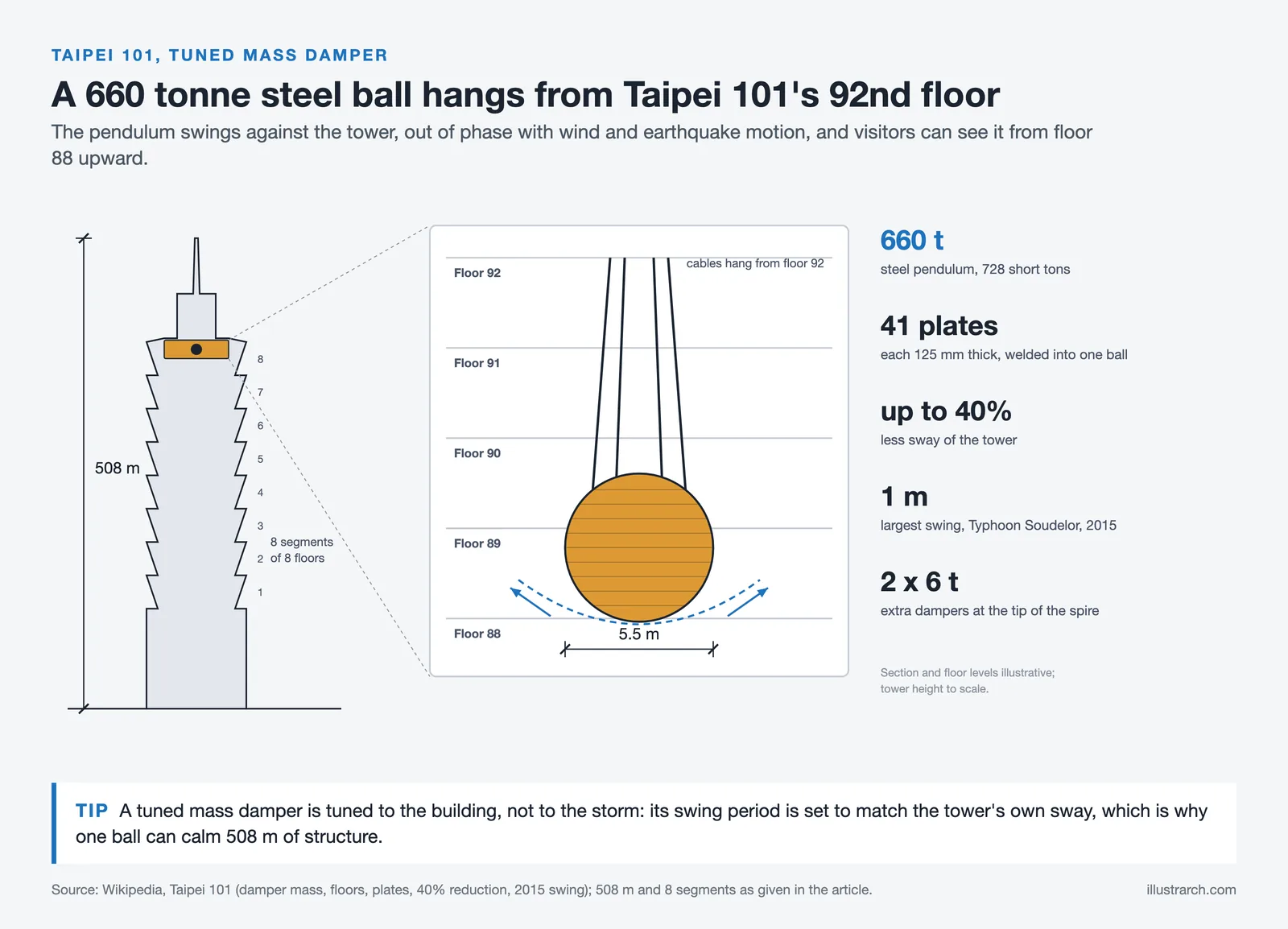
Before the Burj Khalifa claimed the record, Taipei 101 stood as the world’s tallest building from 2004 to 2010. Rising 508 meters in Taiwan’s capital, it was designed by C.Y. Lee & Partners and remains one of the most structurally innovative supertall towers ever conceived, particularly for its seismic resilience.
Taiwan sits along the Pacific Ring of Fire, making earthquake resistance a primary concern for any supertall tower architect working in the region. Taipei 101 addresses this challenge with a 660-tonne (728-short-ton) tuned mass damper (TMD) suspended from the 92nd floor and visible from the 88th floor. This massive steel pendulum, one of the largest ever installed in a building, counteracts lateral movement caused by high winds and earthquakes. Visitors can observe the damper through a glass enclosure, making it both a structural necessity and a tourist attraction.
The tower’s form draws from traditional Chinese architecture. Its eight sections reference the lucky number eight in Chinese culture, and the overall silhouette evokes a bamboo stalk rising toward the sky. The facade features ruyi motifs, symbols of good fortune, integrated into the curtain wall system. Taipei 101 pioneered the use of high-performance concrete in supertall construction, with column mixes reaching compressive strengths of 69 MPa.
Petronas Towers: Twin Ambition in Kuala Lumpur

The Petronas Towers claimed the world’s tallest building title in 1998 and held it until Taipei 101 surpassed them six years later. Each tower stands 451.9 meters tall with 88 floors, connected by a double-decker skybridge at the 41st and 42nd floors. Argentine-American architect César Pelli designed the twin towers, which became a supertall tower architect’s defining legacy.
The floor plan of each tower is based on an eight-pointed star, a geometric form rooted in Islamic art and architecture. This shape provides both cultural resonance and structural efficiency, as the projecting points act as buttresses against wind forces. The towers were built using a high-strength concrete mix rather than a steel frame, which was a deliberate choice to reduce reliance on imported steel and support local industries in Malaysia.
The skybridge connecting the two towers is not rigidly fixed. Instead, it rests on spherical bearings that allow independent sway, a critical design feature given that each tower moves differently in the wind. Construction involved two separate contractors, one working on each tower, creating a competitive dynamic that accelerated the build schedule. The Petronas Towers remain the tallest twin structures on Earth.
Key Facts About the Petronas Towers
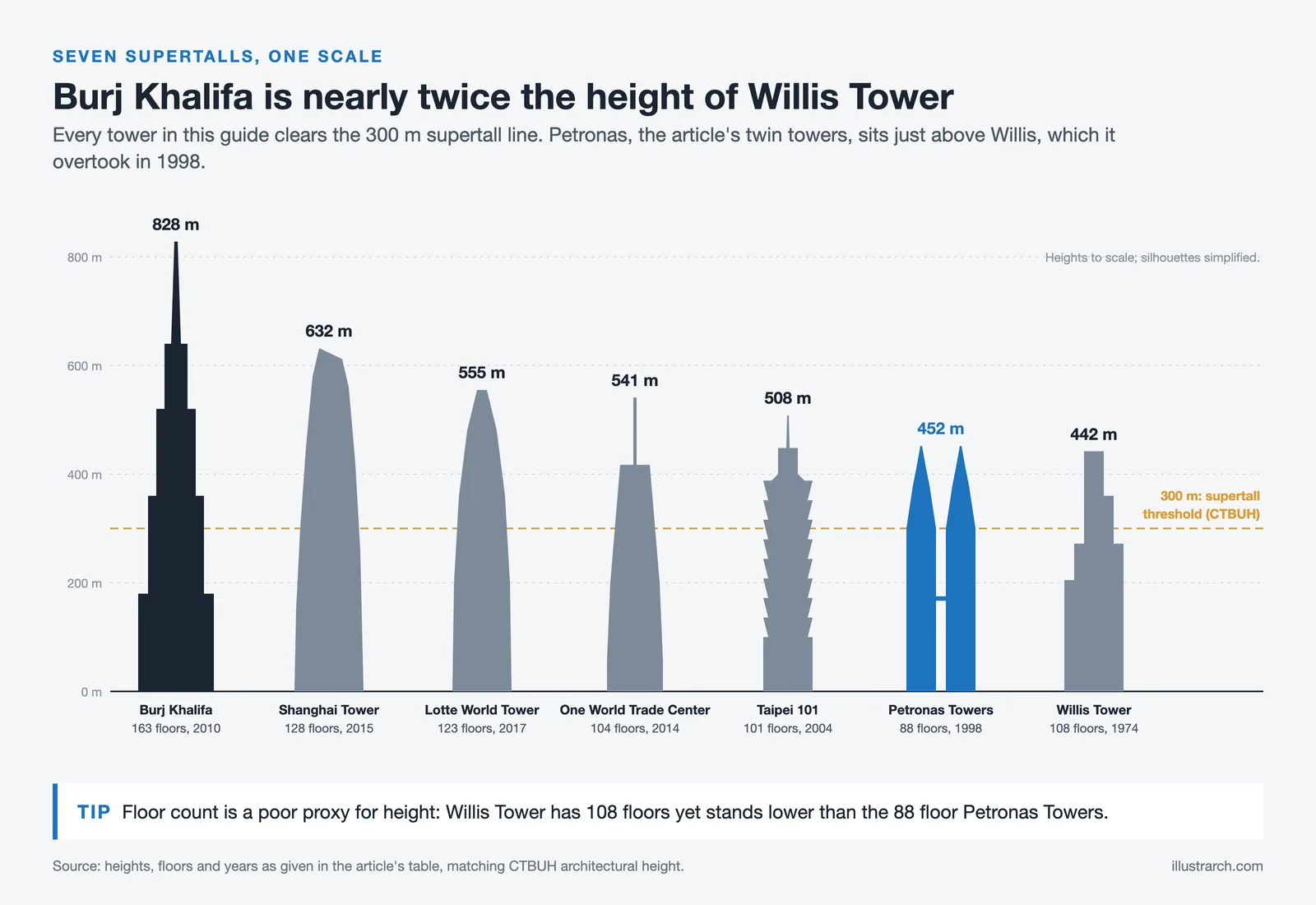
The following table summarizes the key specifications of the Petronas Towers alongside other featured supertall towers in this article:
| Tower | Height (m) | Floors | Year Completed | Architect / Firm | Primary Structural System |
|---|---|---|---|---|---|
| Burj Khalifa | 828 | 163 | 2010 | Adrian Smith / SOM | Buttressed core |
| Shanghai Tower | 632 | 128 | 2015 | Gensler | Mega-columns with outrigger trusses |
| Taipei 101 | 508 | 101 | 2004 | C.Y. Lee & Partners | Steel frame with tuned mass damper |
| Petronas Towers | 452 | 88 | 1998 | César Pelli | Reinforced concrete core with perimeter columns |
| One World Trade Center | 541 | 104 | 2014 | David Childs / SOM | Concrete core with steel exoskeleton |
| Willis Tower | 442 | 108 | 1974 | Fazlur Rahman Khan / SOM | Bundled tube |
| Lotte World Tower | 555 | 123 | 2017 | KPF | Concrete core with outrigger trusses |
One World Trade Center: Resilience Rising from Ground Zero

One World Trade Center stands 541 meters tall in Lower Manhattan, making it the tallest building in the Western Hemisphere. Designed by David Childs of SOM, it was completed in 2014 on the site of the original World Trade Center, destroyed in the September 11 attacks of 2001. Its height in feet, 1,776, is a deliberate reference to the year of American independence.
Security drove many of the building’s design decisions. The base is constructed from a fortified concrete podium rising 57 meters, clad in prismatic glass panels that shift in appearance with changing light and weather. A massive concrete core houses stairwells, elevator shafts, and critical building systems, all reinforced well beyond standard code requirements. The exterior steel frame tapers as the building rises, transforming the square base into an octagonal form at mid-height before tapering to a slender pinnacle.
The building’s curtain wall system was engineered to resist blast pressure while still allowing natural light to flood the interior. Observation decks on the upper floors provide panoramic views across New York Harbor, the Statue of Liberty, and the surrounding skyline. One World Trade Center proves that the most iconic supertall towers carry meaning far beyond their measurements.
Willis Tower: The Pioneer That Changed Everything

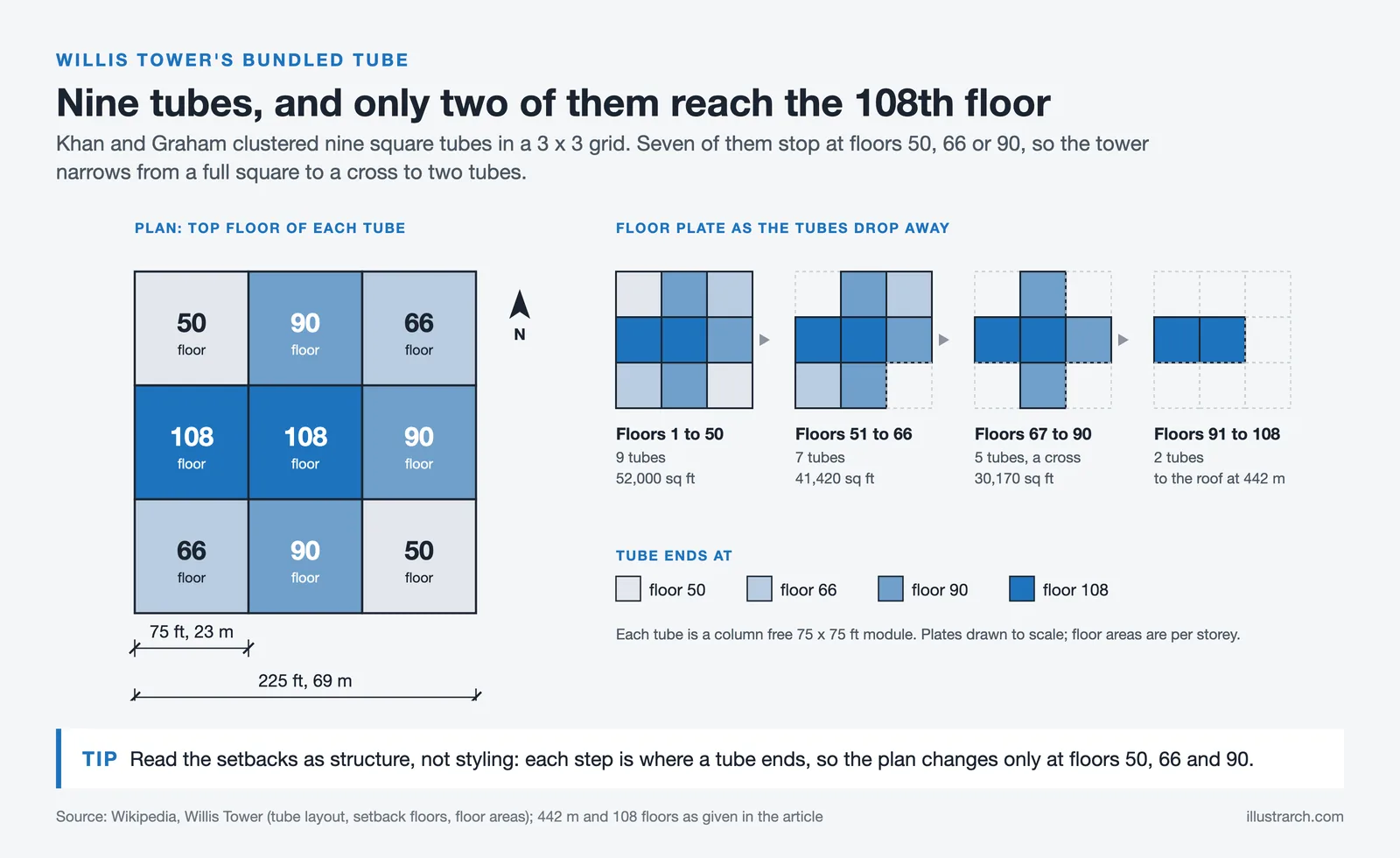
Originally known as the Sears Tower, the Willis Tower in Chicago held the title of world’s tallest building for nearly 25 years, from 1974 until the Petronas Towers surpassed it in 1998. At 442 meters and 108 floors, it remains one of the most significant structures in the history of supertall architecture.
The building owes its existence to Fazlur Rahman Khan, a Bangladeshi-American structural engineer at SOM often called the “father of tubular design.” Khan developed the bundled tube structural system specifically for this project. Nine square tubes of varying heights are clustered together, with each tube terminating at a different level as the building rises. This approach distributes both gravity and lateral loads efficiently while allowing the tower to achieve considerable height with proportionally less steel than earlier skyscrapers. The bundled tube concept influenced virtually every supertall tower architect who followed.
The Willis Tower‘s Skydeck, featuring glass-floored ledges that extend beyond the building’s facade at the 103rd floor, attracts over 1.5 million visitors annually. The building recently underwent a major renovation program to modernize its systems and improve energy efficiency, ensuring its relevance well into the 21st century.
Lotte World Tower: South Korea’s Cultural Landmark

Completed in 2017, the Lotte World Tower in Seoul rises 555 meters across 123 floors, making it the tallest building in South Korea. Designed by Kohn Pedersen Fox Associates (KPF), it draws its form from traditional Korean ceramics and calligraphy, translating cultural heritage into a modern supertall structure.
A vertical seam running along the facade connects the tower visually to Seoul’s historic urban fabric. The exterior is composed of light-toned silver glass with white lacquered metal detailing, giving the building a refined, luminous quality that shifts throughout the day. The tower was engineered to withstand earthquakes up to magnitude 9 on the Richter scale, a critical requirement given the Korean Peninsula’s seismic profile.
The mixed-use program includes offices, the Signiel Seoul luxury hotel, residential apartments, retail space, a concert hall, and an observation deck at 497 meters. A ten-story podium at the base mirrors the tower’s vertical mass, providing structural stability while housing the Lotte World Mall, an aquarium, and a cinema complex. The Lotte World Tower demonstrates how the architecture of supertall tower design can serve as a vehicle for national identity while meeting the functional demands of a modern metropolis.
What Defines the Architecture of a Supertall Tower
Building above 300 meters introduces a set of engineering challenges that fundamentally change the design process. Wind loads increase exponentially with height, requiring aerodynamic shaping, tuned mass dampers, or both. Foundation systems must transfer enormous loads to bedrock or stable ground, often through deep piles exceeding 40 meters in length. Vertical transportation becomes a logistical puzzle, typically solved through sky lobby systems that use express elevators to transfer passengers between zones.
Every supertall tower architect must also contend with the stack effect, where temperature differences between interior and exterior air create powerful updrafts through elevator shafts and stairwells. Fire safety requires pressurized refuge floors at regular intervals, typically every 25 stories. Material choices vary by region and climate. Reinforced concrete dominates in hot climates like Dubai due to its thermal properties, while steel and composite systems are preferred in seismically active zones like Japan and Taiwan.
The most successful supertall towers balance these technical demands with cultural context, environmental performance, and a clear civic purpose. They are not simply tall buildings. They are vertical neighborhoods that compress the functions of an entire district into a single structure, reshaping how people live, work, and move through cities.
The Future of Supertall Towers
The race upward continues. The Jeddah Tower in Saudi Arabia, designed by Adrian Smith + Gordon Gill Architecture, aims to become the first building to exceed one kilometer in height. Construction resumed in 2025 after a prolonged pause, and completion is projected for 2028. If finished as planned, it will surpass the Burj Khalifa by a significant margin and redefine what the world considers possible in vertical construction.
Meanwhile, cities across Asia continue to add supertall towers to their skylines. China alone has dozens of buildings exceeding 300 meters either completed or under construction, although a 2021 policy now limits new skyscrapers to 500 meters. Sustainability is becoming a central design criterion, with newer projects emphasizing renewable energy integration, passive ventilation strategies, and lower embodied carbon in structural materials.
The world’s most iconic supertall towers are more than records in a height competition. They represent a synthesis of engineering mastery, architectural vision, and urban strategy. From the bundled tubes of the Willis Tower to the twisting glass of the Shanghai Tower, each one offers a lesson in what happens when ambition meets ingenuity at extraordinary scale.


2 Comments




How to Write an Architecture Concept Statement for Any Project
A practical guide to writing an architecture concept statement, covering what it...
 Sinan Ozen8 Mins read
Architectural Programming: From Brief to Spatial Needs
A practical look at architectural programming, the pre-design phase where architects gather...
 Elif Ayse Sen6 Mins read
Parametric Architecture Design with Grasshopper for Rhino: 2026 Review
A focused 2026 review of Grasshopper for Rhino for parametric architecture design,...
Furkan Sen8 Mins read

Books by Rem Koolhaas Every Architect Should Read
Rem Koolhaas books have shaped contemporary architectural discourse like no other body...
 Begum Gumusel5 Mins read


I found the section on Taipei 101 really interesting! The tuned mass damper is such a clever solution for earthquake resilience. It’s amazing that visitors can actually see it in action. I wonder how often it has to be adjusted or maintained.
I found it interesting that the Burj Khalifa uses a buttressed core system to withstand wind forces. It’s impressive how the design allows for such height while ensuring stability. I also didn’t know that it was primarily constructed from reinforced concrete, which seems like a smart choice given Dubai’s climate.