

Free Online Architectural Golden Ratio Calculator
How it's calculated
Nearest Fibonacci Numbers
How it's calculated
How it's calculated
How it's calculated
How it's calculated
Read: the design secrets of Le Corbusier
How it's calculated
How it's calculated
Golden Rectangle
Image Golden Ratio Overlay
The golden ratio calculator is an essential tool for architects, designers, and artists seeking to create visually harmonious compositions. This mathematical proportion, approximately equal to 1.618, has guided design excellence from ancient monuments to contemporary masterpieces. Whether you are planning a building façade, designing interior spaces, or crafting graphic layouts, understanding how to calculate the golden ratio transforms ordinary work into extraordinary design.
Throughout history, the golden ratio has appeared in structures that captivate human perception. From the Parthenon in Athens to modern architectural icons, this divine proportion creates an instinctive sense of balance that resonates across cultures and centuries. Our comprehensive guide will help you master the golden section ratio calculator and apply these timeless principles to your projects.
The Golden Ratio in Brief
The golden ratio, phi (Φ), is the proportion in which the whole of a divided line relates to its longer part as the longer part relates to the shorter one, about 1.6180339887. It is closely tied to the Fibonacci sequence, and architects from Le Corbusier onward have used it as a proportioning system. For its history, the buildings it is claimed for and the debate around those claims, read our guide to golden proportions in buildings; this page is about calculating with it.

What Each Mode of the Calculator Does
The calculator has eight modes on one row of tabs, with an image overlay underneath. Every mode uses the ratio picked at the top: the golden ratio φ by default, or the silver ratio, √2 (the A paper ratio), √3, √5, 3:2 or a custom ratio between 1.01 and 3, in px, mm, cm, m, inches or feet and inches. Each link below opens the calculator in that mode.
Single Value
Enter one number and get the next larger and the next smaller golden value, the ratio both ways and the nearest Fibonacci numbers. Open Single Value.
Ratio Check
Enter two lengths, A and B, to see their actual ratio, how far it is from the selected ratio in percent and the ideal B for your A. It is the quickest way to test a façade, a window or a drawing that is said to be golden. Open Ratio Check.
Divide
Split a length into two parts, a and b, whose ratio is the selected ratio, starting from the total, the longer part or the shorter part. Open Divide.
Series
Build a run of terms that grow or shrink by the ratio, up, down or both ways, with a running total: useful for spacing rhythms, module sizes or stepped heights. Open Series.
Rectangle
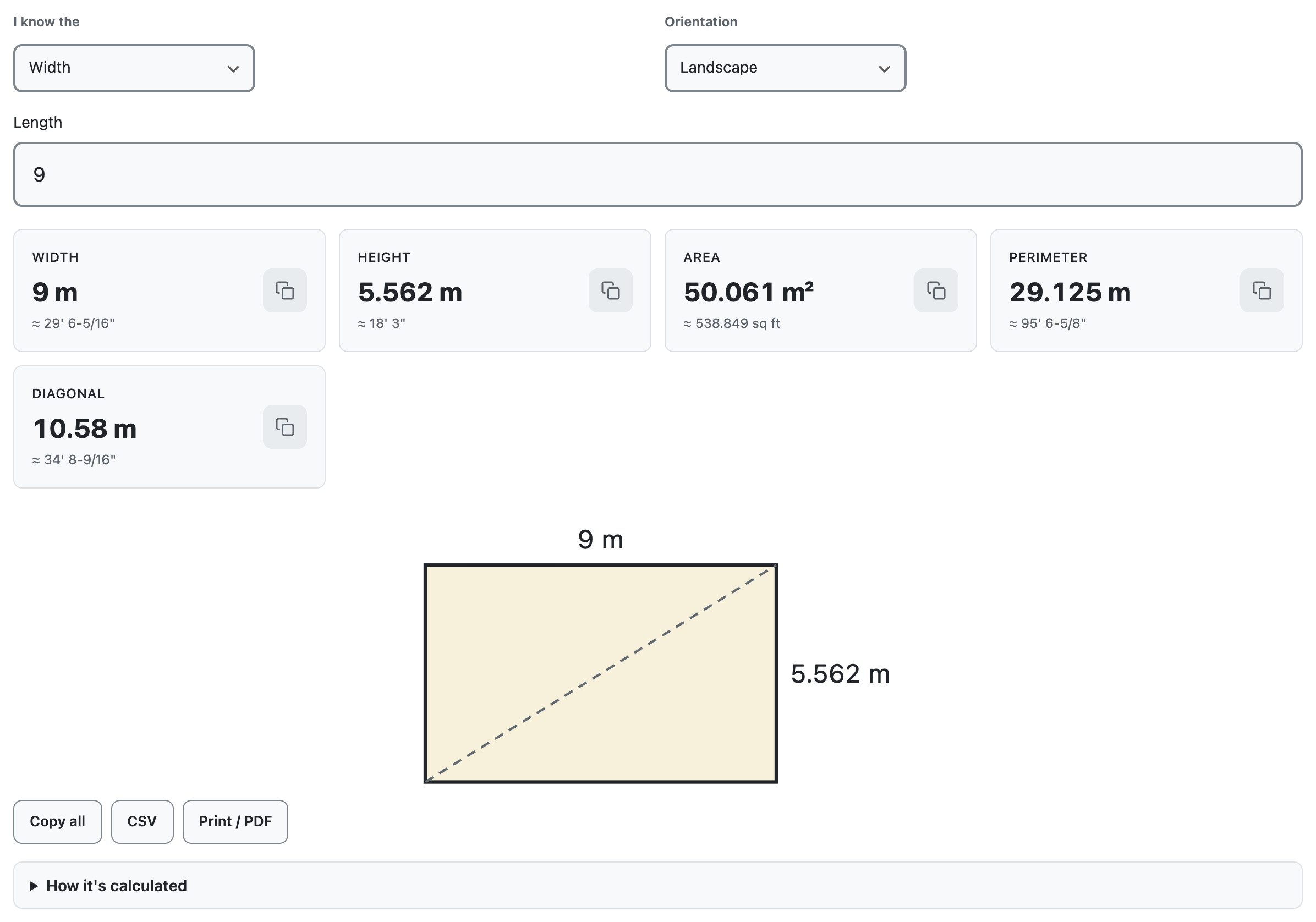
Give the width, the height or the diagonal of a landscape or portrait golden rectangle and get the other sides, area, perimeter and diagonal, with a drawing of the rectangle and its golden spiral that downloads as SVG or PNG. Open Rectangle.
Room
Start from a room’s height, width, length or floor area and get all three dimensions, the floor area and the volume in Golden (1 : 1.618 : 2.618), Compact (1 : 1.272 : 1.618) or selected ratio proportions. A link under the result leads on to the Paint Calculator. Open Room.
Modulor
Enter a body height (Le Corbusier used 183 cm, or 6 ft) to get the navel height, the raised hand height and a table of the red and blue series, where the blue series is twice the red. Open Modulor.
Type Scale
Enter a base font size and a range of steps to get font sizes in px and rem (for a 16 px root) with line heights, plus CSS you can copy, for presentation boards and portfolios. Open Type Scale.
Image Golden Ratio Overlay
Upload a photo or a drawing (PNG, JPG, GIF or WEBP up to 10 MB, or use the camera) and lay a golden spiral, a phi grid, the rule of thirds, golden triangles, diagonals, a harmonic armature, a √2, √3 or √5 rectangle or a centre cross over it, then move, resize, rotate or flip the overlay. It sits below the tabs and works with any mode.
Every result can be copied, saved as CSV or printed, and Share link keeps the current mode and values in a link you can send.
How to Calculate Golden Ratio: The Essential Formula
Learning how to calculate the golden ratio requires understanding its fundamental mathematical expression. The formula states that phi (Φ) equals (1 + √5) / 2, which produces the value 1.618033988749895. This exact formula allows precise calculations for any design application.
When calculating golden ratio proportions, you work with three related measurements: the total length (a + b), the longer segment (a), and the shorter segment (b). The golden proportion exists when (a + b) / a = a / b ≈ 1.618. This relationship enables you to determine unknown dimensions once you establish any single measurement.
For practical application, multiply your known dimension by 1.618 to find the corresponding golden ratio measurement. Conversely, divide by 1.618 to calculate the smaller proportional element. These simple operations form the foundation of every golden ratio rectangle calculator and design tool available today.

Step-by-Step Method to Calculate the Golden Ratio
Follow these steps when you need to calculate golden ratio dimensions for your project:
- Identify your starting measurement: Determine whether you know the total length, the longer segment, or the shorter segment of your design element.
- Apply the golden ratio multiplier: Multiply your known value by 1.618 to find the next larger dimension, or divide by 1.618 to find the next smaller dimension.
- Verify your calculation: Check that your resulting ratio approximates 1.618 by dividing the larger measurement by the smaller one.
- Apply to your design: Use these proportions for building heights, room dimensions, window placements, or any architectural element requiring visual harmony.
This method works whether you are using a calculate golden ratio rectangle approach for façade design or determining proportional relationships for interior space planning.
Golden Ratio Rectangle Calculator: Creating Perfect Proportions
The golden ratio calculator rectangle application represents one of the most practical uses of this mathematical principle. A golden rectangle possesses side lengths in the ratio of 1:1.618, creating a shape that humans instinctively find pleasing. This rectangle exhibits a remarkable property: when you remove a square from it, the remaining rectangle maintains the same golden proportions.

To use a golden ratio rectangle calculator, simply input one known dimension. If your width measures 10 units, multiply by 1.618 to find the length of 16.18 units. This calculation produces a golden rectangle suitable for building façades, room proportions, canvas sizes, or digital design layouts. In this calculator the Rectangle mode does it from the width, the height or the diagonal, in landscape or portrait, and draws the rectangle to proportion with its diagonal. The Golden Rectangle panel under the modes draws the spiral, with 4 to 12 squares, any start corner and either direction, and downloads it as SVG or PNG.
Architects throughout history have employed golden rectangles to achieve visual harmony in their structures. The Parthenon’s façade demonstrates how golden rectangles create balanced proportions, while modern buildings like the UN Secretariat Building continue this tradition in contemporary form.
Open the golden rectangle calculator with a 9 m width
How Do You Calculate the Golden Ratio for Architecture?
Architects apply the golden ratio through various methods depending on their design objectives. Understanding how do you calculate the golden ratio for architectural applications involves examining both overall building proportions and detailed element relationships.
For building massing, divide the total height by the total width. If this ratio approximates 1.618, the structure reflects golden ratio influence. Similarly, comparing floor-to-ceiling heights with room widths reveals whether interior spaces embody these harmonious proportions.

The golden ratio appears in architectural design through multiple applications:
- Façade proportions: Window heights related to wall sections, door dimensions relative to entryways, and overall building width to height relationships.
- Spatial planning: Room proportions, corridor widths, and ceiling heights that create comfortable human-scale environments.
- Decorative elements: Column spacing, ornamental details, and pattern repetitions that establish visual rhythm.
- Site planning: Building placement within landscapes, garden layouts, and urban spacing that achieves natural balance.
Le Corbusier developed his famous Modulor system based on golden ratio proportions combined with human body measurements. This systematic approach influenced countless modernist buildings and continues informing contemporary architectural practice.
Golden Section Ratio Calculator Applications in Modern Design
Contemporary designers employ the golden section ratio calculator across diverse applications beyond traditional architecture. Digital designers use golden proportions for website layouts, establishing content areas, sidebars, and navigation relationships that feel naturally organized.
Product designers apply these ratios to create objects that fit comfortably in human hands and appear visually balanced on shelves. From smartphone dimensions to furniture proportions, the golden ratio guides countless everyday objects toward aesthetic excellence.

Interior designers leverage golden ratio principles when arranging furniture, selecting artwork sizes, and determining spatial relationships within rooms. A sofa positioned according to golden proportions relative to the room creates immediate visual comfort, while artwork hung at golden ratio heights achieves optimal viewing relationships.
The mathematics underlying architecture extends far beyond simple measurements. When combined with understanding of light, materials, and human movement patterns, golden ratio calculations become powerful tools for creating spaces that truly resonate with occupants.
Practical Tips for Using a Golden Mean Ratio Calculator
Maximizing your golden mean ratio calculator results requires understanding both the mathematics and the artistic judgment involved in design. While the golden ratio provides an excellent starting framework, successful design also demands flexibility and contextual awareness.
Begin with rough proportions based on golden ratio calculations, then refine based on site conditions, programmatic requirements, and aesthetic vision. The greatest architectural achievements typically use golden proportions as guidelines rather than rigid constraints.
Consider these practical approaches when applying golden ratio calculations:
- Start with primary dimensions: Establish your most important measurement first, whether building height, room width, or overall composition size.
- Create hierarchical relationships: Apply golden ratio multiplication or division to generate secondary and tertiary dimensions from your primary measurement.
- Test visual perception: Step back from your design to assess whether the proportions feel harmonious, adjusting as needed for context.
- Document your proportions: Record your golden ratio calculations to maintain consistency throughout complex projects.

Remember that many historically celebrated structures achieve beauty through alternative proportional systems. The golden ratio represents one powerful tool among many available to designers seeking visual harmony and functional excellence.
Advanced Golden Ratio Calculations for Professional Design
Professional architects and designers often work with sophisticated variations of basic golden ratio calculator applications. These advanced approaches include creating golden spirals, establishing proportional grids, and developing modular systems based on phi relationships.
The golden spiral emerges when you construct quarter circles within successive golden rectangles. This spiral appears throughout nature in nautilus shells, hurricane formations, and galaxy structures. Architects incorporate these spirals into circulation patterns, creating movement through spaces that feels organic and intuitive.
Proportional grids based on golden ratio divisions help organize complex façades and interior layouts. By establishing a golden ratio grid across a surface, designers can position windows, doors, and decorative elements at mathematically harmonious locations, achieving the balanced compositions evident in Notre Dame Cathedral and similar masterworks.
Modern computational design tools integrate golden ratio calculations into parametric workflows. Architects using professional design software can establish golden ratio relationships as parameters, automatically adjusting multiple elements when primary dimensions change.

Common Mistakes When Using Golden Ratio Calculators
Understanding potential errors helps you avoid common pitfalls when applying golden ratio calculations to real projects. Many designers encounter difficulties that compromise their results despite correct mathematical calculations.
One frequent mistake involves forcing golden proportions onto contexts where they conflict with functional requirements. A room dimensioned perfectly to golden ratio specifications may not accommodate necessary furniture or circulation paths. Always balance mathematical ideals against practical constraints.
Another common error involves measuring existing structures and claiming golden ratio presence based on approximate matches. The historical debate about golden ratio in ancient architecture continues precisely because measurement imprecision makes definitive claims impossible.
Avoid these additional calculation mistakes:
- Rounding too aggressively: Maintain precision in your calculations, rounding only at final construction dimensions.
- Ignoring material constraints: Standard material sizes may not align with ideal golden ratio dimensions, requiring practical compromises.
- Overlooking viewing distance: Proportions perceived at different distances may require adjustment from calculated ideals.
- Applying ratios inconsistently: Mixing golden ratio elements with arbitrary proportions can create visual discord.

Choosing a Mode for Your Project
Match the mode to the question you are asking. For a façade, a panel or a window, use Rectangle; for a plan, Room; for splitting one length into two, Divide; for a run of related sizes, Series; for designing at human scale, Modulor; for the type on a board or in a portfolio, Type Scale; and for checking an existing building, a photo or a drawing, Ratio Check or the image overlay.
Treat every result as a starting proportion rather than a rule. The timeless appeal of golden ratio architecture comes from buildings that adjusted these numbers to site, structure, material sizes and use.
Frequently Asked Questions About Golden Ratio Calculators
What is the exact value of the golden ratio?
The golden ratio equals (1 + √5) / 2, which produces the irrational number 1.6180339887… continuing infinitely without repeating. For practical design calculations, using 1.618 provides sufficient accuracy for most architectural and design applications.

How do you calculate the golden ratio from one measurement?
To find a larger golden ratio dimension, multiply your known measurement by 1.618. To find a smaller proportional dimension, divide your measurement by 1.618. These operations allow you to establish proportional relationships from any starting point.
Can I use the golden ratio for room dimensions?
Yes, interior designers frequently apply golden ratio proportions to room dimensions. A room with width-to-length ratio of approximately 1:1.618 tends to feel naturally balanced and comfortable. Ceiling heights can also relate to room widths through golden proportions. The Room mode calculates the height, width, length, floor area and volume from any one of them.
What is the relationship between the golden ratio and Fibonacci sequence?
The Fibonacci sequence (1, 1, 2, 3, 5, 8, 13, 21…) produces ratios between consecutive numbers that progressively approach the golden ratio. As the sequence extends, these ratios converge toward phi, demonstrating the deep mathematical connection between these concepts.
Is the golden ratio scientifically proven to be more beautiful?
Research on golden ratio aesthetics shows mixed results. While some studies suggest preferences for golden proportions, others find no significant advantage over other ratios. The golden ratio provides a useful design framework, but aesthetic success depends on many factors beyond mathematical proportions alone.
Rate this tool
Was Free Online Architectural Golden Ratio Calculator useful? One tap, no sign-up.

