

Foster + Partners Designs a Manhattan Skyscraper for American Express
Foster + Partners has been confirmed as the design architect for the new American Express global headquarters at 2 World Trade Center in Lower Manhattan. The 55-story, nearly 2-million-square-foot supertall will accommodate up to 10,000 employees, feature landscaped terraces, and target LEED certification upon completion in 2031.
 Elif Ayse Sen6 March 20267 Mins read203

Table of Contents Show
The long-awaited skyscraper for American Express at 2 World Trade Center in Lower Manhattan is finally moving forward. Designed by Foster + Partners and developed by Silverstein Properties, the 55-story, 1,226-foot supertall will serve as the global headquarters of American Express and complete the final commercial component of the World Trade Center campus, nearly 25 years after the September 11 attacks reshaped the site.
What Is the American Express Tower at 2 World Trade Center?
The new American Express headquarters is a 55-story office supertall located at 200 Greenwich Street in Lower Manhattan, also known as 2 World Trade Center. American Express will be the sole owner and occupant of the building, which will span nearly two million square feet across all floors. Construction is expected to begin in spring 2026, with completion targeted for 2031.
Turner Construction is responsible for the core and shell of the project. The Port Authority of New York and New Jersey owns the land, and American Express has secured a long-term ground lease. The tower will stand as the tallest all-electric office building planned in the city at the time of its completion, designed to run entirely on renewable energy and targeting LEED certification.
📌 Did You Know?
American Express has maintained a presence in Lower Manhattan for nearly 200 years and has operated its headquarters at 200 Vesey Street since 1986. The move to 2 World Trade Center will mark the company’s first custom-built global headquarters in decades, designed entirely around its own operational and cultural requirements.

Foster + Partners and the Long Design History of 2 WTC
The history behind the skyscraper for American Express stretches back more than two decades. Silverstein Properties first commissioned Foster + Partners to design a tower at 200 Greenwich Street in 2006, resulting in a striking proposal featuring a distinctive diamond-shaped crown. That design never advanced to construction.
In 2015, Silverstein replaced Foster + Partners with Bjarke Ingels Group (BIG), seeking a more contemporary look to attract the planned anchor tenants News Corporation and 21st Century Fox. BIG produced a boldly stepped, angular design, but that version was also set aside when those tenants walked away. In 2020, Silverstein terminated BIG and brought Foster + Partners back on board.
The current design reflects this layered history. It drops the diamond crown from the 2006 concept but retains the upper-level terraces introduced during BIG’s tenure. Foster + Partners has noted that the released renderings remain subject to change as design development continues.
🎓 Expert Insight
“The design of the American Express building is rooted in sustainability and well-being, to create a state-of-the-art environment that supports the company’s vision for the future. A network of landscaped terraces and gardens provides generous outdoor spaces and contact with nature in the pursuit of a healthier and more desirable working lifestyle.” — Norman Foster, Founder and Executive Chairman, Foster + Partners
This statement points to a broader shift in how large corporate headquarters are being conceived today: not as efficient containers for office floors, but as environments calibrated around worker wellbeing, biophilic design, and long-term sustainability performance.
Architectural Design: What the Tower Will Look Like
The current Foster + Partners design presents a stepped composition of slender glass volumes rising from a rectilinear base. The facade is composed of floor-to-ceiling glazing with expressed structural mullions that accentuate the tower’s vertical movement. Rather than a dramatic signature crown, the building culminates in a flat roof, a deliberate restraint that aligns it with the contextual discipline of the existing World Trade Center campus.
Three terraces are integrated into the upper levels of the building, each filled with greenery and offering panoramic views of the Manhattan skyline and the Hudson River. Six corner gardens are distributed across the facade, providing what Foster + Partners describes as a network of biophilic spaces. A triple-height lobby defines the tower’s civic presence at street level, positioned at the corner adjacent to Santiago Calatrava’s Oculus transit hub.
The building sits on a full-block site bounded by Vesey Street to the north, Fulton Street to the south, Church Street to the east, and Greenwich Street to the west, placing it at the physical and symbolic heart of the redeveloped campus.
💡 Pro Tip
When reviewing supertall office tower designs in dense urban contexts, pay close attention to how the base relates to street-level pedestrian flow. The triple-height lobby and adjacency to the Oculus at 2 WTC are deliberate design decisions, not just aesthetic gestures. Ground-plane activation and transit integration are increasingly central to how planning authorities evaluate large commercial towers in New York City.

Sustainability and Building Performance Targets
The new American Express tower is designed as an all-electric building powered entirely by renewable energy sources. This positions it alongside a growing wave of corporate headquarters that are eliminating fossil fuel reliance at the building systems level, including heating, cooling, and vertical transportation.
The project is targeting LEED certification, though the specific certification tier has not been publicly confirmed. In addition to energy performance, the design integrates more than one acre of outdoor green space through its terraces and gardens, a feature that contributes to both environmental performance and occupant wellbeing. Advanced smart-building technology will be deployed throughout the tower to optimize energy use and operational efficiency.
🔢 Quick Numbers
- 1,226 feet (373.7 m) — height of 2 World Trade Center, classifying it as a supertall (New York YIMBY, 2026)
- ~1.95 million square feet — total rentable area across 55 floors (Silverstein Properties / Governor’s Office, 2026)
- 10,000 employees — planned workforce capacity of the American Express headquarters (American Express, 2026)
- $5.9 billion projected contribution to New York City’s economy during the construction period (New York State Governor’s Office, 2026)
Economic and Urban Impact on Lower Manhattan
The announcement of the new Manhattan skyscraper for American Express carries significant economic weight for Lower Manhattan. According to New York State’s Governor’s Office, construction is projected to generate more than 2,000 union construction jobs and approximately 3,200 total jobs in New York City throughout the project’s duration. The development is expected to contribute roughly $5.9 billion to the city’s economy and $6.3 billion to the state’s economy overall.
New York Governor Kathy Hochul and Mayor Zohran Mamdani both highlighted the project as a statement of confidence in Lower Manhattan as a hub for global commerce. For Silverstein Properties and the Port Authority, the deal also closes a chapter that has been open for over two decades: 2 World Trade Center is the final commercial office tower in the 16-acre master plan developed after September 11.
American Express CEO Stephen Squeri described the project as an investment not just in the company’s operations, but in the Lower Manhattan community where the firm has been based for close to 200 years. The company’s current headquarters at 200 Vesey Street, occupied since 1986, will remain in use until the new building is ready.
🏗️ Real-World Example
270 Park Avenue, JPMorgan Chase Headquarters (New York City, opened October 2024): The 60-story, $3 billion tower designed by Foster + Partners stands 1,400 feet tall and holds the title of New York City’s tallest all-electric skyscraper. Accommodating 10,000 employees across 2.5 million square feet, it offers 2.5 times more outdoor space than its predecessor. 2 World Trade Center follows a similar design philosophy from the same practice, framing how Foster + Partners is defining the next generation of major corporate headquarters in New York.

How Does This Fit Into Foster + Partners’ Broader Portfolio?
The 2 World Trade Center commission represents the second major financial institution headquarters Foster + Partners has delivered in New York City in rapid succession. The firm’s work on 270 Park Avenue for JPMorgan Chase opened in late 2024, establishing a benchmark for large-scale, all-electric, biophilic corporate towers in the city. The American Express project follows a similar conceptual framework, though its location within the World Trade Center campus adds a particular civic and symbolic dimension.
Foster + Partners has long maintained a presence in Manhattan skyscraper design. The firm’s portfolio includes the Hearst Tower in Midtown and earlier proposals for this very site going back to 2005 and 2006. The return to 2 World Trade Center after nearly a decade away is an unusual design history, though it reflects the site’s notoriously complex commercial and political journey rather than any failing of the architecture itself.
For architecture professionals and students tracking Foster and Partners architecture, the 2 WTC tower offers an instructive case study in how leading practices navigate long-duration, politically charged projects where design intent must flex across decades and client changes.
💡 Pro Tip
When analyzing the longevity of major architectural commissions, it’s worth distinguishing between a design firm being “replaced” and a project stalling due to market or tenant conditions. In the case of 2 WTC, Foster + Partners’ return was not a reversal of a quality judgment about BIG’s work but a consequence of a fundamentally different client brief and occupancy model. Understanding this distinction matters when assessing design credit and accountability on long-cycle civic projects.

The World Trade Center Campus: What Remains After 2 WTC
With 2 World Trade Center now confirmed, the World Trade Center redevelopment plan is very close to its intended commercial build-out. The 16-acre site, master-planned by Studio Libeskind following the September 11 attacks, includes One World Trade Center, 3 World Trade Center, 4 World Trade Center, the 9/11 Memorial and Museum, the Oculus transportation hub, and a visitor pavilion.
What remains unbuilt is a neighboring residential tower intended to replace another building damaged in the attacks. Unlike the office towers, that project has yet to secure financing or a confirmed development path. The 2 World Trade Center announcement, however, does represent a major symbolic close to the primary commercial vision of the site.
For those following Manhattan new skyscrapers and the evolution of the Financial District skyline, 2 WTC will fill the most visually prominent remaining gap in the campus when it rises to its full 1,226-foot height by 2031.
✅ Key Takeaways
- Foster + Partners is designing a 55-story, 1,226-foot supertall skyscraper for American Express at 2 World Trade Center, with construction starting spring 2026 and completion expected in 2031.
- American Express will be the sole owner and occupant of the nearly 2-million-square-foot tower, relocating from its current headquarters at 200 Vesey Street.
- The design features a stepped glass facade, a triple-height lobby, three landscaped terraces, and six corner gardens across more than one acre of outdoor space.
- The building is planned as an all-electric, renewable-energy-powered structure targeting LEED certification, making it one of the most ambitious corporate sustainability commitments in the city.
- The project completes the final commercial component of the 16-acre World Trade Center campus master plan, nearly 25 years after the September 11 attacks reshaped the site.
- Construction is projected to generate over 3,200 jobs and contribute approximately $5.9 billion to New York City’s economy during the build.



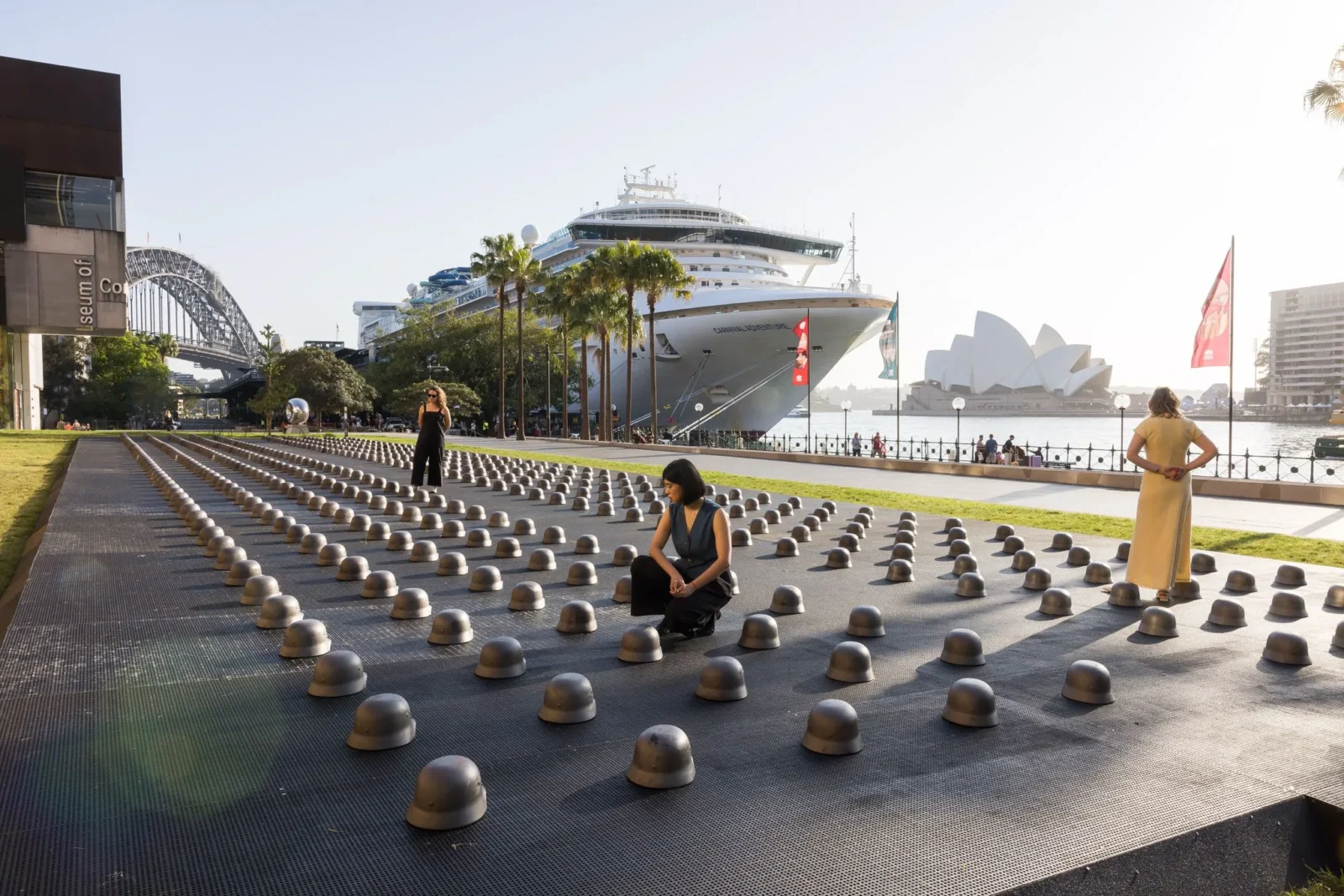
Ai Weiwei Installs 500 Cast-Iron Helmets Outside Sydney Museum
Ai Weiwei's 500 cast-iron helmets opened outside Sydney's MCA on 25 September,...
 illustrarch Editoral Team2 Mins read
Isamu Noguchi at Lever House Traces Sculptor’s Decades-Long Collaboration with Bunshaft
Lever House's new exhibition pairs Noguchi sculptures with unbuilt garden designs made...
illustrarch Editoral Team2 Mins read
Relocated Maya Structures at Mexico’s Balam Tun Memory Park Face Legal Challenge
INAH archaeologists have filed a complaint against 26 officials over Balam Tun...
illustrarch Editoral Team2 Mins read

Heather Roberge, UCLA Architecture Professor and Murmur Founder, Dies at 55
UCLA professor and Murmur founder Heather Roberge, a 2026 AIA LA Educator...
illustrarch Editoral Team2 Mins read


Leave a comment