

Architects Office Designs World Trade Center Biotic in Brasília
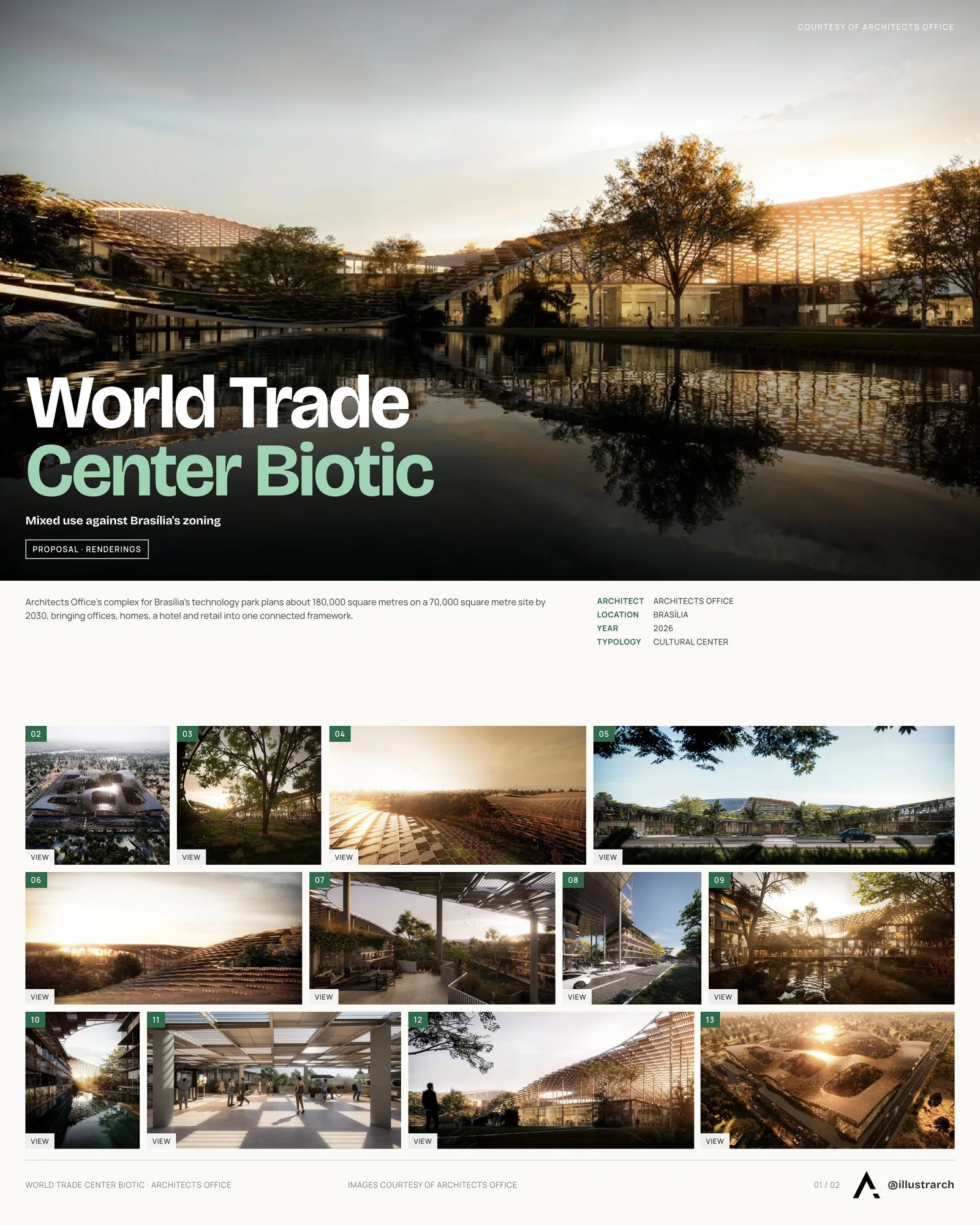
Brazilian studio Architects Office has unveiled the World Trade Center Biotic, a 180,000 sqm mixed-use complex within Brasília's Parque Tecnológico. Built on a 70,000 sqm site as part of Carlo Ratti Associati's 2020 BIOTIC masterplan, the project integrates offices, residences, hotel, and retail under a unified architectural surface, challenging Brasília's historically rigid zoning model.
 Elif Ayse Sen22 March 202610 Mins read230


Table of Contents Show
Architects Office, the Brazilian studio known for pushing the boundaries of mixed-use urban design, has unveiled the World Trade Center Biotic, a large-scale complex planned for Brasília’s Parque Tecnológico. Occupying a 70,000 sqm site and targeting roughly 180,000 sqm of built area by 2030, the project integrates offices, residential units, a hotel, retail, and shared public facilities within a single connected framework, directly challenging the strict functional zoning that has defined architecture in Brasília since the 1950s.
What Is the BIOTIC District and Why Does It Matter for Brasília Architecture?
To understand the WTC Biotic project, you need to understand the urban context it sits within. Brasília was founded in 1960 following a masterplan by Lúcio Costa and architect Oscar Niemeyer, creating one of the most celebrated examples of modernist urbanism in the world, a UNESCO World Heritage Site since 1987. The city’s design deliberately separated functions into distinct sectors: residential, commercial, governmental, and leisure. It was radical and beautiful, but it also created a city where people drive rather than walk, where cafes are in one district and offices in another, and where genuine urban spontaneity rarely develops at street level.
The BIOTIC district, formally known as the Parque Tecnológico de Brasília, was conceived as a direct response to this fragmentation. In 2020, Carlo Ratti Associati (CRA), the practice led by MIT’s SENSEable City Lab director Carlo Ratti, designed a one-million-square-meter masterplan for the district, repositioning Brasília’s iconic Superquadra (Superblock) typology as a mixed-use, pedestrian-friendly urban environment. The masterplan blends the four urban scales Costa originally defined in the Plano Piloto, residential, monumental, gregarious, and bucolic, rather than keeping them rigidly separated.
📌 Did You Know?
Brasília was built from scratch and inaugurated as Brazil’s new capital on April 21, 1960, after just 41 months of construction. The city was designed in the shape of an airplane or bird in flight when viewed from above, and was inscribed as a UNESCO World Heritage Site in 1987, making it one of the youngest cities ever to receive that designation.
The WTC Biotic is the anchor project for this entire new district. Formally announced in 2023, it is the first major building commission to emerge from the BIOTIC masterplan, and the architects office behind it brings a specifically Brazilian perspective to the challenge of reprogramming what Brasília architecture has historically avoided: genuine urban mix.
The Design Concept: Reprogramming Brasília Architecture Style
The central concept driving the WTC Biotic design is what Architects Office calls “reprogramming.” In their framing, this means dismantling the inherited separation between living, working, moving, and leisure, not just at the level of the masterplan, but within a single building complex. The proposal concentrates offices, residences, a hotel, retail spaces, and shared facilities within one interconnected structure where circulation, services, and public areas function collectively.
Rather than organizing these programs as separate towers with independent lobbies and infrastructure, the complex operates as a continuous urban environment. Different activities happen simultaneously and at different times of day across the site: which is how actual cities work, and how brasilian architecture at this scale has rarely been organized before.
🎓 Expert Insight
“The concept of ‘reprogramming’ lies at the heart of this vision. To reprogram is to break away from rigid zoning between living, working, and moving, and between architecture and urbanism.”
Architects Office
This philosophy positions the WTC Biotic not as a single-use landmark building, but as a prototype for a new type of urban architecture in Brasília, one that learns from the modernist legacy while actively correcting its most persistent limitation: mono-functionality.
The spatial organization responds directly to the site’s topography. Instead of stacking programs vertically into towers, Architects Office opted for a predominantly horizontal configuration that spreads across the 70,000 sqm terrain and maintains permeability at ground level. The project adopts what the team describes as “a building of extensive horizontal reach” individual volumes are linked by a continuous architectural surface that simultaneously acts as floor, wall, and roof, organizing movement through the site.
Architecture in Brasília: The Modular Structure and Adaptive Logic
One of the most technically deliberate aspects of the WTC Biotic is its structural system. The entire complex is organized around a modular grid of 8 by 8 meters. This decision is not aesthetic, it is strategic. The modular logic allows interior layouts to be reconfigured over time without dismantling the structural system, meaning the complex can accommodate changes in program as the needs of its users evolve. Office floors can theoretically be converted to residential units, retail spaces can be expanded, and shared zones can be reorganized without major structural intervention.
This approach directly addresses what urban planners have long criticized about large mixed-use developments: that they are built for a specific moment in time rather than for the life of a city. Brasília itself is an example, its rigidly defined sectors have proven difficult to adapt as the city’s needs have shifted over six decades.
💡 Pro Tip
When studying adaptive mixed-use architecture at this scale, pay close attention to the structural grid chosen. An 8×8 meter module, as used in the WTC Biotic, is a well-established benchmark for flexible commercial buildings because it accommodates standard office layouts, residential bay widths, and parking structures with minimal adaptation. Projects that fix unusual structural grids early often face high retrofit costs later.
The modular grid also contributes to construction efficiency. Standardized structural bays simplify procurement, reduce material waste, and make long-term maintenance more predictable, practical benefits that are often underweighted in early design decisions but become significant over a building’s operational life.
The Continuous Surface: How the Canopy Defines the Brasília Architecture Style of WTC Biotic
The most immediately striking element of the WTC Biotic design is its unifying canopy, a continuous, undulating surface that hovers over the complex’s individual volumes. Renderings reveal a roughly 250 by 250 meter development where rectangular buildings sit beneath this large, rippling architectural plane. Large openings punctuate its surface and encircle open courtyards below, creating a pattern of covered and uncovered space across the site.
The canopy is not purely aesthetic. It performs several simultaneous functions. At higher levels, closer to the skyline, the surface incorporates photovoltaic panels positioned to capture solar gain across the project’s substantial horizontal footprint, a significant sustainability advantage of horizontal rather than vertical development. The canopy uses a mixed typology of square panels: solar photovoltaic sections, planter sections for vegetation, and open “pergola” sections that provide shade without full enclosure.
Toward the ground, the architectural surface transitions gradually into plazas, terraces, planted areas, and lawns, extending the landscape into the built environment. Between these conditions, canopy above and ground plane below, an intermediate layer of stepped terraces and pergola structures forms shaded transition zones that mediate between interior and exterior environments. This layered vertical section creates what the project team describes as a continuous urban environment, rather than a building with a defined inside and outside.
💡 Pro Tip
In hot, sunny climates like Brasília’s, the positioning of photovoltaic panels on a large horizontal canopy, rather than on vertical facades, dramatically increases annual solar yield because the panel angle can be optimized for direct sun exposure throughout the day. For mixed-use developments at this scale, integrating PV into the structural roof surface rather than treating it as a retrofit also significantly reduces installation cost per watt.
Program Breakdown: What the WTC Biotic Complex Contains
The WTC Biotic brings together a substantial mix of programs within its integrated framework. According to Architects Office’s published data, the complex allocates approximately 37,000 sqm to office space, 20,000 sqm to hotel and hospitality functions, and 29,000 sqm to residential uses. Additional area covers retail, conference facilities, and shared amenities. The total built area is reported at approximately 140,000 to 180,000 sqm depending on the phase, with an estimated 150,000 sqm targeted for completion by 2030.
The project will serve as a hub for conferences, exhibitions, and international trade events, functions directly tied to the World Trade Center brand and its global network. By concentrating these programs alongside residences and hotel accommodation, the complex aims to generate the kind of round-the-clock activity that Brasília’s strictly zoned districts have historically lacked.
🔢 Quick Numbers
- ~70,000 sqm site area (Architects Office / ArchDaily, 2026)
- ~180,000 sqm planned total built area (Architects Office, 2026)
- ~150,000 sqm targeted for completion by 2030 (Architects Office / ArchDaily, 2026)
- 37,000 sqm dedicated to offices; 29,000 sqm to residential; 20,000 sqm to hotel (Architects Office official project data)
WTC Biotic Within the Broader BIOTIC Masterplan
The WTC Biotic sits within a larger urban story. The BIOTIC district as a whole covers one million square meters and was designed by Carlo Ratti Associati starting in 2018, developed in collaboration with Ernst and Young for public real estate company TerraCap. CRA’s masterplan positions the district between Brasília’s UNESCO World Heritage Plano Piloto and the city’s National Park, a triangular plot of largely undeveloped land at the northern edge of the Federal District.
CRA’s design for the broader district reinterprets Brasília’s Superquadra typology, subdividing the iconic superblock modules into pedestrian blocks with active street fronts. It also introduces a green corridor connecting the nearby Cerrado ecosystem to the BIOTIC site, and envisages autonomous and shared mobility as the primary means of internal circulation. The WTC Biotic, as the district’s anchor project, is intended to demonstrate what this new urban model looks and feels like at the scale of an individual building complex.
🏗️ Real-World Example

MIND Milan Innovation District (Milan, ongoing): Carlo Ratti Associati’s MIND project, developed on the former site of Milan Expo 2015, offers a comparable example of a masterplan-driven innovation district that integrates mixed-use programs and public space within a coherent urban framework. The project demonstrates how large-scale masterplans can activate underused urban land through phased, mixed-function development anchored by signature buildings.
Brasília Architecture and the Legacy of Niemeyer’s Grid
Any new building of significance in Brasília must be understood against the backdrop of Oscar Niemeyer’s legacy. Niemeyer, who worked alongside urban planner Lúcio Costa on the original Plano Piloto, created a city of monumental public buildings, the National Congress, the Presidential Palace, the Supreme Court, organized along a vast Monumental Axis. The brasilia architecture style that emerged from this period is characterized by sweeping horizontal planes, dramatic canopies, curved concrete forms, and a deliberate separation of pedestrian and vehicular movement.
What the WTC Biotic shares with this tradition is the horizontal emphasis. Niemeyer’s most important buildings in Brasília are not towers, they spread across the landscape, using elevation changes and canopy structures to define space. Architects Office has absorbed this spatial instinct while applying it to a fundamentally different urban program: one that requires density, mix, and street-level activation rather than monumental emptiness.
The tension between honoring Brasília’s modernist heritage and correcting its urban failures is precisely what makes projects like the WTC Biotic architecturally interesting. They are neither nostalgic reproductions of Niemeyer’s formal language nor wholesale rejections of it. They represent a third position: architecture brasília can produce when it treats its own history as a resource rather than a constraint.
For more on how Brazilian modernism continues to influence contemporary design, read illustrarch’s overview of modern architecture principles and their global influence, as well as the wider story of radical concepts shaping architecture today.
Sustainability and Landscape Integration
The sustainability strategy of the WTC Biotic operates at several scales simultaneously. At the building level, the photovoltaic canopy captures solar energy across the project’s extensive horizontal footprint. The modular structural system reduces material waste during construction and supports long-term adaptability, minimizing the likelihood of costly demolition and rebuild cycles. The intermediate pergola layer and stepped terraces reduce solar heat gain at occupant level without fully enclosing space, an important passive cooling strategy in Brasília’s tropical savanna climate.
At the landscape scale, the gradual transition from architectural surface to planted ground integrates the complex into its natural surroundings rather than asserting a hard boundary between building and site. This approach aligns with CRA’s broader BIOTIC masterplan philosophy of “domesticating nature” creating architecture that does not stand apart from the landscape but extends into it.
The project also connects to Brasília’s position adjacent to the Cerrado biome, one of the world’s most biodiverse tropical savannas. The green corridor proposed by CRA in the masterplan links the BIOTIC site to this wider ecological system, and the planted terraces and lawns of the WTC Biotic serve as entry points into that corridor at the building scale.
Readers interested in how sustainability principles are being applied in contemporary mixed-use developments globally can explore illustrarch’s coverage of technology and modern architecture for sustainable urban living, and the broader framework of urban design concepts shaping sustainable cities.
✅ Key Takeaways
- The WTC Biotic is designed by Brazilian studio Architects Office as the anchor project for Brasília’s one-million-sqm BIOTIC innovation district, masterplanned by Carlo Ratti Associati in 2020.
- The project integrates offices, residences, hotel, retail, and shared facilities within a single continuous urban framework, directly challenging Brasília’s historically rigid functional zoning.
- An 8×8 meter modular structural grid allows interior layouts to be reconfigured over time, making the complex genuinely adaptable rather than purpose-built for a single moment.
- A large undulating canopy incorporating photovoltaic panels, planters, and open pergola sections unifies the complex and provides passive solar management at the scale of the entire site.
- The design takes a horizontal rather than vertical approach, reflecting both Brasília’s modernist architectural tradition and the practical advantages of distributed solar collection on a large site.
- Approximately 150,000 sqm of built area is targeted for completion by 2030, with the complex serving as a hub for international trade, conferences, and mixed-use urban life.
What This Project Means for the Future of Brasília Architecture
The WTC Biotic is significant beyond its own program. It is an argument, made in built form, about what architecture in Brasília can become when it chooses to engage with the city’s urban problems rather than simply adding another isolated landmark to the landscape. The project takes the formal logic of Brasília’s modernist heritage (horizontality, canopy structures, the relationship between building and ground) and uses it to generate a spatial model that is genuinely urban: mixed, active, connected, and designed for change over time.
For the global architecture profession, the WTC Biotic is also a useful case study in how to design large-scale mixed-use development without defaulting to the conventional tower-podium typology. By choosing horizontal extension over vertical stacking, Architects Office has produced a complex that maintains a human scale at ground level, activates multiple surfaces for public use, and integrates sustainability systems into the building’s primary structure rather than treating them as retrofitted additions.
The project is currently under development, with completion of the initial phase targeted for 2030. As one of the most significant architectural commissions to emerge from brasília architecture in recent years, it will be worth following closely, both as an urban experiment and as a demonstration of what Brazilian architectural practice can contribute to contemporary debates about cities, mix, and adaptability.
For additional context on the architecture studio behind this project, visit the Architects Office official website. For the broader BIOTIC masterplan context, see Carlo Ratti Associati’s project page. The original project coverage is available via ArchDaily and Dezeen.




Brussels’s €230m Kanal Museum Nears Opening as Questions Grow over Its Future Funding
Housed in a converted Citroën garage, Brussels's Kanal museum opens on 28...
 illustrarch Editoral Team1 Mins read
MoMA’s Full Disclosure Exhibition Traces Information Design from Hand-Drawn Data to AI Memories
Full Disclosure: The Edge of Information Design, curated by Paola Antonelli, is...
illustrarch Editoral Team2 Mins read
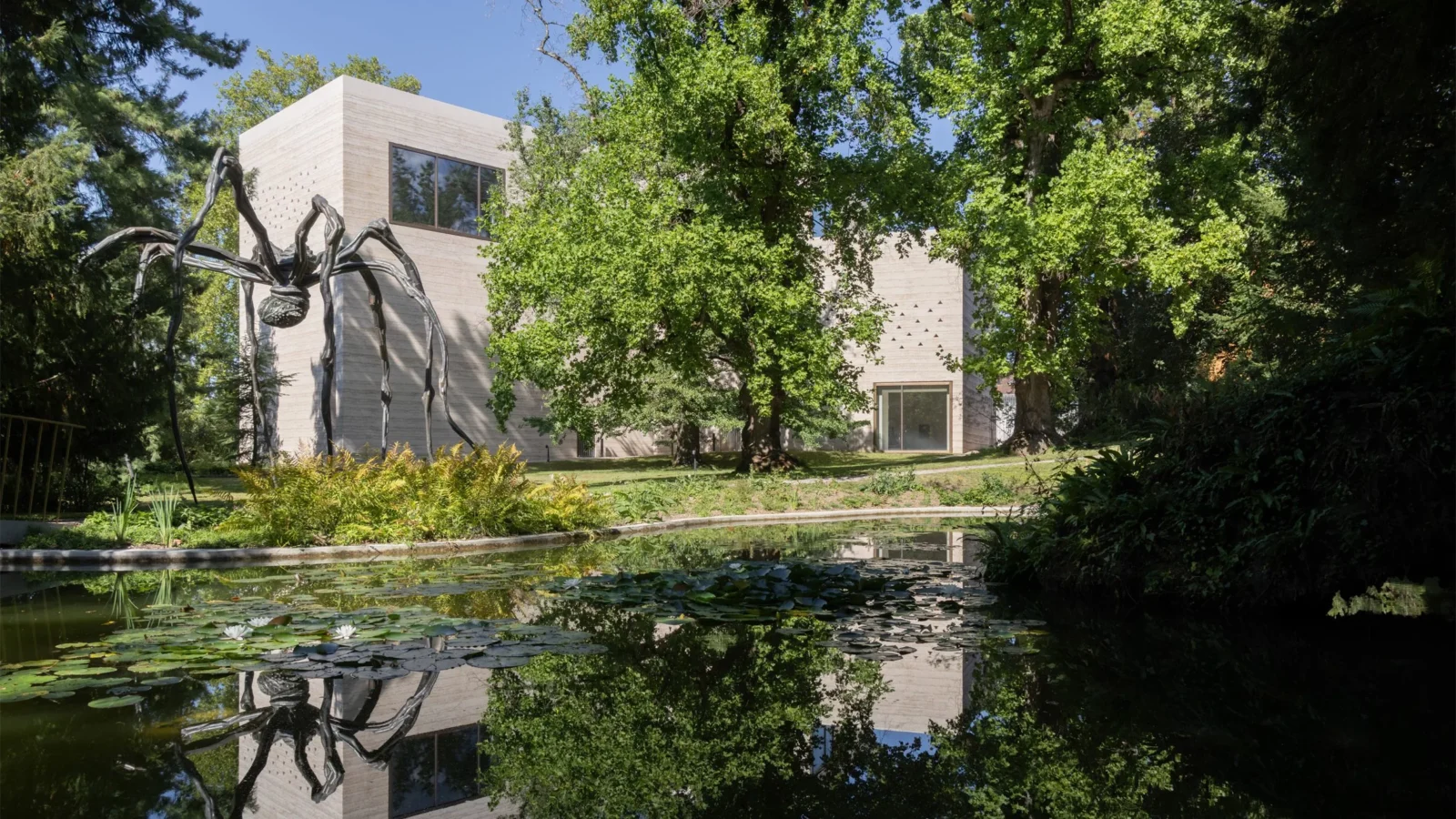
Zumthor’s Three New Buildings Open at Fondation Beyeler in Riehen
Peter Zumthor's Wyss Museum, Ammann Pavilion and Erlen Torhaus open at Fondation...
illustrarch Editoral Team4 Mins read

Benthem Crouwel Completes the Afsluitdijk Revamp with a Fish Passage and Domed Pumping Stations
The 32 km Afsluitdijk in the Netherlands has been raised, armoured and...
illustrarch Editoral Team2 Mins read


Leave a comment