

Bauhaus Architecture vs Brutalism: A Clash of Architectural Ideals
Bauhaus architecture emerged in Germany in 1919, championing lightness, precision, and the unity of art with industry. Brutalism followed after World War II, favoring raw exposed concrete and monumental mass. This article examines how two movements with shared modernist DNA produced radically different architectural languages.
 Furkan Sen22 March 202610 Mins read234

Table of Contents Show
Bauhaus architecture and brutalist architecture are two of the most influential movements in modern design history. Both emerged as radical responses to their times, both rejected ornamentation, and both placed function at the center of the design process. Yet in almost every other respect they diverged dramatically, in materials, in atmosphere, in cultural purpose, and in the emotional experience they produce. Understanding the differences between these two movements is essential for anyone studying the full spectrum of architectural styles or contemporary design practice.
What Is Bauhaus Architecture?

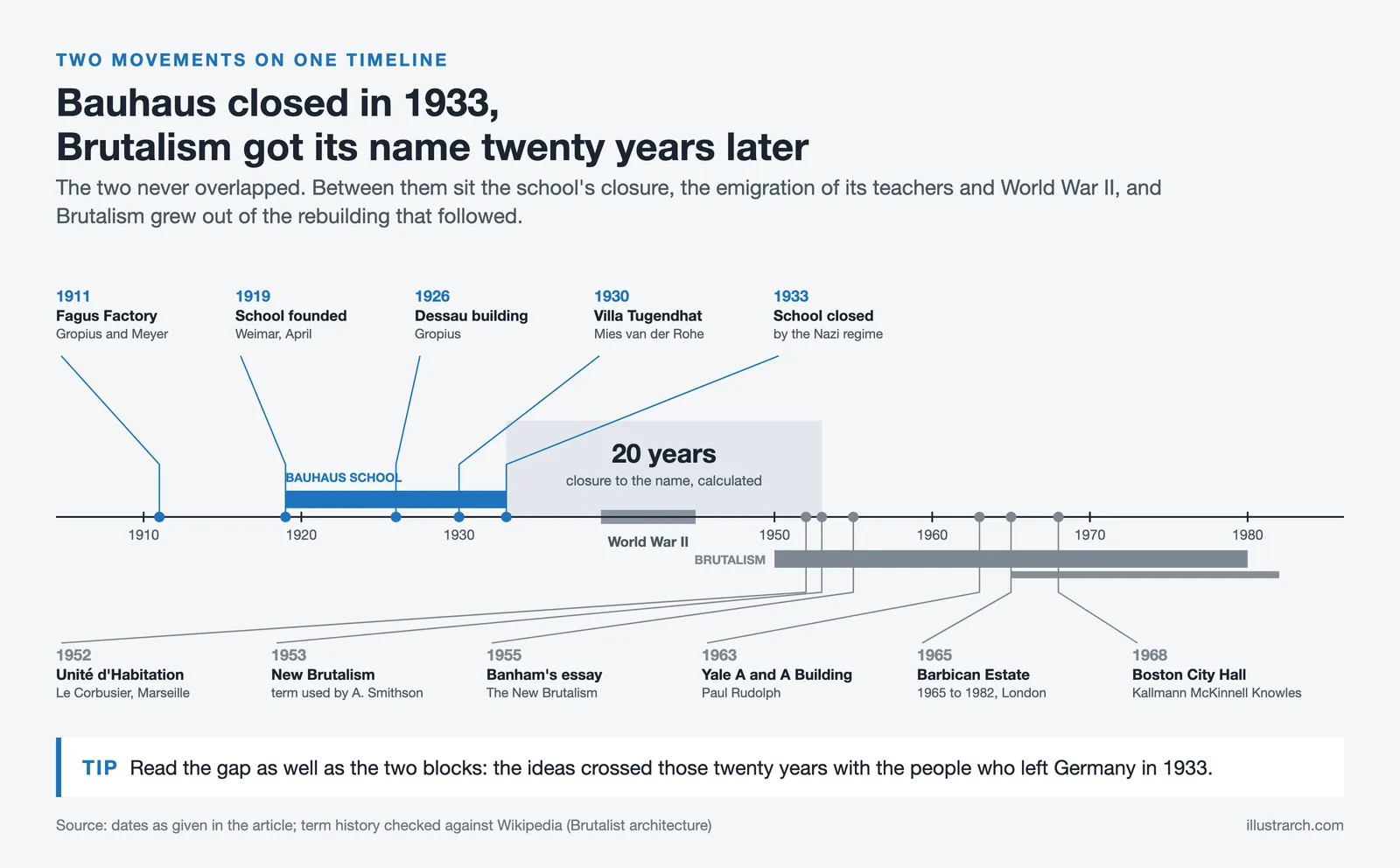
Bauhaus architecture is the built legacy of the Bauhaus school, founded by Walter Gropius in Weimar, Germany, on April 1, 1919. The word translates roughly as “building house,” and the school’s founding mission was to unite fine art, applied craft, and industrial production under a single educational framework. Faculty members including Wassily Kandinsky, Paul Klee, Marcel Breuer, and Ludwig Mies van der Rohe shaped its philosophy across the school’s three cities, Weimar, Dessau, and Berlin, until the Nazi regime forced its closure in 1933.
What is bauhaus style architecture at its core? It is a design language built on functional clarity, geometric purity, and the honest expression of industrial materials. Flat roofs, smooth white-rendered facades, asymmetrical compositions, ribbon windows, and steel-framed curtain walls define the visual vocabulary. As explored in our Art Deco vs Bauhaus comparison, buildings produced in the bauhaus architecture germany tradition were not monuments; they were living laboratories where art, craft, and technology merged into a unified vision of modern life.
The most complete architectural statement of the movement remains the Bauhaus Building in Dessau, designed by Gropius and completed in 1926. Its glass curtain wall on the workshop wing was revolutionary, dissolving the boundary between interior work spaces and the city outside. Each wing directly expressed its internal program, studios, workshops, administrative areas, making the organization of the building readable from the outside. Our guide to five iconic Bauhaus buildings you must visit explores how this principle of programmatic transparency played out across other key projects and continues to influence contemporary design.
💡 Pro Tip
When studying bauhaus germany architecture on site, pay close attention to how each wing serves a distinct programmatic function. Gropius deliberately made the building’s internal organization readable from the exterior, a principle still directly applicable today when clarity of circulation is a primary design goal. For a broader context on how this shaped modern interiors, see our overview of the evolution of modern interior architecture.
What Is Brutalist Architecture?

What is brutalist architecture? The term derives from the French béton brut, meaning raw concrete, a phrase popularized by architectural critic Reyner Banham in the 1950s. As the Royal Institute of British Architects (RIBA) notes, the term “New Brutalism” was used by Alison Smithson in 1953 (Swedish architect Hans Asplund had coined “nybrutalism” in 1950) and formally established as a movement by Banham’s 1955 essay “The New Brutalism” in the Architectural Review, which held up the Smithsons’ Hunstanton School as its example. Brutalism emerged in the post-World War II period as a direct response to the urgent need for housing, civic centers, schools, and infrastructure across war-damaged Europe.
Brutalist architecture examples range from Le Corbusier’s Unité d’Habitation in Marseille (1952) to London’s Barbican Estate (completed 1982), Paul Rudolph’s Yale Art and Architecture Building (1963), and Boston City Hall (1968). What connects them is a shared commitment to raw material expression: exposed concrete left unfinished, structural systems made visible, and massive geometric forms that assert their physical presence without apology. Our essay on Brutalism revisited examines why raw concrete still divides opinion today. You can also explore more examples in our dedicated piece on brutalist architecture.
📌 Did You Know?
The Barbican Estate in London, one of the most ambitious examples of brutalist architecture, took nearly two decades to complete (1965-1982) and houses over 4,000 residents across 2,000 flats, three tower blocks, and a major arts center. It was originally controversial, but is now a Grade II listed complex and one of the most sought-after addresses in the city. For a comparison of how brutalist values contrast with later minimalism, see our article on Brutalism vs Minimalism in contemporary architecture.
Origins and Historical Context: Different Worlds, Shared Impulse

Both movements arose from periods of profound social upheaval, but the nature of those upheavals shaped them in opposite directions. Bauhaus architecture germany was a product of post-World War I optimism and technological idealism. Gropius envisioned the school as a force for social reconstruction, training designers who could create affordable, functional environments for ordinary citizens through standardized industrial production. As detailed in our piece on Bauhaus vs Baroque, the atmosphere at the school was one of deliberate creative experimentation and international exchange, a sharp contrast to the ornamental traditions it sought to replace.
Brutalism, by contrast, was born from the harsher realities of post-World War II reconstruction. Governments across Europe needed to build quickly, cheaply, and at enormous scale. Concrete offered speed, economy, and fire resistance. The architects who embraced it, Le Corbusier, Alison and Peter Smithson, Denys Lasdun, Paul Rudolph, believed that the raw honesty of the material carried a moral charge. Brutalism was democratic architecture for democratic societies, built to last and designed to serve collective rather than individual needs. As our Brutalism vs Modernism comparison shows, this commitment to materiality set it decisively apart from earlier modernist refinement.
Timeline at a Glance
The following table places both movements in their broader modern architecture context:
| Dimension | Bauhaus Architecture | Brutalist Architecture |
|---|---|---|
| Active period | 1919-1933 | 1950s-1970s |
| Origin country | Germany (Weimar, Dessau, Berlin) | UK, France, global |
| Founding figure | Walter Gropius | Le Corbusier, Alison & Peter Smithson |
| Primary material | Steel, glass, refined concrete | Raw exposed concrete (béton brut) |
| Aesthetic character | Light, transparent, ordered | Heavy, monumental, sculptural |
| Historical context | Post-WWI idealism | Post-WWII reconstruction |
| Typical building type | Schools, housing, workshops | Public housing, civic buildings, universities |
Materials and Aesthetics: Light vs Weight
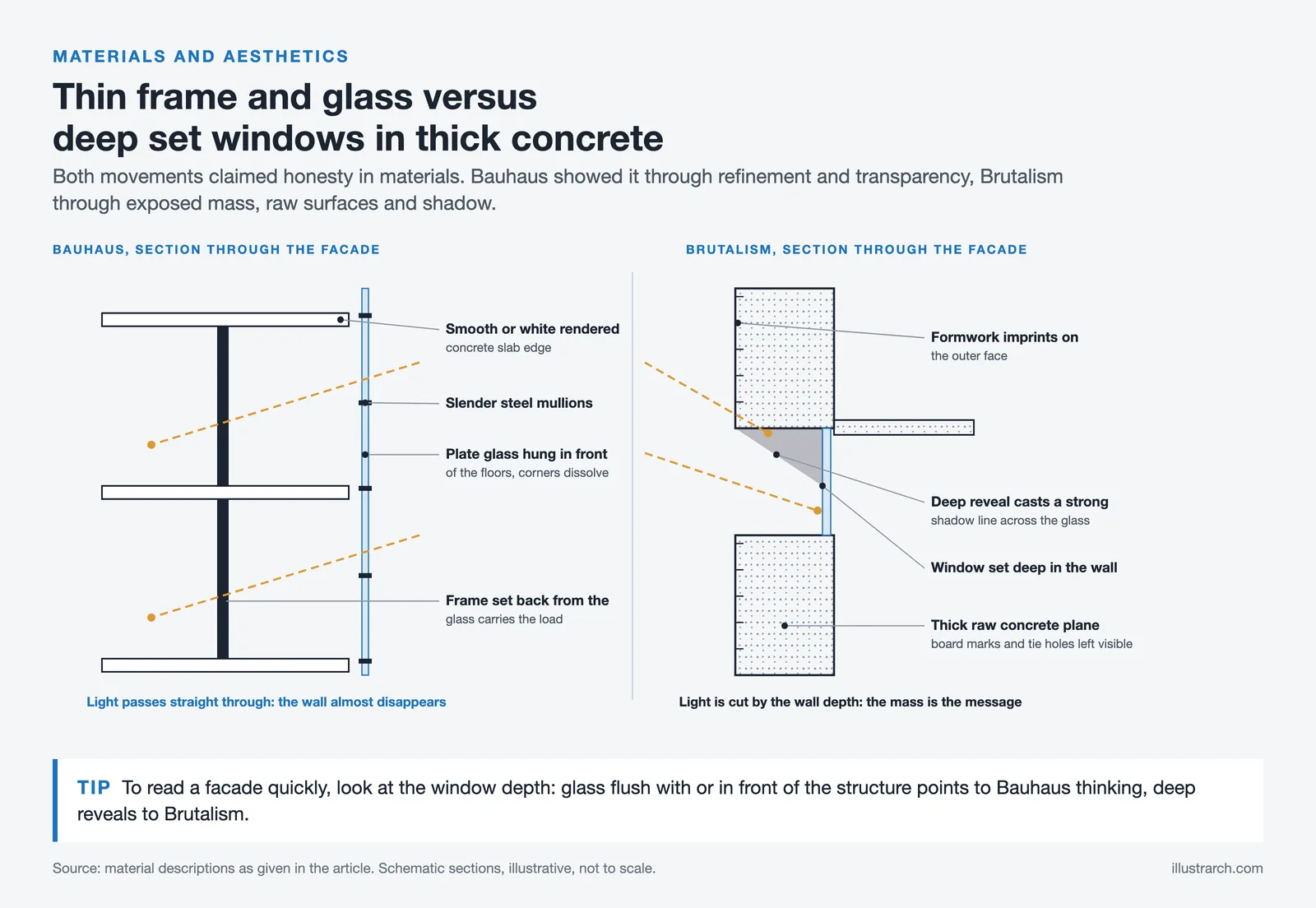
The material contrast between bauhaus architecture and brutalism is the most immediately visible difference. Bauhaus buildings rely on slender steel frames, expansive plate glass, and concrete rendered smooth or painted white. The result is transparency, lightness, and a sense of buildings that float above the ground rather than pressing into it. The Fagus Factory (1911), designed by Gropius in collaboration with Adolf Meyer, demonstrated this quality years before the school opened: floor-to-ceiling glass panels dissolved the corners of the building, making the structure appear almost weightless. Our guide to five iconic Bauhaus buildings shows how this material logic played out across different programs and scales. For an even deeper dive into how Bauhaus material thinking influenced furniture and product design, see our article on iconic furniture by famous architects.
Brutalism takes those same materials and inverts their visual logic. Concrete is left raw, not refined. Surfaces carry the imprints of formwork: board marks, tie-hole patterns, aggregate textures that record the act of construction. Windows are deep-set into thick concrete planes, casting strong shadow lines that accentuate the building’s mass rather than minimizing it. Where bauhaus style architecture conveys calm and openness, brutalist style architecture conveys force, weight, and institutional permanence. This contrast is explored in further detail in our analysis of the ten key differences between Bauhaus and Brutalism. For context on how these aesthetic differences map onto broader minimalism in architecture, the comparison remains instructive today.
🎓 Expert Insight
Reyner Banham, in his 1966 book The New Brutalism: Ethic or Aesthetic?, asked whether the movement was a moral stance or merely a visual style, a question that still frames debates about post-war concrete architecture.
Banham’s framing captures something Bauhaus architects would have recognized: the belief that architecture carries ethical responsibility. Both movements insisted on honesty in materials and construction, but Bauhaus expressed that honesty through refinement while Brutalism expressed it through exposure. The RIBA’s analysis of the Brutalism movement provides extensive primary documentation of this philosophy in practice.
Philosophy and Social Mission

Both architecture bauhaus and brutalist architecture style were driven by a conviction that design should serve society. Their interpretations of that conviction, however, differed significantly. For a broader framing of how these philosophies fit into the arc of modern architecture as a whole, it is worth understanding that both movements operated within a wider modernist project that rejected ornament in favor of function.
Bauhaus championed the idea that good design should be democratic through standardization. By developing standardized, industrially produced components, architects and designers could create beautiful, functional environments accessible to everyone, not just the wealthy. The emphasis was on integrating art with technology to improve daily life at scale. Ludwig Mies van der Rohe’s phrase “less is more” captures the Bauhaus ethos: restraint, precision, and the elimination of everything that does not serve function or spatial experience. You can trace how this thinking shaped domestic spaces in our overview of the evolution of modern interior architecture from Bauhaus to smart homes.
Brutalism pursued a different kind of social ambition. Rather than beauty through efficiency, it sought dignity through honesty. The raw materials that built post-war housing estates were not hidden behind plaster or paint; they were celebrated as the substance of collective life. Brutalist buildings were often monumental not because their designers wanted to intimidate, but because scale was believed to confer civic weight. The Fondation Le Corbusier’s documentation of the Unité d’Habitation illustrates how every dimension of the building, from apartment layouts to the rooftop terrace, was conceived as a social instrument, not merely a formal statement.
⚠️ Common Mistake to Avoid
Many people assume Brutalism’s name refers to the visual harshness of the buildings. It does not. “Brutalism” derives from béton brut, French for raw concrete, the term Le Corbusier used to describe unfinished concrete surfaces. The movement was named after a material, not a temperament. Similarly, Bauhaus is sometimes treated as a synonym for minimalism; in fact, the school encompassed painting, theater, typography, furniture, and textiles alongside architecture. For more on how these labels get misapplied, see our primer on three key architectural styles and how they are commonly confused.
Key Brutalist Architecture Examples and Bauhaus Buildings Compared

Looking at specific buildings makes the philosophical contrast concrete. The Bauhaus Building in Dessau (Gropius, 1926) and Boston City Hall (Kallmann, McKinnell & Knowles, 1968) offer a useful pairing. Both are public, civic-scaled buildings. Both reject ornament. But where the Dessau building uses glazed curtain walls and white plaster to communicate openness and transparency, Boston City Hall uses massive concrete overhangs and deeply recessed windows to communicate authority and permanence. The buildings feel like they belong to different emotional registers of the same modernist project. Our ten key differences article develops this building-by-building comparison further.
Villa Tugendhat (Mies van der Rohe, 1930) and Le Corbusier’s Unité d’Habitation in Marseille (1952) offer another comparison. Both are celebrated residential works; both use industrial materials in their structural vocabulary. But the Tugendhat residence uses slender steel columns and floor-to-ceiling glass to achieve spatial fluidity and a sense of weightlessness, while the Unité d’Habitation rests on massive béton brut pilotis that lift the building off the ground with a deliberate, almost theatrical display of structural effort. For a broader perspective on how brutalist and minimalist values diverge, our piece on Brutalism vs Minimalism in contemporary architecture is a useful companion read.
🏗️ Real-World Example
Yale Art and Architecture Building (New Haven, 1963): Paul Rudolph’s building is among the most studied examples of American brutalist architecture. Its bush-hammered concrete surfaces, created by hammering the cured concrete to expose aggregate, demonstrate how Brutalism could achieve genuine material richness through texture alone, without any applied decoration. The building’s complex split-level interiors and dramatic vertical spaces show that brutalist architecture examples are not always monolithic; at their best, they can be spatially intricate and deeply expressive. For similar complexity in a different tradition, compare with the work of Louis Kahn, whose poetic concrete forms bridged Brutalism and a more philosophical material sensibility.
How Bauhaus Influenced Brutalism

The relationship between these two movements is not simply one of contrast. Bauhaus directly seeded Brutalism through the movement of people. When the Nazi regime closed the Bauhaus school in 1933, its faculty and graduates dispersed across the world. Walter Gropius joined Harvard’s Graduate School of Design. Ludwig Mies van der Rohe became head of the architecture school at the Armour Institute of Technology (today the Illinois Institute of Technology) in 1938. Marcel Breuer, trained at the Bauhaus, later produced some of the most significant brutalist buildings in the United States, including the Whitney Museum of American Art (now the Breuer Building, home to Sotheby’s) in New York and the UNESCO Headquarters in Paris (1958, designed with Pier Luigi Nervi and Bernard Zehrfuss). As explored in our article on Brutalism vs Modernism, Breuer’s career arc is one of the clearest illustrations of this cross-movement lineage.
These figures carried Bauhaus principles, honesty of materials, clarity of structure, rejection of ornament, into the post-war context and translated them through the material realities of reconstruction. In this sense, Brutalism is not the opposite of Bauhaus architecture; it is one of its inheritors, adapted to a harder world. The evolution from Bauhaus to Brutalism is therefore best understood as a continuity rather than a rupture, the same moral ambition expressed through very different material means.
💡 Pro Tip
When analyzing the transition from Bauhaus to Brutalism in a design history context, trace individual architects rather than abstract movements. Marcel Breuer’s career arc, from Bauhaus student to furniture designer to monumental concrete architect, illustrates how a single practitioner can embody both movements and reveal the continuities that purely stylistic comparisons tend to obscure. For a structured way to approach this kind of cross-movement analysis, our guide to modern architecture provides a useful timeline and framework.

Legacy and Contemporary Relevance

Both movements are experiencing significant revivals in contemporary culture, though through different channels. Bauhaus architecture influences technology company branding, Scandinavian furniture design, and architectural education worldwide. Its emphasis on simplicity, usability, and the integration of form with function resonates strongly with the interface design and product design cultures of the 21st century. The Bauhaus Dessau Foundation, which manages the movement’s historic buildings and a collection of over 50,000 objects, continues to advance Bauhaus research and attract more than 100,000 visitors annually to its UNESCO World Heritage sites. For how these Bauhaus principles translated into contemporary domestic design, see our overview of modern nuances in interior design styles.
Brutalism’s revival is more contested and more culturally rich. Preservation campaigns have emerged around threatened buildings including Park Hill in Sheffield, the Tricorn Centre in Portsmouth (demolished in 2004), and structures across the former Eastern Bloc. Photography communities dedicated to brutalist architecture have built substantial followings. Academic interest in the evolution that connects Bauhaus to Brutalism, Latin American brutalism, and the colonial dimensions of the style has expanded the conversation well beyond its British origins. The style has also influenced fashion, graphic design, and web design, where its raw, unfinished aesthetic signals authenticity and resistance to mainstream polish.
Both movements remind architects that design carries social meaning, that the choice of a material, the scale of a building, the relationship between structure and surface all communicate values to the people who inhabit and pass through the built environment. Understanding how each movement made those choices is fundamental to any serious engagement with modern architecture. For further reading across both traditions, our piece on modern architecture vs contemporary architecture traces where these mid-century values survive, and where they have been challenged, in current practice.
✅ Key Takeaways
- Bauhaus architecture (1919-1933) was founded by Walter Gropius in Germany and championed lightness, transparency, and the unity of art with industrial production. Brutalism (1950s-1970s) emerged from post-war reconstruction and favored raw exposed concrete, monumental mass, and civic scale. See our full ten key differences guide for a detailed breakdown.
- The two movements share a common core, rejection of ornament, honesty of materials, prioritization of function, but express those values through dramatically different material strategies and emotional registers.
- Brutalism was directly seeded by Bauhaus; Marcel Breuer, Mies van der Rohe, and other Bauhaus figures carried the school’s principles into the post-war world and helped translate them into the brutalist vocabulary. Read more in our piece on the evolution from Bauhaus to Brutalism.
- Brutalism’s name comes from béton brut (raw concrete), not from any sense of visual aggression. The RIBA archive documents the exact etymology and first usage of the term in 1953.
- Both movements are experiencing contemporary revivals: Bauhaus through design and technology culture, Brutalism through preservation advocacy, architectural photography, and expanded scholarly attention to its global variants.




Georgian Architecture: Features, History & Examples
Georgian architecture (1714-1830) is defined by strict symmetry, classical proportion, sash windows...
 illustrarch Editoral Team9 Mins read
Neoclassical Architecture: Features, History & Examples
Neoclassical architecture emerged in the mid-18th century, reviving Greek and Roman forms...
illustrarch Editoral Team8 Mins read

Craftsman Architecture: Features, History & Examples
Craftsman architecture emerged in early 1900s America as a response to Victorian...
illustrarch Editoral Team10 Mins read

Florence Renaissance Architecture: How Building Became an Authored Art
Florence Renaissance architecture is usually told as a list of buildings. The...
Furkan Sen6 Mins read


Leave a comment