

Minoru Yamasaki Building in Minneapolis Becomes Hotel in 2028
Minoru Yamasaki's Northwestern National Life Building in Minneapolis, vacant since 2023, is being transformed into a 165-room hotel with a ballroom, rooftop patio, and restaurant. The adaptive reuse project preserves the building's iconic portico and mid-century architectural identity while opening it to the public for the first time.
 Elif Ayse Sen11 May 202610 Mins read283

Table of Contents Show
Minoru Yamasaki‘s Northwestern National Life Building at 20 Washington Avenue South in Minneapolis is being converted into a 165-room hotel. The mid-century landmark, vacant since 2023, will be adapted into a hospitality destination with a ballroom, rooftop patio, wellness areas, and a restaurant along its original reflecting pools, with a projected opening in 2028.
The History Behind Yamasaki’s Minneapolis Landmark
The Northwestern National Life Building opened in 1965 as the headquarters of the Northwestern National Life Insurance Company. The company selected Minoru Yamasaki as architect after an extensive search that included interviews with 39 candidates. John Pillsbury, who ran one of Minnesota’s largest life insurance companies at the time, ultimately chose Yamasaki for the commission.
The original program called for a corporate headquarters accommodating roughly 500 employees, including underwriters, actuaries, medical examiners, and administrative staff. Unusually for an office building, the headquarters also housed an in-house medical department equipped with x-ray machines and electrocardiographs so the insurance company could assess applicants’ mortality risks on-site.
The building sits in the Gateway District of Minneapolis, one of the first areas to undergo large-scale adaptive reuse and urban renewal in the city. In the late 1950s and early 1960s, nearly 17 square blocks of aging downtown structures were demolished to make way for modern development. Yamasaki’s building was positioned as the centerpiece of this transformation, placed at a key location near the junction of Hennepin and Nicollet Avenues, serving as the visual endpoint of Minneapolis’s historic retail corridor.
Over the decades, the building changed hands and names multiple times. Northwestern National Life became ReliaStar, then ING, and most recently Voya Financial. In 2023, Voya moved its operations across the street, leaving the structure vacant for the first time in nearly six decades.
📌 Did You Know?
The building previously sold as part of a larger complex in 2014 for $103 million. In November 2025, Minneapolis developer Chad Tepley purchased it for just $7.1 million, a fraction of its earlier value, reflecting the sharp decline in downtown office property values across the United States.
Architectural Identity: The Design of the Northwestern National Life Building

The Northwestern National Life Building is widely considered a high point of 1960s modernism in Minneapolis. Minoru Yamasaki designed it in the New Formalism style, a movement he co-pioneered alongside architect Edward Durell Stone. New Formalism combined the structural honesty of modernism with references to classical architecture, including columns, symmetry, and formal spatial sequences.
The building’s most recognizable feature is its monumental portico: a colonnade of approximately 63 slender, pointed arches cast in white quartz-faced concrete, rising about 85 feet (26 meters) above ground level. This elevated porch spans roughly 6,000 square feet and serves as the visual terminus of the Nicollet Mall, framing sightlines from the Mississippi River toward downtown. Yamasaki described his design intent as creating something “monumental and dignified, yet graceful.”
The facade is clad in verde antique marble, and the grounds include paired reflecting pools and sculptured landscaping developed in collaboration with landscape architect Lawrence Halprin. Yamasaki referred to the project as “a park with a building in it,” emphasizing a design philosophy that prioritized visual openness and pedestrian experience within a monumental framework.
💡 Pro Tip
When evaluating a mid-century building for adaptive reuse, pay close attention to floor-to-ceiling heights and column spacing. Buildings from this era often have generous structural proportions that translate well into hospitality layouts, reducing the need for costly structural modifications during conversion.
Architecture critic Larry Millett described the building as “a temple to the gods of underwriting, built by an insurance company and mixing luxury and high camp in a way that, say, Liberace would have appreciated.” The formal ambiguity of the design has prompted varied interpretations over the years. Depending on the observer, the building has been read as a Roman temple, a jewel box, an oversized music box, or a classical portico reinterpreted through a modernist lens.
Who Was Minoru Yamasaki?

Minoru Yamasaki (1912-1986) was a Japanese-American architect born in Seattle, Washington. He studied architecture at the University of Washington, graduated in 1934, and continued his studies at New York University. After working at several New York firms through the 1930s and 1940s, he moved to Detroit in 1945 to serve as chief of design at Smith, Hinchman, and Grylls. He founded his own practice, Minoru Yamasaki & Associates, in Troy, Michigan in 1949.
Yamasaki is best known as the architect of the original World Trade Center in New York City (completed 1973), but his body of work includes dozens of significant buildings across the United States and internationally. His architectural language centered on repetition, verticality, and refined material expression. He sought to create environments that offered calm and a human-scaled experience within larger monumental forms.
Notable Minoru Yamasaki Buildings
The following table highlights some of the most significant buildings in Yamasaki’s career, giving context to where the Northwestern National Life Building fits within his broader portfolio.
| Building | Location | Year | Significance |
|---|---|---|---|
| Lambert-St. Louis Airport Terminal | St. Louis, MO | 1956 | Thin-shell concrete vaults; early career breakthrough |
| McGregor Memorial Conference Center | Detroit, MI | 1958 | Reflecting pools and temple-like proportions |
| Pacific Science Center | Seattle, WA | 1962 | Built for the Seattle World’s Fair; Gothic arches in concrete |
| Northwestern National Life Building | Minneapolis, MN | 1965 | Quartz-faced colonnade; New Formalism landmark |
| World Trade Center (Twin Towers) | New York, NY | 1973 | 110-story towers; Yamasaki’s most famous project |
| Century Plaza Towers | Los Angeles, CA | 1975 | Paired aluminum-clad towers in Century City |
| Rainier Tower | Seattle, WA | 1977 | Inverted pedestal base; distinctive silhouette |
🎓 Expert Insight
“I want to make the kind of buildings where people feel comfortable, where they experience a sense of serenity and delight.” — Minoru Yamasaki, A Life in Architecture (1979)
This philosophy is directly visible in the Northwestern National Life Building’s design. Where many corporate headquarters of the era prioritized imposing scale, Yamasaki’s Minneapolis building balances monumentality with intimate, walkable spaces and sensory details like water features and filtered light through the colonnade.
Yamasaki’s career was not without controversy. His Pruitt-Igoe public housing project in St. Louis (1956), once praised as progressive design, deteriorated rapidly due to mismanagement and underfunding, becoming a national symbol of failed urban planning. Its demolition in 1972 is often cited as a symbolic endpoint for modernist idealism in public housing. Yamasaki himself expressed increasing skepticism about architecture’s ability to solve social problems in his later years.
The Hotel Conversion Plan: What We Know

Minneapolis developer Chad Tepley, founder and president of CDT Realty, purchased the building in November 2025 for $7.1 million. In April 2026, Tepley presented initial plans for converting the structure into a hotel, walking media crews through the empty lobby and describing the vision for the project.
The proposed hotel program includes:
- 165 guest rooms distributed across the upper floors, following the lines of the building’s arched floor-to-ceiling windows
- A ballroom and pool deck located in the former mechanical penthouse
- A 17,000-square-foot patio built on top of the portico
- A restaurant positioned along the building’s reflecting pools
- Wellness and fitness areas
- Event and retail spaces at ground level
Tepley noted that the building’s original layout naturally lends itself to hotel use. The existing service elevator reaches all floors, including what will become the penthouse level, and the floor plates do not require major structural cuts to create light wells, a common and expensive challenge in office-to-hotel conversions. The arched windows will frame natural light into individual guest rooms, a feature that would be difficult and expensive to create from scratch in a new-build project.
The developer has stated that CDT Realty does not plan to seek local financial assistance for the conversion. However, the project’s critical path will likely depend on eligibility for historic tax credits, which can offset a significant portion of rehabilitation costs for qualifying properties. The projected opening is targeted for 2028, pending approvals and financing.
💡 Pro Tip
Historic tax credits can cover 20% of qualified rehabilitation expenditures for income-producing buildings listed on the National Register. For developers evaluating mid-century office-to-hotel conversions, this incentive can make or break project feasibility, especially when the building’s heritage features require specialized preservation work.
Why Convert an Office Building into a Hotel?

The Yamasaki building Minneapolis hotel conversion reflects a broader national trend. Across major U.S. cities, mid-20th-century office buildings are being repurposed as remote work, downsizing, and changing corporate real estate strategies leave large swaths of commercial space vacant. Downtown Minneapolis has been particularly affected, with several significant office buildings selling at steep discounts in recent years.
Office-to-hotel conversions offer several advantages over residential conversions. Hotel rooms are typically smaller than apartments, making it easier to work within existing floor plate dimensions without adding plumbing stacks or reconfiguring structural bays. Hotels also generate foot traffic and street-level activity that can support restaurants, retail, and event programming in ways that purely residential projects do not.
For architecturally significant buildings like the Northwestern National Life Building, adaptive reuse also addresses a preservation question. Demolishing a building with this level of design quality would be a cultural loss. Converting it to a use that generates revenue and public access provides both economic justification for preservation and a way to fulfill the building’s original civic ambition.
🏗️ Real-World Example
The TWA Hotel at JFK Airport (New York, 2019): Eero Saarinen’s 1962 TWA Flight Center was converted into a 512-room hotel by MCR and Morse Development. The project preserved Saarinen’s sculptural concrete interior while adding two new hotel wings. It demonstrated that mid-century modernist buildings with strong spatial identities can be successfully adapted for hospitality without sacrificing their architectural character.
Preservation Challenges and the Portico Question

The most architecturally sensitive aspect of the conversion is the 6,000-square-foot portico. Yamasaki designed the colonnade as a “porch to the city,” a semi-public space meant to be walked through and experienced. The proposed plan to build a 17,000-square-foot patio on top of the portico raises questions about how the colonnade’s proportions, visual lightness, and spatial transparency will be affected.
Additionally, the building’s post-9/11 history introduced its own complications. After the destruction of Yamasaki’s World Trade Center towers in 2001, security concerns led to changes at many of his surviving buildings. At the Northwestern National Life Building, access to the grounds was restricted and photographers were sometimes asked to leave, undermining the open civic character that Yamasaki originally intended.
The hotel conversion presents an opportunity to reverse that trend. By making the building publicly accessible for the first time in years, with a restaurant, event spaces, and activated ground-floor areas, the project could actually bring the structure closer to Yamasaki’s original vision of a public-facing urban landmark than it has been in decades.
⚠️ Common Mistake to Avoid
A frequent error in adaptive reuse projects is treating the building’s most distinctive feature as an obstacle rather than an asset. In the case of the Northwestern National Life Building, the portico is not empty overhead space to be filled. It is the building’s defining spatial experience. Successful conversions preserve and activate these signature elements rather than enclosing or altering them beyond recognition.
What the Yamasaki Minneapolis Hotel Means for Downtown
Downtown Minneapolis has struggled since the pandemic, with office vacancy rates climbing and street-level activity declining. The Northwestern National Life Building sits at a strategically important intersection near the Hennepin Avenue Bridge, connecting the city’s core to the riverfront and the Mill District.
Converting the building into a hotel addresses multiple urban priorities at once. It brings overnight visitors who spend money at nearby restaurants and businesses. It activates a prominent street corner that has been dark since 2023. And it preserves a building that the AIA Minnesota and local historians consider one of the finest pieces of architecture in the city.
Michael Rainville, the City Council member representing the area, expressed support for the project, emphasizing the benefit of bringing visitors and community engagement to the site. CDT Realty’s track record in the city includes a warehouse-to-office conversion (Burlap Lofts) and a 49-unit apartment complex (1000 Main Street), both in northeast Minneapolis.
The Minneapolis-St. Paul hotel market has shown signs of recovery in recent years. By year-end 2023, hotel occupancy in the Twin Cities had rebounded to approximately 57%, according to STR, and revenue per available room continued to climb through 2024. The timing of a 2028 opening could align with further market improvement, though the project’s success will ultimately depend on execution quality and the ability to position the building as a destination rather than just another hotel room count.
Yamasaki’s Architectural Legacy in Context
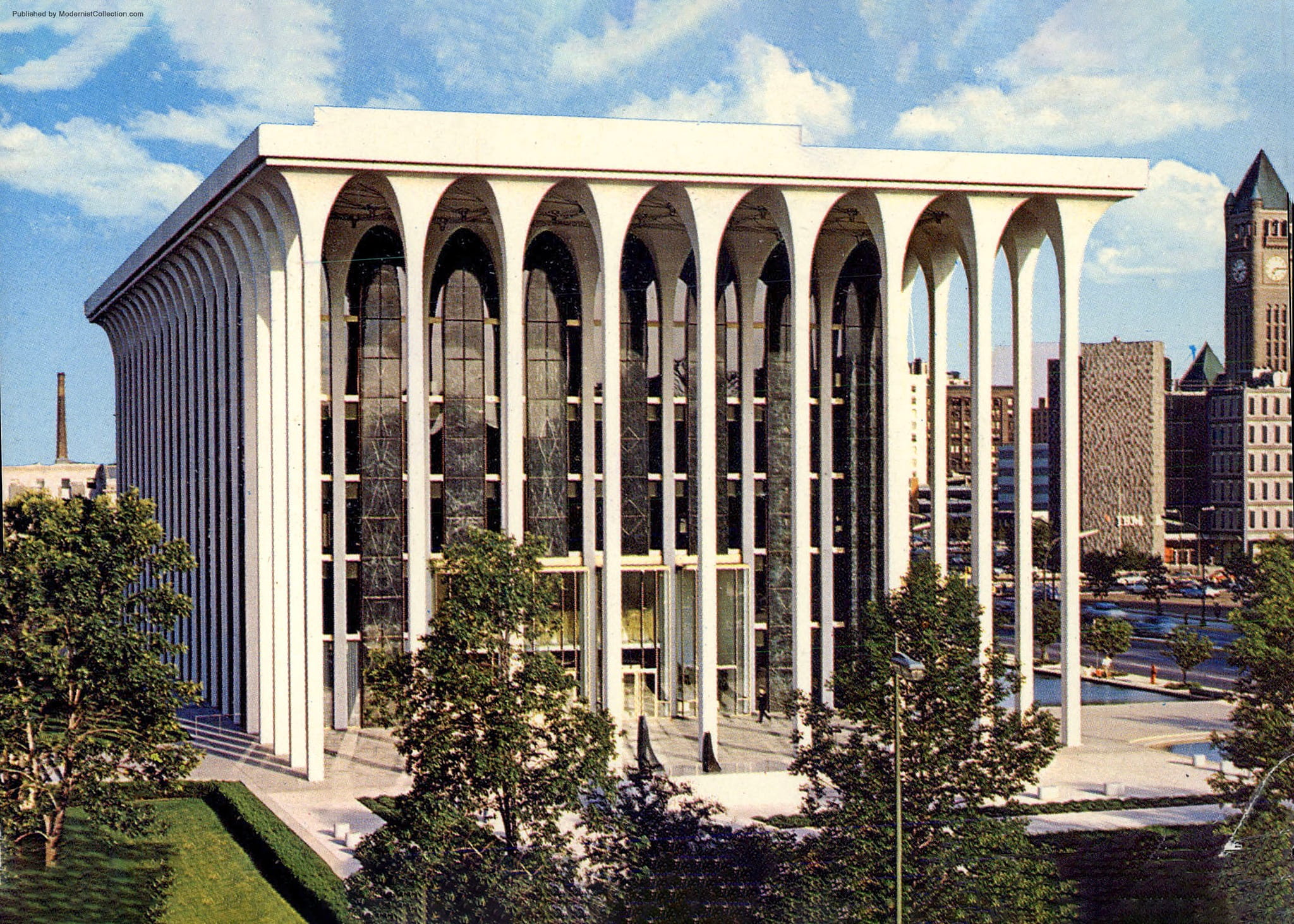
Minoru Yamasaki occupies a complicated place in architectural history. During the 1950s and early 1960s, he was among the most celebrated architects in America. His work was featured at the Walker Art Center in Minneapolis in 1964, and he received the commission for the World Trade Center, the largest real estate development in history at the time. The Northwestern National Life Building was designed at the peak of this period, just before the World Trade Center commission.
By the late 1960s, critical opinion began to shift. The twin towers were polarizing from the moment they were revealed. Pruitt-Igoe’s failure, though largely caused by policy decisions rather than architectural ones, tarnished Yamasaki’s reputation. His death in 1986 and the destruction of the World Trade Center in 2001 further complicated how his work is remembered.
The Docomomo US/MN chapter has documented Yamasaki’s Minnesota work as part of a broader effort to recognize and preserve significant modern architecture. The Northwestern National Life Building, along with the neighboring 100 Washington Square (also designed by Yamasaki), represents an important cluster of his work outside his Detroit base.
The hotel conversion offers a chance to reintroduce Yamasaki’s architecture to a public that may only associate his name with the World Trade Center. Visitors who stay at the hotel or dine along the reflecting pools will experience firsthand the qualities that defined his design philosophy: the interplay of light and structure, the rhythm of repeated forms, and the tension between monumental scale and human comfort.
✅ Key Takeaways
- Minoru Yamasaki’s Northwestern National Life Building (1965) in Minneapolis is being converted into a 165-room hotel, with a projected 2028 opening.
- Developer Chad Tepley of CDT Realty purchased the building for $7.1 million in November 2025 after it sat vacant since 2023.
- The conversion preserves the building’s defining features, including its 85-foot portico, quartz-faced colonnade, reflecting pools, and marble facade.
- The project reflects a growing national trend of adaptive reuse for mid-century office buildings no longer suited to modern workplace demands.
- The hotel will be the first time the building has been open to the general public in a meaningful way since its construction as a private corporate headquarters.
Final Thoughts
The Minoru Yamasaki Northwestern National Life Building hotel conversion is more than a real estate transaction. It is a test case for whether cities can preserve their best mid-century architecture by finding new economic purposes for buildings whose original functions have become obsolete. If the project succeeds, it could serve as a model for similar conversions across the country, demonstrating that buildings with strong design identities and quality construction deserve a second life rather than a wrecking ball.
For architecture enthusiasts, the project is worth following closely. The decisions made about the portico, the reflecting pools, and the balance between new programming and original character will determine whether the building’s next chapter honors Yamasaki’s vision or merely occupies his structure. The best adaptive reuse projects manage to do both.
Project details, timelines, and scope are based on publicly available information as of April 2026 and remain subject to change pending regulatory approvals and financing.
- adaptive reuse minneapolis
- minoru yamasaki
- minoru yamasaki architecture
- minoru yamasaki buildings
- minoru yamasaki hotel conversion
- minoru yamasaki northwestern national life building
- northwestern national life building hotel
- northwestern national life building minneapolis
- yamasaki building minneapolis hotel
- yamasaki minneapolis hotel 2028



Groupwork Completes 10-Storey Loadbearing Granite Flats in London
Groupwork's Petra Heights on Finchley Road is a 10-storey block of 22...
 illustrarch Editoral Team2 Mins read
Ai Weiwei Installs 500 Cast-Iron Helmets Outside Sydney Museum
Ai Weiwei's 500 cast-iron helmets opened outside Sydney's MCA on 25 September,...
illustrarch Editoral Team2 Mins read
Isamu Noguchi at Lever House Traces Sculptor’s Decades-Long Collaboration with Bunshaft
Lever House's new exhibition pairs Noguchi sculptures with unbuilt garden designs made...
illustrarch Editoral Team2 Mins read
Relocated Maya Structures at Mexico’s Balam Tun Memory Park Face Legal Challenge
INAH archaeologists have filed a complaint against 26 officials over Balam Tun...
illustrarch Editoral Team2 Mins read


Leave a comment