

SOM Designs 272-Meter Tower Complex for Alatau, Kazakhstan
SOM's Iconic Complex in Alatau, Kazakhstan features a 272-meter primary tower and an 80-metre secondary tower, together forming a 276,800 sqm mixed-use vertical district inspired by the Trans-Ili Alatau mountain range and designed to anchor the new city's central business district.
 Elif Ayse Sen19 March 20268 Mins read281


Table of Contents Show
The SOM Designs 272-Metre Tower Complex for Alatau is a landmark mixed-use development conceived by Skidmore, Owings & Merrill (SOM) to serve as the architectural and economic nucleus of Kazakhstan’s planned new city. Forming the centrepiece of the Gateway District masterplan, the project integrates office space, premium residences, a luxury hotel, retail, and cultural venues within two stepped towers totalling 276,800 square metres of gross floor area.
What Is the SOM Alatau Iconic Complex?
Revealed publicly on March 5, 2026, the Alatau Iconic Complex is SOM’s contribution to one of Central Asia’s most ambitious urban development initiatives. The project sits within a Special Economic Zone covering nearly 97,900 hectares, and Alatau itself is envisioned as an international hub along the Almaty–Qonaev highway, connecting to broader regional trade corridors associated with the New Silk Road network. The city’s masterplan extends through 2050, with the first phase of major infrastructure projects scheduled for completion by 2030.
SOM was commissioned to create what the client describes as an “economic and administrative nucleus” for Alatau City. The resulting design consists of two towers forming a vertical district: a 272-metre primary tower rising across approximately 56 floors, and an adjacent 80-metre secondary tower. Together they will define the city’s central business district and establish the visual identity of a skyline that does not yet exist.
💡 Pro Tip
When designing towers for new cities without an established urban context, experienced architects prioritise vertical programme stacking to create density around a single walkable core. SOM’s decision to concentrate office, residential, hotel, and retail within two towers rather than spread across a campus reflects this logic: you need critical mass before the city can generate its own energy.
The project is led by the Alatau City Development Group LLP alongside long-term investors and government partners. Preparatory construction work has already begun on site, with commissioning targeted for the end of 2029.
Design Concept: The Trans-Ili Alatau as Architectural Source
The most distinctive aspect of SOM’s approach is how directly the design draws from its geographic setting. The Trans-Ili Alatau is a 350-kilometre range of valleys, glaciers, and stratified geological terrain that defines the southern horizon of the Almaty region. SOM translated this landscape into architectural form through faceted surfaces, stepped massing, and terraced profiles that echo the layered character of the mountains.
Both towers feature wedge-like, pyramidal profiles that step back as they rise, with external terraces at each level reinforcing the connection to the mountainous silhouette. The primary tower’s approximately 56-floor stack accommodates Class-A office space in the lower and middle sections alongside premium residential apartments in the upper floors. The secondary 80-metre tower focuses on hospitality, integrating a luxury hotel and branded residences that strengthen the development’s mixed-use offer.
📌 Did You Know?
Upon completion, the 272-metre primary tower will become the tallest structure in the Almaty region and in all of southern Kazakhstan. The entire new city of Alatau, once complete, is planned to span 88,000 hectares across four districts, making it one of the largest planned urban developments currently under construction in Central Asia.
At the base, a three-level podium of 58,000 square metres anchors the complex to the public realm. Terracing toward the street in a form that echoes the local foothills, the podium accommodates retail, cultural venues, and event spaces while fostering active pedestrian engagement. Landscaped public realm surrounds the complex at street level, positioning the Gateway District as a genuinely walkable urban quarter within a city still being built.
For illustrarch readers interested in the broader computational and material logic behind this kind of contextually driven facade work, the step-by-step guide to creating striking parametric facades provides useful technical context on how architects translate environmental and geographic inputs into building skin geometry.
High-Performance Facade and Structural Engineering
The Almaty region presents a challenging engineering context. The area sits in a high-seismic zone, which means structural resilience is not a secondary concern but a primary driver of architectural form. SOM embedded seismically resilient framing and damping systems proven in high-seismic regions such as Japan and Taiwan directly into the architectural design. These systems dissipate earthquake energy while maintaining structural continuity, ensuring that the towers are as safe as they are visually ambitious.
📐 Technical Note
Seismic damping systems used in high-rise design typically fall into passive categories (tuned mass dampers, viscous fluid dampers) and active categories (computer-controlled systems that counteract seismic forces in real time). For towers in high-seismic zones, building codes generally require designs to resist ground accelerations equivalent to a peak ground acceleration of 0.3g or higher, depending on the hazard classification of the site. The Almaty region is classified as one of the highest seismic risk zones in Central Asia.
On the environmental performance side, both towers feature high-performance facades with integrated shading strategies designed to reduce solar gain in a region that experiences significant summer heat. Central atria within both buildings draw natural light deep into the floor plates while framing panoramic views of the surrounding mountains. This approach reduces reliance on artificial lighting in deep floor plans while maintaining the visual connection to the landscape that gives the project much of its conceptual coherence.
This kind of performance-driven envelope thinking connects to wider trends in facade design. The overview of modern facade building design on illustrarch covers how high-performance glazed systems, integrated shading, and double-skin strategies are reshaping contemporary tower skins.
SOM Architecture: A Firm Built on Landmark Tall Buildings
Understanding why SOM was chosen for this project requires a brief look at the SOM architecture firm’s broader portfolio. Founded in Chicago in 1936 by Louis Skidmore and Nathaniel Owings and joined in 1939 by engineer John Merrill, the practice has spent nearly ninety years building a reputation specifically around structurally and environmentally advanced tall buildings.
The firm’s landmark projects include the Willis Tower (formerly Sears Tower) in Chicago, which held the title of the world’s tallest building for more than twenty years after its 1973 completion; One World Trade Center in New York; the Jin Mao Tower in Shanghai; and the Burj Khalifa in Dubai, currently the world’s tallest building at 828 metres. The structural engineering innovations developed at SOM, particularly Fazlur Khan’s tubular frame systems and Bill Baker’s buttressed core concept for the Burj Khalifa, have become foundational references across the global tall building industry.
🎓 Expert Insight
“Architecture should speak of its time and place, but yearn for timelessness.” — Frank Gehry
This principle underlies SOM’s approach to the Alatau complex. The towers are unmistakably of their moment in terms of programme, engineering, and sustainability strategy, yet the decision to root their form in the geology and landscape of the Trans-Ili Alatau range is an attempt to give the project a longer cultural life than its immediate economic function alone could provide.
In Kazakhstan specifically, SOM has prior context. The firm previously designed the Talan Towers complex in Astana (now Nur-Sultan), giving the practice direct experience with the country’s construction environment, regulatory frameworks, and climate conditions. That experience, combined with SOM’s global tall-building expertise, informed the structural and environmental strategy for the Alatau Iconic Complex.
The parametric architecture design process article discusses how firms like SOM integrate computational workflows into the design of structurally complex and environmentally responsive buildings.
SOM Architecture Projects in Central Asia: Context and Significance
The Alatau Iconic Complex does not exist in isolation. It is part of a broader pattern of Central Asian cities using landmark architecture as a tool of economic and political identity. Kazakhstan has been particularly systematic in this approach, commissioning major international firms to design buildings that signal the country’s emergence as a regional hub for investment, technology, and logistics.
SOM architecture projects in this part of the world tend to combine global structural expertise with explicit responses to local landscape and cultural context. The Talan Towers in Astana already demonstrated this capacity. The Alatau commission extends that logic to a more ambitious scale: rather than a single tower inserted into an existing city, SOM is here designing the centrepiece of a city that does not yet exist, with the dual challenge of creating urban density from scratch and establishing an architectural identity that will define how Alatau is perceived internationally.
🏗️ Real-World Example
Talan Towers (Astana, Kazakhstan): SOM’s earlier work in Kazakhstan provides a reference point for the Alatau commission. The Talan Towers complex in Astana demonstrated the firm’s ability to design high-rise mixed-use development within Kazakhstan’s specific regulatory, seismic, and climatic conditions. That project established trust with Kazakh clients and gave SOM direct material knowledge of building in a context defined by extreme temperature ranges, high seismic activity, and strong winds.
For architecture students and professionals tracking how global firms navigate new city commissions, illustrarch’s article on the tallest skyscrapers in New York City offers a useful comparative lens on how tall buildings acquire meaning within their urban contexts over time.
Programme and Urban Strategy: Building a City from a Single Complex
One of the most instructive aspects of this project is how SOM has addressed the challenge of creating urban life within a city that currently has no residents, no established street culture, and no existing commercial ecosystem. The mixed-use stacking of the Iconic Complex, combining offices, premium residences, a hotel, branded residential apartments, retail, and cultural venues within two towers and a 58,000-square-metre podium, is a deliberate strategy to manufacture the density and activity that normally takes decades to accumulate organically.
The programme logic follows a pattern SOM has deployed in other contexts: concentrate multiple uses vertically to ensure the building generates pedestrian activity at multiple times of day. Office workers occupy the building from morning through evening. Hotel guests and residential tenants create demand outside business hours. The podium retail and cultural venues give the public realm a reason to exist even before the surrounding city fabric fills in.
💡 Pro Tip
When evaluating mixed-use tower proposals, look at how the programme is stacked, not just what uses are included. The most successful mixed-use towers position retail and cultural functions at the base to activate the public realm, office and commercial uses in the mid-section for column-free efficiency, and residential or hotel in the upper floors where views and reduced noise make premium pricing viable. The Alatau complex follows this logic closely.
The Gateway District masterplan surrounding the Iconic Complex extends this thinking to the urban scale, planning a walkable, transit-oriented centre that connects to Alatau’s broader infrastructure network. The mobility-oriented approach reflects current best practice in new city design, where car dependency is viewed as an obstacle to the kind of spontaneous urban activity that makes new cities feel genuinely inhabited rather than merely functional.
What the Alatau Complex Means for SOM Architecture Kazakhstan
The Alatau commission marks SOM architecture Kazakhstan work deepening into a second generation. Where the Talan Towers was a project within an established capital city context, the Iconic Complex asks the firm to operate at a fundamentally different scale of ambition: defining the identity of an entire new urban centre.
The project also signals something broader about contemporary architectural practice in Central Asia. International firms are no longer simply parachuting standard tower typologies into new markets. The explicit integration of the Trans-Ili Alatau mountain landscape into the architectural concept, the seismic engineering strategy drawn from analogous high-risk environments in Japan and Taiwan, and the mixed-use programme calibrated to the specific demands of a city at zero-day occupancy, all reflect a more sophisticated and contextually embedded approach to tall building design.
External coverage of the project has appeared across major architectural media. ArchDaily’s coverage of the Alatau Iconic Complex provides additional imagery and project data. Dezeen’s report on the project focuses on the stepped facade geometry and the tower’s relationship to the mountain range. SOM has published the official project brief and design narrative on their own website, which includes the most complete set of publicly available renderings.
For readers wanting to understand the structural engineering principles that underpin SOM’s tall building work more broadly, the Wikipedia entry on Skidmore, Owings & Merrill covers the firm’s foundational engineering contributions, including Fazlur Khan’s tubular frame systems and Bill Baker’s buttressed core concept.
✅ Key Takeaways
- SOM’s Alatau Iconic Complex pairs a 272-metre primary tower with an 80-metre secondary tower, forming a 276,800 sqm mixed-use vertical district designed to anchor Kazakhstan’s new city of Alatau.
- The design derives its stepped, faceted form from the Trans-Ili Alatau mountain range, translating geological stratification and layered terrain into architectural massing and facade geometry.
- Structural seismic resilience is embedded directly in the architectural design, using damping and framing systems proven in high-seismic environments in Japan and Taiwan.
- SOM’s prior Kazakhstan work on the Talan Towers in Astana gave the firm direct knowledge of building in the country’s specific climatic and regulatory context.
- The project is expected to be commissioned by end of 2029 and will become the tallest structure in the Almaty region upon completion.
- The mixed-use programme — offices, residences, hotel, retail, cultural venues, and a public podium — is designed to generate urban density in a city that is being built from scratch.



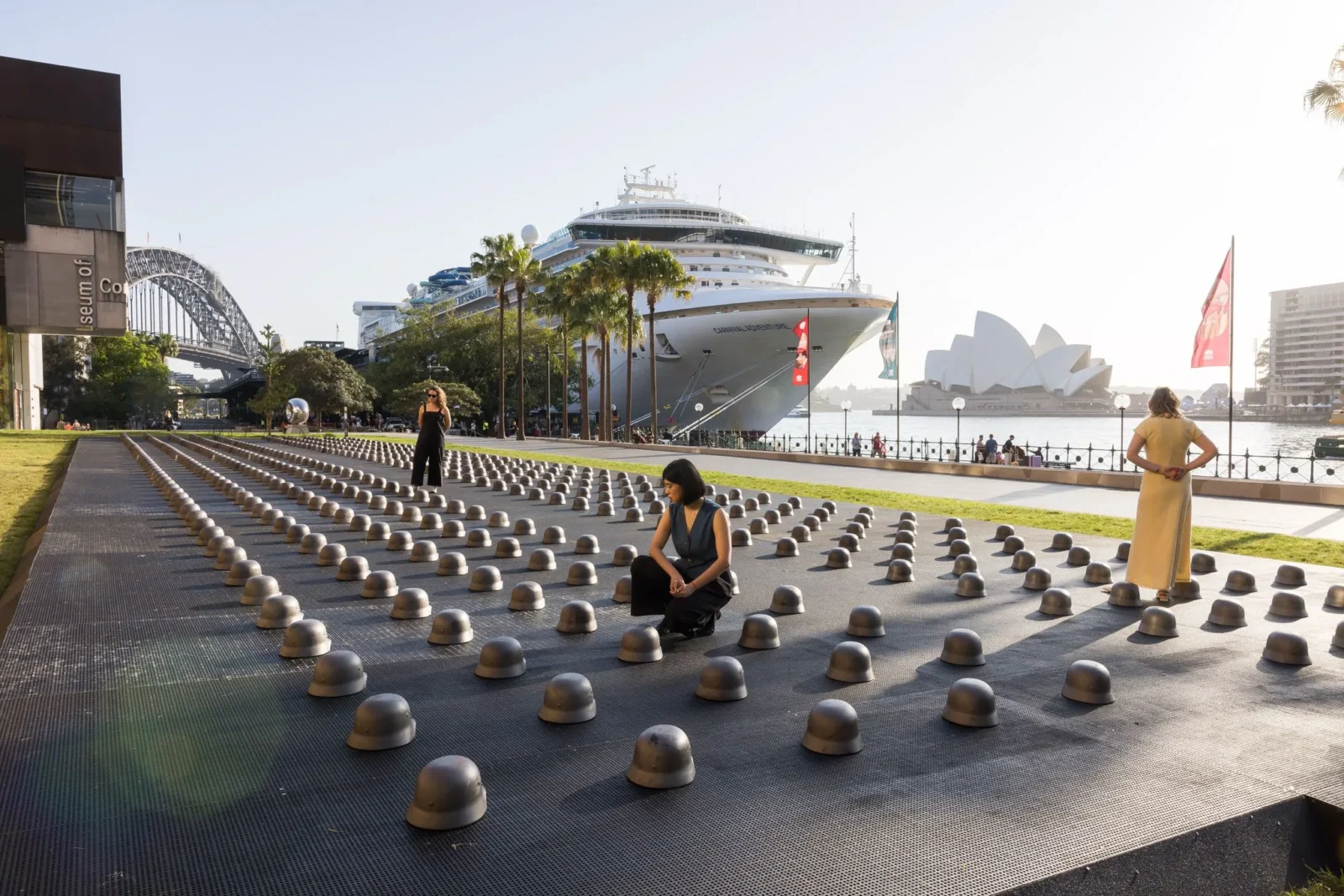
Ai Weiwei Installs 500 Cast-Iron Helmets Outside Sydney Museum
Ai Weiwei's 500 cast-iron helmets opened outside Sydney's MCA on 25 September,...
 illustrarch Editoral Team2 Mins read
Isamu Noguchi at Lever House Traces Sculptor’s Decades-Long Collaboration with Bunshaft
Lever House's new exhibition pairs Noguchi sculptures with unbuilt garden designs made...
illustrarch Editoral Team2 Mins read
Relocated Maya Structures at Mexico’s Balam Tun Memory Park Face Legal Challenge
INAH archaeologists have filed a complaint against 26 officials over Balam Tun...
illustrarch Editoral Team2 Mins read

Heather Roberge, UCLA Architecture Professor and Murmur Founder, Dies at 55
UCLA professor and Murmur founder Heather Roberge, a 2026 AIA LA Educator...
illustrarch Editoral Team2 Mins read


Leave a comment