

Selimiye Mosque: Sinan’s Mastery of Dome and Structure
Explore the Selimiye Mosque in Edirne, the self-declared masterpiece of Ottoman architect Mimar Sinan. This article examines the mosque's 31-meter dome supported by eight piers, its Iznik tile decoration, the kulliye social complex, and its UNESCO World Heritage status, with detailed structural analysis and historical context.
 Furkan Sen9 March 20268 Mins read231

Table of Contents Show
The Selimiye Mosque in Edirne stands as the crowning achievement of Ottoman architect Mimar Sinan, featuring a 31.28-meter dome supported by eight piers and four 71-meter minarets. Commissioned by Sultan Selim II and built between 1568 and 1575, this UNESCO World Heritage Site represents the pinnacle of Ottoman architectural innovation and remains one of the most significant religious buildings in world architecture.
When Sinan was already in his late seventies, he took on the commission that would define his legacy. The legacy of Ottoman architecture reaches its apex in a single building: the Selimiye Mosque in Edirne, Turkey. Sinan himself called it his masterpiece, the culmination of a career spanning five decades and more than 300 structures. What makes this mosque so remarkable is not merely its size or ornamentation, but the way its structure disappears into the experience of space. Walk beneath the dome and you feel openness, light, and calm rather than the weight of stone. That vanishing act is what separates great engineering from great architecture.
Who Was Mimar Sinan, the Ottoman Architect Behind the Mosque?

Mimar Sinan, born around 1490 near Kayseri in central Anatolia, followed his father’s trade as a stonemason before being conscripted into the Janissary corps in 1512. He converted to Islam, trained as a military engineer, and traveled extensively across Ottoman territories, studying buildings from Baghdad to Vienna. According to the Encyclopaedia Britannica, Sinan served as the chief Ottoman architect from 1539 until his death in 1588, producing an extraordinary body of work across nearly 50 years of service.
Sinan famously categorized his career through three masterworks. He described the Sehzade Mosque in Istanbul as his apprenticeship piece, the Suleymaniye Mosque as his journeyman work, and the Selimiye Mosque Edirne as his masterpiece. Each building shows a progression in his thinking about centralized domed spaces, structural efficiency, and the relationship between interior volume and exterior silhouette. The Hagia Sophia interior remained a constant reference point throughout his career, pushing him toward ever bolder structural solutions.
Why Sultan Selim II Chose Edirne Over Istanbul
The decision to build the selimiye mosque in Edirne rather than the Ottoman capital raised eyebrows at the time, and historians still debate the exact reasoning. Sultan Selim II had served as governor of Edirne between 1548 and 1550 and visited the city frequently after ascending to the throne. According to Smarthistory, Edirne was the first major city that European travelers encountered when entering Ottoman territory, so building a monumental complex there offered a powerful statement of imperial prestige.
There was also a practical advantage. Istanbul’s hills were already crowded with monumental mosque complexes, making it difficult for any new building to dominate the skyline. Edirne, a flatter city with lower-rise traditional architecture, gave Sinan the architect a clear canvas. He personally selected the site at Sari Tepe, a hill he knew well from having built a water cistern there decades earlier. His familiarity with the geological conditions, including the bedrock depth of 20 meters and the seismic risks of the region, influenced both the location and the structural approach.
Structural Innovation: The Dome of Selimiye Mosque

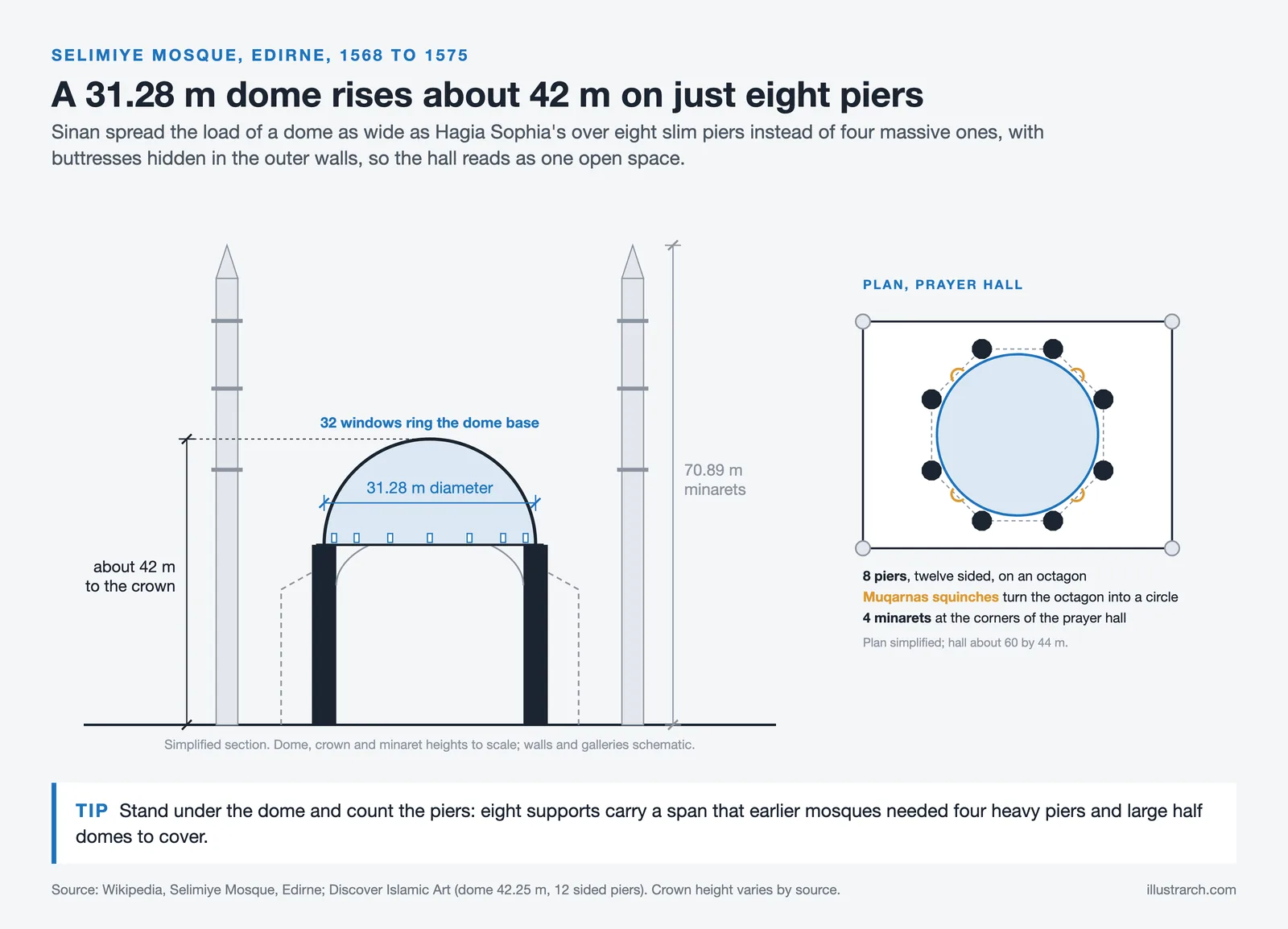
The dome is where Sinan’s ambition and engineering genius intersect most dramatically. The hemispherical dome of the Selimiye Mosque Turkey measures 31.28 meters in diameter and rises approximately 42.25 meters above the floor, according to the UNESCO World Heritage nomination documentation. The diameter nearly matches the dome of Hagia Sophia, a feat that Ottoman architects had pursued for over a century.
In his biography Tezkiret ul-Bunyan, recorded by his friend Sa’i Mustafa Celebi, Sinan claimed he had erected a dome six cubits higher and four cubits wider than the dome of Hagia Sophia. Whether or not the exact measurements bear out this claim (scholars debate the precise figures), the structural approach is what truly sets the Selimiye apart.
The Eight-Pier System
Rather than relying on four massive piers, as in earlier domed mosques, Sinan distributed the dome’s load across eight piers arranged in an octagonal plan. According to Archnet, these piers are twelve-sided and cleverly integrated into the surrounding wall structure, with buttresses concealed behind exterior porticoes and galleries. The result is a prayer hall that feels remarkably open. Visitors often describe the sensation of the dome hovering overhead without visible means of support.
Muqarnas-corbelled squinches bridge the transition between the octagonal pier system and the circular base of the dome. These faceted forms step outward as they rise, expanding the clear span and creating the visual impression of weightlessness. Sinan also minimized the use of half-domes compared to his earlier work, using only five (primarily over the mihrab apse), which allowed the full circular profile of the main dome to read clearly from the interior.
Key Architectural Dimensions of Selimiye Mosque
The following table summarizes the primary structural and spatial measurements of the mosque:
| Feature | Measurement | Significance |
|---|---|---|
| Dome diameter | 31.28 m (102.6 ft) | Nearly matches Hagia Sophia’s 32 m span |
| Dome height | ~42.25 m (138.6 ft) | Crowns a single unified prayer hall |
| Interior floor area | 1,620 sq m | Unified prayer hall without obstructions |
| Minaret height | ~71 m (233 ft) | Among the tallest of the Ottoman era |
| Number of structural piers | 8 | Octagonal plan increases interior openness |
| Complex footprint | 190 x 130 m | Includes mosque, madrasas, and market |
Interior Design: Light, Tile, and Spatial Experience

Stepping inside the selimiye mosque is an experience shaped by light as much as by stone. Sinan placed windows at multiple levels, including 32 small windows in the dome’s drum and additional rows across the facade. Despite knowing that windows represented structural weak points, he calculated their placement to maintain load-bearing integrity while flooding the prayer hall with natural illumination. The effect is a space that feels expansive and almost ethereal, especially in morning light.
The Ottoman architectural tradition of integrating decorative arts into structural frameworks reaches its peak here. The mosque’s Iznik tiles, produced during the finest period of Ottoman ceramic art, cover the mihrab wall, the sultan’s lodge, and key accent areas. According to the UNESCO inscription, the tile decoration represents a high point in this art form that was never surpassed. Motifs include tulips, carnations, hyacinths, and blossoming fruit trees rendered in cobalt blue, turquoise, green, and the distinctive coral red that Iznik kilns achieved for only a brief period in the late 16th century.
“The Selimiye Mosque Complex at Edirne is a masterpiece of the human creative genius of the architect Sinan, the most famous of all Ottoman architects in the 16th century.”
— UNESCO World Heritage Committee, Inscription Criteria (2011)
The marble minbar (pulpit) and mihrab (prayer niche) display some of the finest stone carving in Ottoman art. The mihrab is set within a projecting apse that receives light from three sides, creating a luminous focal point for the congregation. The muezzin’s platform sits directly beneath the center of the dome, an unusual placement that Ottoman art historian Gulru Necipoglu has compared to the positioning of an altar or ambo in Christian churches. This arrangement reinforces a vertical axis from floor to dome apex, connecting the geometry of square, octagon, and circle in a symbolic progression from earth to sky.
The Kulliye: A Social Complex Beyond the Mosque

The Selimiye Mosque was never intended to stand alone. Like all major Ottoman imperial mosques, it was the centerpiece of a kulliye, a complex of charitable and educational institutions funded by a waqf (endowment). The complex includes two madrasas (the Dar ul-Kurra for Quranic recitation and the Dar ul-Hadis for hadith study), an elementary school, a covered market (arasta), a clock house, and a library, all arranged symmetrically around the mosque within a walled compound.
This integrated approach to urban planning set Ottoman architecture apart. The kulliye was not just a religious campus; it functioned as an economic engine and social anchor for the surrounding neighborhood. The arasta generated income to maintain the mosque and its institutions, while the madrasas provided free education. Today, the Dar ul-Kurra houses the Selimiye Foundation Museum and the Dar ul-Hadis operates as the Museum of Turkish and Islamic Arts of Edirne. The concept of architecture serving multiple community functions simultaneously remains relevant to contemporary discussions about architectural heritage and future urban design.
The Four Minarets: Engineering and Symbolism

The four minarets of the Selimiye Mosque rise approximately 71 meters from ground level, each featuring three balconies. Placed at the four corners of the domed cube, they serve both structural and visual functions. Visually, the slender pencil minarets draw the eye upward and exaggerate the apparent height of the building. Structurally, they work in concert with the corner buttressing system to stabilize the dome against lateral forces.
An often-noted engineering detail involves the two minarets flanking the main entrance. Each contains three separate internal staircases, allowing three people to ascend simultaneously and reach the third balcony without crossing paths or making visual contact. This feat of spatial planning within a narrow cylindrical form demonstrates the level of geometric precision that defined Sinan’s practice. The minarets also reference the nearby Uc Serefeli Mosque, an earlier Edirne landmark known for its innovative minaret design, placing the Selimiye in dialogue with the city’s existing mosque architectural tradition.
How Does Selimiye Mosque Compare to Hagia Sophia?
The relationship between the Selimiye Mosque and Hagia Sophia is central to understanding Sinan’s ambition. According to the Encyclopaedia Britannica, one of Sinan’s primary objectives was to surpass the Hagia Sophia’s dome, motivated in part by claims that Ottoman builders could not match the Byzantine achievement. While the Hagia Sophia’s dome relies on four massive piers and a complex system of half-domes and pendentives, Sinan chose a radically different approach with eight slimmer piers, achieving a comparable span with less visual mass.
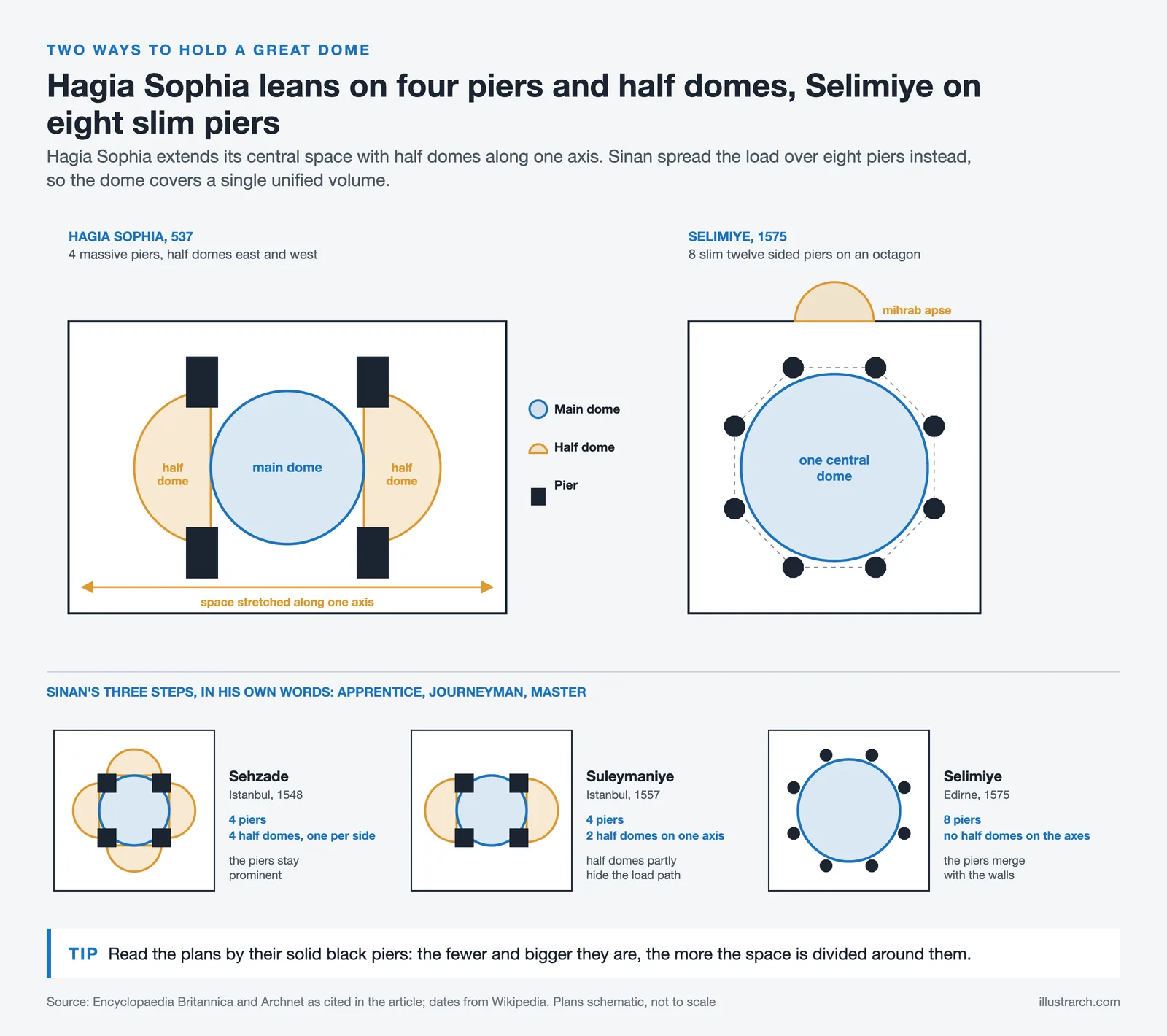
The Hagia Sophia creates drama through cascading volumes, with half-domes expanding the central space longitudinally. The Selimiye, by contrast, achieves its drama through a single unified volume. There are no secondary domed bays competing for attention. Every element in the interior is subordinated to the central dome, creating what many architectural historians consider a purer expression of the centralized domed space. For architects interested in how these two buildings shaped each other’s legacy, our Hagia Sophia interior guide provides a detailed analysis of the Byzantine prototype.
Conservation and UNESCO World Heritage Status

The Selimiye Mosque and its social complex were inscribed on the UNESCO World Heritage List in 2011 under two criteria: as a masterpiece of human creative genius (Criterion i) and as an outstanding example illustrating a significant stage in human history (Criterion iv). The inscription recognizes both the architectural achievement and the Iznik tile decoration, which UNESCO describes as testifying to a great art form that was never surpassed.
The mosque has undergone multiple restorations since its completion. Sinan himself repaired lightning damage in 1584. An earthquake in 1752 damaged minaret balconies and windows. The interior was re-plastered and redecorated during the reign of Sultan Abdulmecid I in the mid-19th century. During the Russo-Turkish War of 1877-78, Russian officers removed some original Iznik tiles and carved decorations from the sultan’s lodge. The dome’s painted decorations were restored between 1978 and 1985, and the mosque continues to function as an active place of worship. The property is protected under Turkey’s National Act on the Preservation of Cultural and Natural Heritage (No. 2863) and the Act on Pious Foundations (No. 5737).
Selimiye’s Lasting Influence on Mosque Architecture
The design principles Sinan established at the Selimiye Mosque have echoed through centuries of mosque construction. The 18th-century Laleli Mosque in Istanbul adopted a similar domed form despite its Baroque detailing. More recently, the Sabanci Merkez Mosque in Adana, completed in 1998, was modeled partly on the Selimiye. The Nizamiye Mosque in South Africa, one of the largest mosques in the Southern Hemisphere, also draws on the Selimiye template.
For contemporary architects, the Selimiye offers lessons that transcend historical style. Sinan demonstrated that structural ambition and spatial serenity are not opposed qualities. His approach to integrating load paths invisibly, programming social infrastructure around a central monument, and responding to site topography with precision rather than force continues to inform thoughtful architectural practice across Turkey and beyond. French modernist architect Le Corbusier, who visited Edirne as a young man, reportedly described the city’s historic mosques with the phrase “Gloria Deo” (divine magnificence), with the Selimiye standing as its crown.
Architectural data referenced in this article is drawn from UNESCO documentation, Encyclopaedia Britannica, and Archnet. Specific measurements of historical buildings may vary slightly across sources due to different survey methods and dates.



Relocated Maya Structures at Mexico’s Balam Tun Memory Park Face Legal Challenge
INAH archaeologists have filed a complaint against 26 officials over Balam Tun...
 illustrarch Editoral Team2 Mins read
Allies and Morrison Win Approval to Restore Barbican Sculpture Court
City of London Corporation approves Allies and Morrison's plan to restore the...
illustrarch Editoral Team2 Mins read

The Great Wall of China: History, Architecture, and Enduring Legacy
A detailed architectural exploration of the Great Wall of China covering its...
Furkan Sen7 Mins read
Prague Architecture: How Charles Bridge and Prague Castle Built Bohemian Gothic
Charles Bridge and Prague Castle explained as architecture: the 1357 bridge under...
Furkan Sen6 Mins read


Leave a comment