

How Much Does It Cost to Become an Architect? A Comprehensive Guide to Expenses and ROI
Planning an architecture career? Learn how much it costs to become an architect, from B.Arch tuition and licensing fees to hiring costs. Compare cheap architecture schools, online degree options, and salary expectations to plan your investment wisely.
 Furkan Sen30 November 202519 Mins read1.2k

Table of Contents Show
The total cost to become an architect in the United States ranges from $125,000 to $315,000, covering education, licensing exams, software, supplies, and professional fees over 8 to 13 years. Public university graduates with scholarships can keep costs near $125,000, while private B.Arch college graduates may spend $250,000 or more. This guide breaks down every expense category so you can plan your investment and understand the long-term return.
For the full picture, see our complete guide to how to study architecture and what to expect.
Becoming an architect is a dream for many, but understanding the financial commitment is crucial before you start this journey. Whether you’re exploring a traditional architecture program near me or looking into a B.Arch online option, the costs can vary significantly. How much does it cost to become an architect? From education and architect fees for licensing to software and supplies, this guide breaks down every expense you need to plan for, along with the long-term return on investment.
First, let’s address the most common question: how long does it take to become an architect? The path typically requires 8 to 13 years after high school, combining education, experience, and examination. You should also know that architect costs extend well beyond tuition. Licensing exams, professional memberships, and ongoing continuing education all add up. Understanding these financial and time investments will help you make informed decisions about pursuing a career in architecture.
🔢 Quick Numbers
- Median architect salary: $99,280 per year (U.S. Bureau of Labor Statistics, May 2025)
- Total cost to become licensed: $125,000 to $315,000 over 8 to 13 years
- ARE exam total: $1,578 for all six divisions at $263 each (NCARB, as of October 2026)
- Projected job growth: 4% from 2024 to 2034, with ~7,800 annual openings (BLS)

How Long Does It Take to Become an Architect?
One of the most frequently asked questions is how many years to become an architect. The answer depends on your educational path and dedication. Here is a breakdown of how much schooling to be an architect through various routes.

How many years of school to become an architect? Most architects complete a 5-year Bachelor of Architecture (B.Arch) degree or follow a “4+2” pathway with a 4-year undergraduate degree followed by a 2-year Master of Architecture (M.Arch). Some programs offer integrated paths that combine education with practical experience. Several online architecture courses can also supplement your formal education along the way.
After completing your degree, you’ll need to gain practical experience through the Architectural Experience Program (AXP), which requires 3,740 hours of documented work experience. This typically takes 2 to 3 years. NCARB updated the AXP in November 2025, refreshing experience area descriptions and replacing the strict reporting requirement with a more flexible reporting policy. Finally, you must pass the Architect Registration Examination (ARE), which can take an additional 1 to 2 years to complete all six divisions.
In total, how long to become an architect ranges from 8 to 13 years when combining education, experience, and examination. According to the National Council of Architectural Registration Boards (NCARB), the average time to licensure is approximately 12.3 years from starting college. For a broader look at whether this timeline aligns with your goals, our guide on careers in architecture covers the full range of paths and specializations available after licensure.
Understanding the Costs of Becoming an Architect
Pursuing a career in architecture requires a considerable financial investment. Below, we detail the key expenses that contribute to the overall cost of becoming a licensed architect. Whether you attend a public university, a private institution like the NewSchool of Architecture and Design in San Diego, or pursue a B.Arch online program, each path carries distinct pricing.
Education and Degree Costs
Enrollment in architecture programs involves significant expenses. Tuition fees for undergraduate architecture programs average $19,000 annually at public institutions and $34,000 at private ones. Graduate programs often cost more. Books, studio supplies, and software add approximately $2,000 to $4,000 per year to these totals. Scholarships and financial aid can mitigate some of these costs if eligible. When evaluating programs, always verify that the school holds NAAB accreditation, since most state licensing boards require a degree from an accredited program before you can sit for the ARE.
🎓 Expert Insight
“Investing in an architecture degree is a significant financial commitment. In the United States, a five-year Bachelor of Architecture (B.Arch) program can cost between $100,000 and $180,000, depending on the institution. Additionally, aspiring architects must account for expenses related to internships, specialized materials, software, and study trips.”
Khaled Dasher, CEO at Avenue Remodeling
This estimate aligns with data from NCARB and university fee schedules, though students at public in-state institutions can often reduce total costs to $50,000 to $100,000 over five years.
Online Architecture Degree Cost
If you’re looking for a more flexible route, the online architecture degree cost tends to be lower than traditional on-campus programs. Average tuition for accredited online architecture degrees ranges from $15,000 to $50,000 total, depending on the institution type, program length, and accreditation status. Schools like Boston Architectural College and the University of Arizona offer online B.Arch and M.Arch pathways that allow working professionals to study on their own schedule.
Keep in mind that online programs still require you to purchase software licenses, a capable computer, and sometimes travel to campus for studio intensives. Still, for students looking for cheap architecture schools or budget-friendly alternatives, an online degree can reduce housing and commuting expenses substantially.
B.Arch Architecture: What You Need to Know
A B.Arch architecture degree is the most direct path to licensure. This professional degree typically takes five years and is accredited by the National Architectural Accrediting Board (NAAB). As of 2024, there are 176 NAAB-accredited programs housed in 140 institutions across the country, enrolling a total of 33,558 students according to NAAB data. Students enrolled in a B.Arch program study design studios, structural engineering, building systems, architectural history, and digital tools. Many top B.Arch institutes combine classroom learning with hands-on studio projects every semester.
B.Arch colleges vary widely in cost. Public institutions may charge $50,000 to $100,000 over five years, while private institutions like the NewSchool of Architecture & Design San Diego can exceed $150,000. When comparing B.Arch institutes, evaluate not just tuition but also studio fees, technology requirements, and location costs. Some students pursue a B.Arch online through hybrid programs that blend digital coursework with periodic on-campus residencies. For a detailed comparison of top programs, see our guide to the best architecture schools in the US.
Architecture Tuition Comparison: Public vs. Private vs. Online
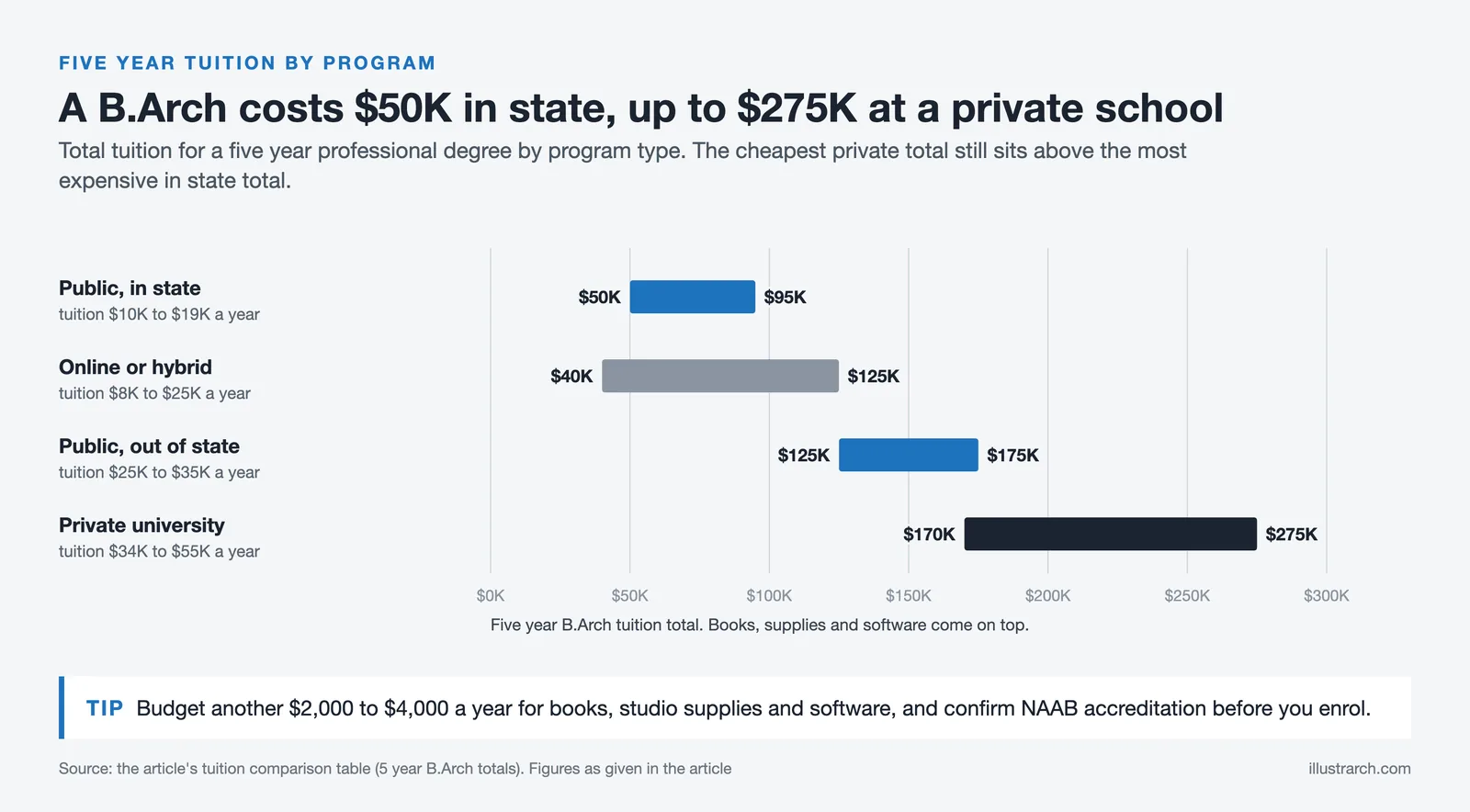
Tuition is the single largest expense on the road to licensure. The table below compares average costs across the three main program types so you can weigh your options at a glance.
| Program Type | Annual Tuition (Avg.) | 5-Year B.Arch Total | Key Advantage |
|---|---|---|---|
| Public University (In-State) | $10,000 to $19,000 | $50,000 to $95,000 | Lowest tuition, strong state aid |
| Public University (Out-of-State) | $25,000 to $35,000 | $125,000 to $175,000 | Access to top-ranked programs |
| Private University | $34,000 to $55,000 | $170,000 to $275,000 | Smaller classes, prestige network |
| Online / Hybrid Program | $8,000 to $25,000 | $40,000 to $125,000 | Flexibility, lower living costs |
How Hard Is It to Become an Architect?
Understanding how hard is it to become an architect goes beyond just financial considerations. Architecture programs are among the most demanding in higher education, requiring intense studio work, rigorous coursework in design, engineering, and history, plus developing technical skills in CAD software. Students often spend 40 or more hours per week in studio alone. The ARE examination has an overall pass rate of approximately 55% according to 2024 NCARB data, and many candidates take multiple attempts. The hardest division, Project Planning and Design, has a pass rate near 48%, while Project Management sits at about 67%. For those passionate about design and building, however, the challenges are deeply rewarding. Our article on whether being an architect is hard covers the day-to-day realities of the profession.
💡 Pro Tip
Many large architecture firms reimburse ARE exam fees once you pass each division. Before paying out of pocket, ask your employer about licensure support programs. Some firms also cover NCARB Record fees and study materials, which can save you $2,000 or more during the licensure process.
Career Preparation and Professional Development
Planning and preparing for your career is crucial when transitioning from studying to working. Architecture students and new graduates need to develop professional skills beyond technical abilities to stand out in a competitive job market.
Building a strong professional foundation starts with creating job application materials that showcase your architectural knowledge, project experience, and design skills. Many aspiring architects invest in professional resume services and portfolio development. These investments help turn your educational experience into compelling presentations that resonate with architectural firms and demonstrate your readiness for professional practice. Consider attending events hosted by an architects training institute or professional organizations like the AIA for networking opportunities. For practical guidance on assembling your work, see our architecture portfolio tips.
Licensing and Examination Fees
After completing an architecture degree, licensure is essential. The Architect Registration Examination (ARE) consists of six divisions. As of October 2026, each division costs $263, bringing total examination fees to $1,578. Additionally, candidates must cover state application fees, which vary by state and often range from $100 to $300. Maintaining a professional license requires ongoing continuing education courses and renewal fees every few years, typically costing $150 to $300 annually.
NCARB updated its record fees in August 2024. The Licensure Candidate Record application fee is $105, with an annual renewal of $105 (as of October 2026). For architects seeking an NCARB Certificate for reciprocal licensure, the application fee is $1,415 with an annual renewal of $300. These architecture fees add up, so planning ahead is important. NCARB is also implementing changes to the ARE in April 2026, including streamlined case studies and minor adjustments to exam objectives aligned with the new NCARB Competency Standard for Architects.
⚠️ Common Mistake to Avoid
Many candidates assume the ARE costs only $1,578 for all six divisions. In reality, retake fees, rescheduling charges ($75 to $150 per reschedule, $200 per cancellation), study materials, and travel to testing centers often push the true cost to $2,500 to $4,000. Budget for at least one retake per division to avoid financial surprises.

How Much Does an Architect Cost to Hire?
While this article primarily covers the cost to become an architect, many readers also search for how much does an architect cost when hiring one for a project. Understanding architect pricing from the client’s perspective can also help aspiring architects set realistic expectations for their future earnings.
Average Architect Fees for Residential and Commercial Projects
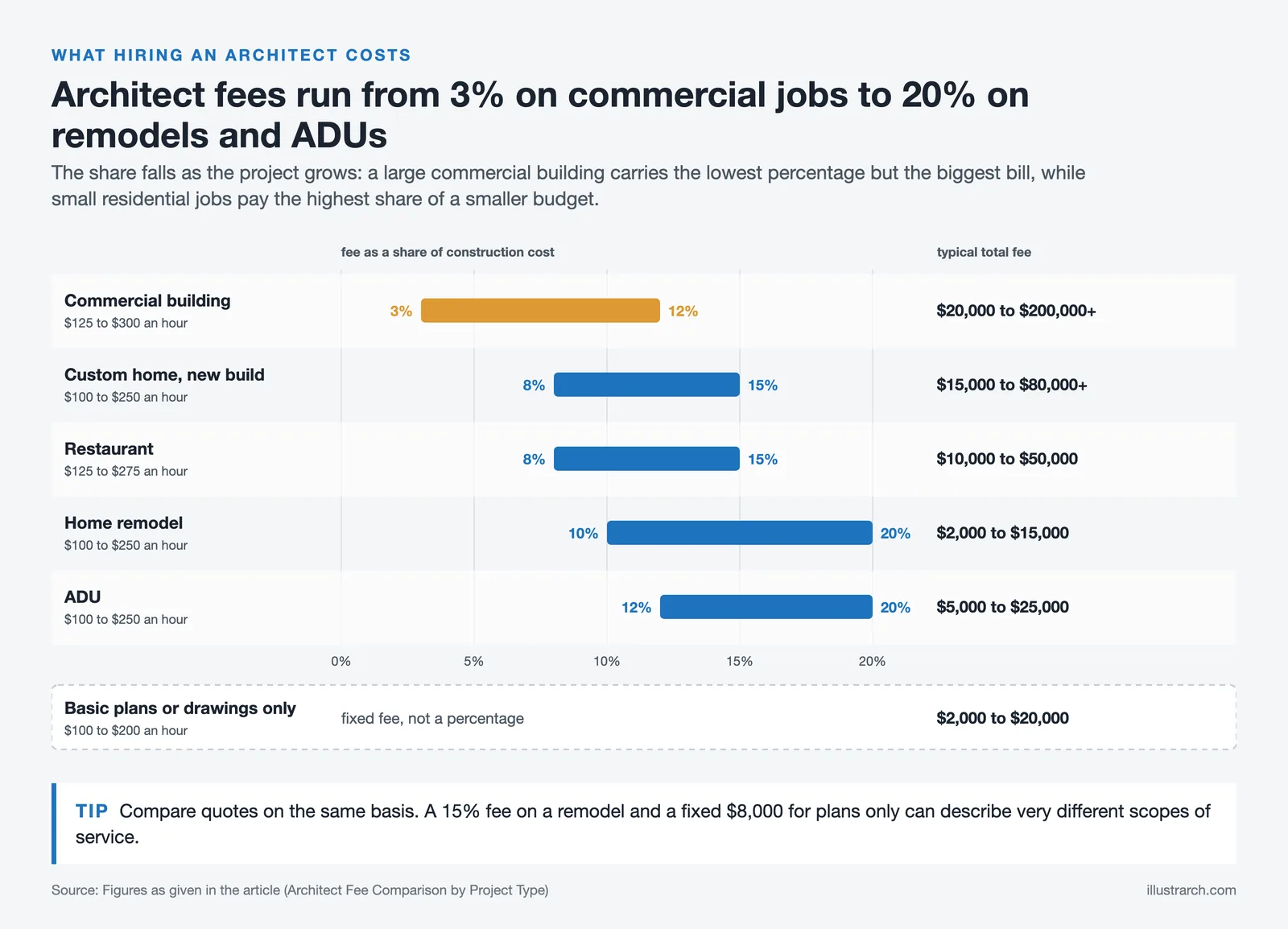
Architect fees for residential projects typically range from 8% to 15% of total construction costs for custom homes and 10% to 20% for remodels. The average cost of an architect for a home project falls between $5,000 and $60,000, depending on the scope of work. Hourly rates generally run from $100 to $250, while the architect price per square foot sits between $2 and $15.
The following table provides a quick reference for typical architect fees based on project type.
Architect Fee Comparison by Project Type
| Project Type | Typical Architect Fee | Average Total Cost | Hourly Rate |
|---|---|---|---|
| Custom Home (New Build) | 8% to 15% of construction cost | $15,000 to $80,000+ | $100 to $250/hr |
| Home Remodel | 10% to 20% of construction cost | $2,000 to $15,000 | $100 to $250/hr |
| ADU (Accessory Dwelling Unit) | 12% to 20% of construction cost | $5,000 to $25,000 | $100 to $250/hr |
| Commercial Building | 3% to 12% of construction cost | $20,000 to $200,000+ | $125 to $300/hr |
| Restaurant Design | 8% to 15% of construction cost | $10,000 to $50,000 | $125 to $275/hr |
| Basic Plans/Drawings Only | Fixed fee | $2,000 to $20,000 | $100 to $200/hr |
So, how much should an architect cost? It depends on your project scope. For a straightforward home addition, you might pay closer to $5,000. For a full custom home or a restaurant build, expect the cost of an architect to climb to $50,000 or more. How much does an architect cost to design a restaurant specifically? Restaurant projects typically require specialized knowledge of commercial building codes, kitchen layouts, and ADA compliance, so architect fees tend to run $10,000 to $50,000 depending on square footage and complexity.
If you’re searching for an architecture studio near me or wondering how much are architects fees in your area, remember that location plays a major role. Architects in high-cost markets like California and New York generally charge more than those in smaller cities. The ADU architect cost, for example, runs higher in California due to stricter energy compliance and zoning rules. For data on how location affects architect pay, see our detailed breakdown of USA architect salary trends for 2026.
How to Become an Architect in California
How to become an architect in California requires understanding the state’s unique requirements. California has some of the most flexible yet rigorous licensing requirements in the nation. Here’s what you need:
California requires candidates to complete eight years of combined education and experience, pass all divisions of the Architect Registration Examination (ARE), complete the Architectural Experience Program (AXP), and pass the California Supplemental Examination (CSE). The CSE is unique to California and tests knowledge specific to California laws, regulations, and conditions. The California Architects Board (CAB) administers the CSE and oversees state-level licensing.
Unlike many other states, California does not strictly require a degree from a NAAB-accredited program. Candidates can qualify through various pathways, including work experience in lieu of formal education. This flexibility makes California one of the more accessible states for those pursuing alternative paths to licensure. As of October 2025, candidates can obtain testing authorization for the ARE or CSE before fully documenting their training and educational experience.
How to Become an Architect Without a Degree
While challenging, it’s possible to learn how to become an architect without a degree in certain U.S. jurisdictions. Currently, 17 states offer alternative pathways to licensure that don’t require graduation from a NAAB-accredited program. These states include California, Colorado, Hawaii, Washington, Arizona, and others.
The typical requirements for non-degree pathways include extensive work experience (often 8 to 11 years) under a licensed architect, completion of the AXP, and passing the ARE. NCARB also offers the Education Alternative program, which includes two paths: the “Two Times AXP” requiring 7,480 documented hours of experience for those with architecture-related degrees, or the NCARB Certificate Portfolio for those with other degrees or no degree.
States like Hawaii require at least 11 years of work experience for aspiring architects without a degree, while Washington requires 9 years plus AXP completion. This path requires significant dedication but offers an alternative for those unable to pursue traditional education. Some candidates also supplement their learning with free architect program resources and online courses to build foundational knowledge. For a full overview of the education and experience options, see our guide on becoming a licensed architect in the United States.
📌 Did You Know?
Frank Lloyd Wright, one of the most influential architects in American history, never completed a formal architecture degree. He studied civil engineering at the University of Wisconsin for a few semesters before leaving to apprentice at a Chicago architecture firm. While the profession has become far more regulated since Wright’s era, 17 U.S. states still allow alternative paths to licensure through extensive supervised work experience.
Specialized Architecture Paths
How to Become an Interior Architect
For those interested in how to become an interior architect, the path combines architecture fundamentals with specialized interior design knowledge. Interior architects focus on designing functional and aesthetically pleasing interior spaces while ensuring structural integrity and building code compliance.
Requirements typically include a Bachelor’s or Master’s degree in Interior Architecture from an accredited program, completion of practical experience (similar to the AXP), and passing the National Council for Interior Design Qualification (NCIDQ) exam. Many interior architects also pursue LEED or WELL certifications to specialize in sustainable or wellness-focused design. Interior designers earned a median annual wage of $63,490 in 2024 according to the U.S. Bureau of Labor Statistics, with employment projected to grow 3% from 2024 to 2034.
How to Become a Sustainable Design Architect
Sustainable design is one of the fastest-growing specializations in architecture. Architects with LEED AP or Passive House certifications can command salaries 10% to 20% above their peers, according to industry salary surveys. The path typically involves earning a standard architecture degree, gaining licensure, and then pursuing additional credentials through the U.S. Green Building Council (USGBC) or the Passive House Institute.
The BLS reports that insurance-related activities ($171,340), management consulting ($140,490), and scientific research ($135,400) are among the highest-paying industries for architects, and many positions in these sectors focus on sustainability and energy performance. For a deeper look at green architecture principles, our sustainability coverage explores how these skills translate into practice.
Additional Expenses in Architectural Training
Architectural training involves various additional costs beyond tuition and licensing fees. These expenses are essential for a well-rounded education.
Books and Supplies
Books and supplies represent a significant cost for architecture students. Required textbooks often include titles on design principles, architectural history, and technical subjects. These books can total between $1,000 and $2,000 annually. Supplies like drafting tools, sketchbooks, and specialized equipment for model-making add to the financial burden. High-quality drafting tables range from $100 to $500, and model-making materials can cost several hundred dollars per project.
Software and Technology Needs
Software and technology form another substantial cost segment. Architecture students use specialized programs including AutoCAD, Revit, SketchUp, Rhino, and Adobe Creative Suite. Software licenses and subscriptions can accumulate to approximately $500 to $1,500 per year. A powerful laptop or desktop optimized for architecture work costs between $1,500 and $3,000. Investment in technology is imperative for meeting academic requirements and keeping up with industry standards.
💡 Pro Tip
Most major software vendors offer free or heavily discounted licenses for students. Autodesk provides free educational licenses for AutoCAD, Revit, and 3ds Max. Adobe offers Creative Cloud at roughly 60% off the regular price. Always verify your eligibility through your school’s IT department before purchasing full-price licenses.
Annual Recurring Expenses for Architecture Students
Beyond tuition, architecture students face several yearly costs that other majors rarely encounter. Here is a realistic breakdown of what to budget each academic year.
| Expense Category | Low Estimate (per year) | High Estimate (per year) | Notes |
|---|---|---|---|
| Textbooks and Reference Books | $500 | $2,000 | Used copies can cut costs in half |
| Drafting Tools and Supplies | $200 | $600 | Scales, pens, markers, paper |
| Model-Making Materials | $300 | $1,000 | Foam board, basswood, 3D printing |
| Software Subscriptions | $200 | $1,500 | Student discounts available for most |
| Printing and Plotting | $200 | $800 | Large-format prints for reviews |
| Computer / Laptop | $300 | $600 | Amortized over 5 years ($1,500 to $3,000) |
| Study Trips and Field Visits | $200 | $2,000 | Varies by program; international trips cost more |
| Estimated Annual Total | $1,900 | $8,500 | On top of tuition |
Cheap Architecture Schools and Budget-Friendly Options
Not every path to licensure has to drain your savings. Several strategies can bring down the total architecture cost of your education. Public universities with in-state tuition remain the most affordable option, with some programs costing under $10,000 per year. Community colleges can also serve as a stepping stone: completing general education requirements at a two-year school before transferring to an accredited B.Arch program saves thousands.
Look for schools that offer robust financial aid packages. The best architecture scholarships can cover a significant portion of tuition. Some architect program free resources, including MOOCs from Harvard, MIT, and Delft University, allow you to build foundational knowledge at no cost before committing to a degree. Schools like the City College of New York’s Spitzer School of Architecture offer graduate tuition as low as $15,000 per year for in-state residents.
The NewSchool of Architecture and Design San Diego is another option worth exploring, especially for students interested in a non-traditional educational environment. While it is a private institution, NewSchool offers various scholarship opportunities and multiple start dates throughout the year.
Financial Aid and Scholarships
Various financial aid and scholarship opportunities can significantly offset the costs associated with becoming an architect.
Options for Prospective Architecture Students
Prospective architecture students can explore numerous financial aid options. Federal student aid through FAFSA offers grants and low-interest loans. State-sponsored programs provide additional grants and scholarships based on residency and academic performance. Private scholarships from architectural firms, non-profits, and foundations like the AIA Foundation also help fund education. Many universities offer merit-based and need-based scholarships specific to architecture students.
Before committing to the academic and financial path, it’s wise to understand all the pros and cons of being an architect to ensure it aligns with your long-term career goals.

Long-Term Financial Considerations
Understanding the long-term financial impact of becoming an architect is crucial for making an informed decision about this career path.
Salary Expectations and ROI
Architect salaries vary based on location, experience, and specialization. According to the U.S. Bureau of Labor Statistics, the median annual wage for architects was $99,280 in May 2025. Entry-level architects may start with salaries around $60,000, while experienced architects can earn upwards of $161,420. The highest-paid 25% earned $123,300 in May 2024.
Specializing in areas like sustainable design, urban planning, healthcare architecture, or technology integration often leads to higher pay. Top-paying industries include insurance-related activities ($171,340), management consulting ($140,490), and scientific research ($135,400).
Employment of architects is projected to grow 4% from 2024 to 2034 according to the BLS, with approximately 7,800 job openings projected annually. Architects specializing in sustainable design and those who embrace AI and BIM technologies are expected to be particularly in demand. For more on how earning potential shifts over time, our architecture career salaries guide covers each stage from entry-level to principal.
Architect Salary by Experience Level and Specialization
Your earning potential as an architect depends heavily on experience and the niche you pursue. The table below shows how salaries compare across different career stages and specializations, based on 2024 and 2025 BLS and industry data.
| Career Stage / Specialization | Median Annual Salary | Top 25% Earnings | Typical Experience |
|---|---|---|---|
| Entry-Level Architect | $55,000 to $65,000 | $72,000 | 0 to 3 years |
| Mid-Career Architect | $80,000 to $99,280 | $123,300 | 5 to 10 years |
| Senior / Principal Architect | $110,000 to $159,800 | $175,000+ | 15+ years |
| Sustainable Design Specialist | $95,000 to $130,000 | $150,000+ | 5+ years + LEED cert |
| Healthcare Architecture | $100,000 to $140,000 | $165,000+ | 7+ years |
| Interior Architect | $55,000 to $63,490 | $86,000 | 3+ years + NCIDQ |
| Licensed vs. Unlicensed | $99,280 vs. $54,500 | $123,300 vs. $70,000 | License makes a major difference |
How Much Should Architectural Plans Cost vs. What You Earn
From a client’s perspective, how much should architectural plans cost depends on the project scope, but basic plans run $2,000 to $20,000. From an architect’s perspective, understanding these architect prices helps you gauge your earning potential once licensed. A licensed architect billing at $150 per hour who works 40 billable hours per week generates $312,000 in annual revenue for their firm, even before accounting for overhead.
The cost for architect services varies by region, but the trend is upward. With growing demand for sustainable building and urban development, architect pricing has steadily risen over the past decade. This is good news for anyone investing in an architecture education today. Freelance architects can also set their own rates, with experienced professionals charging $50 to $150 or more per hour depending on specialization.
Is Architecture School Worth the Investment?
When you compare the total cost of becoming an architect ($125,000 to $315,000) against the median salary of $99,280 and top-quartile earnings of $123,300, the return on investment depends heavily on your choices. An in-state public university graduate who enters the profession with $80,000 in student debt and earns $60,000 in their first year can expect to break even on their education investment within 8 to 12 years, assuming steady career progression.
Private school graduates carrying $200,000+ in debt face a longer path to positive ROI, though higher starting salaries at prestigious firms can partly offset this gap. The licensed-versus-unlicensed salary difference ($99,280 vs. approximately $54,500 median) makes a powerful case for completing the full licensure process rather than stopping at a degree alone. For those weighing this decision, the pros and cons of being an architect offers a balanced perspective on what to expect.
Summary: Total Cost to Become an Architect
Here’s a breakdown of how much does it cost to become an architect, covering every major expense category:
Cost Breakdown to Become a Licensed Architect
| Expense Category | Estimated Cost Range | Notes |
|---|---|---|
| Education (5 to 7 years) | $100,000 to $250,000 | Public vs. private institution |
| Books and Supplies (per year) | $2,000 to $4,000 | $10,000 to $28,000 total |
| Software and Technology (per year) | $2,000 to $4,500 | $10,000 to $31,500 total |
| ARE Examination (6 divisions) | $1,578 | $263 per division (as of October 2026) |
| NCARB Record Fees | $105 to $1,415 | Candidate ($105) vs. Certificate holder ($1,415) |
| State Licensing Fees | $100 to $500 | Varies by state |
| California CSE (if applicable) | $100 | California-specific exam |
| Continuing Education (annual) | $150 to $300 | Required for license renewal |
Total estimated investment: $125,000 to $315,000 over 8 to 13 years. Online programs and public universities sit at the lower end, while private B.Arch colleges push costs toward the upper range.
✅ Key Takeaways
- The total cost to become a licensed architect ranges from $125,000 to $315,000, including education, supplies, software, and licensing fees.
- Public in-state universities and online hybrid programs offer the most affordable routes to a B.Arch or M.Arch degree.
- ARE exam fees total $1,578 for six divisions at $263 each, but budget $2,500 to $4,000 including retakes, study materials, and travel.
- Licensed architects earn a median of $99,280 per year (BLS, May 2025), nearly double the median for unlicensed architectural designers.
- Specializations in sustainable design, healthcare, or management consulting can push salaries above $140,000 annually.
- Seventeen U.S. states allow alternative paths to licensure without a NAAB-accredited degree, though these typically require 8 to 11 years of supervised experience.
Frequently Asked Questions
How much does it cost to become an architect in total?
The total cost ranges from $125,000 to $315,000 when you factor in education, books, software, licensing exams, and NCARB fees. Public university students who earn scholarships can keep costs closer to $125,000, while private school graduates may spend $250,000 or more. Online architecture degree programs offer a middle ground, with total costs between $60,000 and $150,000 for tuition alone.
How much does an architect cost to hire for a home project?
Average architect fees for residential projects run 8% to 15% of construction costs. For a typical custom home with a $400,000 construction budget, you might pay $32,000 to $60,000 in architect fees. Simpler projects like drawing basic plans can cost as little as $2,000 to $5,000. The cost of architect services also depends on your location and the complexity of your design.
Can you become an architect without a degree?
Yes, in 17 U.S. states including California, Colorado, and Hawaii, you can become a licensed architect through alternative pathways. These typically require 8 to 11 years of supervised work experience, completion of the AXP, and passing the ARE. NCARB’s Education Alternative program also offers paths for those with non-traditional backgrounds.
What is the cheapest way to get an architecture degree?
The most affordable route is attending a public, in-state university with a NAAB-accredited architecture program. Completing general education credits at a community college first can save thousands. Some students also explore B.Arch online hybrid programs, which eliminate housing and commuting costs. Applying for architecture scholarships is also essential.
How much does an architect cost to design a restaurant?
Restaurant design typically costs $10,000 to $50,000 in architect fees, or roughly 8% to 15% of construction costs. Restaurant projects require expertise in commercial building codes, kitchen workflow design, ADA compliance, and sometimes liquor licensing requirements. The more complex the concept, the higher the architecture fees.
How much do architects earn after becoming licensed?
According to the U.S. Bureau of Labor Statistics (May 2025 data), licensed architects earn a median annual salary of $99,280. The lowest 10% earn less than $62,300, while the highest 10% earn more than $161,420. Specializations like healthcare architecture and sustainable design tend to command higher pay. Geographic location also matters: architects in New York and California typically earn above the national median. For detailed salary data, visit our architecture salary guide.
What are the ARE exam fees for 2025 and 2026?
As of October 2026, each ARE division costs $263, bringing the total for all six divisions to $1,578. The NCARB Licensure Candidate Record application and annual renewal fees are each $105. NCARB is implementing minor updates to the ARE in April 2026, but the fee structure and division count remain unchanged. Check the NCARB fees page for the most current pricing.
Frequently Asked Questions
Costs vary widely by country and school, but the main expenses are several years of university tuition, plus licensing exams, study materials, software and professional registration. In the United States the total usually runs from $125,000 to $315,000 over 8 to 13 years.
In the United States it typically takes 8 to 13 years: a professional degree (typically five years), followed by a period of supervised practical experience and licensing examinations before you can register as an architect.
For many it is, given the long-term career, creative work and earning potential. The key is to weigh tuition and time against expected salary and to look for scholarships, affordable programmes and paid internships.
Conclusion
Understanding the cost to become an architect involves multiple factors, from how many years does it take to become an architect to the various educational and licensing expenses. Whether you’re pursuing traditional licensure at a B.Arch college, exploring how to become an architect without a degree, or considering specialized paths like interior architecture or sustainable design, each pathway has unique requirements and costs.
Maximizing financial aid opportunities can significantly lessen this burden. Federal student aid, state-sponsored programs, private scholarships, and university-specific scholarships for architecture students are essential resources.
Long-term financial factors play a critical role in this decision. With median salaries of $99,280 and top earners exceeding $161,420 according to BLS May 2025 data, architecture offers strong earning potential. Assessing the ROI and strategizing career moves is key. Although achieving a positive return on education and licensure investments may take time, informed career decisions, including choosing the right specialization and location, can speed this process considerably.
Balancing initial costs with long-term earnings potential is essential for a successful and financially rewarding architecture career. Whether you specialize in residential design, sustainable architecture, or healthcare facilities, the investment in your education and professional development can lead to a fulfilling and prosperous future. For further guidance on getting started, explore LearnArchitecture.net for educational resources tailored to aspiring architects.
Disclaimer: All costs, fees, and salary figures cited in this article are based on publicly available data from the U.S. Bureau of Labor Statistics (May 2024 and May 2025), NCARB (2024 fee schedule), and institutional websites. Actual costs vary by institution, state, and individual circumstances. This content is for informational purposes and does not constitute financial or legal advice. Verify current fees and requirements with the relevant organizations before making financial decisions.
Last updated:


1 Comment






Can You Become a Licensed Architect Through Experience Only?
Twenty-one US jurisdictions let candidates qualify for licensure with documented experience instead...
 Sinan Ozen5 Mins read

InDesign Alternatives for Architects: 6 Tools That Handle Portfolios and Boards
Adobe InDesign is still the default layout tool in architecture, but the...
Furkan Sen7 Mins read

How to Get Work Experience in Architecture Before Graduation
Waiting on one summer internship is the slowest way into practice. This...
Sinan Ozen6 Mins read

What It’s Like Working as an Architect: 5 Things Architecture School Doesn’t Teach You
Architecture school teaches design. Practice runs on construction documents, fee phases, consultant...
Furkan Sen7 Mins read


This article really helped me understand the costs involved in becoming an architect. I had no idea it could take up to 11 years! The breakdown of expenses like tuition and software costs was super helpful. I’m also glad to see that there are alternative paths to licensure for those who can’t go the traditional route. It feels more accessible now!