

USA Architect Salary 2026: Average Pay by Role, State & Experience
Architect and designer salary trends in the USA for 2026 reveal deeper shifts in professional value, work culture, and spatial practice. From regional pay gaps to specialization and evolving firm models, compensation reflects how architecture is redefining itself in a changing economic and technological landscape.
 Elif Ayse Sen26 January 20269 Mins read536

Table of Contents Show
By 2026, conversations around salary in architecture and design have moved decisively from the margins to the center of professional discourse. The architect average salary is no longer confined to private negotiations, and compensation is now widely understood as a structural force that shapes who can enter the profession and who is able to remain within it. According to the U.S. Bureau of Labor Statistics, the median annual wage for architects reached $99,280 in May 2025, with employment projected to grow 4% from 2024 to 2034. In a field that demands long years of education, extended apprenticeships, and continuous intellectual labor, understanding salary of architects has become inseparable from questions of access, equity, and long-term professional sustainability.

In the United States, architectural practice in the mid-2020s is unfolding within a complex landscape defined by economic volatility, rapid technological acceleration, and mounting climate responsibility. Whether you’re exploring an entry level architect salary or aiming for a principal architect salary, understanding these compensation trends is essential for career planning. Inflationary pressures, shifting employment models, and the normalization of hybrid practices have disrupted long-established assumptions about what architectural labor is worth. For a broader perspective on whether the profession aligns with your goals, our article on the pros and cons of being an architect offers a balanced overview.

How Much Do Architects Make? The Short Answer
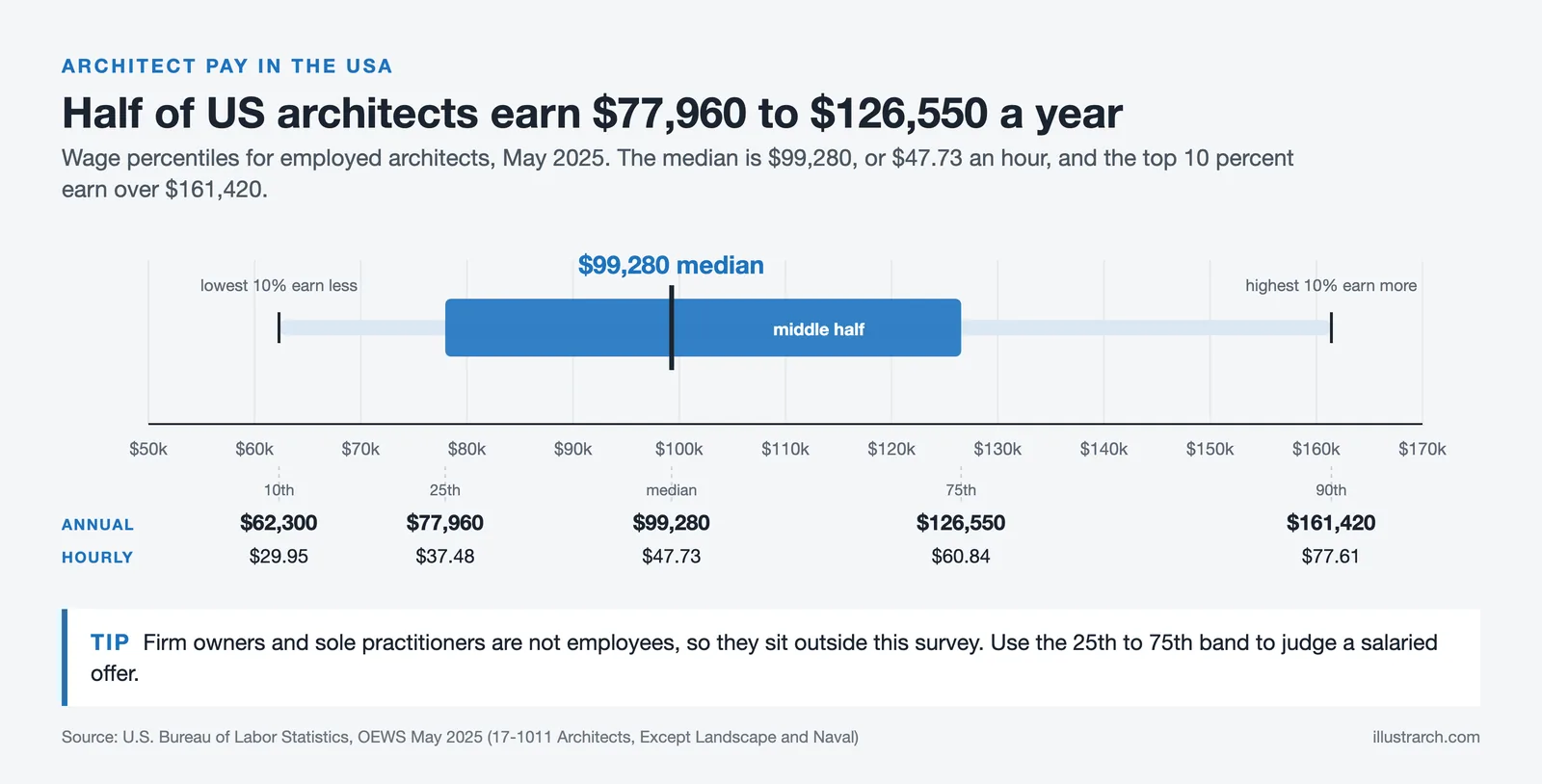
In the United States, O*NET’s summary of the BLS figures for architects put the median wage for architects at $99,280 a year, or $47.73 an hour, in 2025. Half of employed architects earn more than that and half earn less. The spread around the median is wide: an entry level graduate and a firm principal in the same city can be three times apart, and the same role in two states can differ by a third.
That single number is the honest answer to how much do architects make, and it is also almost useless on its own. Four things move an individual figure more than the national median does: licensure status, city, firm size and sector. The rest of this page breaks each of them out, and the section on international comparison explains why an architecture salary quoted in one country cannot be read straight across to another.
What Is the Average Salary for an Architect in 2026?
The average salary for architects varies significantly based on experience, specialization, and location. Based on the latest Bureau of Labor Statistics data and industry reports, here’s what architects can expect:
| Experience Level | Annual Salary Range |
|---|---|
| Entry-Level (0-3 years) | $55,000-$70,000 |
| Mid-Career (4-9 years) | $80,000-$110,000 |
| Senior Level (10+ years) | $105,000-$150,000 |
| Principal/Partner | $150,000-$250,000+ |
| Architectural Managers | $167,740 (median) |
The architect median salary of $99,280 (May 2025) positions the profession well above the national median for all occupations ($50,980). Approximately 6,900 job openings for architects are expected annually through 2034, driven by replacement needs and urban transformation projects.
The BLS wage distribution reveals significant variation across the profession:
| Wage Percentile | Hourly Wage | Annual Salary |
|---|---|---|
| 10th Percentile | $29.95 | $62,300 |
| 25th Percentile | $37.48 | $77,960 |
| 50th Percentile (Median) | $47.73 | $99,280 |
| 75th Percentile | $60.84 | $126,550 |
| 90th Percentile | $77.61 | $161,420 |
The gap between the 10th and 90th percentile, nearly $100,000, illustrates the dramatic impact of experience, licensure, specialization, and geography on architectural earnings.
Additionally, the industry in which an architect works significantly affects compensation. The highest-paying industries for architects in 2024 include:
| Industry | Average Annual Salary |
|---|---|
| Insurance & Financial Activities | $171,340 |
| Management & Technical Consulting | $140,490 |
| Scientific Research & Development | $135,400 |
| Government (Federal, State, Local) | $110,000-$120,000 |
| Architectural & Engineering Services | $99,710 |
| Residential Building Construction | $92,000-$98,000 |
Notably, architects working outside traditional architectural firms, particularly in consulting, finance, and research sectors, often command significantly higher salaries than those in conventional practice settings.

Architect Salary NYC and Regional Variations
Geography continues to play a decisive role in architectural compensation. The architect salary NYC consistently ranks among the highest in the nation due to the concentration of major firms and high-value projects:
| City/Region | Average Architect Salary |
|---|---|
| New York City, NY | $140,000-$156,500 |
| San Francisco, CA | $136,770 |
| San Jose, CA | $136,190 |
| Los Angeles, CA | $92,000-$105,000 |
| Seattle, WA | $105,000 |
| Chicago, IL | $95,000 |
| Boston, MA | $100,000 |
The salary architect New York premium reflects both the cost of living and the presence of world-renowned firms. Industries offering the highest new york city architect salary include real estate ($166,968 median), management consulting ($162,606), and financial services ($149,855). Meanwhile, architect salary California averages $98,610 to $117,010 annually, with San Francisco architects earning the highest in the state.
While global cities such as New York still command the highest nominal salaries, their dominance is increasingly challenged by rising living costs. Hybrid and remote workflows are now embedded in many firms’ operational models, allowing talent to disperse beyond traditional architectural centers. Mid-sized cities offer more sustainable economic conditions, enabling architects to align income with quality of life.
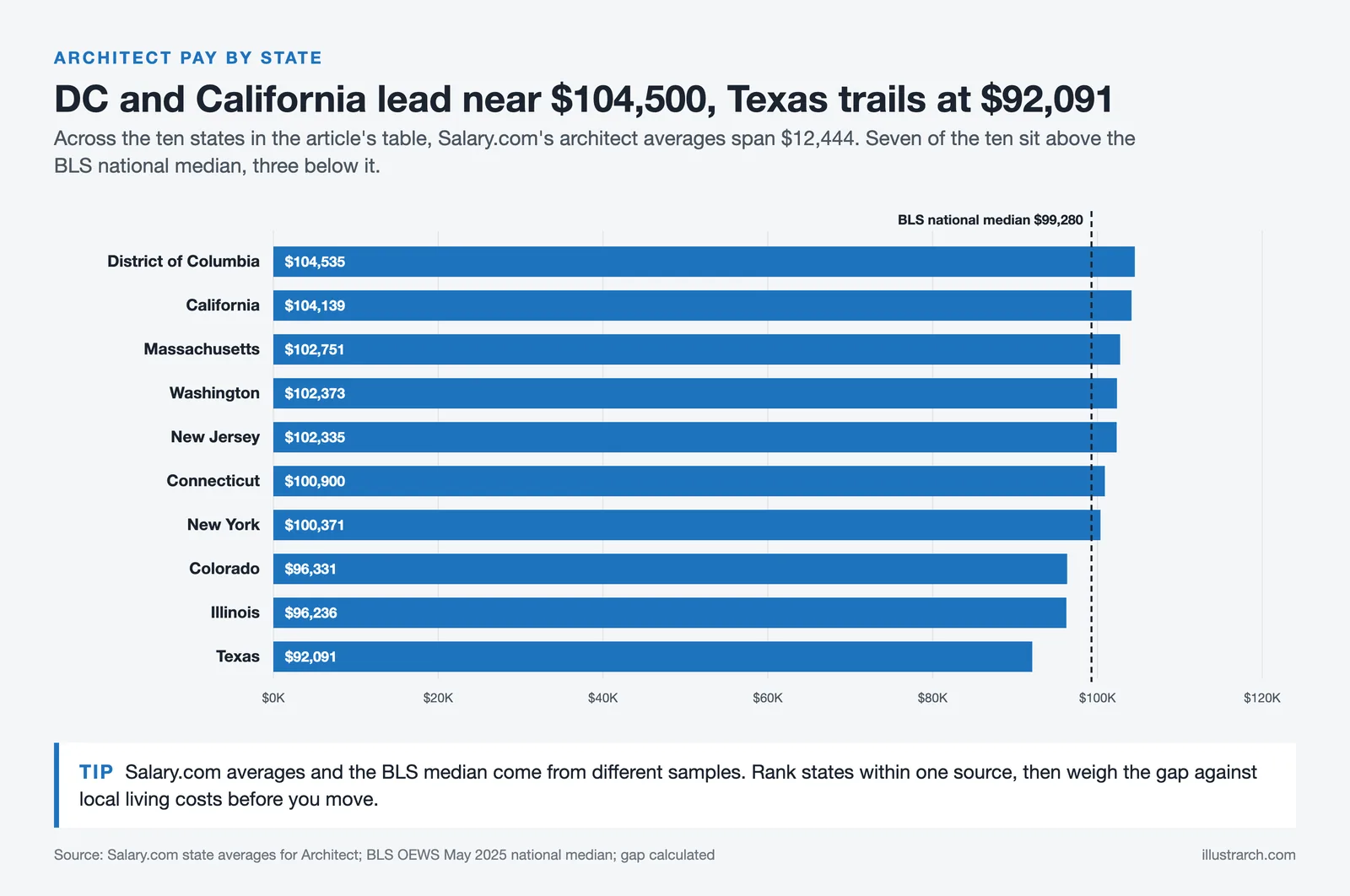
Beyond individual cities, Salary.com data for selected states shows how average architect pay varies:
| State | Average Annual Salary |
|---|---|
| District of Columbia | $104,535 |
| California | $104,139 |
| Massachusetts | $102,751 |
| Washington | $102,373 |
| New Jersey | $102,335 |
| Connecticut | $100,900 |
| New York | $100,371 |
| Colorado | $96,331 |
| Illinois | $96,236 |
| Texas | $92,091 |
While these figures provide useful benchmarks, architects should weigh state-level salaries against cost of living. States like Colorado and Texas, for instance, offer competitive salaries with considerably lower living expenses than California or New York.

Interior Architect Salary and Specialization Premiums
The interior architect salary reflects the specialized skills required in this growing field. According to current data:
- Average Interior Architect Salary: $62,000-$89,000 annually
- Salary for Interior Architect (Entry-Level): $44,000-$56,000
- Salary of an Interior Architect (Experienced): $75,000-$120,000
- Interior Designer Architect Salary: $72,000-$80,000 average
The architect and interior designer salary reflects the dual skill set required in this specialization. Professionals combining architectural licensure with interior design expertise command premium compensation in luxury residential and hospitality sectors. For those interested in expanding their skills, mastering design software can significantly boost earning potential. Architects considering a pivot or exploring adjacent roles may also find our guide on job alternatives for architects and interior designers helpful for understanding the full range of opportunities available.
The table below compares average salaries across major architecture specializations:
| Specialization | Average Annual Salary | Growth Outlook |
|---|---|---|
| Commercial Architect | $95,000-$140,000 | Stable |
| Residential Architect | $75,000-$115,000 | Moderate |
| Healthcare Facility Architect | $100,000-$145,000 | High |
| Sustainable/Green Architect | $90,000-$135,000 | High |
| Interior Architect | $62,000-$120,000 | Moderate |
| Landscape Architect | $50,000-$120,000 | Moderate |
| Urban Designer/Planner | $70,000-$110,000 | Stable |
| Computational/Parametric Design | $95,000-$150,000 | High |
Healthcare and sustainable design specializations continue to show the strongest growth outlook, driven by aging infrastructure needs and regulatory mandates around energy efficiency.

Entry Level vs. Principal Architect Salary: Career Progression
By 2026, experience in architecture is measured less by tenure alone and more by the capacity to navigate complexity. The architect starting salary typically ranges from $55,000 to $70,000, while the starting salary of an architect in high-cost cities can reach $65,000-$80,000.
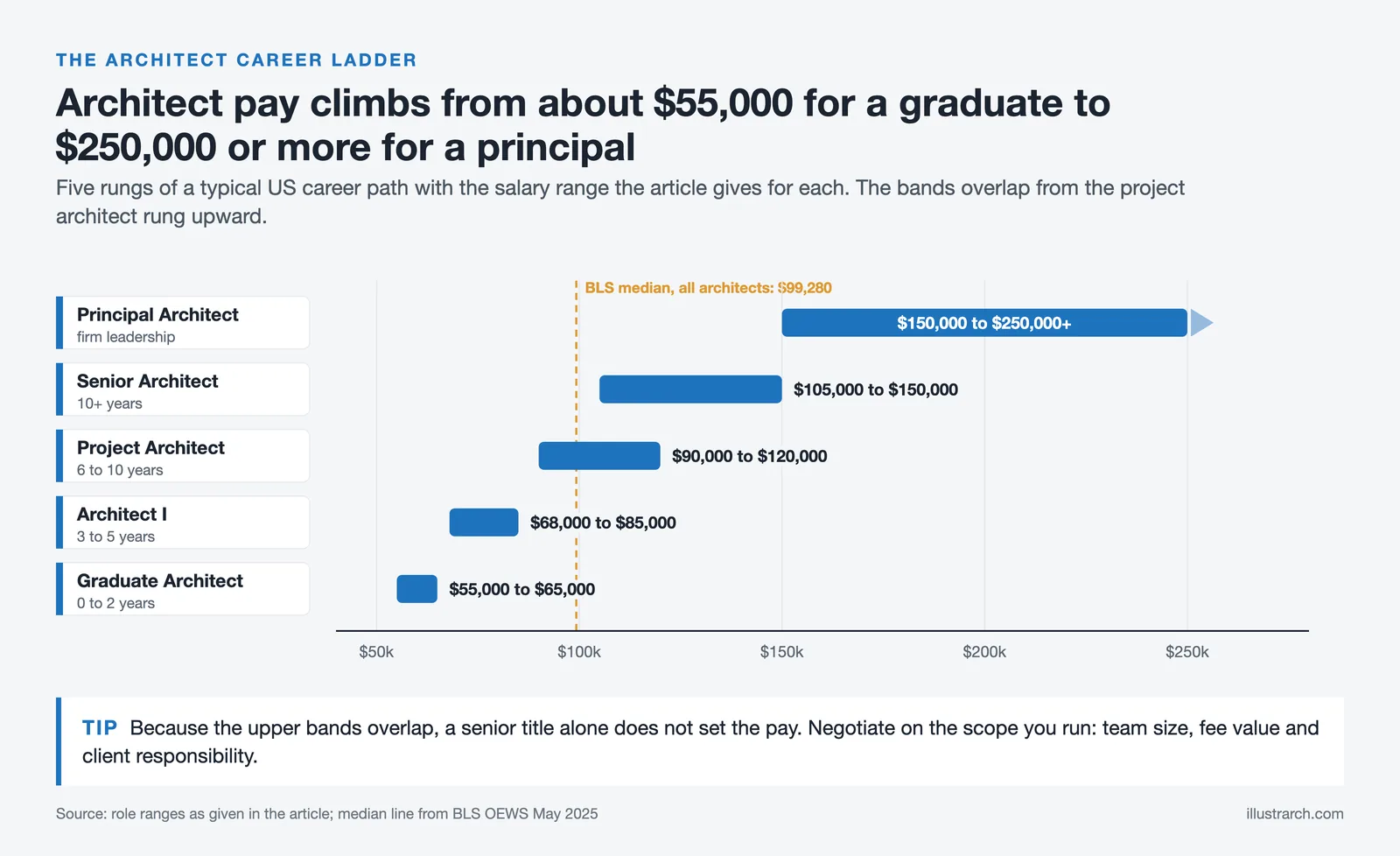
Licensure remains an important milestone, the average salary of an architect with professional licensure is 20-30% higher than unlicensed designers. For a complete roadmap on achieving this critical credential, see our guide on how to become a licensed architect in the United States. Firms increasingly reward architects who combine technical competence with leadership and strategic thinking. The progression from entry level architect salary to principal architect salary typically follows this trajectory:
- Graduate Architect (0-2 years): $55,000-$65,000
- Architect I (3-5 years): $68,000-$85,000
- Project Architect (6-10 years): $90,000-$120,000
- Senior Architect (10+ years): $105,000-$150,000
- Principal Architect: $150,000-$250,000+
Early-career architects continue to face challenges, as rising educational costs and modest starting salaries expose structural imbalances. For strategies on maximizing earnings, explore our guide on how to increase architecture salary.

Technology Skills and the Economics of Specialization
Salary trajectories in 2026 clearly reflect the profession’s technological evolution. The enterprise architect salary (IT sector) averages $158,000-$202,000, while senior solutions architect salary reaches $160,000-$200,000. Note that these IT roles differ from building architecture, though both require strong analytical skills.
For building architects, technological fluency commands significant premiums:
- BIM Specialists: 10-15% salary premium
- Computational Design: 12-18% increase
- Sustainable Design (LEED): 10-20% premium
- AI-Assisted Design: Emerging 8-12% premium
These skills are central to how contemporary architecture is conceived and delivered. The economic premium placed on technological fluency underscores a critical reality: architecture’s future viability depends on integrating design intelligence with evolving tools. To understand how BIM proficiency can shape your career trajectory, our article on BIM for architectural career provides a comprehensive overview. Learn more about architecture salary trends and career stage expectations.

Firm Culture, Work Models, and Compensation Beyond Pay
In 2026, salary discussions are inseparable from broader questions of workplace culture. Architects increasingly evaluate compensation as a holistic system including flexibility, authorship, well-being, and long-term growth. The question “do architects make good money” now encompasses total compensation packages.
Progressive practices are experimenting with transparent pay structures, profit-sharing models, and clearer advancement pathways. Hybrid work arrangements and revised productivity metrics are dismantling the myth that architectural dedication must be proven through exhaustion. For those considering alternative income streams, explore side hustles for architects and freelance architecture opportunities.
What Is the Average Salary for a Landscape Architect?
For those wondering about related specializations, the landscape architect salary data shows:
- Median Annual Wage: $79,660 (BLS May 2024)
- Employment Growth: 3% projected through 2034
- Entry-Level Range: $50,000-$60,000
- Senior Level Range: $95,000-$120,000
Education, Economic Reality, and the Next Generation
Salary trends cast a critical light on architectural education. As students enter the profession with heightened awareness of economic realities, schools are pressured to address professional economics alongside design theory. Understanding how much it costs to become an architect is essential for informed career decisions.
The traditional linear trajectory, from studio to licensure to partnership, no longer reflects the diversity of architectural careers. For job seekers, our guide on where to find architect job openings provides valuable resources.

Architecture Salary Outside the United States
Most salary pages for this profession are national and do not say so. If you are reading a figure from a different country than the one you work in, the number is probably not comparable, and the reason is not the exchange rate. Each national source measures a different thing.
| Source and country | What it actually measures | What it leaves out | How to use it |
|---|---|---|---|
| the Occupational Employment and Wage Statistics database, United States | Gross annual wages for employees, by occupation code, from an employer survey. | Sole practitioners and firm owners, since they are not employees. Bonuses and profit share. | The most reliable floor for employed architects. Read the tenth and ninetieth percentiles, not just the median. |
| Professional body earnings surveys, such as those published through RIBA’s knowledge and resources library | Self-reported earnings from members, usually split by role, region and firm size. | Non-members and unregistered designers, which skews the sample toward established practice. | Best source for role-by-role progression. Treat the absolute level as optimistic. |
| the Architects’ Council of Europe publications, Europe | Sector-wide data on practice economics: fee income, practice size, and earnings across member countries. | Comparability between countries with very different employment structures. | Use it for the shape of a national market, not for a personal salary expectation. |
| Job advertisement aggregators | Advertised ranges for open roles, right now. | Everything not advertised, which is most senior hiring, and the actual agreed figure. | A live read on entry and mid-level demand. Systematically understates the top of the market. |
| Recruitment consultancy salary guides | Placements made by that consultancy, in the markets it operates in. | Roles filled directly, and any market the firm does not cover. | Useful for cities the consultancy is strong in. Check the sample size before quoting it. |
Four adjustments have to be made before any two figures can be compared honestly.
- Gross against net. Effective tax and social contribution rates vary enough between countries to move take-home pay by twenty percentage points or more on the same gross figure.
- What the employer pays for. Health insurance, pension contribution, paid leave and professional indemnity are employer costs in some countries and personal costs in others. A lower headline salary can be worth more.
- Hours. Compare hourly, not annual, wherever the data allows it. Statutory working weeks differ, and unpaid overtime is unevenly distributed across this profession.
- Purchasing power, not the exchange rate. Converting at the market rate compares nothing useful. Housing cost in the city where the job is located does more to determine a real standard of living than the salary difference does.
The structural point underneath all of this is that the route to registration differs by country, and so does what the title is worth. In the United Kingdom the title is protected by statute and administered by the Architects Registration Board. Elsewhere the protected act is the signing of drawings rather than the use of the word. the UIA education commission maintains the comparative picture of education and registration requirements internationally, and it is the right starting point before assuming your qualification transfers.
How Do Architect Salaries Compare to Related Professions?
Understanding where architecture stands relative to adjacent fields helps contextualize the profession’s compensation:
| Profession | Median Annual Salary (2024) | Projected Growth (2024-2034) |
|---|---|---|
| Architect | $96,690 | 4% |
| Civil Engineer | $97,380 | 5% |
| Mechanical Engineer | $100,820 | 2% |
| Environmental Engineer | $101,670 | 6% |
| Construction Manager | $104,900 | 8% |
| Landscape Architect | $79,660 | 3% |
| Architectural/Engineering Manager | $167,740 | 4% |
| Urban & Regional Planner | $83,170 | 4% |
While architect salaries are competitive with engineering disciplines, the profession’s extended educational requirements (5+ years of schooling, AXP hours, and licensure exams) represent a higher barrier to entry. Construction management and engineering management roles offer significantly higher pay, often attracting architects seeking upward mobility.
Conclusion
Looking toward 2026, the architect average salary reveals a profession actively renegotiating its foundations. Compensation is no longer a silent backdrop to architectural culture; it is a visible measure of how the discipline values labor and knowledge. From the premium architect salary NYC to competitive architect salary California markets, understanding salary of architects across regions and specializations helps inform career decisions.
Whether evaluating an interior architect salary, comparing salary for interior architect opportunities, or planning the path from entry level architect salary to principal architect salary, engaging with these trends is an act of professional literacy. The 4% projected employment growth through 2035 suggests continued positive momentum, particularly for architects embracing sustainable design and technological innovation.
For architects committed to professional development, the investment in BIM proficiency, sustainable certifications, and leadership skills consistently correlates with above-average salary outcomes. To explore more resources, visit our comprehensive architecture career section and discover opportunities in this dynamic and evolving field.









Can You Become a Licensed Architect Through Experience Only?
Twenty-one US jurisdictions let candidates qualify for licensure with documented experience instead...
 Sinan Ozen5 Mins read

InDesign Alternatives for Architects: 6 Tools That Handle Portfolios and Boards
Adobe InDesign is still the default layout tool in architecture, but the...
 Furkan Sen7 Mins read

How to Get Work Experience in Architecture Before Graduation
Waiting on one summer internship is the slowest way into practice. This...
Sinan Ozen6 Mins read

What It’s Like Working as an Architect: 5 Things Architecture School Doesn’t Teach You
Architecture school teaches design. Practice runs on construction documents, fee phases, consultant...
Furkan Sen7 Mins read


Leave a comment