

Minimal vs Modern Interiors: Key Differences, Features, and How to Choose in 2026
Confused about minimal vs modern interiors? This guide covers origins, color palettes, furniture, materials, and spatial philosophies of each style, plus practical tips for blending them into a modern minimalist home that matches your lifestyle.
 Elif Ayse Sen16 March 20247 Mins read707

Table of Contents Show
Minimal vs modern interiors describe two related but separate styles: modern interiors grew out of early 20th century modernism and favor open, functional rooms with mixed materials and bold accents, while minimal interiors follow a later “less is more” philosophy built on restraint, empty space, and a tight color palette. Knowing the difference helps you choose the right look for your home in 2026.
Both styles value clean lines and uncluttered rooms, so people often treat them as one thing. They come from different eras and answer different questions. The sections below break down the origins, defining features, and practical ways to blend them into a modern minimal house interior that fits how you actually live.
The Roots of Modernism in Interior Design
Modernism in interior design appeared in the early 20th century, growing out of the modernist art movement and a response to the industrial age. It embraced simplicity, function, and new materials such as steel, glass, and concrete. Designers like Le Corbusier, Walter Gropius, and Ludwig Mies van der Rohe championed open floor plans, clean lines, and the removal of unnecessary ornament.
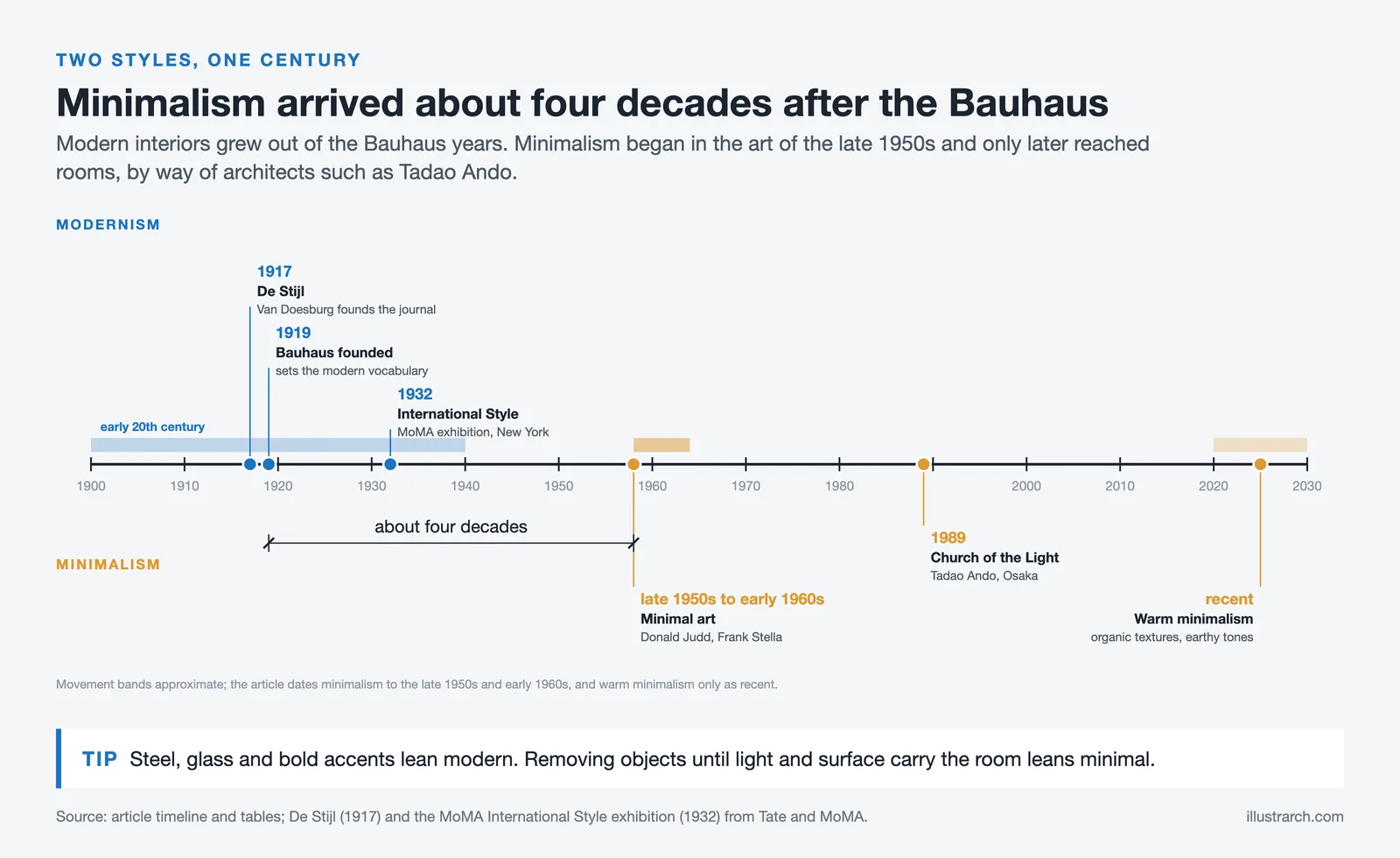
The Bauhaus school, founded in 1919, set much of this vocabulary in place. It embraced the principle “form follows function”, coined by Louis Sullivan in 1896, which shaped everything from chairs to facades, and related movements such as De Stijl and the International Style carried the look across Europe and North America. You still see that influence in homes, offices, and public buildings today.

The Emergence of Minimalism as a Design Philosophy
Minimalism took shape in the art world of the late 1950s and early 1960s before spreading to fashion, lifestyle, and interiors. Artists like Donald Judd and Frank Stella reduced their work to essential forms, rejecting emotional excess. The idea of “less is more”, a phrase borrowed from modernist architect Ludwig Mies van der Rohe, became a guiding rule, treating design as a question of what truly belongs in a space.
In rooms, that means sparse furnishings, a narrow color palette, and clear surfaces that let each object stand on its own. Japanese Zen aesthetics and Scandinavian simplicity both shaped this approach. Architects such as Tadao Ando and John Pawson built it into physical form using raw concrete, natural light, and restrained palettes that feel almost meditative.
Modernism vs. Minimalism: Historical Overview
The table below summarizes how the two styles differ in origin, philosophy, and cultural influence.
| Aspect | Modernism | Minimalism |
|---|---|---|
| Origin Period | Early 20th century | Late 1950s to early 1960s |
| Root Movement | Modernist art, response to the Industrial Revolution | Minimalist art, later expanded to lifestyle and interiors |
| Core Philosophy | Embrace technology, function, and modern materials | “Less is more,” essentialism and introspection |
| Key Pioneers | Le Corbusier, Walter Gropius, Mies van der Rohe | Donald Judd, Frank Stella, John Pawson, Tadao Ando |
| Signature Materials | Steel, glass, concrete, plywood | Natural stone, wood, concrete, glass |
| Cultural Influence | Bauhaus, De Stijl, International Style | Japanese Zen aesthetics, Scandinavian simplicity |
Distinguishing Features of Modern and Minimal Interiors
Both styles celebrate clean lines, yet a few differences set them apart. These distinctions matter when you shop for furniture, pick paint colors, or brief a designer on the direction you want.
- Color and texture: Modern interiors use a broader palette of neutrals, bold colors, and patterns. Minimal rooms stay closer to whites, beiges, and greys for a calmer feel.
- Furniture and decor: Modern design favors comfortable, functional pieces with industrial materials and geometric forms. Minimal spaces keep only the essentials, each chosen for form, function, and how it sits with the room.
- Space and form: Modernism opens up rooms but fills them with focal points. Minimalism treats empty space itself as part of the design, often using simple but bold forms to make a statement.
Detailed Feature Comparison: Modern vs. Minimal Interiors
For a side-by-side look across eight common design elements, see the comparison below.
| Feature | Modern Interior | Minimal Interior |
|---|---|---|
| Color Palette | Neutrals with bold accent colors and patterns | Monochromatic: whites, beiges, greys |
| Furniture Style | Comfortable, functional; industrial and geometric | Only essentials; chosen for form and harmony |
| Decor Level | Moderate: design objects, art, statement lighting | Restrained, little to no decoration |
| Use of Space | Open plans filled with functional focal points | Empty space itself is the design element |
| Texture and Pattern | Mixed textures; geometric patterns welcome | Subtle, uniform textures; patterns are rare |
| Lighting | Sculptural fixtures; layered lighting | Natural light first; recessed or hidden fixtures |
| Architectural Details | Clean lines, large windows, flat roofs | Bold forms; smooth surfaces, hidden storage |
| Overall Atmosphere | Visually engaging, warm, expressive | Serene, contemplative, tranquil |
💡 Pro Tip
Before you commit to either style, live with a single room for a few weeks. Clear the surfaces, remove half the decor, and see how it feels. Most people discover they lean modern in shared spaces and minimal in private ones, which points naturally toward a fusion rather than a strict choice.
Minimal vs Minimalist: Is There a Difference?
People often ask whether “minimal” and “minimalist” mean the same thing. In casual talk they overlap, but there is a useful distinction. Minimal describes the visual result, a room that looks pared back and uncluttered. Minimalist points to the broader philosophy of intentional reduction, where every object has to earn its place.
A minimal room can look clean without following any strict rule. A minimalist interior, by contrast, reflects a conscious choice to remove excess, favor quality over quantity, and treat empty space as an active part of the design. In practice, the minimalist spends more time editing possessions than the person who simply likes a tidy look.
Modern Minimalism: A Fusion Trend for Today’s Homes
A modern minimal house interior blends the strengths of both. You keep the modernist taste for quality craft and mixed materials while applying the minimalist discipline of editing down to essentials. The result feels warm and lived in, yet never crowded. Rooms breathe, surfaces stay clear, and each object carries real visual weight.

🏗️ Real-World Example
Church of the Light (Osaka, 1989): Tadao Ando’s chapel reduces a building to bare concrete, a cross-shaped slot of daylight, and almost nothing else. It shows how minimalism uses absence and light as the main materials, where a modern interior would add furniture and color to fill the same volume.
How to Achieve a Modern Minimal Interior
If both styles appeal to you, a few steps merge them well. Start with a neutral base such as white or warm grey walls. Layer in one or two natural materials like oak flooring or a stone counter. Choose furniture with clean silhouettes, then add a single statement piece per room, such as a sculptural pendant or a bold armchair. Keep surfaces clear and invest in hidden storage so daily clutter stays out of sight.
Choosing the Right Materials for Each Style
Material choice is where the two styles separate most visibly. Modern interiors enjoy variety: a leather sofa on polished concrete, a walnut side table, a steel-framed shelf. The mix of textures builds depth and warmth across the room.
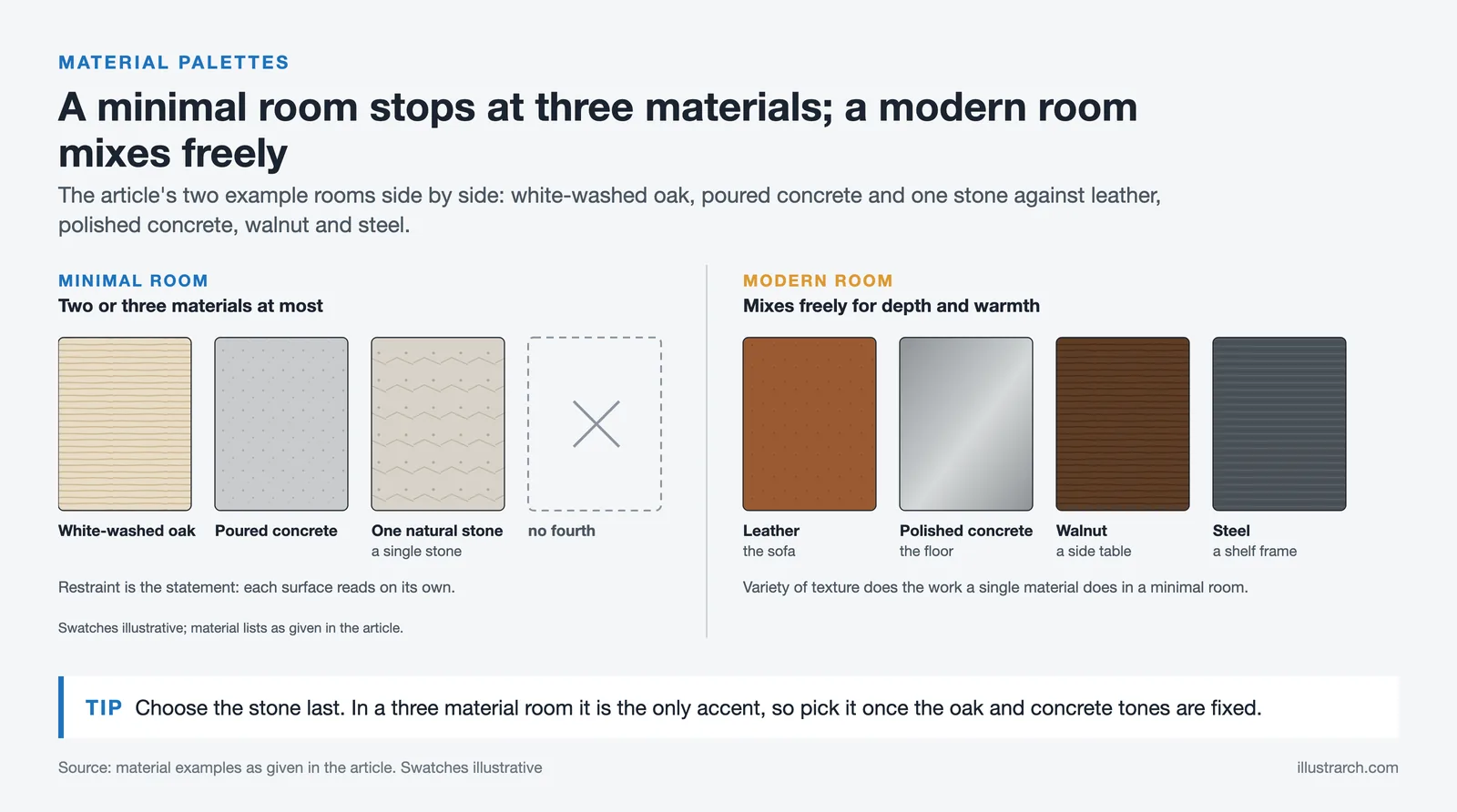
Minimal interiors hold the palette to two or three materials at most. A typical minimal room might pair white-washed oak with poured concrete and a single natural stone. The restraint becomes the statement, and the lack of visual competition lets you read each surface clearly. Either way, high-quality, sustainable material choices like reclaimed wood or low-VOC finishes help the interior age well.
How to Choose Between Modern and Minimal Interiors
The right choice in the minimal vs modern interiors question comes down to how you want a space to feel and function. Pick modern if you like expressive rooms with color, mixed materials, and iconic furniture that draws the eye. Pick minimal if calm, order, and open space matter more to you than visual variety, and if you are willing to keep editing what you own.
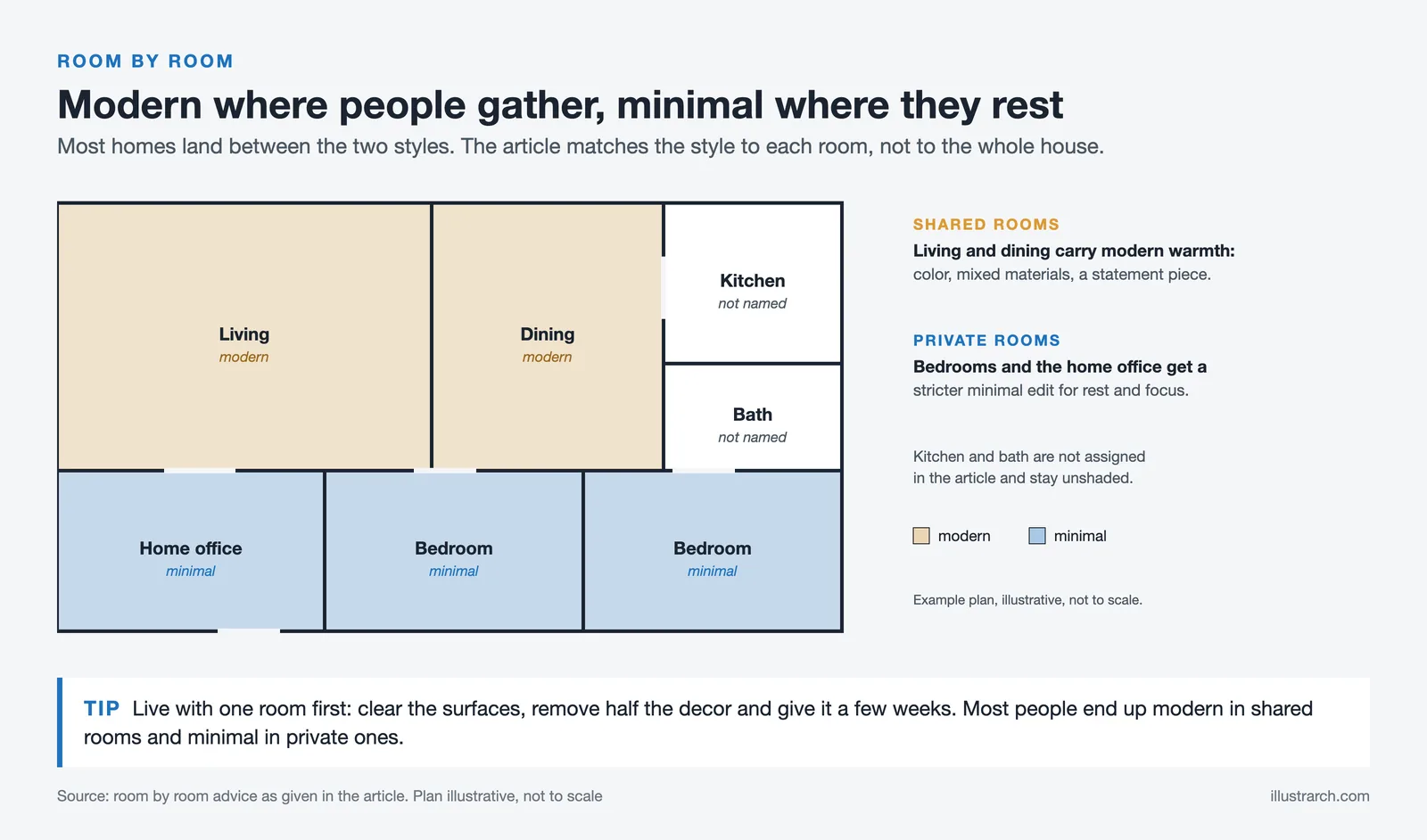
Most homeowners land somewhere between the two. Shared rooms such as living and dining areas often carry a modern warmth, while bedrooms and home offices benefit from a stricter minimal edit that supports rest and focus. Matching the style to each room, rather than the whole house, usually gives the best result. For more direction, see these popular interior design concepts.
Frequently Asked Questions
What is the main difference between modern and minimal interiors?
Modern interiors focus on function and open space while still using color, mixed materials, and statement pieces. Minimal interiors strip a room down to essentials with a narrow palette and clear surfaces, treating empty space as part of the design rather than something to fill.
Is a minimal interior cheaper than a modern one?
Not necessarily. Minimal rooms use fewer items, but each piece is usually chosen for high quality, so the cost can match or exceed a modern room with more varied furnishings. The savings come from buying less over time, not from lower individual prices.
Can you combine modern and minimal styles in one home?
Yes, and the blend is common. A modern minimal approach keeps the clean lines and quality materials of modern design while applying minimalist restraint. Start with a neutral base, limit accents, and use hidden storage to keep the look intentional rather than busy.
Which style works best for small spaces in 2026?
Minimal and modern minimal interiors tend to suit small spaces better because clear surfaces and limited furniture make rooms feel larger. A modern scheme can still work if you keep one focal point and avoid crowding the space with decor.
The Bigger Picture
The line between modern and minimal keeps moving. Recent “warm minimalism” softens the cooler minimalist look with organic textures and earthy tones, borrowing modernism’s love of tactile materials. Seen that way, the choice is less about picking a camp and more about deciding how much your rooms should say, and how much they should leave unsaid. The most personal interiors usually find their own point on that scale. For broader background, the architecture of Tadao Ando on ArchDaily, ArchDaily’s minimalism coverage, and the wider history of minimalism are good places to keep reading.


1 Comment




A New Book Records the 1970s Interiors of Ebony and Jet’s Chicago Headquarters
820 Ebony/Jet collects Barbara Karant's photographs of the empty Johnson Publishing Company...
 illustrarch Editoral Team2 Mins read
Spa-Like Serenity: 5 Accessible Luxury Upgrades to Transform Your Master Bathroom
Five accessible upgrades, from decluttering and layered lighting to plush textiles, natural...
illustrarch Editoral Team3 Mins read
How to Fill a Large TV Wall?
A broad living room wall poses an immediate spatial challenge the moment...
illustrarch Editoral Team4 Mins read
How Integrated Furniture Can Shape the Architecture of Urban Interiors
Most people treat furniture as the last decision in interior architecture, yet...
illustrarch Editoral Team2 Mins read


I don’t get why people think minimalism is so great. The article talks about how it’s all about ‘less is more,’ but sometimes less just feels empty and lifeless. And the monochromatic color schemes? They can be so boring. Honestly, a little bit of color and personality in a space goes a long way.