

Concert Hall
The concert hall by Gumus Cimen revitalizes a historic square in Kayseri by enhancing circulation through an existing building while integrating modern performance spaces.
 illustrarch Editoral Team10 December 20212 Mins read469


This concert hall by Gumus Cimen sits on the south wall of Kayseri Cumhuriyet Square, where a dense knot of historical buildings, two of the city’s important streets, underpasses, and eating and drinking places meet. The design grows out of a single observation: the existing building at the center of the site holds a passage that once connected the area’s courtyard, a meeting point, to the green area, yet that passage had apparently lost this quality over time. Reclaiming it became the primary goal of the project.
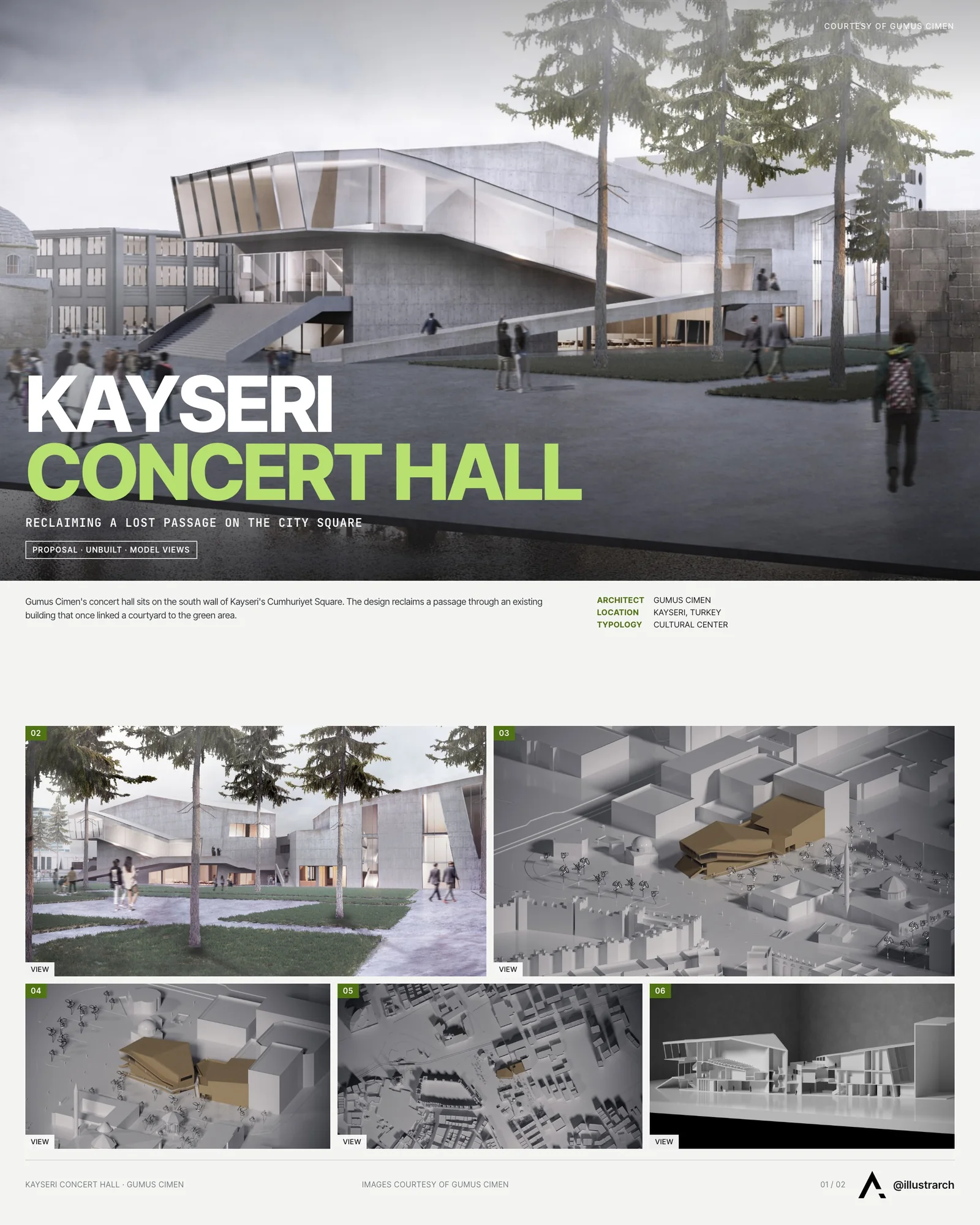
Rather than erase the old structure, the proposal reinterprets it. The passage is enlarged along the axes and orientations already present on the site and broken open into slits. Stairs and ramps then divide these slits into vertical elevations, and those elevations are what tie the concert hall and the artist accommodation units together in a meaningful way. The result is a building whose interior logic is legible from the street, because the ramps and stairs of the outer shell announce the function held inside.
Designing a cultural center inside a historic square
A cultural center placed within a historic civic square carries a particular set of demands. It must hold large gathering spaces and the acoustic requirements of a concert hall while staying respectful of older neighbors and keeping the public realm continuous. Threading circulation through a kept building, as this design does, is a common strategy for that balance: it preserves a familiar route while giving it new purpose, so visitors move through architecture rather than around it.
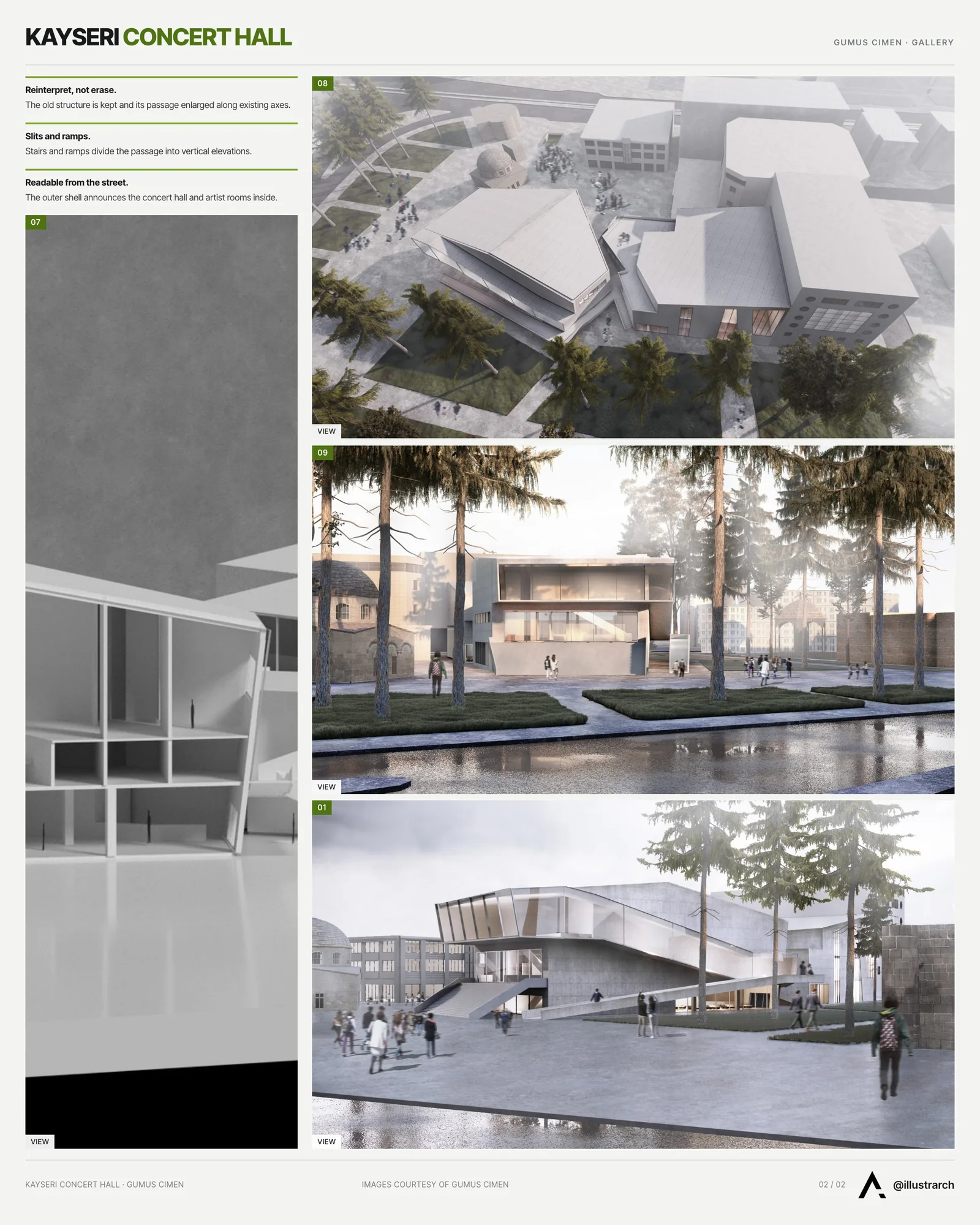
The choice to treat circulation as the organizing idea also responds to how people already use the square in Kayseri. Because the user frequently comes and goes through this area, a building that invites passage rather than blocking it keeps the courtyard, the green area, and the surrounding streets stitched together. Performance spaces depend on this kind of generous, well-marked approach, since the experience of attending a concert begins well before the first note.
By letting the section do the work, with slits, ramps, and stairs setting the rhythm, the project turns a worn shortcut back into a place worth lingering in. It reads as a quiet argument that conservation and new cultural life can share the same footprint when movement is treated as the heart of the plan.


CCA Tashkent Opens in Studio KO’s Revamped 1912 Tram Depot
Studio KO has converted a 1912 Tashkent tram depot into CCA Tashkent,...
illustrarch Editoral Team2 Mins read

Tidsmaskinen After-School Center by BBP Arkitekter
BBP Arkitekter add a heptagonal tower and a greenhouse to a 1918...
illustrarch Editoral Team2 Mins read

People’s Theatre Opens Permanent Inwood Home After 18 Years
WORKac's ramp-driven design gives Mino Lora's People's Theatre its first permanent home...
illustrarch Editoral Team2 Mins read

KAFD Metro Station by Zaha Hadid Architects
Zaha Hadid Architects' KAFD Metro Station ties three Riyadh Metro lines together...
illustrarch Editoral Team4 Mins read


Leave a comment