

Paul Doumer School Complex by AT architectes
The Paul Doumer School Complex by AT architectes transforms a constrained renovation into a long-term civic project, reimagining educational architecture as a flexible, climate-responsive, and community-oriented urban catalyst.
 Begum Gumusel23 January 20264 Mins read283


Table of Contents Show
The transformation of the Paul Doumer School Complex illustrates how educational architecture can evolve beyond its immediate function to become a lasting civic asset. Designed by AT architectes, the project responds to the challenge of renovating an aging school campus while it remained fully operational. Rather than treating construction constraints as limitations, the architects used them as a framework to rethink how schools can adapt over time, support community life, and contribute meaningfully to the urban fabric of a small town.
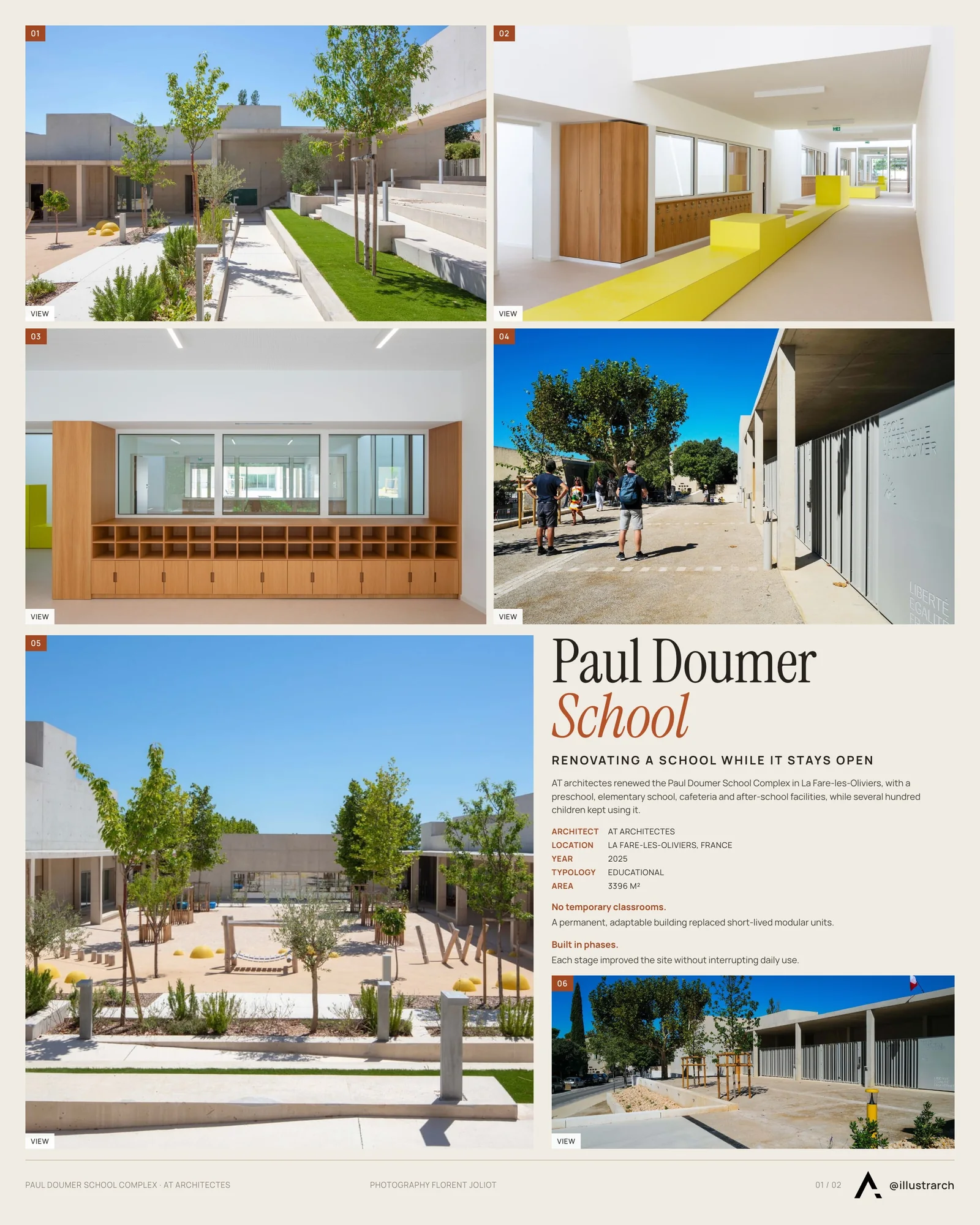
Located at the western entrance of La Fare-les-Oliviers in southern France, the complex brings together a preschool, elementary school, cafeteria, after-school facilities, and generous outdoor spaces. Commissioned by the municipality, the project had to address serious structural issues in existing buildings while ensuring uninterrupted daily use for several hundred children, a condition that fundamentally shaped both the architectural and strategic approach.
A Constrained Site, a Strategic Opportunity
The site presented a combination of physical and operational constraints. Limited land availability, variations in ground level, proximity to sports facilities, and the need for multi-year phased construction all required careful coordination. In many similar projects, such constraints would result in the installation of temporary modular classrooms, solutions that often represent sunk costs and offer little long-term value.
Through close dialogue between the architects and the city, a more ambitious alternative emerged. Instead of investing in short-lived temporary structures, the project proposed the construction of a permanent yet adaptable building capable of responding to immediate educational needs while anticipating future municipal uses. This decision reframed the entire project, shifting it from a reactive intervention to a long-term urban investment.
Architecture as an Ongoing Process
Rather than a single, definitive architectural gesture, the Paul Doumer School Complex was conceived as a progressive transformation. Construction unfolded in multiple phases, each designed to improve the site while maintaining continuity of use. The first step was the creation of a “temporary but durable” building to host students during renovation works.
Designed with robust materials and flexible layouts, this building was never intended to be disposable. Following the completion of the school works, it is set to become the city’s sports department, directly connected to the adjacent athletic fields. This approach demonstrates a rare commitment to architectural reversibility, ensuring that every construction phase contributes lasting value to the town.
Rehabilitation, Reconstruction, and Climatic Intelligence
The existing elementary school buildings were extensively rehabilitated, preserving their structural framework while significantly improving comfort and performance. In contrast, the preschool and cafeteria, severely affected by ground movement, were entirely rebuilt. Across both new and renovated structures, the architectural language remains sober, coherent, and deeply responsive to climate.
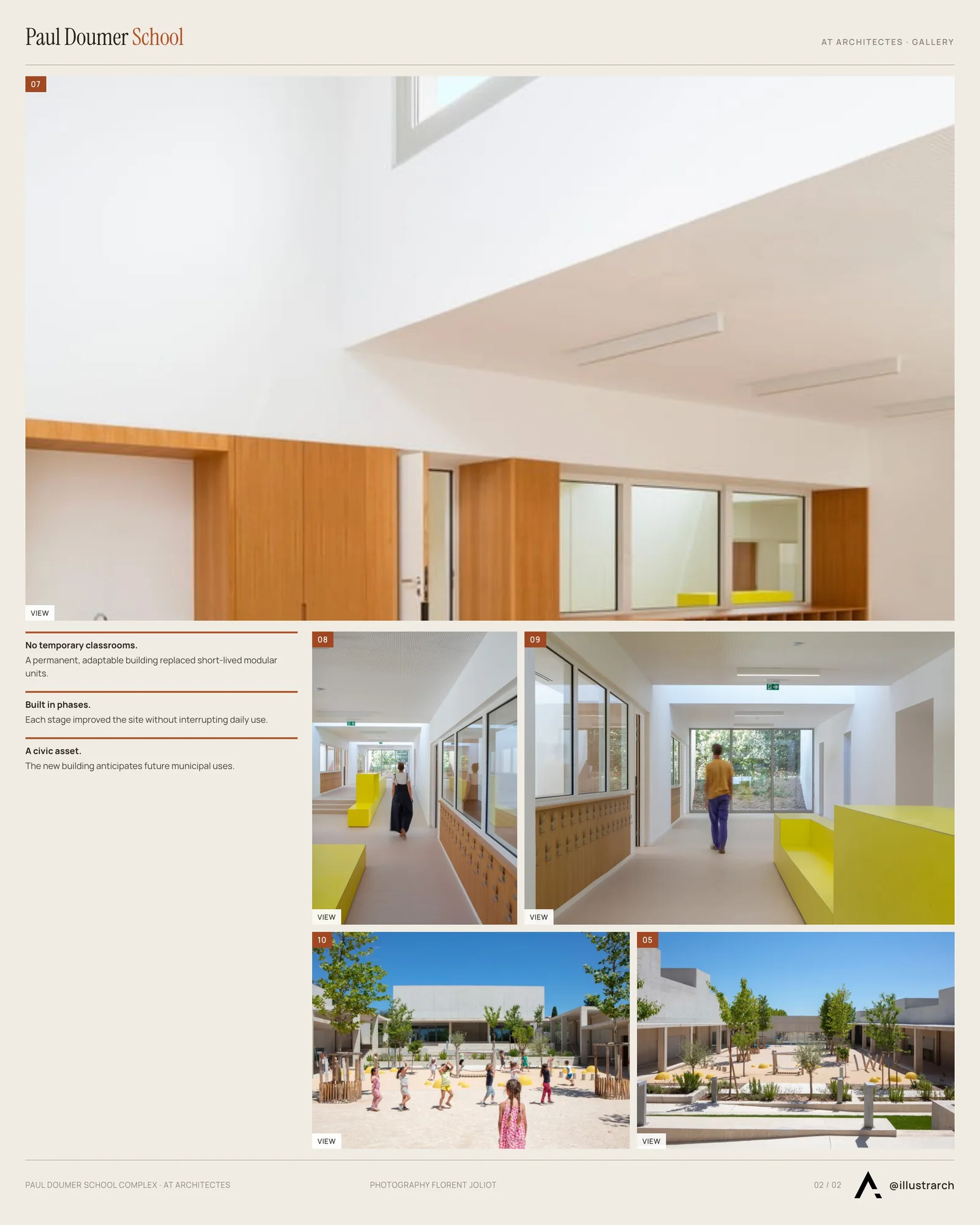
Classrooms are naturally ventilated through roof sheds that enable effective cross-ventilation during the day and promote night-time cooling during warmer months. These passive strategies reduce reliance on mechanical systems while ensuring a healthy indoor environment. Rather than showcasing technical complexity, the project prioritizes simple, robust solutions that are easy to maintain over time.
Outdoor spaces play an equally important role. Courtyards are conceived as “oasis spaces,” combining vegetation, permeable ground surfaces, and shaded zones. These landscaped areas mitigate heat, improve microclimatic comfort, and offer children restorative environments that extend learning beyond the classroom.
Shared Spaces and Evolving Educational Models
Inside the buildings, spatial organization favors shared circulation areas that act as more than mere corridors. These spaces are animated by custom-designed furniture that supports informal learning, group interaction, and moments of pause throughout the school day. The architecture acknowledges that education does not happen only in classrooms but also in the in-between spaces where social life unfolds.
A key element of the project is a connecting building between the preschool and elementary school. This structure houses reversible classrooms designed to adapt to demographic shifts and future programmatic changes. By anticipating evolution rather than fixing functions permanently, the school gains resilience, an essential quality for public buildings expected to serve generations.
Material choices throughout the complex emphasize durability, low maintenance, and thermal comfort. The architectural expression remains restrained, allowing spatial quality, light, and landscape to define the experience rather than relying on decorative effects.
The School as Urban Interface
Completed in 2025, the final phase of the project extends beyond the school buildings themselves. A newly landscaped and de-sealed forecourt marks the entrance to the complex and acts as an urban connector. This parvis links the school with its surrounding neighborhood and nearby sports facilities, creating a new public space at the town’s gateway.
By opening the school toward the city, the project reinforces its role as a shared civic institution rather than an enclosed educational enclave. Parents, residents, and local associations can engage with the site, strengthening its social relevance beyond school hours.
A Model for Sustainable Civic Architecture
The Paul Doumer School Complex demonstrates how educational architecture can address immediate functional needs while contributing to broader urban and environmental goals. By replacing temporary solutions with lasting infrastructure, the project embodies a culture of care, adaptability, and long-term vision.
More than a place of learning, the school now operates as a civic anchor for La Fare-les-Oliviers, supporting education, public life, and environmental responsibility in equal measure. It stands as a compelling example of how thoughtful architectural strategy can transform constraints into opportunities, shaping not only how children learn, but how a community evolves over time.
Photography: Florent Joliot




Herzog & de Meuron Builds Amherst College Student Center Atop Old Foundations
Herzog & de Meuron built a mass-timber student center at Amherst College...
 illustrarch Editoral Team2 Mins read
MIT Architecture School Moves Into DS+R-Converted Metropolitan Storage Warehouse
MIT's architecture school has moved into a DS+R-converted 1894 warehouse in Cambridge,...
illustrarch Editoral Team3 Mins read

SENA Tunja Training Center by TAP Arquitectura
TAP Arquitectura's unbuilt competition proposal for SENA in Tunja wraps a 4,400...
illustrarch Editoral Team2 Mins read
Best Software in Architecture School and What to Learn First
A practical look at the best software to learn in architecture school,...
 Elif Ayse Sen6 Mins read


Leave a comment