

Library and School Gate of CAUC by TJAD Original Design Studio
The Library and School Gate of CAUC by TJAD Original Design Studio redefines academic architecture through openness, shared learning spaces, and a climate-responsive campus landmark.
 Begum Gumusel4 January 20263 Mins read236


Table of Contents Show
Located in Ninghe District, Tianjin, the Library and School Gate of the Civil Aviation University of China (CAUC) forms the symbolic and functional heart of the university’s new campus. Designed by TJAD Original Design Studio, the project brings together two key elements, the main library and the southern campus gate, into a cohesive architectural composition that represents openness, shared learning, and institutional identity. With a total construction area of 40,000 square meters, the library stands as the core building of the first construction phase, redefining the role of academic architecture within a highly structured campus master plan.
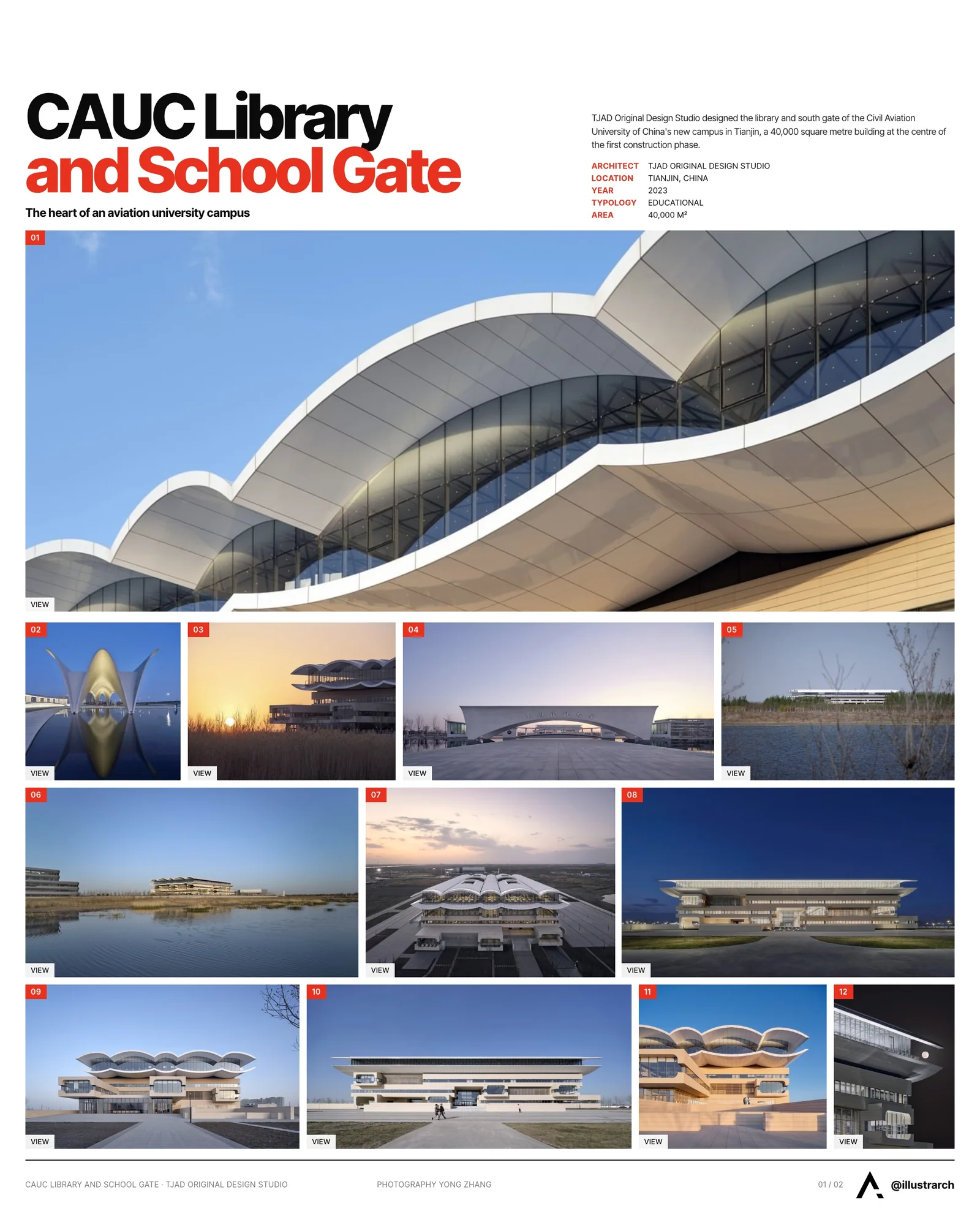
A Central Node within a Strong Campus Axis
The new CAUC campus is characterized by a clear and powerful axial layout. Rather than asserting the library’s importance through excessive height or monumental massing, the architects chose a more nuanced strategy. The library is conceived as a spatial hinge and connective node, optimizing the campus structure by linking teaching, living, and public zones in multiple directions.
By positioning the building at the natural center of pedestrian movement, airflow, and landscape corridors, the library becomes an integral part of daily campus life. It shifts away from the traditional model of an isolated academic building, instead functioning as a shared platform where learning, circulation, and social interaction intersect.
From Enclosure to Openness
The architectural language of the library reflects a deliberate transition from introverted educational typologies toward openness and accessibility. Responding to Tianjin’s local climate, the building’s protruding volumes create self-shading façades, reducing direct solar exposure on lower levels and improving indoor comfort. Horizontal ribbon windows are carefully proportioned to lower the window-to-wall ratio, enhancing thermal insulation while maintaining visual continuity with the surrounding landscape.
These environmental strategies are seamlessly integrated into the architectural form, allowing performance-driven decisions to shape the building’s appearance without compromising clarity or elegance.
A Library Reimagined for Shared Learning
Internally, the library is organized into three interrelated spatial systems, each addressing a distinct aspect of contemporary academic life.
The structural core forms the backbone of the building. It accommodates dense book storage, vertical circulation, and service spaces, providing both structural stability and organizational clarity. This core ensures efficiency while freeing peripheral zones for more flexible and experiential uses.
Wrapped around the core, the cabin reading rooms are stacked vertically, creating layered environments for general reading, study, and administrative functions. These spaces balance intimacy and openness, offering students and faculty a variety of learning atmospheres suited to different modes of concentration and collaboration.
At the top of the building, the Cloud Hall becomes the library’s most expressive and symbolic space. Designed as a large, column-free hall with a flat floor, it supports dynamic and adaptable uses, from group study and exhibitions to lectures and informal gatherings. This elevated shared space embodies the idea of the library as a cultural and social catalyst rather than a purely functional repository of books.
The School Gate as an Architectural Threshold
Complementing the library, the south gate of the campus establishes a clear and dignified entrance to the university. Designed using a concrete thin-shell structure, the gate presents a light yet powerful architectural gesture. Its simplicity and structural clarity create a strong first impression, marking the transition from city to campus while aligning visually with the library’s architectural language.
Together, the gate and library form a unified identity, one that emphasizes openness, innovation, and academic exchange.
From Function to Cultural Identity
Beyond its programmatic requirements, the Library and School Gate of CAUC plays a crucial role in shaping the cultural image of the new campus. The building moves away from rigid functionalism, instead embracing shared spaces, visual transparency, and spatial continuity as core values. By integrating circulation, landscape, and learning environments, the project fosters a sense of collective ownership and engagement among students and faculty.
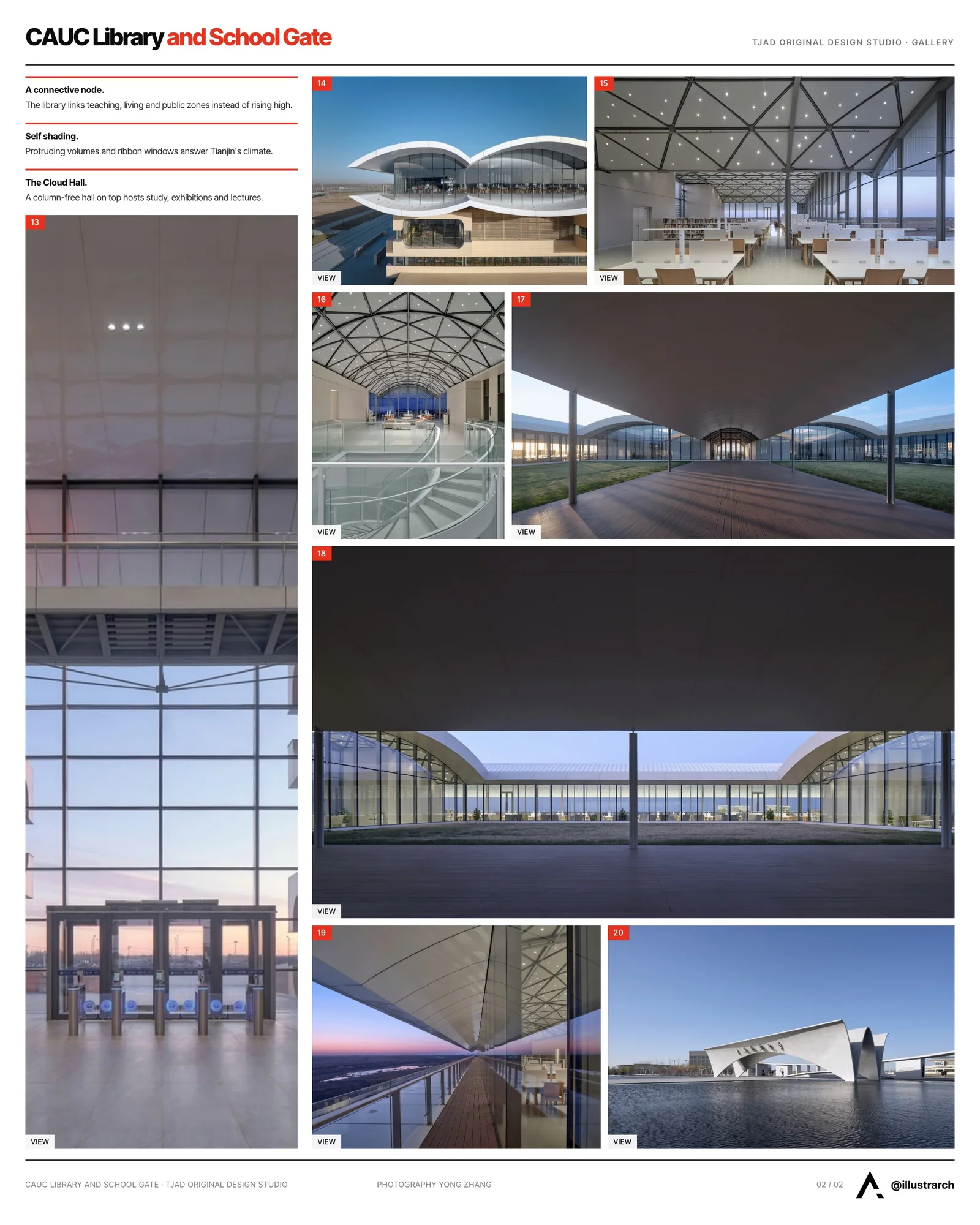
Through its restrained yet expressive form, the library ultimately establishes itself as a landmark of the new CAUC campus, representing a shift toward open education models and future-oriented academic environments.
Photography: Yong Zhang





Herzog & de Meuron Builds Amherst College Student Center Atop Old Foundations
Herzog & de Meuron built a mass-timber student center at Amherst College...
 illustrarch Editoral Team2 Mins read
MIT Architecture School Moves Into DS+R-Converted Metropolitan Storage Warehouse
MIT's architecture school has moved into a DS+R-converted 1894 warehouse in Cambridge,...
illustrarch Editoral Team3 Mins read

SENA Tunja Training Center by TAP Arquitectura
TAP Arquitectura's unbuilt competition proposal for SENA in Tunja wraps a 4,400...
illustrarch Editoral Team2 Mins read
Best Software in Architecture School and What to Learn First
A practical look at the best software to learn in architecture school,...
 Elif Ayse Sen6 Mins read


Leave a comment