

Queen Victoria Building: A Complete Guide to Sydney’s Romanesque Revival Masterpiece
Built between 1893 and 1898, the Queen Victoria Building occupies an entire city block in Sydney's CBD. This guide covers its Romanesque Revival architecture, original purpose, the Tea Room, the 21 copper domes, and the remarkable restoration that saved it from demolition.
 Sinan Ozen17 April 202610 Mins read316
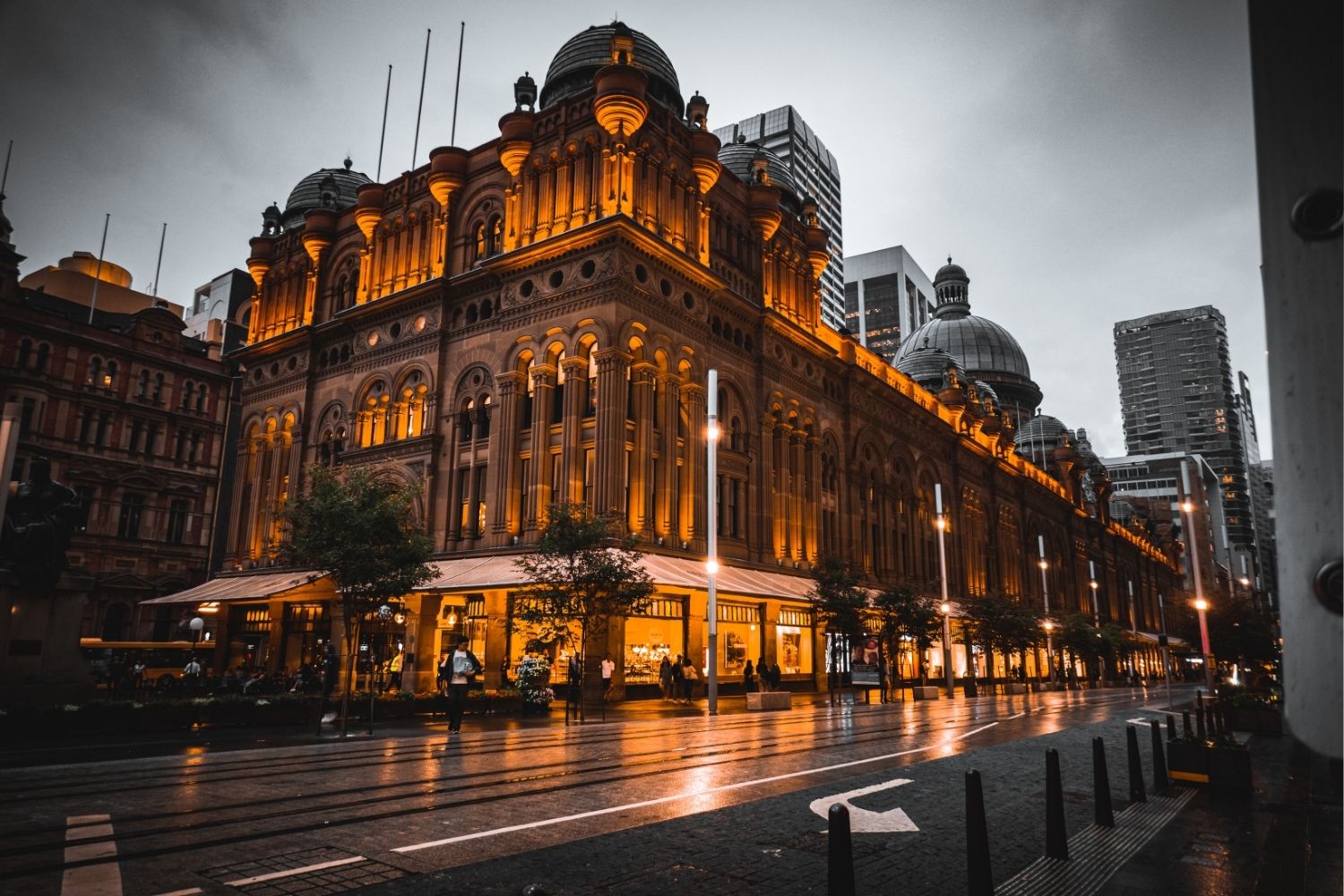
Table of Contents Show
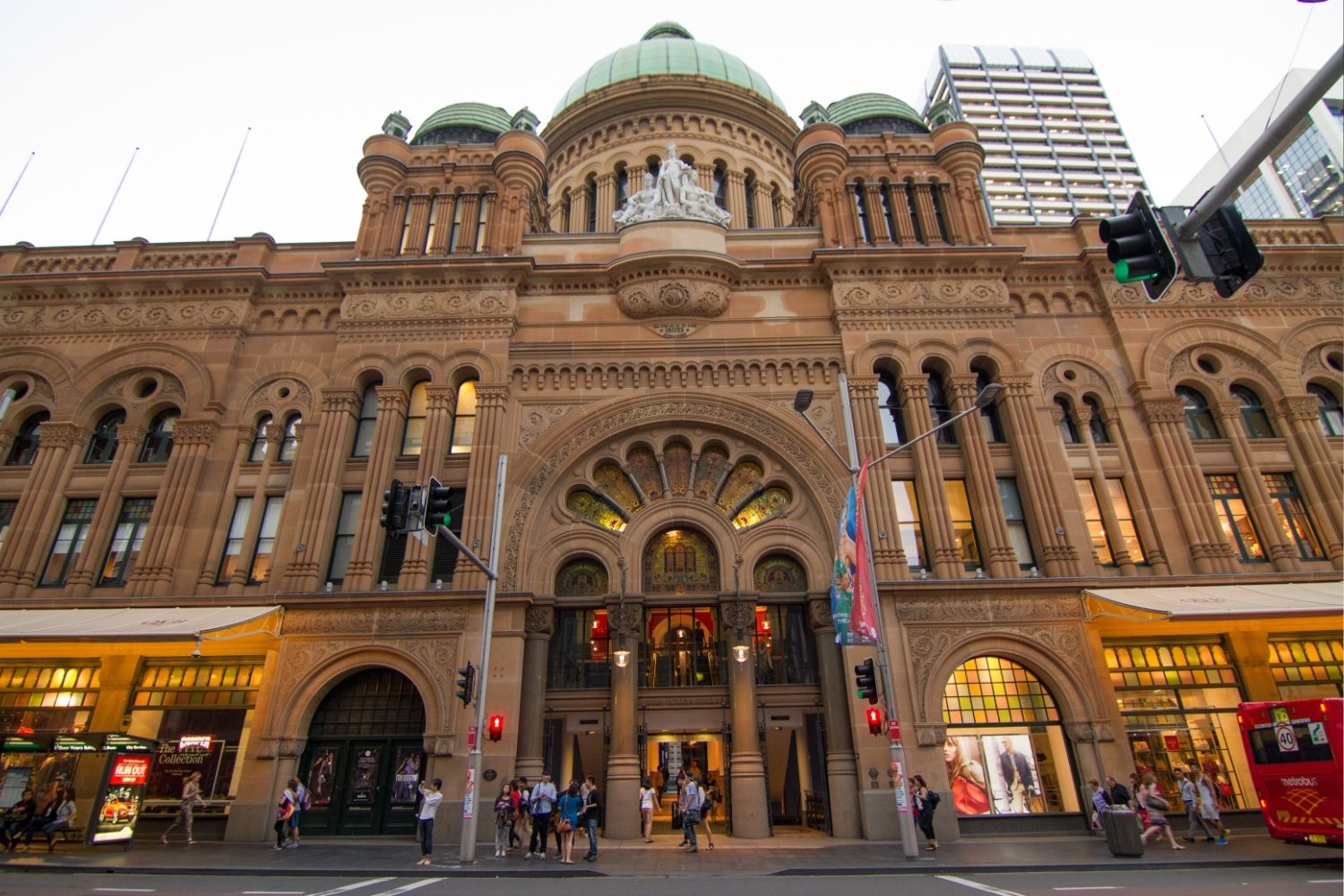
The Queen Victoria Building is a heritage-listed late-19th-century landmark at 429-481 George Street in Sydney’s central business district. Designed by Scottish-born architect George McRae and constructed between 1893 and 1898, this Romanesque Revival structure spans an entire city block, stretching 190 metres in length with 21 copper domes rising above its sandstone facade. Today it operates as a retail and dining destination while remaining one of Australia’s most intact examples of Victorian civic architecture. Full history and current tenancy details are maintained at qvb.com.au.
What Was the Queen Victoria Building Originally Built For?
The Queen Victoria Building was originally designed to replace the Sydney Central Markets, which had occupied the George Street site since the early 19th century. By the late 1880s, market activity had migrated to other parts of the city, leaving the prominent block adjacent to Sydney Town Hall effectively redundant. The Sydney City Council commissioned a new building in 1888, with the dual purpose of creating a modern civic marketplace and marking Queen Victoria’s Diamond Jubilee of 1897. The Dictionary of Sydney holds primary source records on the site dating back to Governor Macquarie’s use of the land in 1810.
Construction began in December 1893, during one of Sydney’s most severe economic recessions. This timing was not incidental. The project was deliberately structured to employ large numbers of skilled craftsmen who had been put out of work by the financial downturn, including stonemasons, plasterers, ironworkers, and stained glass artists. The Queen Victoria Building Sydney NSW was, in this sense, as much a public employment programme as an architectural statement.
At opening on 21 July 1898, the ground floor housed 58 shops with tenants ranging from tailors and chemists to florists and boot importers. Upper floors contained showrooms, warehouses, a residential hotel at the Druitt Street end, and a concert hall with capacity for 500 people at the Market Street end. The building was not a traditional produce market at all. Its name, the Queen Victoria Market Building, was something of a bureaucratic holdover, and the structure was always intended for retail and civic purposes.
📌 Did You Know?
The Queen Victoria Building’s construction cost, equivalent to roughly AUD $2 billion in today’s terms, was justified partly as an economic relief measure during Sydney’s 1890s recession. Architect George McRae deliberately specified labour-intensive ornamental stonework, stained glass, and tilework to maximise employment of skilled tradesmen who were out of work during the economic depression (Architecture AU, 2018).
The Architect: George McRae and the Choice of Romanesque Revival
George McRae was born in Edinburgh in 1857 and emigrated to Sydney in 1884, rising swiftly through the city’s building profession to become City Architect and City Building Surveyor, a position he held from 1889 to 1897. He was responsible for several of Sydney’s key civic buildings and was regarded by contemporaries as one of the leading figures of new construction methods then challenging the conservatism of established practice.
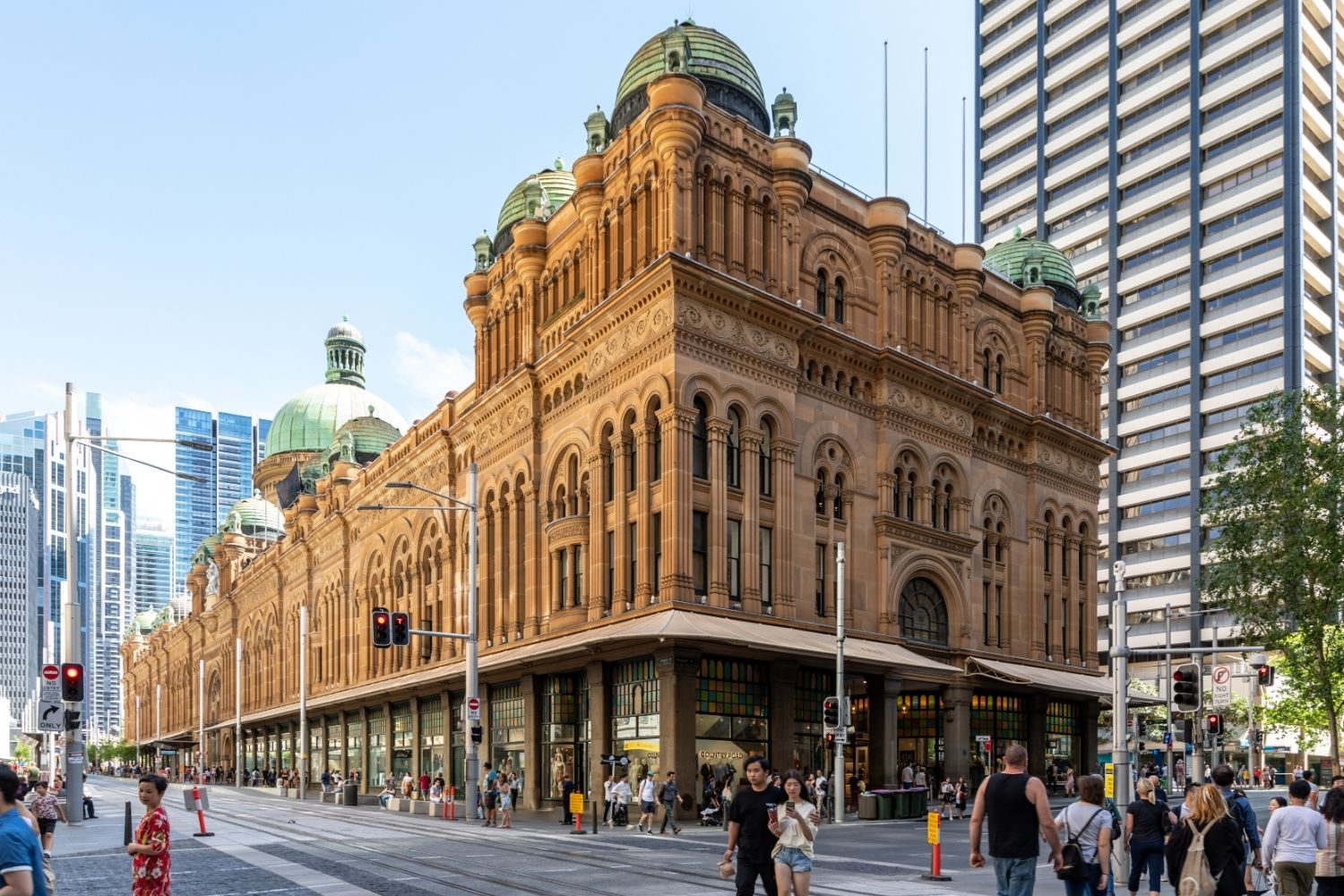
For the George Street site, McRae produced four full facade designs in different architectural styles: Gothic, Renaissance, Queen Anne, and American Romanesque. These were exhibited publicly in July 1893 and described by the Australasian Builder and Contractors’ News as, respectively, “scholarly Renaissance”, “picturesque Queen Anne”, “classic Gothic”, and “American Romanesque.” The council’s choice fell on the last option. The Romanesque design drew heavily on the influence of American architect Henry Hobson Richardson, whose Richardsonian Romanesque style, established between 1877 and 1886, was characterised by round arches, rough-cut stone, bold massing, and profuse ornamental detail.
McRae’s selection of sandstone as the primary material was a practical and symbolic choice. Sydney sandstone was the city’s signature building material, already used in the Town Hall next door. The stone’s warm honey colour gave the new building an immediate civic gravitas while tying it visually to its neighbour and to the broader character of colonial Sydney’s public architecture. For a deeper look at how Sydney’s built environment reflects climate and local conditions, the illustrarch article on how Sydney’s architecture responds to climate, light, and lifestyle provides useful context.
💡 Pro Tip
When visiting the Queen Victoria Building, enter from the George Street side and look up immediately after crossing the threshold. The cartwheel stained glass window depicting Sydney’s coat of arms is best seen from directly below at ground level, where its full scale and the quality of its individual panels are most apparent. Most visitors walk straight past it.
Architectural Features of the Queen Victoria Building
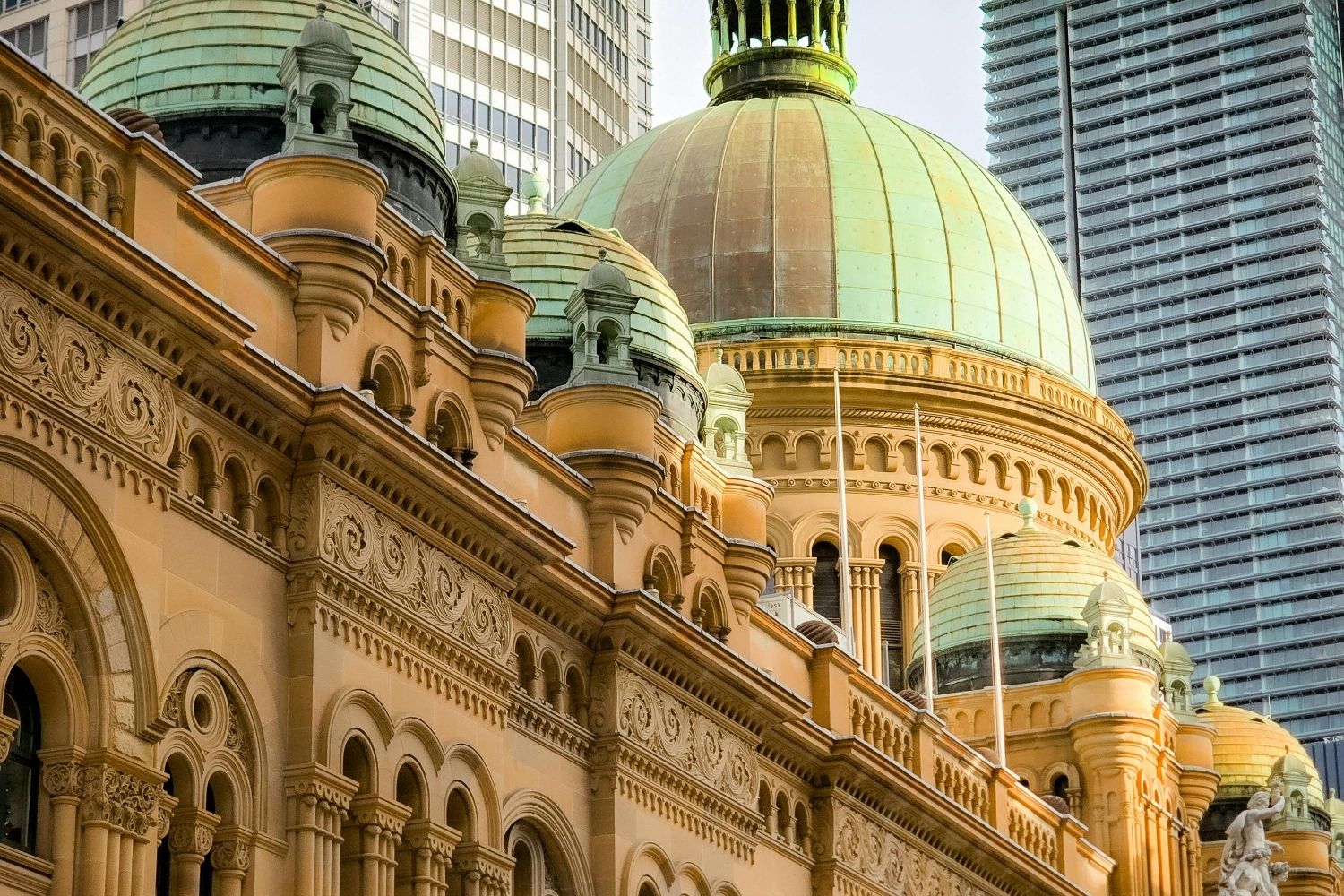
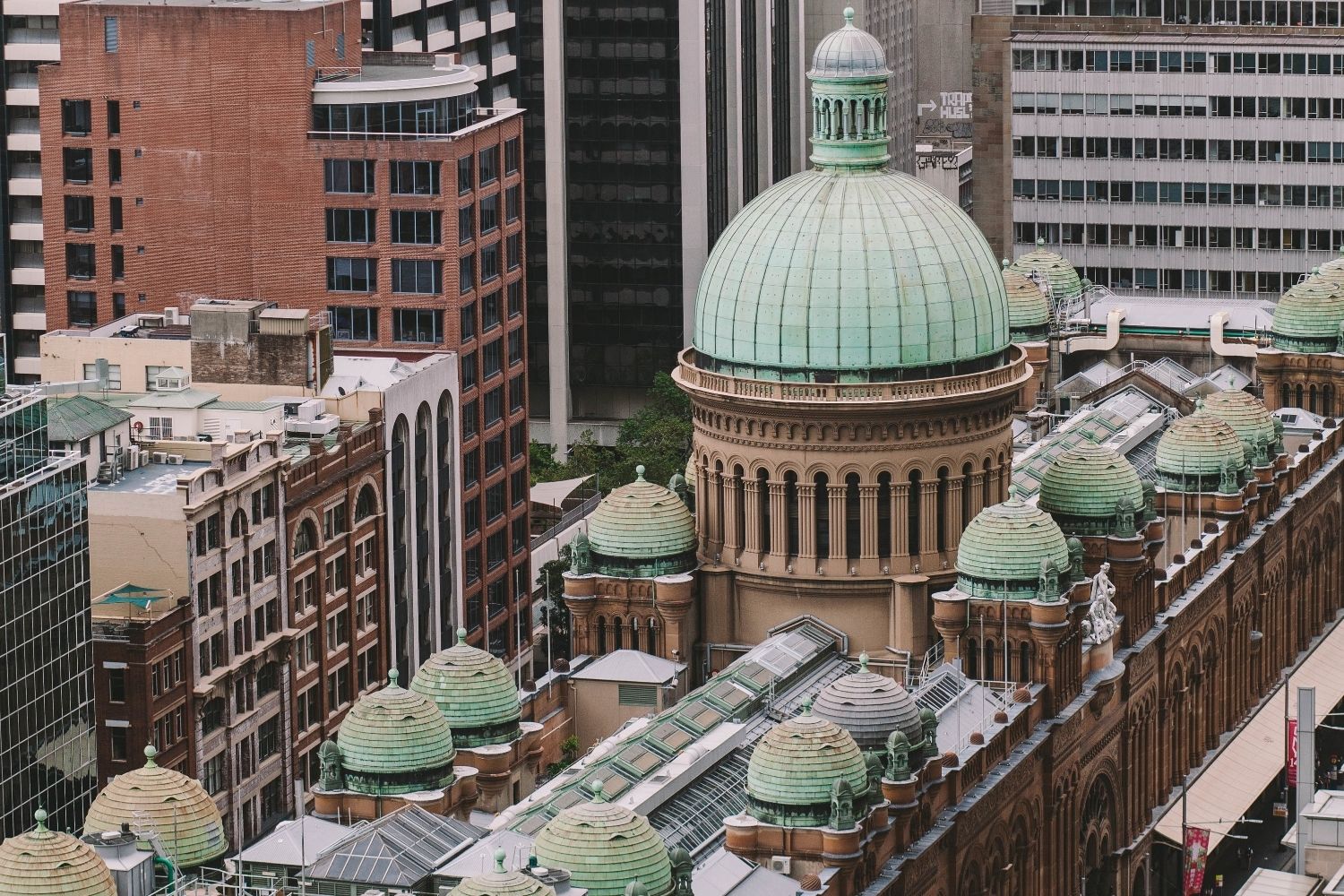
The building measures 30 metres wide by 190 metres long and fills its entire city block, bounded by George, Market, York, and Druitt Streets. Five storeys in height, it presents a sandstone facade marked by colonnades, semicircular arches, ornate balustrades, and cupolas at every cornice level. The roofscape carries 21 copper domes of varying sizes, with the central dome as its dominant feature.
The Central Dome and Glass Roof
The central dome consists of an inner glass dome set within a copper-sheathed exterior, topped by a domed cupola. It was constructed by Ritchie Brothers, a steel and metal company that also built trains, trams, and farm equipment, which speaks to the engineering integration required for a structure of this scale in the 1890s. Smaller domes sit on each upper corner of the rectangular building and at intervals along the roofline.
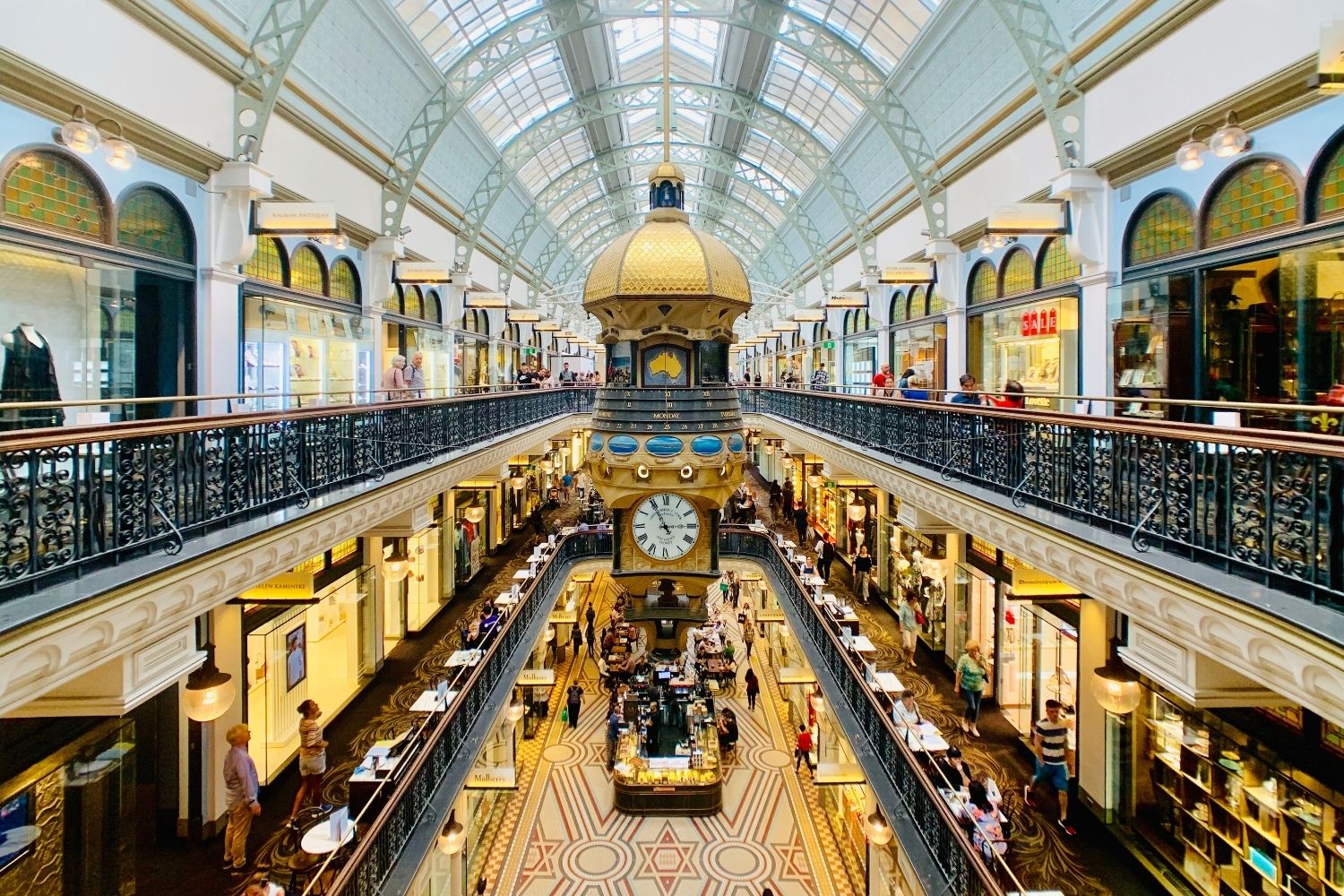
Below the central dome, arched skylights run north and south along the building’s full length, flooding the interior arcade with natural light. This integration of glass and steel within a Romanesque masonry shell was considered technically advanced at the time and is one reason McRae’s reputation among architectural historians rests partly on his engineering as well as his design sensibility.
Stained Glass, Tiling, and Ornamental Detail
Stained glass windows appear throughout the building, including the prominent cartwheel window depicting the arms of the City of Sydney. Each panel within it carries a specific symbolic meaning: the beehive represents commerce, the sailing ship represents trade, and the dolphins represent Sydney Harbour. Above the main entrances on George Street and York Street, two groups of allegorical marble figures were sculpted by William Priestly MacIntosh. One group centres on the “Genius of the City” and the other on the “Genius of Civilisation,” the latter said to have been modelled on Australian swimmer Percy Cavill.
The tiled floors throughout the building are original Victorian encaustic tiles, restored during the 1980s renovation. Their geometric patterns and warm colour palette complement the sandstone walls and create a sensory coherence between floor, wall, and ceiling that is rarely achieved in Victorian commercial buildings of this scale. For architectural context on how historic ornament and proportion continue to inform contemporary practice, see illustrarch’s article on 10 architectural styles that shaped history, which covers the Romanesque and its revival movements. Detailed archival drawings and construction plans are held by the City of Sydney Archives.
🎓 Expert Insight
“Sydney has grown back into the Queen Victoria Building.”
Philip Thalis, Architect and City of Sydney Councillor
Thalis made this observation at the QVB’s 120th anniversary in 2018, capturing the way the building’s scale and location, once seen as oversized and impractical, now reads as precisely calibrated to its CBD surroundings. What seemed like excess in 1898 became civic ambition in retrospect.
What Is the Queen Victoria Building Used For Today?
The Queen Victoria Building today operates as a premium retail and dining destination. The building houses more than 180 boutiques and specialty stores across its lower ground, ground, first, second, and third levels. The mix runs from Australian fashion labels and jewellers to confectionery, beauty, homewares, and book and gift retailers. Access from Town Hall Station on the lower ground floor means the building functions as a daily transit point for commuters as well as a retail destination.
The QVB is co-owned by the City of Sydney and Link REIT, and was added to the New South Wales State Heritage Register on 5 March 2010. This listing confirmed its status as a protected cultural asset and placed formal constraints on any future alteration of its fabric or character. The property’s management operates within these heritage obligations.
The Tea Room Queen Victoria Building
On Level 3 at the Market Street end, the Tea Room Queen Victoria Building occupies what was originally the building’s Grand Ballroom. The Tea Room Queen Victoria Building Sydney was established in 1997 by Manuel Spinola of the Grand Pacific Group and has since developed into one of the city’s most recognisable function venues. Custom Baccarat crystal chandeliers commissioned during a 2014 renovation hang above the original ornate Victorian ceiling, combining period fabric with contemporary luxury specification. Full event and dining information is available at thetearoom.com.au.
The Tea Room QVB operates primarily as a function venue for weddings, corporate events, and private dining, but its signature offering is the traditional afternoon high tea service, available to walk-in guests during regular trading hours. The service runs Monday to Friday 10am to 5pm and Saturday and Sunday 10am to 4pm. It sits on Level 3 and is accessible by lift or stair from the Market Street entrance. The address is 455 George Street, Sydney NSW 2000.
The tradition of tea rooms in the building dates to December 1898, when merchant Quong Tart opened the Elite Dining Room and tea rooms in the newly completed Queen Victoria Markets building. Quong Tart’s establishment could accommodate over 500 diners in its upper hall and was among the most popular dining venues in colonial Sydney, making the present Tea Room a direct continuation of a hospitality tradition running back to the building’s first year of operation. This kind of continuity is central to what makes heritage buildings function as genuine community assets, a theme covered in the illustrarch piece on adaptive reuse in architecture.
💡 Pro Tip
The Tea Room QVB is on Level 3, but there is also a separate cafe on Level 2 that sometimes causes confusion. The Tea Room is at the Market Street end of the building, not the Druitt Street end. If you arrive via the Town Hall Station lower ground entrance, take the lift to Level 3 and walk toward the Market Street signage. Note that the Tea Room operates primarily as an event venue, so walk-in high tea is best confirmed in advance by phone.
From Near-Demolition to Heritage Listing: The QVB’s Turbulent History
The Queen Victoria Building’s survival was not inevitable. Between its opening in 1898 and its eventual heritage listing in 2010, the building narrowly escaped demolition more than once and underwent changes that compromised its character before restoration reversed them.
During the 1930s, the main galleries were floored over and shopfronts were remodelled in an Art Deco idiom to suit the Sydney City Council, which had become the building’s principal tenant. By 1959, Lord Mayor Harry Jensen had formally proposed demolishing the entire structure to create a civic square with parking and shopping underground. The plan attracted serious political support and came close to execution before a sustained public campaign intervened. A group calling itself Friends of the Queen Victoria Building formed, with supporters including Barry Humphries, and in May 1971 the council committed to restoration rather than demolition.
The National Trust classified the building in 1974. In 1980, the council opened a tender process and in 1983 signed a 99-year lease with Malaysian company Ipoh Garden Berhad, which carried out the major restoration. The building reopened to the public in 1986, with its galleria, domes, and ornamental details painstakingly reinstated. A further refurbishment in 2009 added new escalators, updated elevators, and refreshed finishes throughout. The illustrarch article on the value of preserving historic buildings examines the economic and cultural case for retention over demolition, arguments that were central to the QVB’s survival.
⚠️ Common Mistake to Avoid
The Queen Victoria Building is frequently described as a “shopping centre,” which understates both its architectural complexity and its heritage status. It is a State Heritage-listed building operating as a retail destination, not a retail centre that happens to be old. This distinction matters practically: alterations to tenancies, signage, and fit-outs must satisfy NSW Heritage Office requirements, which places design constraints on how retailers present within the space that would not apply in a standard mall.
The Royal Wishing Well and Queen Victoria’s Statue
Outside the Queen Victoria Building on Town Hall Place, facing the Town Hall, stand the Royal Wishing Well and a bronze statue of Queen Victoria. The wishing well is a functional working feature that accepts coins. A recorded voice, said to represent the ghost of Queen Victoria herself, periodically remarks on the coins deposited. The statue dates to the restoration period and was placed to reinforce the building’s civic identity at street level.
Inside the building, a sealed letter from Queen Elizabeth II is held near the central dome on the top level. Written in 1986, it is addressed to the future Lord Mayor of Sydney and is not to be opened or read until 2085. Its contents are unknown to everyone, including the current building management. The hanging mechanical clock on the upper levels displays a series of animated tableaux of British monarchs every hour, ending with the beheading of Charles I, an unusual and memorable detail that draws visitors repeatedly throughout the day.
The QVB Within Sydney’s Architectural Landscape
The Queen Victoria Building does not stand in isolation. It forms part of a dense cluster of Victorian civic buildings along George Street, including the Sydney Town Hall immediately to the south, constructed between 1868 and 1889 in a broadly French Renaissance style. Together, these two buildings frame one of Sydney’s most architecturally coherent streetscapes. For a broader comparison of how Sydney’s other great public building was conceived and built, the Sydney Opera House architecture guide on illustrarch covers Utzon’s design process in detail. The Architecture AU anniversary feature on the QVB’s 120th year offers commentary from practising Sydney architects on the building’s long-term significance.
The Queen Victoria Building Sydney NSW also demonstrates how a Victorian civic structure can absorb contemporary retail use without surrendering its architectural integrity. The illustrarch article on how historic structures inspire today’s architects covers the practical lessons that buildings like this offer for passive design, proportion, and material honesty. The Wikipedia entry on the Queen Victoria Building provides a well-sourced overview of the Richardsonian Romanesque influences and the building’s full construction chronology for those wanting primary source references.
✅ Key Takeaways
- The Queen Victoria Building was built between 1893 and 1898 to replace Sydney’s central markets and to provide employment during a severe recession, not primarily as a shopping centre.
- Architect George McRae submitted four style options to the city council; the Romanesque design was chosen for its connection to Richardsonian Romanesque, an American-influenced form of Victorian revival architecture.
- The building’s 21 copper domes, original encaustic tile floors, stained glass windows, and allegorical marble figures survive intact, making it one of the most complete Victorian commercial interiors in Australia.
- The Tea Room Queen Victoria Building occupies the original Grand Ballroom on Level 3 and continues a hospitality tradition that began with Quong Tart’s tea rooms in the building’s opening year of 1898.
- The QVB narrowly escaped demolition in the 1960s and 1970s before a public campaign led to its restoration and eventual listing on the NSW State Heritage Register in 2010.
- queen victoria building
- queen victoria building nsw
- queen victoria building sydney
- queen victoria building sydney nsw
- queen victoria building tea room
- the tea room queen victoria building
- the tea room queen victoria building sydney
- what is the queen victoria building used for
- what was the queen victoria building originally built for


A 2,500-Year-Old Solar Observatory in Puebla Is the First Group E Complex Found Outside the Maya Area
Archaeologists working for Mexico's INAH have confirmed that two platforms at Teteles...
 illustrarch Editoral Team2 Mins read
Donald Insall, the Conservation Architect Who Led Windsor Castle’s Restoration, Dies at 100
Donald Insall, the British architect who turned conservation into a planning discipline...
illustrarch Editoral Team2 Mins read
New Digging Season at the Mieza Gymnasium Uncovers Alexander’s School Complex
New digs at Mieza uncover teaching halls and mosaic banquet rooms at...
illustrarch Editoral Team2 Mins read
A Record El Niño Threatens More Than 10,000 Adobe Heritage Sites on Peru’s Coast
With a possibly record-breaking El Niño under way, Peru's coastal adobe heritage...
illustrarch Editoral Team2 Mins read


Leave a comment