

The Restoration of Notre Dame: Architecture, Memory, and Responsibility
The restoration of Notre Dame cathedral is the largest heritage reconstruction project of the 21st century. This article covers the fire's damage, the five-year reconstruction timeline, BIM and laser scanning technology, material sourcing challenges, the 846 million euros raised from 340,000 donors, and what the project reveals about architectural preservation in practice.
 Elif Ayse Sen13 April 202612 Mins read335

Table of Contents Show
The restoration of Notre Dame cathedral is the most significant heritage reconstruction project of the 21st century. After a fire on April 15, 2019, destroyed the medieval oak roof and collapsed the 19th-century spire, approximately 2,000 craftspeople and 250 companies spent five years returning the Gothic structure to public use. The cathedral reopened on December 7, 2024, with ongoing work expected to continue through 2026 and into 2027.
Notre Dame sat on the Ile de la Cite in Paris for over 860 years before the fire. Constructed between 1163 and 1345, it pioneered the flying buttress, the ribbed vault, and the monumental rose window. These structural innovations allowed builders to push walls higher and thinner than any previous Romanesque structure, filling the interior with colored light from stained glass spanning up to 13 meters in diameter. The fire threatened to erase all of it in a single evening. What followed was an unprecedented effort that combined medieval craftsmanship with 21st-century digital tools, and it produced lessons that extend far beyond a single building.
How the 2019 Fire Damaged the Notre Dame Cathedral
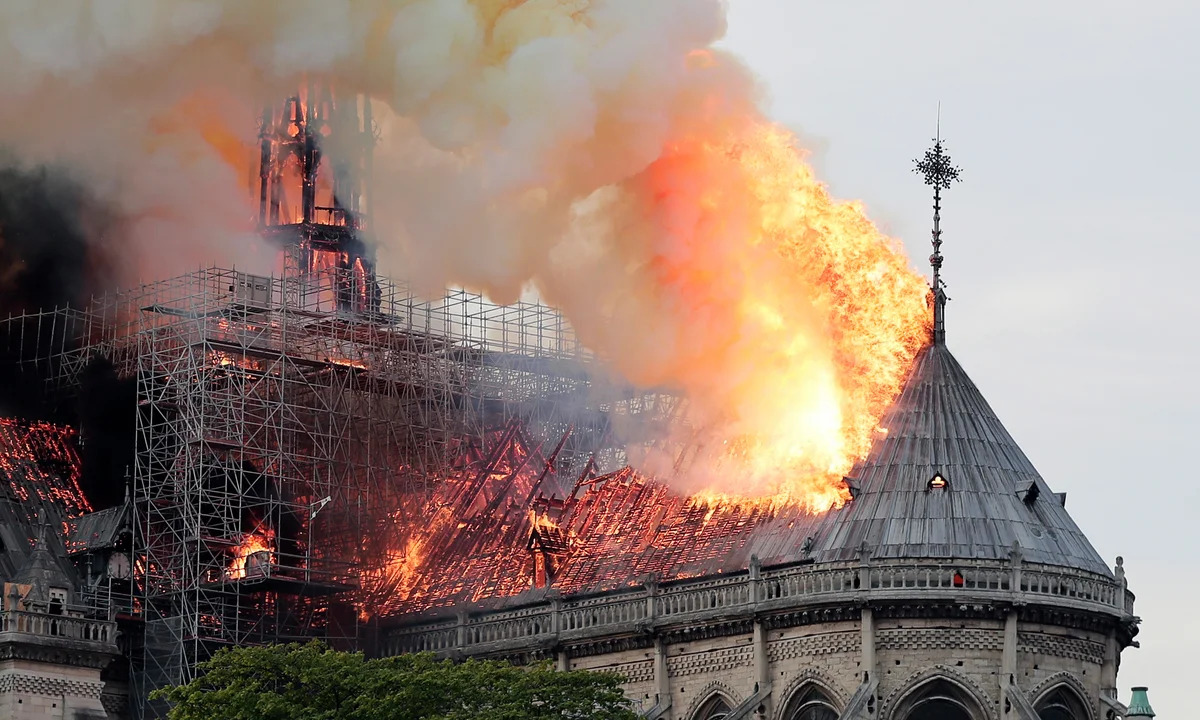
The fire broke out just after 6:43 PM local time on April 15, 2019, in the roof space of the cathedral. Fueled by the medieval oak framework known as “la foret” (the forest), the blaze consumed the roof structure and brought down the 96-meter spire designed by architect Eugene Viollet-le-Duc in the 19th century. The spire, weighing roughly 400 tons including its lead cladding, crashed through the stone vaulting below, opening massive holes in the ceiling.
Despite the severity of the fire, several critical elements survived. The twin bell towers, the three rose windows (dating from the 13th century), and most of the interior artwork remained intact. Firefighters made the strategic decision to focus on saving the towers, which contained eight bells and the structural connections that held the facade together. Had either tower collapsed, the entire west facade could have followed.
The immediate aftermath presented a building on the edge of total failure. The remaining walls, stripped of their roof load and exposed to the elements, were at risk of lateral collapse. Over 200 tons of melted scaffolding from a renovation project underway at the time of the fire sat tangled in the structure, pressing against thin stone walls. Lead contamination from the melted roof and spire posed environmental and health hazards across the surrounding neighborhood.
📌 Did You Know?
Notre Dame’s medieval oak roof was nicknamed “la foret” (the forest) because it required roughly 52 acres of timber to construct. When the fire destroyed it, France launched a nationwide search across public and private forests to source over 2,500 oak trees for the reconstruction, each one barcoded and tracked from forest to workshop.
How Is the Restoration of Notre Dame Going?

The restoration of Notre Dame has moved through three distinct phases since the fire. The first, running from 2019 through mid-2021, focused entirely on stabilizing the structure. Workers built 28 bespoke arches from larchwood, each weighing eight tons and each one a different shape, to temporarily support the flying buttresses. Remote-controlled robots cleared debris from the interior, and every fragment of stone and wood was sorted and classified for archaeological study.
The second phase, beginning in September 2021, was the active reconstruction. Carpenters rebuilt the oak roof framework using traditional scribing techniques, hand-hewing beams with custom-forged axes stamped with an image of the cathedral. The choir frame alone measured 32 meters long by 14 meters wide by 10 meters high. Geological surveys identified quarries supplying 1,300 cubic meters of limestone matching the original “white Parisian banks” stone. Stonemasons repaired or replaced damaged vault stones, while a desalinization process using kaolin and clay compresses drew salts from fire-damaged masonry.
The third phase, still underway in 2026, addresses exterior facades, the sacristy roof, the choir flying buttresses, and eroded sculptures. A new fire prevention system now protects the rebuilt structure: thermal cameras, an air suction detection device, and an automated misting system sit alongside the medieval stonework. The cathedral forecourt, being redesigned by Belgian landscape architect Bas Smets, is scheduled for completion in 2027.
💡 Pro Tip
If you study the Notre Dame restoration as a case study in heritage project management, pay attention to the phased reopening strategy. Chief architect Philippe Villeneuve defined a public milestone (the December 2024 reopening) while continuing detailed work behind the scenes. This approach allowed the team to meet the political deadline without sacrificing craftsmanship on elements that required more time, such as the organ tuning, stained glass installation, and exterior sculpture restoration.
How Much Was the Restoration of Notre Dame?

The restoration of Notre Dame cost approximately 700 million euros (roughly $740 million) for the primary reconstruction work. The total amount raised, however, reached 846 million euros ($928 million) from 340,000 donors across 150 countries, according to Rebatir Notre-Dame de Paris, the public agency managing the project.
Major donations came from some of France’s wealthiest families. The Arnault family, owners of LVMH, pledged 200 million euros. Francois-Henri Pinault, head of Kering (parent company of Gucci and Yves Saint Laurent), committed 100 million euros. French energy company TotalEnergies and cosmetics company L’Oreal each contributed significant sums. However, the initial surge of small donations, totaling $39 million from 46,000 individuals and 60 businesses, actually funded the first wave of stabilization work while the larger pledges were being formalized.
The surplus of roughly 140 million euros will fund a “Phase 3” of restoration beginning in 2025 and continuing beyond, covering the exterior facades, sacristy roof, flying buttresses, and eroded decorative elements. The French foundation managing donations has confirmed that surplus funds will remain dedicated to the cathedral, not diverted to other heritage sites.
🔢 Quick Numbers
- 846 million euros raised from 340,000 donors in 150 countries (Rebatir Notre-Dame de Paris, 2024)
- Approximately 700 million euros spent on primary reconstruction (Bloomberg, December 2024)
- Over 2,000 craftspeople and 250 companies involved across all phases (ArchDaily, 2024)
- 2,500 oak trees sourced from forests across France for roof and spire reconstruction (Fast Company, 2024)
The Role of 3D Laser Scanning and BIM in the Restoration

One of the most significant factors in the restoration of Notre Dame was a dataset that almost did not exist. In 2010, Andrew Tallon, an architectural historian and professor at Vassar College, used a Leica terrestrial laser scanner to capture the entire cathedral. He placed his scanner at 50 different positions in and around the building, collecting over one billion data points. The resulting point cloud recorded every arch, column, flying buttress, and carved detail with millimeter precision.
Tallon passed away in 2018, a year before the fire. His scans became the single most valuable reference document for the reconstruction team. Without them, architects would have had no accurate as-built measurements of the cathedral. Historical drawings and archival records, accumulated over centuries of modifications, were incomplete and often contradictory. The laser data provided ground truth that no other source could match.
Autodesk, working with the restoration team, converted Tallon’s point cloud data into a Building Information Model (BIM) using Revit software for most of the structure and Maya for the ornate spire. The resulting digital twin contained over 12,450 modeled objects and totaled nearly 1 GB of data. It revealed that out of 180 cathedral vaults, not a single one was geometrically identical to another, a discovery that made standardized replacement impossible and required each vault repair to be individually designed.
The BIM model served multiple practical purposes throughout the project. It allowed teams to plan logistics and sequencing in cramped site conditions where most fabrication had to happen off-site. It enabled coordination between dozens of specialized companies working simultaneously on different elements. And it integrated modern fire prevention systems into the medieval structure without altering its appearance. After the restoration, the complete digital model was transferred to the French state via Autodesk Construction Cloud for ongoing maintenance and future conservation.
🎓 Expert Insight
“If there was no scan, there were no drawings, there was nothing.”
Nicolas Mangon, VP of AEC Industry Strategy, Autodesk
Mangon, who led Autodesk’s contribution to the restoration, stressed that the pre-fire 3D scans were the only accurate record of the cathedral’s true geometry. The comment highlights a broader lesson for heritage conservation: without prior digital documentation, faithful reconstruction after disaster becomes largely guesswork.
Is the Restoration of Notre Dame Complete?
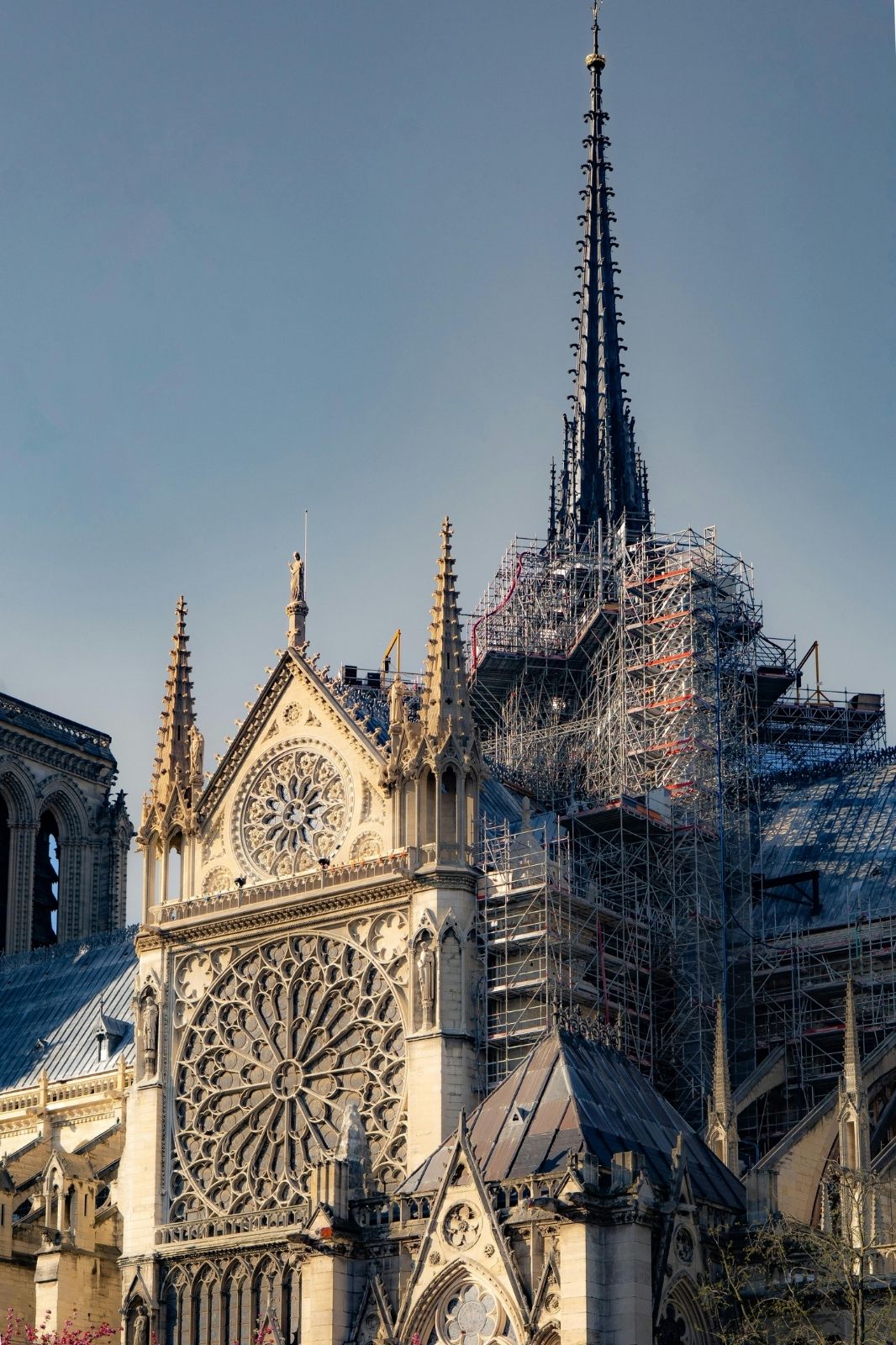
No. While the cathedral reopened to the public on December 7, 2024, the restoration of Notre Dame is not fully complete. Several major elements remain in progress as of early 2026.
The apse and sacristy restoration continued through 2025. New stained glass windows, designed by a contemporary French artist selected from over 100 submissions, are scheduled for installation in 2026. Eight finalists, including Daniel Buren (known for his striped columns at the Palais Royal), competed for the commission. The existing 19th-century windows will be moved to a museum. France’s National Commission for Heritage and Architecture has expressed opposition to replacing the historic windows, and the debate continues.
The cathedral towers reopened to visitors in September 2025 during Heritage Days weekend. The 16 copper apostle statues returned to the spire by July 2025 after individual restoration in workshops. A Sennheiser sound system was finalized in February 2026. The forecourt redesign under Bas Smets, which will create a new public space around the cathedral, is the last major piece, with completion expected in 2027.
The Grand Organ, the largest in France with 8,000 pipes and 115 stops, survived the fire but required extensive cleaning to remove lead dust that settled through the instrument. Its restoration and tuning were completed in time for the reopening, and regular organ performances now take place every Sunday afternoon.
How Traditional Craftsmanship Drove the Reconstruction

The restoration of the Notre Dame cathedral was, at its core, a project of hands and hand tools. Rather than appointing a single large contractor, the project distributed work across more than 250 specialized businesses, many with fewer than 20 employees, scattered across France and neighboring countries. This decentralized model, according to the chief architect and construction manager, shortened the timeline by years compared to a conventional approach.
The roof reconstruction offers the clearest example. Carpenters at Ateliers Desmonts in Normandy rebuilt the entire roof framework using medieval techniques. Vermont-based carpenter Will Gusakov, whose firm specializes in traditional timber framing, joined the effort for the first half of 2023. His team and roughly 20 others used hand-forged axes to shape beams, replicating the marks and joinery methods visible in surviving medieval examples. The completed framework was stress-tested in the workshop, disassembled, shipped to Paris, and reassembled on site.
Stone restoration followed a similar logic of material fidelity. Collapsed vaults were rebuilt using original methods: wooden struts supported newly cut stones, precisely replicating the original voussoir shapes. Damaged coped walls and tracery were repaired or replaced with stones cut from the same geological formations used by 12th-century builders. A desalinization process removed fire-deposited salts from existing masonry, using techniques borrowed from paintings conservation.
🏗️ Real-World Example
York Minster (York, UK, 1984): When fire destroyed the south transept roof of York Minster in 1984, the English restoration team faced the same dilemma Notre Dame’s architects encountered 35 years later: rebuild exactly as before, or introduce modern improvements? York’s team chose to rebuild the structure faithfully but added a sophisticated fire suppression system, a decision that directly influenced Notre Dame’s approach of integrating invisible modern fire prevention into a historically accurate reconstruction.
What the Restoration of Notre Dame Reveals About Heritage Preservation

The restoration of Notre Dame produced several lessons that apply to architectural heritage preservation broadly. The first is about documentation. Andrew Tallon’s laser scans were made for academic research, not disaster preparedness. The fact that they proved essential to the reconstruction was, as multiple project leaders acknowledged, largely a matter of luck. For every Notre Dame with a billion-point dataset, thousands of historically significant buildings exist with no accurate digital record at all. The case makes a strong argument for proactive 3D scanning of cultural heritage sites before disaster strikes.
The second lesson concerns the relationship between speed and quality. French President Emmanuel Macron’s five-year deadline was widely dismissed as impossible by conservation experts when announced. The project met it, partly by defining a phased completion strategy and partly by maintaining intense coordination across hundreds of small teams. The result suggests that ambitious timelines, when paired with strong logistics and clear milestones, can produce better outcomes than open-ended schedules that diffuse urgency.
The third lesson is about material authenticity. The decision to rebuild Notre Dame’s roof in oak rather than a modern fire-resistant alternative was controversial. The French Senate ultimately mandated that the cathedral be restored to its pre-fire condition using original materials. This choice prioritized historical continuity over pragmatic efficiency, but it also activated supply chains and craft skills that had been dormant for decades. The project’s demand for hand-hewn oak beams, hand-cut limestone, and traditionally mixed lime mortars revived artisan trades and created training opportunities that will benefit future heritage projects.
💡 Pro Tip
Architects working on heritage projects should consider establishing a pre-disaster digital baseline for their buildings. A single terrestrial laser scan, completed in a few days, can generate the kind of billion-point dataset that proved irreplaceable at Notre Dame. The cost of scanning is trivial compared to the value of having accurate geometric data available if the unexpected happens.
The Before and After: What Changed Inside Notre Dame

Visitors entering Notre Dame after the reopening encounter a space that looks dramatically different from the pre-fire interior, even though the structural form is identical. The reason is simple: centuries of soot from candles, pollution from Parisian air, and accumulated grime had darkened the limestone walls to a deep gray-brown. The fire cleanup and restoration process stripped all of that away, revealing the pale, warm-toned Lutetian limestone underneath.
The original ochre color on the ribbed vaults has been repainted, and the checkered floor tiles have been cleaned and repaired. Paintings and frescoes hidden under layers of grime for generations now show vivid colors. A new lighting system using over 1,000 precisely placed projectors highlights architectural features and creates a warmth that the pre-fire Gothic interior never had in modern memory.
New liturgical furniture designed by Guillaume Bardet, chairs by Ionna Vautrin, and a reliquary for the Holy Crown of Thorns by Sylvain Dubuisson introduce contemporary design elements into the medieval space. Jean-Charles de Castelbajac designed the liturgical vestments for the reopening ceremony. These additions reflect President Macron’s stated goal that the 21st century should “have its place among the many others that feature in the works of this cathedral.”
⚠️ Common Mistake to Avoid
Many people assume that the “dark and mysterious” atmosphere of Gothic cathedrals was intentional. In reality, medieval cathedrals like Notre Dame were designed to be filled with light, and their stone walls were originally pale and often painted in bright colors. The darkness associated with Gothic architecture is a product of centuries of candle soot and urban pollution, not the builders’ intent. The restored Notre Dame actually looks closer to what its 12th-century creators envisioned.
The Global Response and What It Means for Architecture

The scale of public response to the Notre Dame fire surprised even French officials. Donations arrived from individuals and institutions across 150 countries. The speed at which 846 million euros materialized, largely within the first few weeks, demonstrated something about the relationship between people and buildings that numbers alone cannot explain. Architecture professor Lucy Maulsby of Northeastern University noted that Notre Dame’s importance goes far beyond its physical materials: it functions as a marker and symbol of a city and, by extension, a nation.
For the architecture profession, the restoration offered a rare opportunity to study medieval construction techniques at full scale. Analysis of fallen vault stones confirmed they were quarried in the Vexin region and transported by boat along the Seine. A lead sarcophagus from the 14th century was uncovered during excavations beneath the transept crossing in 2022. Archaeological research published in 2023 confirmed that Notre Dame was the first Gothic cathedral to use iron systematically as a binding material between stones, a construction technique previously unknown at this scale.
The structural performance of the building under extreme stress also validated principles that Gothic builders developed 860 years ago. Despite losing its entire roof and spire, the stone vaulting held firm and largely prevented total collapse. The flying buttresses continued to support the weakened structure through months of exposure to wind and rain. For students of architectural history, this was a dramatic real-world test of structural principles first theorized in the 12th century.
The restoration also raised difficult questions about heritage funding in France. Over 1,600 of the 40,000 religious buildings managed by French local authorities are currently closed due to disrepair. Thousands more require urgent work. The 846 million euros directed to a single building, while other structures crumble, has prompted debate about whether the entry to Notre Dame should carry a small fee to help fund broader heritage preservation. The Catholic Church has resisted this, arguing that places of worship must remain free and unconditional. The debate remains unresolved.
✅ Key Takeaways
- The restoration of Notre Dame cost approximately 700 million euros and involved over 2,000 craftspeople across 250 companies, making it the largest heritage reconstruction of the 21st century.
- Andrew Tallon’s pre-fire laser scans, capturing over one billion data points, proved essential to accurate reconstruction and highlight the urgent need for digital documentation of cultural heritage sites worldwide.
- The project blended medieval craftsmanship (hand-hewn oak, quarry-matched limestone, traditional joinery) with modern tools (BIM modeling, robotic debris clearing, thermal fire detection), proving that old and new methods can work together effectively.
- Despite losing its roof and spire, Notre Dame’s Gothic structural system (flying buttresses, ribbed vaults, pointed arches) held firm, demonstrating that 12th-century engineering principles remain sound after 860 years.
- The five-year timeline, initially dismissed as unrealistic, was met through a phased reopening strategy and decentralized project management across hundreds of small specialist firms rather than a single large contractor.
Final Thoughts
The restoration of Notre Dame is not simply a story about rebuilding a damaged building. It is a test case for how societies choose to relate to their architectural past. Every decision made during the reconstruction, from the choice of oak over steel to the integration of contemporary liturgical design, reflected values that extend beyond engineering or budget. The project asked whether material authenticity matters, whether craft skills are worth preserving, and whether a single building can represent something larger than itself.
The answers, embedded in the restored stone and new-growth oak now standing on the Ile de la Cite, suggest that architecture at its best is an act of sustained attention across generations. The 12th-century builders who raised Notre Dame’s walls could not have imagined the fire. The 21st-century workers who rebuilt them could not have imagined the original construction. Yet both groups, separated by 860 years, shared a commitment to getting the geometry right, one stone at a time. That continuity is the real story of the restoration of Notre Dame.
Cost figures referenced in this article are approximate and reflect publicly reported data from Rebatir Notre-Dame de Paris and international media sources. Actual expenditures may vary as Phase 3 restoration work continues through 2027.






A Record El Niño Threatens More Than 10,000 Adobe Heritage Sites on Peru’s Coast
With a possibly record-breaking El Niño under way, Peru's coastal adobe heritage...
 illustrarch Editoral Team2 Mins read
Aspendos Excavation Uncovers 6,000-Year-Old Settlement Traces Near Antalya
Digs beneath Aspendos shop floors turned up Chalcolithic pottery and tools, pushing...
illustrarch Editoral Team2 Mins read
Relocated Maya Structures at Mexico’s Balam Tun Memory Park Face Legal Challenge
INAH archaeologists have filed a complaint against 26 officials over Balam Tun...
illustrarch Editoral Team2 Mins read
Allies and Morrison Win Approval to Restore Barbican Sculpture Court
City of London Corporation approves Allies and Morrison's plan to restore the...
illustrarch Editoral Team2 Mins read


Leave a comment