

Sydney Opera House Architecture: Utzon’s Iconic Design Guide
The Sydney Opera House stands as one of modern architecture's most radical experiments, where sculptural form, structural logic, and landscape converge on Bennelong Point. This guide explores Jørn Utzon's visionary design, the building's innovative interior, iconic glass walls, and its enduring global legacy.
 Sinan Ozen2 February 202611 Mins read409

Table of Contents Show
Few buildings have so completely escaped the gravitational pull of their own time as the Sydney Opera House. Conceived in the optimism of the postwar era yet perpetually contemporary in its cultural relevance, this masterpiece of opera house Sydney architecture occupies a rare position in architectural history: at once an emblem of national identity, a technical experiment pushed to its limits, and a manifesto in built form. Perched on Bennelong Point, where land dissolves into harbor, the Opera House resists simple categorization. It is neither purely modernist nor fully expressionist, neither monument nor object, but something closer to a spatial event, an architecture experienced through movement, reflection, and distance as much as through occupation. The Sydney Opera House architect, Jørn Utzon, did not merely propose a new building type; he suggested a new relationship between architecture, landscape, and public life. More than half a century after its completion, the Opera House continues to provoke debate, admiration, and study, not because it resolved the tensions of modern architecture, but because it embodied them with extraordinary clarity.

Who Made the Sydney Opera House: Jørn Utzon’s Vision
For anyone wondering who made the Sydney Opera House, the answer begins with a 1956 international design competition organized by the New South Wales Government. Danish architect Jørn Utzon submitted one of 233 entries from 32 countries, and his radical proposal was selected by a jury that included the renowned Finnish-American architect Eero Saarinen. Utzon’s submission consisted of little more than preliminary sketches, yet the conceptual power was undeniable. Born in Copenhagen in 1918, Utzon drew deeply from Scandinavian craft traditions, Mayan temple platforms, and Chinese courtyard architecture to develop what he later called Additive Architecture, an approach that compared design growth to the organic patterns of nature. The project formally broke ground on 2 March 1959, initiating what would become a 16-year journey of innovation, conflict, and ultimately, cultural triumph. In 2003, Utzon received the Pritzker Architecture Prize, the highest honor in the field, confirming his legacy as one of the twentieth century’s most visionary architects.
Architecture as Sculpture in the Landscape
Utzon’s most radical contribution was his insistence that the Opera House be understood as a sculptural form inseparable from its site. Rather than treating Bennelong Point as a neutral platform, Utzon amplified its peninsular condition, allowing the building to rise as a man-made extension of the harbor’s geological drama. The famous shell forms, often compared to sails, shells, or sections of a sphere, were never intended as literal metaphors, but as abstract responses to the shifting light, wind, and water of Sydney’s harbor. Their power lies in their ambiguity: solid yet weightless, monumental yet responsive. This approach challenged the prevailing modernist emphasis on rational envelopes and planar clarity, proposing instead that architecture could operate as a civic sculpture, legible from afar and constantly reinterpreted through changing atmospheric conditions. In doing so, Utzon reframed the role of form itself, positioning it not as decoration or expression, but as a primary spatial and cultural agent. This site-responsive philosophy has influenced generations of architects, from Frank Gehry’s Guggenheim Bilbao to contemporary waterfront cultural buildings around the world.

The Geometry of Imagination and Discipline
Behind the apparent freedom of the Opera House’s silhouette lies a rigorous geometric logic that emerged only after years of experimentation. From 1957 to 1963, the design team explored at least twelve iterations, including schemes with parabolas, circular ribs, and ellipsoids, before arriving at the breakthrough solution. Utzon derived all shell forms from a single sphere of 75 meters in diameter, allowing the concrete ribs to be standardized, prefabricated, and structurally coherent. This moment is crucial to understanding the building’s architectural significance: it demonstrates how imagination and discipline can coexist, even under extreme technical constraints. The spherical geometry did not reduce the expressive power of the design; instead, it intensified it by aligning structural necessity with formal clarity. In an era increasingly dominated by computational design, the Opera House stands as a reminder that complexity does not require digital excess, but can emerge from the patient refinement of a single governing idea. Utzon’s process offers a model of design thinking where concept, construction, and material logic are inseparable.
How Was the Sydney Opera House Built? The Three Construction Stages
The Sydney Opera House was built in three stages over 14 years, from 1959 to 1973, by a workforce of around 10,000 construction workers. The NSW Government started work before the design was resolved, partly to secure public and political support, and that decision shaped every stage that followed. The original estimate was AUD 7 million and four years of construction; the final cost was AUD 102 million, which, according to the Sydney Opera House, was largely paid for by a state lottery.
- Stage I, the podium (1959 to 1963): the contractor Civil & Civic built the concrete platform on Bennelong Point. Because the roof had not yet been engineered, the podium columns later proved too weak to carry the shells and had to be rebuilt.
- Stage II, the roof shells (1963 to 1967): M.R. Hornibrook erected the shells using the spherical geometry that Utzon and the engineers of Ove Arup & Partners settled on in the early 1960s. The roof is made of 2,194 precast concrete sections weighing up to 15 tonnes each, cast in an on-site factory and tied together with tensioned steel cables.
- Stage III, glass walls and interiors (1967 to 1973): after Utzon’s departure, Peter Hall, Lionel Todd and David Littlemore completed the glazing, the halls and the fit-out.
The shells were the hardest part of the job. Because every rib in the final scheme is cut from the same sphere, the segments share a common curvature, so moulds could be reused and pieces produced in series. That single decision turned a sculptural competition sketch into something a contractor could actually build, and it is why the roof took shape in four years once the geometry was fixed.
The price of starting early was paid in time, money and authorship. Utzon resigned on 28 February 1966 amid disputes with the new Minister for Public Works, Davis Hughes, over costs and payments, and he never returned to see the finished building. Queen Elizabeth II formally opened the Sydney Opera House on 20 October 1973, ten years later than the original completion date.
Sydney Opera House Interior Design: From Vision to Reality
A New Relationship Between Interior and Exterior
While the Opera House is most often celebrated for its exterior form, the Sydney Opera House interior design reveals an equally ambitious spatial vision. Utzon envisioned the building as a sequence of elevated platforms and transitional spaces, where the act of approaching a performance would become part of the cultural experience. The monumental stairways, expansive foyers, and panoramic glazing were intended to blur the boundary between the civic realm and the performance hall, allowing the city and the harbor to participate in the ritual of arrival. Although Utzon did not oversee the final interior completion, the underlying spatial concept remains legible: architecture as a mediator between art and everyday life. This emphasis on procession and threshold has influenced generations of cultural buildings, reminding architects that performance does not begin at the stage, but in the movement of bodies through space.
The interior of the Sydney Opera House today houses multiple venues, including the 2,679-seat Concert Hall, home to the Sydney Opera House Grand Organ, the largest mechanical tracker action organ in the world with over 10,000 pipes, and the 1,507-seat Joan Sutherland Theatre. Interior surface treatments include off-form concrete, Australian white birch plywood, and brush box glulam, creating warm acoustic environments that contrast with the cool geometry of the exterior shells. In 2004, the Utzon Room was reopened following Utzon’s own redesign, featuring tapestry inspired by his original vision and offering a rare glimpse of what the complete interior might have been under his sole direction.

Does the Sydney Opera House Have Glass? The Iconic Glass Walls
One of the most frequently asked questions about the building is: does the Sydney Opera House have glass? The answer is a resounding yes, and the glass walls represent one of the project’s most remarkable engineering achievements. Over 6,200 square meters of laminated glass, imported from the French company Boussois-Souchon-Neuvesel, enclose the openings between the roof sails and the podium structure. Utzon originally envisioned curtains of glass that appeared suspended from the shell roofs, supported by discrete plywood and brass mullions. After his departure, architect Peter Hall and the Ove Arup engineering team developed the final structural solution, using steel mullion frameworks to balance Utzon’s aesthetic vision with engineering and acoustic requirements. The result was one of the first large-scale examples of glass used as a structural load-bearing material in a building, a pioneering achievement that earned the Engineering Excellence Award in 1972 from the Association of Consulting Engineers of Australia.
The Sydney Opera House Illusion: Perception and Architectural Ambiguity
The Sydney Opera House illusion refers to the remarkable way the building appears to change form depending on the viewer’s position, the time of day, and prevailing weather conditions. From the harbor, the shells seem to billow like sails; from the Royal Botanic Garden, they resemble opening petals; from the air, the interlocking geometry reveals its mathematical precision. This quality of perceptual ambiguity was not accidental: Utzon deliberately crafted forms that would resist a single reading. The 1,056,006 Swedish-made ceramic tiles covering the shells, in alternating glossy white and matte cream arranged in a chevron pattern, further enhance this illusion by reflecting and absorbing light differently throughout the day. This is one of the reasons the building continues to fascinate both architecture professionals and casual observers alike: the Opera House never looks quite the same twice.
Australia Sydney Opera House at Night: A Luminous Landmark
While the building is magnificent under daylight, Australia Sydney Opera House at night transforms into one of the most photographed scenes in the world. The sails are permanently illuminated, their white surfaces glowing against the dark harbor waters and the sparkling city skyline. In recent years, the building has become a canvas for large-scale digital art through programs like Badu Gili, meaning “water light” in the Gadigal language of the traditional owners of Bennelong Point, which projects First Nations artwork onto the eastern sails nightly from sunset, free of charge. The annual Vivid Sydney festival transforms the sails into a spectacular light installation, attracting hundreds of thousands of visitors each year and reinforcing the Opera House’s role as a dynamic cultural platform, not just a static monument. The New Year’s Eve fireworks display, with the Opera House and Harbour Bridge as its centerpiece, is broadcast globally, making the building a universal symbol of celebration and renewal.

Conflict, Authorship, and Architectural Integrity
The turbulent history of the Opera House’s construction is inseparable from its architectural meaning. Utzon’s resignation in 1966, following political pressure from the new NSW Minister for Public Works Davis Hughes and escalating costs, exposed the fragility of architectural authorship within large public projects. Peter Hall took over as design architect, completing the interiors with a team that included Lionel Todd and David Littlemore. The final cost reached approximately AUD $102 million, far exceeding initial estimates, yet the building’s enduring coherence suggests that its conceptual strength was resilient enough to survive institutional conflict. This episode continues to resonate within architectural culture, raising questions about the role of the architect in relation to clients, governments, and public expectation. The Opera House illustrates both the vulnerability and necessity of visionary thinking: without risk, architecture remains cautious; without support, vision becomes compromised. Utzon’s eventual reconciliation with the building, culminating in the UNESCO World Heritage designation in 2007 and his receipt of the Pritzker Prize in 2003, underscores the idea that architecture can be an ongoing dialogue rather than a closed historical artifact.
Sydney Opera House Fire Safety and Preservation
Searches for “Sydney Opera House fire” have spiked periodically, most notably due to an AI-generated hoax video in 2025 that showed the building engulfed in flames, a clip confirmed as entirely fabricated by AAP FactCheck. In reality, the Sydney Opera House has never experienced a significant fire. However, fire safety is a critical aspect of the building’s ongoing conservation program. The Sydney Opera House Trust, in partnership with Arup fire engineers, has implemented sophisticated smoke curtain systems, updated compartmentation designs, and advanced evacuation modeling using pedestrian simulation software. As part of a comprehensive Decade of Renewal initiated in 2013, significant upgrades improved both accessibility and safety without compromising the building’s heritage design integrity.

Lego Architecture Sydney Opera House: Cultural Icon in Miniature
The Opera House’s cultural reach extends well beyond the world of professional architecture. The Lego Architecture Sydney Opera House sets, including the original Architecture series model (21012) designed by American architect Adam Reed Tucker and the larger Creator Expert set (10234) featuring over 2,989 pieces, demonstrate the building’s status as a universally recognized design icon. The Lego Architecture Sydney skyline set (21032) also features a miniature Opera House alongside the Harbour Bridge and Sydney Tower. These models employ advanced building techniques to recreate the complex shell geometry, angled walls, and subtle detailing of the original, making them popular among both architecture enthusiasts and collectors. The existence of these sets reflects a broader cultural phenomenon: the Opera House has transcended its function as a performing arts venue to become a symbol of architectural ambition itself, a design object that inspires creativity at every scale.
Global Legacy and Contemporary Relevance
Today, the Sydney Opera House functions as more than a performance venue; it operates as a global reference point for architectural ambition. Its influence can be traced in the renewed interest in expressive public buildings, in the resurgence of site-responsive monumental forms, and in the growing recognition of architecture’s cultural symbolism. In a time when sustainability, adaptability, and social value dominate architectural discourse, the Opera House remains relevant not because it offers direct solutions, but because it exemplifies the courage to imagine architecture as a cultural proposition. Its continued use, careful conservation, and evolving programming demonstrate how iconic buildings can adapt without losing their conceptual integrity. The building hosts over 1,500 performances annually, welcomes more than 10 million visitors each year to the precinct, and continues to evolve its programming to reflect contemporary Australian culture and identity.

Conclusion
The Sydney Opera House endures not as a frozen masterpiece, but as a living argument for architecture’s capacity to shape cultural identity. Jørn Utzon’s sculptural vision challenged the limitations of modern architecture by insisting that form, structure, and landscape could be synthesized into a single, resonant idea. For architects and students today, the building offers more than aesthetic inspiration; it provides a lesson in perseverance, conceptual clarity, and the ethical weight of design decisions. As architectural practice navigates increasing technical complexity and social responsibility, the Opera House stands as a reminder that the most meaningful architecture is not merely efficient or iconic, but deeply imagined, capable of transforming how a society sees itself and its place in the world.


1 Comment

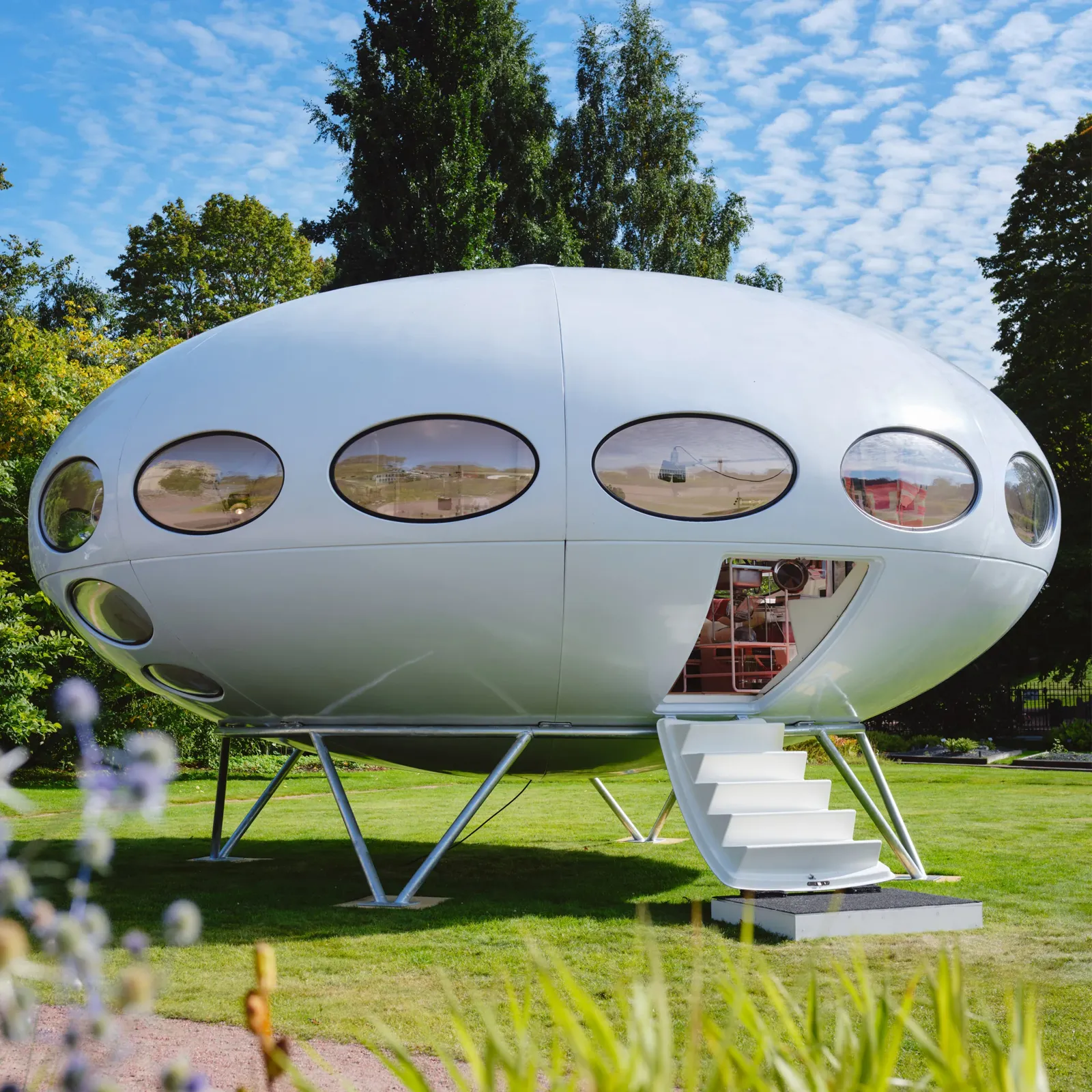
Futuro House Production Revived in Finland After Decades-Long Hiatus
A Facebook listing for abandoned moulds led to the first new Futuro...
 illustrarch Editoral Team3 Mins read
Building Your Dream Home in NSW: What You Should Know About Montgomery Homes
Montgomery Homes has been building across Sydney, Newcastle, the Hunter, Wollongong and...
illustrarch Editoral Team4 Mins read
Designing a Home Theater: Where Drapery Fits Into the Plan
In a media room the curtains are a performance layer, not decoration....
illustrarch Editoral Team3 Mins read
Oscar Niemeyer’s Cathedral of Brasília: The Hyperboloid Concrete Hymn
The Cathedral of Brasília reads as a single gesture, yet it stood...
 Furkan Sen7 Mins read


The Sydney Opera House seems interesting. I like how it connects with the landscape and its history. It’s good to know that it has a deeper meaning beyond just being a building.