

Machu Picchu Architecture: 8 Inca Design Secrets Explained
Machu Picchu's architecture is far more than a visual wonder. Built around 1450 by Emperor Pachacuti, the Inca citadel fuses dry-stone masonry, terraced engineering, and celestial alignment into one coherent design. This article breaks down the key structural features and the logic behind every stone.
 Furkan Sen18 April 202611 Mins read0

Table of Contents Show
Machu Picchu is a 15th-century Inca citadel perched at 2,430 meters above sea level in the Peruvian Andes. Built under Emperor Pachacuti around 1450, the site combines dry-stone masonry, terraced engineering, and astronomical alignment into a single unified design. Its architecture has survived more than 600 years of earthquakes, rain, and tropical conditions without a drop of mortar.
Where Is Machu Picchu and Why Was It Built There?
Machu Picchu sits on a saddle-like mountain ridge between two dramatic peaks in Peru’s Cusco region, roughly 80 kilometers northwest of the city of Cusco. The Urubamba River wraps around three sides of the mountain far below, creating a natural moat. The location sits at the meeting point between the Peruvian Andes and the upper Amazon basin, giving it an unusually tropical microclimate for its altitude.
The Incas did not choose this site at random. In Andean cosmology, mountains were sacred beings called apus. Building at such an altitude, between prominent peaks and above a sacred river, placed the citadel in direct dialogue with the forces the Incas considered divine. Practical advantages reinforced the spiritual ones: the ridge provided natural defense, the spring-fed water table offered a reliable water source, and the surrounding geology gave ready access to high-quality granite for construction.
Scholars widely believe Machu Picchu served as a royal estate and ceremonial sanctuary for Pachacuti rather than a conventional urban settlement. The uniform architectural quality across the site, which led researchers to conclude a single patron commissioned it in one coordinated campaign, supports this reading. At its peak, the residential sector likely housed between 300 and 1,000 elite members, priests, and support staff.
📌 Did You Know?
Machu Picchu was built directly above two intersecting geological fault lines. The Incas used the exposed granite created by these faults as an on-site quarry, meaning most of the building stone never had to be transported at all. This geological opportunism reduced labor enormously and kept the material language of the site visually continuous with the bedrock beneath it.
What Is the Architecture Style of Machu Picchu?

The architecture of Machu Picchu belongs to the Inca imperial style, sometimes called Cusco-style masonry, which reached its highest refinement during the 15th-century reign of Pachacuti. Its defining principle, shared across all Inca sites but executed with exceptional precision at Machu Picchu, is the integration of human construction with existing topography rather than imposing a rigid geometric plan over it.
Rather than flattening the mountain, the Inca planners read its contours and designed around them. Rock outcroppings were carved and incorporated into walls and altars rather than removed. Slopes were stabilized rather than filled. Sightlines were framed by building placement so that key structures align with surrounding peaks, the rising sun, or the river below. The result is a city that appears to grow organically from the granite on which it stands.
UNESCO, which designated the Historic Sanctuary of Machu Picchu a World Heritage Site in 1983, describes the site’s architecture as a masterpiece that “blends exceptionally well with the stunning natural environment, with which it is intricately linked.” That assessment points directly at what makes Machu Picchu distinct from other ancient monumental sites: it is not architecture placed in a landscape, but architecture that is inseparable from one.
For context on how this approach fits within the longer history of building traditions, the illustrarch history of architecture timeline traces how different civilizations from Egypt to Rome have engaged with the relationship between structure and site. Inca architecture stands apart by refusing to separate the two.
Machu Picchu Architectural Features: The Core Building Blocks

Understanding what the site looks like today requires knowing the specific technical features that define Inca construction. These are not decorative choices. Each element solves a problem posed by the altitude, the seismicity of the Andes, or the steep terrain.
Ashlar Masonry: Stones Without Mortar
The most discussed feature of Machu Picchu’s construction is its mortar-free stonework. The Incas used two related techniques. Ashlar masonry, used in the highest-status structures like the Temple of the Sun, involved cutting rectangular stone blocks to precise dimensions so they would bear load evenly across their full surface. Polygonal masonry, used in retaining walls and other large-scale applications, involved fitting irregularly shaped stones together in jigsaw-like patterns.
In both cases, the stones interlock without cement or mortar. The primary building material is andesite, a dense volcanic rock quarried from nearby mountains, chosen for its strength and resistance to seismic stress. Bronze tools, harder stones used as abrasives, and repeated fitting and adjustment created tolerances that modern surveyors have described as measured in fractions of millimeters. Some stones weigh more than 50 tons.
🎓 Expert Insight
“What the Incas did that was really smart is, rather than trying to make an architecture that alone is going to be impressive, they instead made an architecture that was in dialogue with the vast impressive landscape.” — Stella Nair, Architectural Historian, University of California, Los Angeles
Nair’s observation cuts to the heart of what distinguishes Inca design from contemporary European monumental architecture. Where Spanish colonial builders who arrived later constructed massive cathedrals to dominate the Andean landscape, Inca architects chose to amplify it instead, using human-scale precision to frame rather than compete with the surrounding mountains.
Trapezoidal Openings and Inward-Leaning Walls
Nearly every door, window, and niche at Machu Picchu is trapezoidal rather than rectangular: wider at the base, narrower at the top. This shape was not an aesthetic preference. A trapezoidal opening distributes lateral forces during seismic events more effectively than a right-angle frame, which concentrates stress at the corners. Similarly, Inca walls are slightly inclined inward and are wider at the base than at the top, lowering the center of gravity and improving stability against horizontal shaking.
This combination of trapezoidal geometry and inclined walls is why Machu Picchu’s structures survived the major 1650 earthquake that collapsed many Spanish colonial buildings in nearby Cusco, which were built with mortar, right-angle geometry, and vertical walls. The Inca buildings, designed to flex rather than resist, remained standing.
Terraces: Agriculture, Drainage, and Stability in One System
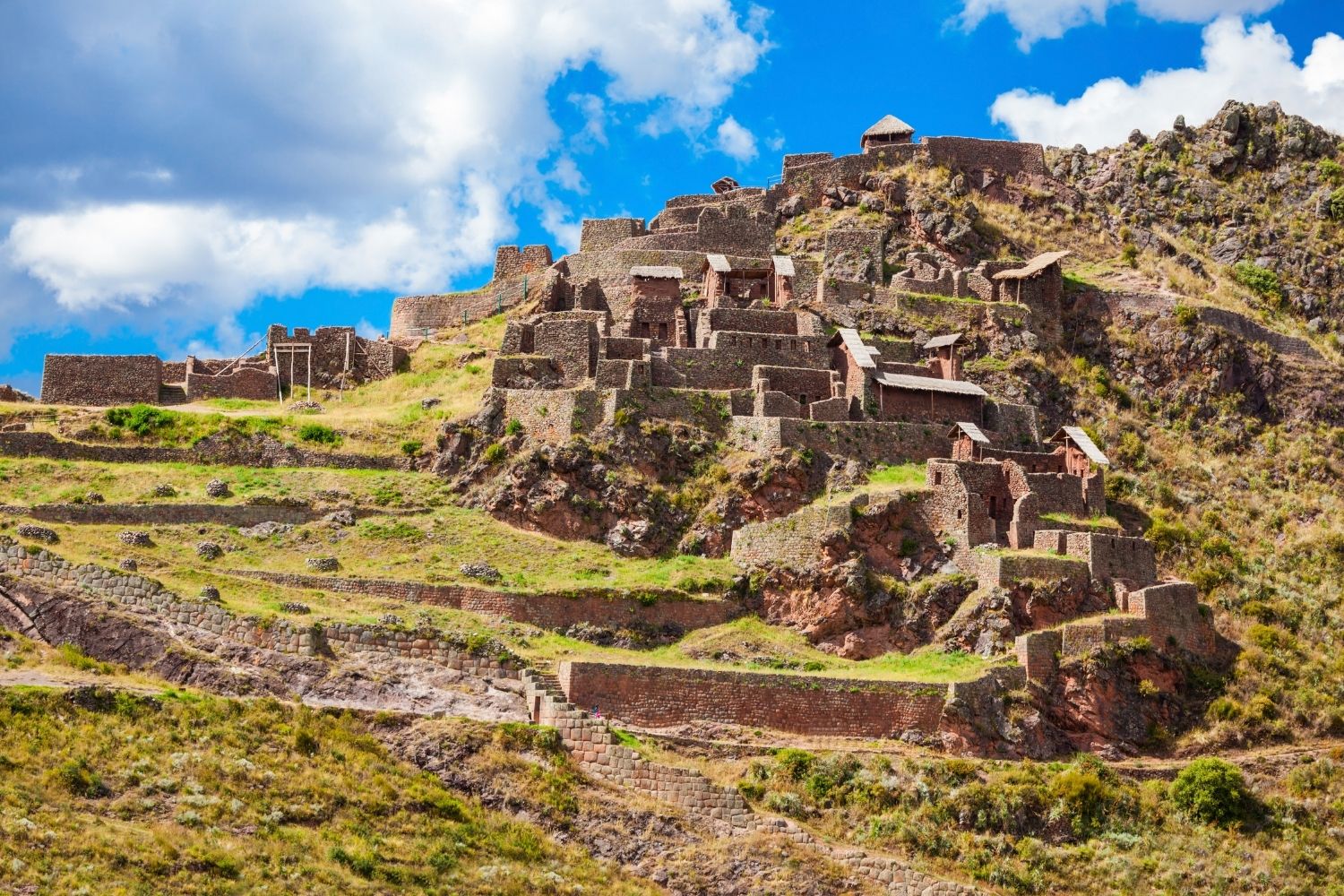
The agricultural terraces, known as andenes, make up the majority of Machu Picchu’s visible structure by area. The site contains roughly 200 terraces covering steep slopes that would otherwise be unusable for cultivation. But they served three simultaneous functions that went well beyond farming.
Each terrace acts as a retaining wall that prevents soil erosion on the slope below it. Inside the terrace fill, the Incas layered gravel, sand, and topsoil in a sequence that functions as a passive drainage filter: rainwater percolates through the layers and exits through drainage holes rather than building up pressure against the stone face. Studies of Machu Picchu’s infrastructure have documented approximately 130 drainage holes in city walls and structures, evidence of how thoroughly the Incas engineered water movement through the site.
💡 Pro Tip
When analyzing Machu Picchu’s terraces as a precedent for contemporary hillside projects, focus on the drainage layer sequencing rather than the stone facing. The gravel-sand-topsoil filter system the Incas used is functionally identical to modern french drain principles. It is the detail that kept these structures intact after 600 years of Andean rainfall, and it scales directly to contemporary retaining wall and green roof applications.
Water Management and the Fountain System
Machu Picchu’s water supply came from a spring on the slopes of the adjacent Machu Picchu mountain, fed by geological fissures. The Incas channeled this water through a stone canal over 750 meters long to the city’s main fountain system, known as the Stairway of Fountains, which cascades through 16 interconnected stone basins from the highest point of the urban sector downward.
The hydraulic engineering behind this system is precise. The gradient of the main canal was calibrated to maintain a steady flow without erosion, and the basins are designed so overflow from one feeds the next. The system carried fresh water to temples, elite residences, and communal areas in a planned sequence that reflected social hierarchy as much as hydraulic logic. It has continued functioning, without major modification, for more than five centuries.
Machu Picchu Elevation and Its Impact on Design

The Machu Picchu elevation of 2,430 meters above sea level shaped every aspect of the site’s design. At that altitude, temperature swings between day and night are pronounced, and rainfall during the wet season is intense, reaching approximately 1,800 millimeters annually. Frost can occur at night even in warmer months. Any building system that could not handle these conditions would have failed quickly.
The Incas responded on multiple fronts. Roofs were constructed from wooden beams covered with ichu grass, a high-altitude plant that grows nearby, layered thickly enough to insulate interiors against cold nights and shed heavy rain efficiently. The steep 60-degree roof pitch shed water quickly before it could saturate the thatch. Walls of andesite stone, dense and slow to change temperature, provided thermal mass that moderated interior temperatures passively.
The choice of site itself was also climatically strategic. The ridge location catches prevailing winds that reduce humidity, while the lower elevation compared to Cusco’s 3,400 meters gives Machu Picchu a more temperate microclimate overall. The surrounding cloud forest maintains high ambient moisture without the cold aridity of the high Andean plateau. These environmental conditions made the site suitable for the diverse crops cultivated on the terraces, including varieties of maize that could not grow at Cusco’s altitude.
📐 Technical Note
Inca walls at Machu Picchu typically lean inward at a gradient of approximately 3 to 5 degrees from vertical. Foundation stones extend between 0.6 and 1.8 meters below grade and are anchored directly to bedrock where possible. The fill inside terraced platforms consists of three distinct layers: large broken stones at the base for drainage, a layer of gravel and coarse sand as a filter medium, and topsoil above. This layering is functionally equivalent to a Type B retaining wall drainage system as described in modern geotechnical engineering standards.
Astronomical Alignment in Inca Architecture

Several of Machu Picchu’s most important structures are oriented to align with astronomical events, reflecting the Inca integration of cosmology into built form. The most well-known is the Intihuatana, a carved granite stone whose name translates roughly as “hitching post of the sun.” It is positioned so that during the spring and autumn equinoxes, the sun stands almost directly above the stone, casting no shadow at solar noon. On the winter solstice, the stone casts its shadow at a specific angle that marked the beginning of the Inca ceremonial calendar.
The Temple of the Sun, built over a natural rock outcropping with a rounded outer wall unique in the site, has two trapezoidal windows precisely positioned to admit sunrise light at the summer solstice through one window and at the winter solstice through the other. The interior stone that receives this light was likely the site of offerings and ceremonies marking the solar year.
This astronomical integration was not decoration but an architectural system that embedded the calendar into the structure of the city. The site itself became the instrument for tracking time, seasons, and the agricultural cycles on which the population depended. For readers interested in how religious and cosmological principles have driven architectural form across cultures, the illustrarch guide to ancient architectural styles covers comparable examples from Egypt, Mesopotamia, and classical Greece.
Urban Planning: How the City Was Organized
Machu Picchu is divided into two primary zones separated by a central open plaza. The upper sector, closer to the prominent peaks, contains the main religious and ceremonial buildings, including the Sacred Plaza, the Temple of the Sun, the Room of the Three Windows, and the Intihuatana. The lower sector contains residential buildings, workshops, and storage structures. Agricultural terraces occupy the outer slopes on all sides.
The basic unit of Inca urban planning is the kancha, a rectangular enclosure housing three or more rectangular buildings arranged symmetrically around a central courtyard. This module scales from modest residential compounds to elite palace groups, giving the city a legible organizational logic even to a first-time visitor. Streets and stairways cut through the terraces to connect different levels, and the path system is designed to channel movement through ceremonial spaces on the way between utilitarian ones.
Building quality varied deliberately by social function. Elite residences and temples used the finest ashlar stonework with the tightest tolerances. Residential buildings for common workers used cruder polygonal masonry. Storage structures, which needed to manage temperature and ventilation more than aesthetic finish, were built with walls that include small vents and are sited on exposed ridges where airflow is strongest. The material language of each building signals its place in the social hierarchy.
🏗️ Real-World Example
Temple of the Sun, Machu Picchu (c. 1450): The only curved structure at the site, the Temple of the Sun is built directly over a large granite boulder that forms part of its floor. Its curved wall follows the natural contour of the underlying rock rather than imposing a predetermined geometry onto it. The two precisely aligned windows admit sunlight on the solstices with an accuracy that modern archaeoastronomers have confirmed requires less than one degree of orientation error. This structure demonstrates the Inca principle of reading the landscape before determining form, at the scale of a single sacred building.
Why Machu Picchu’s Architecture Still Matters
For contemporary architects and designers, Machu Picchu is not primarily interesting as a ruin. It is interesting as a working precedent for site-integrated design, passive environmental performance, and structural systems that prioritize resilience over rigidity.
The terracing logic the Incas developed, read the slope, stabilize with retaining layers, manage water through the fill rather than around it, is directly applicable to hillside development and green infrastructure today. The principle of mortar-free construction, which allows individual stones to shift and resettle during seismic events rather than cracking at rigid joints, has influenced discussions of earthquake-resistant design in Peru and beyond. And the deliberate orientation of spaces to celestial events, which the Incas used to embed the calendar into the built environment, maps directly onto contemporary passive solar design strategies.
The site also offers a counterpoint to the dominant narrative of architecture as an act of imposing human will on a neutral landscape. At Machu Picchu, the landscape was never neutral, and the architecture was never separate from it. The site’s endurance, through earthquakes, invasions, and centuries of abandonment, suggests that this approach produced something more durable than the purely formal alternatives that replaced it. For more on how ancient building knowledge is being reinterpreted by contemporary designers, the illustrarch article on how historic structures inspire today’s architects covers this territory in depth. The rise of contemporary vernacular architecture also traces how place-specific building traditions are being recovered as a response to the uniformity of global modernism.
Machu Picchu sits at the extreme end of what vernacular and site-responsive architecture can achieve, a place where the builders had no option but to work with what the mountain gave them, and turned that constraint into one of the most celebrated architectural achievements in human history. For a broader look at how this principle plays out across cultures and time periods, see the illustrarch comparison of vernacular and international style architecture and the top 10 examples of contemporary vernacular architecture.
⚠️ Common Mistake to Avoid
A common misconception is that Machu Picchu was a “lost city” hidden from all knowledge until Hiram Bingham’s 1911 expedition. In reality, local Quechua-speaking communities had always known the site. Bingham’s contribution was introducing it to Western academic and popular attention, and his expedition was guided by local farmers who led him directly to it. Describing it as “discovered” in 1911 erases the continuous local knowledge of the site that persisted through the colonial period and beyond.
💡 Pro Tip
Architects studying Machu Picchu as a design precedent should pay particular attention to how the Inca planners handled transitions between different grades. Rather than using retaining walls as purely structural elements, they designed each terrace edge as a spatial threshold with a functional identity, agricultural, ceremonial, or residential. This approach to grade change as programmatic organization rather than pure civil engineering is directly applicable to contemporary hillside housing, campus design, and public terracing projects.
✅ Key Takeaways
- Machu Picchu was built around 1450 during the reign of Emperor Pachacuti at 2,430 meters above sea level in the Peruvian Andes, functioning as a royal estate and ceremonial sanctuary rather than a conventional city.
- Its defining architectural technique, mortar-free ashlar masonry using precisely fitted andesite blocks, produces walls that flex during earthquakes rather than cracking, which is why many structures have survived 600 years of seismic activity.
- Trapezoidal doorways and windows, inward-leaning walls, and a three-layer terrace drainage system solve structural and environmental challenges specific to high-altitude mountain construction.
- Key structures including the Intihuatana and the Temple of the Sun align with solstices and equinoxes, embedding astronomical observation directly into the architecture of the site.
- The Inca design principle of reading and working with landscape topography rather than overriding it produced a site that feels continuous with its mountain setting, an approach with direct relevance to contemporary site-responsive and vernacular design practice.
Further Reading and Key References
For official documentation of the site’s heritage values, the UNESCO World Heritage listing for the Historic Sanctuary of Machu Picchu provides the authoritative statement on why the site meets the criteria for Outstanding Universal Value. The Wikipedia overview of Inca architecture covers the broader building tradition from which Machu Picchu emerged, including its roots in the Tiwanaku legacy. For a focused examination of the structural engineering behind the stonework, the History.com analysis of Machu Picchu’s construction includes commentary from civil engineers and architectural historians actively researching the site. For the broader context of how site-integrated architecture connects to nature and sustainability, the illustrarch article on symbiotic design draws out those parallels in contemporary practice.




Queen Victoria Building: A Complete Guide to Sydney’s Romanesque Revival Masterpiece
Built between 1893 and 1898, the Queen Victoria Building occupies an entire...
 Sinan Ozen10 Mins read

The Pantheon Rome: History, Dome, and Ancient Concrete Engineering Explained
The Pantheon in Rome stands as one of the best-preserved buildings of...
Furkan Sen9 Mins read

The Restoration of Notre Dame: Architecture, Memory, and Responsibility
The restoration of Notre Dame cathedral is the largest heritage reconstruction project...
 Elif Ayse Sen12 Mins read

Notre Dame Cathedral: Architecture, Memory, and Collective Identity
Notre Dame Cathedral is one of the most studied examples of Gothic...
Elif Ayse Sen11 Mins read


Leave a comment