

What Is Deconstructivism in Architecture? Principles, Timeline and Iconic Buildings
Deconstructivism in architecture emerged in the 1980s as a deliberate challenge to structural harmony and visual order. This guide covers its philosophical roots in Derrida's thought, the 1988 MoMA exhibition that launched it internationally, core principles like fragmentation and non-linear geometry, and the landmark buildings that define the movement from Bilbao to Berlin.
 Furkan Sen4 June 202616 Mins read205
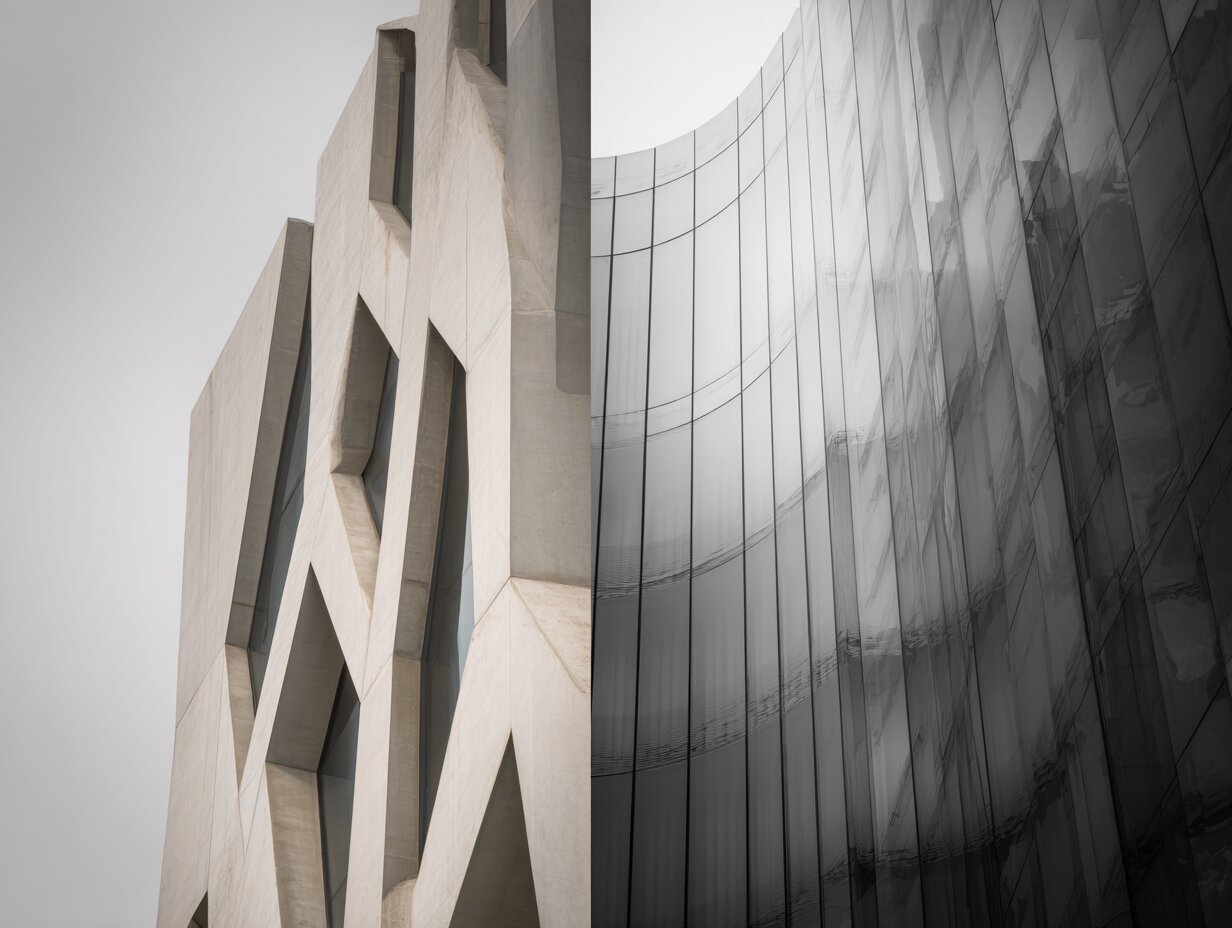
Table of Contents Show
Deconstructivism in architecture is a late 20th-century movement defined by fragmented forms, non-linear geometries, and a deliberate rejection of visual harmony. Rooted in the philosophy of Jacques Derrida and brought to international attention by the 1988 MoMA exhibition in New York, it challenged every assumption about what buildings should look like and how they should behave structurally.
If you have ever stood in front of a building that seemed to twist, lean, or collapse into itself on purpose, you were likely looking at a work of deconstructivist architecture. The movement emerged during the 1980s as a direct challenge to both the clean rationalism of modernism and the playful historicism of postmodern architecture. Where modernism sought universal order and postmodernism borrowed from history with irony, deconstructivism asked a different question: what happens when you treat instability, tension, and fragmentation as legitimate design principles rather than problems to solve?
The answer, as buildings from Bilbao to Berlin have shown, is architecture that provokes strong reactions. Some people find deconstructivist buildings disorienting. Others find them thrilling. Very few find them forgettable. This guide breaks down the meaning of deconstructivism in architecture, traces its origins, identifies its core principles, and examines the buildings and architects that shaped the movement from an academic provocation into a global force.
The Philosophical Roots: Jacques Derrida and Deconstruction
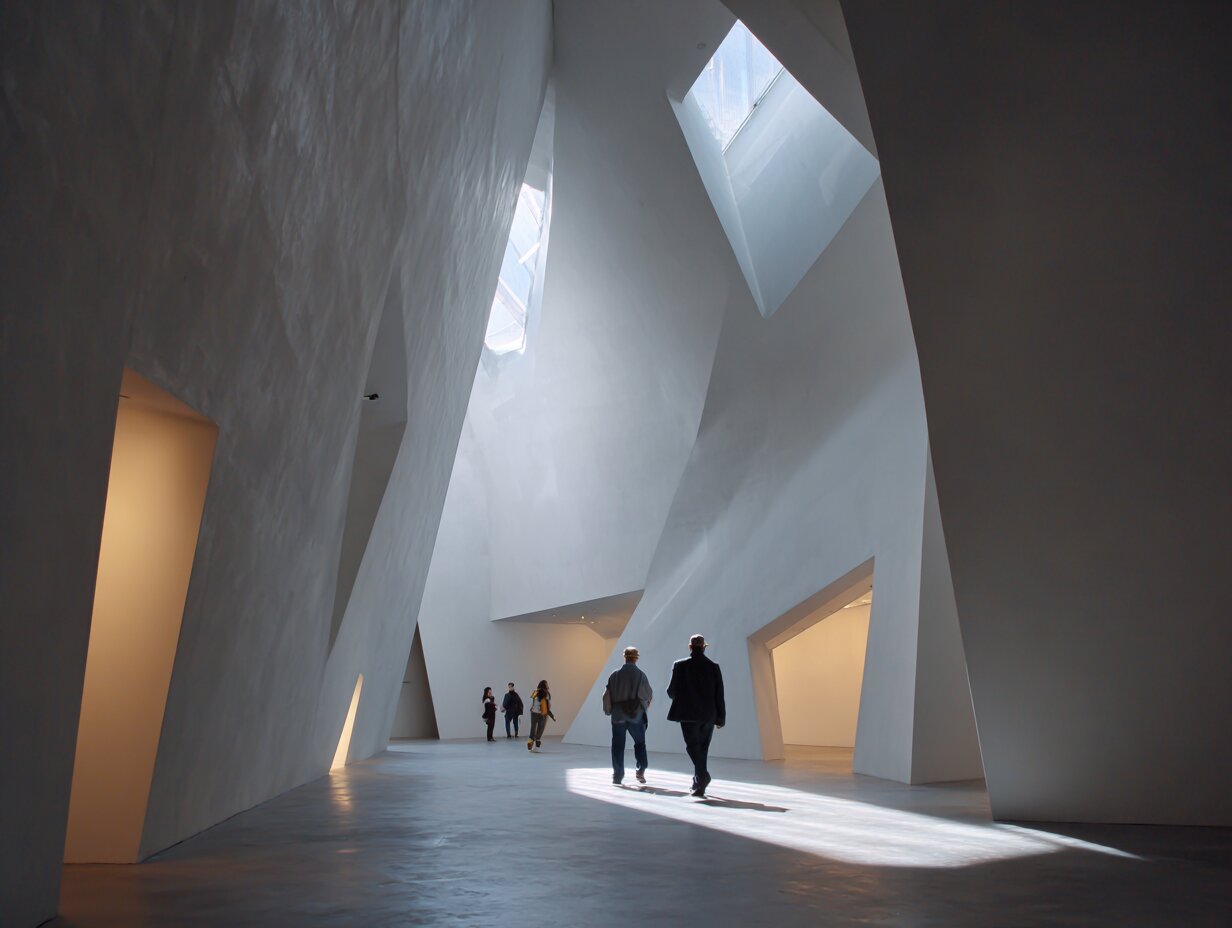
Understanding what is deconstructivism in architecture requires a brief look at its intellectual source. The movement takes its name from “deconstruction,” a method of critical analysis developed by the French philosopher Jacques Derrida in the 1960s and 1970s. Derrida argued that texts, systems, and structures always contain internal contradictions and hidden assumptions. Rather than ignoring those contradictions, deconstruction brings them to the surface and examines them.
Architects translated this philosophical stance into physical form. If traditional architecture assumes that a building should express stability, order, and unity, then a deconstructivist building questions those assumptions by making instability, disorder, and fragmentation visible. The walls tilt. The floors slope. Volumes collide rather than align. None of this is accidental; it is a calculated refusal to treat conventional architectural logic as neutral or inevitable.
⚠️ Common Mistake to Avoid Deconstructivism is regularly confused with Russian Constructivism, which it borrowed from formally while rejecting its politics. Our comparison of constructivism and deconstructivism sets the two side by side.
Many people confuse deconstructivism with buildings that simply look unusual or angular. A building is not deconstructivist just because it has an irregular shape. The deconstructivism definition in architecture specifically refers to a philosophically grounded challenge to the idea that architecture must express order, stability, and resolved form. Buildings that are merely asymmetrical without this conceptual foundation belong to other categories entirely.
Derrida himself was initially skeptical about applying his ideas to architecture. He eventually collaborated with architect Peter Eisenman on a garden design for Parc de la Villette in Paris during the late 1980s, an experience that proved both productive and contentious. Derrida later acknowledged that architecture offered a unique testing ground for deconstruction because buildings, unlike texts, have to physically stand up. The tension between philosophical destabilization and structural necessity became one of the movement’s defining characteristics.
The 1988 MoMA Exhibition: Deconstructivism Goes Public
The moment deconstructivism in architecture entered the mainstream was the summer of 1988, when the Museum of Modern Art in New York hosted an exhibition titled “Deconstructivist Architecture.” Organized by architect Philip Johnson and theorist Mark Wigley, the show presented work by seven architects: Frank Gehry, Daniel Libeskind, Rem Koolhaas, Peter Eisenman, Zaha Hadid, Coop Himmelb(l)au, and Bernard Tschumi.
The exhibition catalogue made the movement’s position clear. Wigley wrote that deconstructivist architecture “does not dismantle buildings” but rather “locates the inherent dilemmas within buildings.” The show drew connections between these seven very different practices by identifying shared concerns: fragmented geometries, the disruption of conventional expectations about walls, floors, and ceilings, and a willingness to make buildings look unstable even while remaining structurally sound.
📌 Did You Know?
The 1988 MoMA exhibition deliberately echoed an earlier, equally influential show: the 1932 “International Style” exhibition at the same museum, also organized by Philip Johnson. Johnson intended the 1988 show to mark a similarly decisive shift in architectural thinking. Most of the seven featured architects, however, rejected the “deconstructivist” label and denied being part of any unified movement.
Johnson’s involvement was significant. As the co-curator of the 1932 exhibition that had helped define modernism for American audiences, he was deliberately positioning deconstructivism as the next chapter. Whether the architects themselves agreed with that framing is another matter. Gehry, Hadid, and Libeskind all distanced themselves from the label at various points, arguing that their work was driven by individual concerns rather than a shared manifesto. Still, the exhibition gave the movement a name, a public platform, and a set of reference points that architecture critics and students have used ever since.
Constructivism and Deconstructivism in Architecture: What Connects Them?

The relationship between constructivism and deconstructivism in architecture is more than a linguistic coincidence. Russian Constructivism, the early 20th-century avant-garde movement, used diagonal lines, asymmetric compositions, and dynamic forms to express revolutionary social ideals. Architects like Vladimir Tatlin and El Lissitzky designed structures that looked as though they were in motion, frozen mid-explosion.
Deconstructivism borrowed some of this visual vocabulary. Wigley, in the MoMA catalogue, explicitly acknowledged the connection, noting that deconstructivist architects drew on Constructivist formal strategies while stripping away the original political program. Where Constructivists used fragmentation to symbolize a new social order, deconstructivists used it to question the possibility of any stable order at all.
The distinction matters. Constructivism was utopian; it believed architecture could help build a better society. Deconstructivism is skeptical; it questions whether architecture’s claims to order and stability are honest. Both movements produced buildings that look dynamic and unstable, but the reasons behind those forms are fundamentally different. For a deeper comparison, see our full article on constructivism vs deconstructivism in architecture.
Core Principles of Deconstructivism in Architecture
While the architects associated with this movement resist neat categorization, several principles of deconstructivism in architecture appear consistently across their work. These are not rules in the traditional sense; they are tendencies, recurring strategies that give deconstructivist buildings their distinctive character.
Fragmentation and Dislocation
Deconstructivist buildings break apart conventional building elements. Walls do not meet floors at expected angles. Volumes collide, overlap, or appear to slide past each other. The effect is a building that looks as though it has been taken apart and reassembled with deliberate misalignments. Daniel Libeskind’s Jewish Museum in Berlin is a clear example: its zigzagging plan, slashed window openings, and “voids” that cut vertically through the structure create a sense of spatial rupture that directly reflects its subject matter.
Non-Linear Geometry
Straight lines and right angles are not eliminated but they are no longer the default. Deconstructivist architects favor acute angles, curved planes, and geometries that resist easy reading. Frank Gehry’s Guggenheim Museum Bilbao, with its flowing titanium surfaces, and Zaha Hadid’s fluid forms both demonstrate how non-linear geometry can produce buildings that seem to move even while standing still.
Controlled Instability
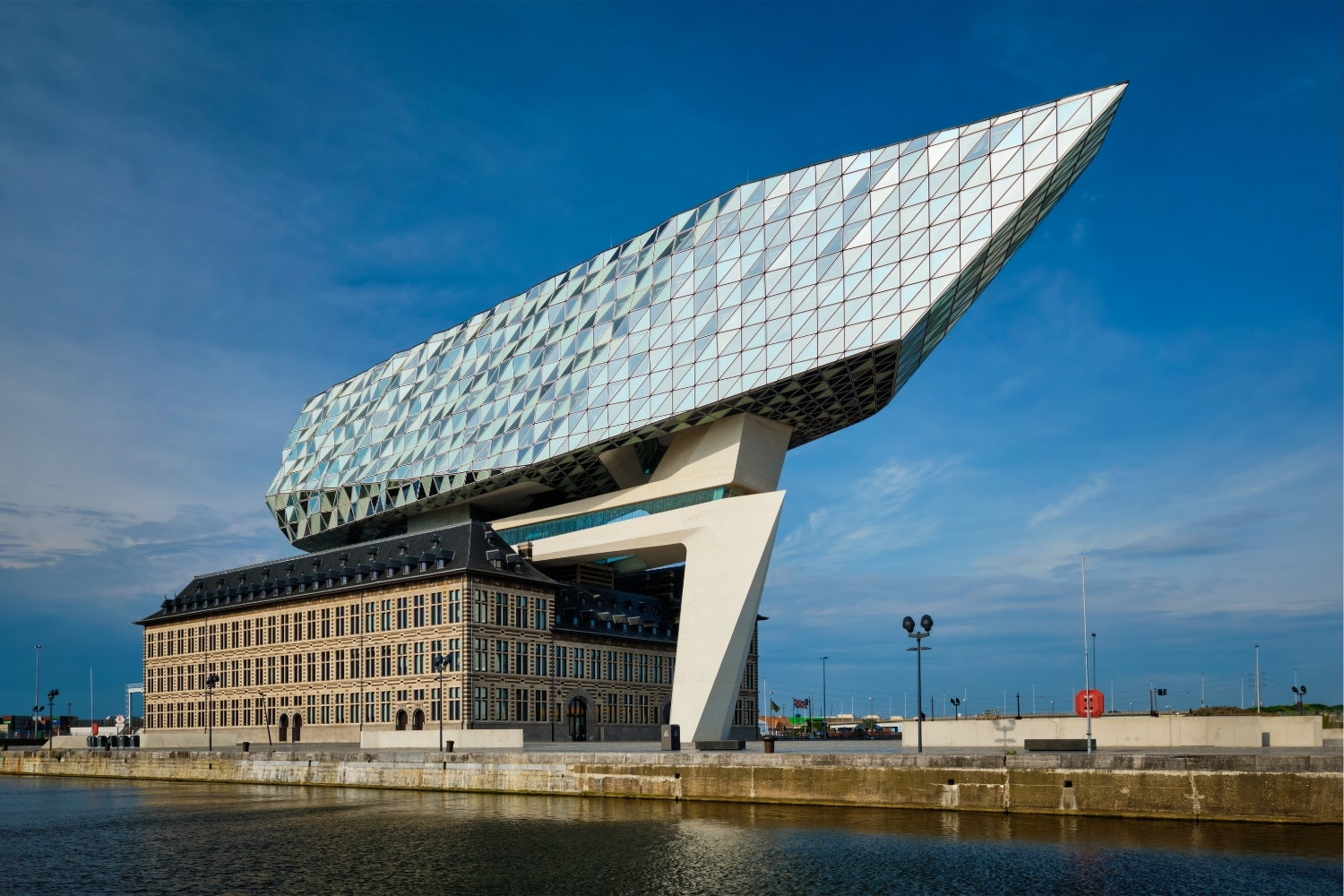
Deconstructivist buildings often look structurally precarious. Walls lean, cantilevers extend farther than expected, and surfaces appear to peel away from the structure. This visual instability is always an illusion; the buildings are engineered to be as structurally sound as any conventional structure. The point is to make the viewer question assumptions about what “stable” looks like.
Surface Tension and Materiality
Materials in deconstructivist buildings are used to heighten the sense of visual conflict. Reflective metals sit next to raw concrete. Glass panels are set at unexpected angles to distort reflections. Coop Himmelb(l)au’s rooftop remodeling in Vienna, one of the seven MoMA exhibition projects, used twisted steel and glass to create a form that looked like an explosion frozen in time.
💡 Pro Tip
When studying deconstructivist buildings in person, pay close attention to how your body reacts to the spaces. The tilted walls and angled floors in buildings like Libeskind’s Jewish Museum Berlin are designed to create physical disorientation, not just visual interest. Experienced architects use this deliberately to connect spatial experience with the building’s conceptual program.

Deconstructivism in Architecture Timeline: Key Dates

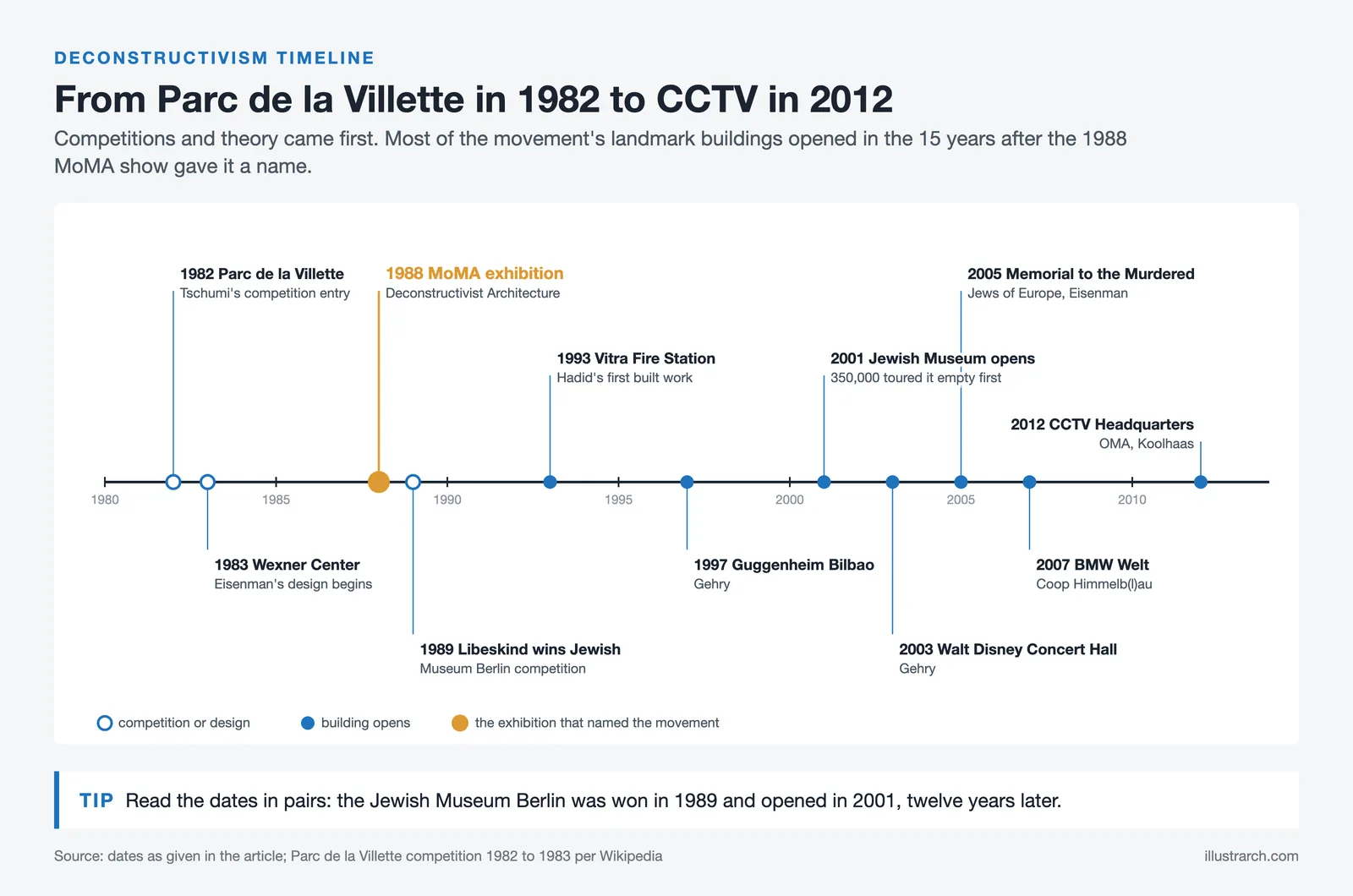
Tracing the deconstructivism in architecture timeline helps clarify how the movement evolved from philosophical speculation to built reality. The following table summarizes the major milestones.
Timeline of Deconstructivism in Architecture
The table below outlines the key events that shaped the movement from the early 1980s to the present day.
| Year | Event | Significance |
|---|---|---|
| 1982 | Parc de la Villette competition, Paris | Bernard Tschumi’s winning entry applied deconstructive theory to urban planning at large scale |
| 1983 | Peter Eisenman’s Wexner Center, design phase begins | One of the first built projects to apply deconstructive principles to a major public building |
| 1988 | MoMA “Deconstructivist Architecture” exhibition | Named and publicly launched the movement with seven featured architects |
| 1989 | Daniel Libeskind wins the Jewish Museum Berlin competition | Demonstrated how deconstructivist form could carry deep narrative and emotional meaning |
| 1993 | Vitra Fire Station by Zaha Hadid completed in Weil am Rhein | Hadid’s first built project; proved deconstructivist ideas could be realized at building scale |
| 1997 | Guggenheim Museum Bilbao by Frank Gehry opens | Global cultural impact; coined the term “Bilbao Effect” for architecture-led urban renewal |
| 2001 | Jewish Museum Berlin opens to the public | 350,000 visitors toured the empty building before exhibitions opened, proving architecture alone can draw audiences |
| 2000s onward | Movement evolves into parametric and computational design | Digital tools enabled new formal explorations building on deconstructivist principles |
The Seven Architects of the 1988 Exhibition
The MoMA exhibition selected seven architects whose work, despite significant differences in approach, shared a willingness to disturb conventional architectural expectations. Each brought a distinct perspective to what deconstructivism in architecture could mean in practice.
Frank Gehry
Frank Gehry was perhaps the most publicly visible architect associated with deconstructivism, though he consistently resisted the label. His early work, including the radical renovation of his own Santa Monica house in 1978 using chain-link fencing and corrugated metal, established a practice of treating buildings as unfinished, layered objects. The Guggenheim Museum Bilbao (1997) became the movement’s most famous built work, demonstrating that complex, non-linear forms could be constructed on budget and on schedule using aerospace software (CATIA) originally designed for fighter jet design.
Daniel Libeskind
Libeskind brought a deeply narrative dimension to deconstructivist architecture. His Jewish Museum Berlin (competition won 1989, opened 2001) used a zigzagging plan derived from the addresses of Jewish and German cultural figures plotted on a map of Berlin. The building’s slash-like windows, titled “Between the Lines,” create disorienting interior spaces that directly express absence, memory, and loss. Before any exhibitions were installed, 350,000 people visited the empty building, drawn by the architecture itself.
Zaha Hadid
Zaha Hadid began her career producing visionary paintings and drawings that imagined buildings as explosive, gravity-defying compositions. Her early deconstructivist work was angular and fragmented, influenced by Russian Suprematism and the paintings of Kazimir Malevich. Over time, her style evolved toward the fluid, curved forms associated with parametric architecture, but her commitment to challenging conventional spatial expectations remained constant throughout her career.
Peter Eisenman
Eisenman was the most theoretically rigorous of the seven. His buildings are generated through formal processes (grids, rotations, scalings) that treat the architectural plan as a field of operations rather than a functional layout. The Wexner Center for the Arts at Ohio State University (1989) used an incomplete scaffolding grid that runs through the building, disrupting the distinction between interior and exterior. Eisenman once described his goal as making “architecture that is not about something but is something.”
Rem Koolhaas
Koolhaas, working through his firm OMA (Office for Metropolitan Architecture), approached deconstructivism from an urban and programmatic angle rather than a purely formal one. His designs fragment conventional spatial hierarchies by mixing programs, inverting expected relationships between public and private space, and treating circulation as a design generator rather than a service element.
Bernard Tschumi
Tschumi’s Parc de la Villette in Paris (competition held 1982 to 1983, completed in stages through the 1990s) is one of the foundational deconstructivist projects. Rather than designing a conventional park, Tschumi distributed a series of red steel follies on a point grid across the site, creating a landscape that resists any single reading or narrative. The project applied Derrida’s ideas about textual instability directly to the design of public space.
Coop Himmelb(l)au
The Vienna-based firm led by Wolf D. Prix brought an aggressive, expressionist energy to deconstructivism. Their Rooftop Remodeling on Falkestrasse in Vienna (1988) is a twisted steel-and-glass structure that erupts from the top of a conventional building, looking like a bird of prey about to take flight. Prix described their design method as “architecture must blaze,” and their work consistently prioritized visceral spatial impact over refined detailing.
🎓 Expert Insight
“I have always felt slightly repulsed by the word deconstructivism. I never wanted to be part of an ism.” — Daniel Libeskind, Architect
Libeskind’s discomfort with the label reflects a broader pattern among the seven MoMA architects. Most saw their work as deeply individual rather than belonging to a shared movement, yet the exhibition’s framing gave critics and historians a useful category that has persisted for nearly four decades.
Landmark Deconstructivist Buildings Around the World

Beyond the original seven architects, deconstructivism influenced a wide range of built projects across multiple continents. These buildings demonstrate how the principles of deconstructivism in architecture translated into real structures that people use, visit, and debate.
Guggenheim Museum Bilbao (Spain, 1997)
Designed by Frank Gehry, this museum became the single most influential deconstructivist building ever constructed. Its titanium-clad exterior, composed of approximately 33,000 individually shaped panels, creates a form that shifts in appearance depending on the weather, time of day, and viewing angle. The building transformed Bilbao from a declining industrial port into a major cultural destination, a phenomenon urban planners now study under the name “the Bilbao Effect.” According to the Guggenheim Foundation, the museum attracted nearly 4 million visitors in its first three years, generating roughly 500 million euros in economic activity.
Jewish Museum Berlin (Germany, 2001)
Libeskind’s zigzagging, titanium-zinc-clad extension to the old Berlin Museum uses architecture to embody the experience of absence. The building has no entrance of its own; visitors access it through an underground passageway from the adjacent baroque courthouse. Inside, three intersecting axes organize movement: the Axis of Continuity, the Axis of Exile, and the Axis of the Holocaust. Five “voids,” empty concrete shafts that cut through every floor of the building, represent what Libeskind called “that which can never be exhibited.”
Walt Disney Concert Hall (Los Angeles, 2003)
Gehry’s concert hall for the Los Angeles Philharmonic uses sweeping stainless steel curves that echo the Bilbao museum’s formal language but serve an entirely different program. The building’s acoustics, designed by Yasuhisa Toyota, are considered among the finest in the world, demonstrating that deconstructivist forms can achieve exceptional functional performance alongside visual drama.
CCTV Headquarters (Beijing, 2012)
Designed by Rem Koolhaas and OMA, this building takes the form of a continuous loop, with two leaning towers connected by a cantilevered bridge at the top and a shared base at the bottom. The structure directly challenges the conventional skyscraper typology by rejecting the vertical, freestanding tower in favor of a three-dimensional loop that redistributes structural forces through its entire form.
🏗️ Real-World Example
Vitra Fire Station (Weil am Rhein, Germany, 1993): Zaha Hadid’s first completed building was a small fire station for the Vitra furniture campus. Its sharp, angular concrete planes look as though they are frozen in the act of exploding outward. The building was decommissioned as a fire station in 1999 but remains one of the most important early examples of deconstructivist architecture realized at full scale. It proved that Hadid’s radical drawings could be translated into physical, habitable space.
Video: Deconstructivism in Architecture Explained
This video from Curious Muse provides a concise visual overview of deconstructivism’s origins, key buildings, and the architects who shaped the movement.
How Does Deconstructivism Differ from Postmodernism?
Both deconstructivism and postmodernism emerged as reactions against modernism, but they moved in opposite directions. Postmodern architecture responded to modernism’s severity by reintroducing historical references, ornament, color, and irony. Architects like Robert Venturi and Michael Graves looked backward, borrowing from classical and vernacular traditions to create buildings that communicated through familiar symbols.
Deconstructivism looked forward, or rather sideways. Instead of bringing back historical forms, deconstructivist architects questioned the very foundations of architectural thinking. They were not interested in decorating buildings with historical references but in exposing the hidden assumptions that shape how buildings are designed and experienced. Where postmodernism added layers of meaning through ornament and allusion, deconstructivism stripped away the assumption that meaning in architecture needs to be stable or resolved at all.
The practical difference is visible in the buildings themselves. A postmodern building like Michael Graves’s Portland Building (1982) uses classical columns and colorful decorative panels to create a legible, symbol-rich facade. A deconstructivist building like Eisenman’s Wexner Center uses colliding grids and incomplete structural frames to create deliberate spatial confusion. Both challenge modernism, but one does it through addition and the other through disruption.
The Seven Architects: Where They Went Afterwards
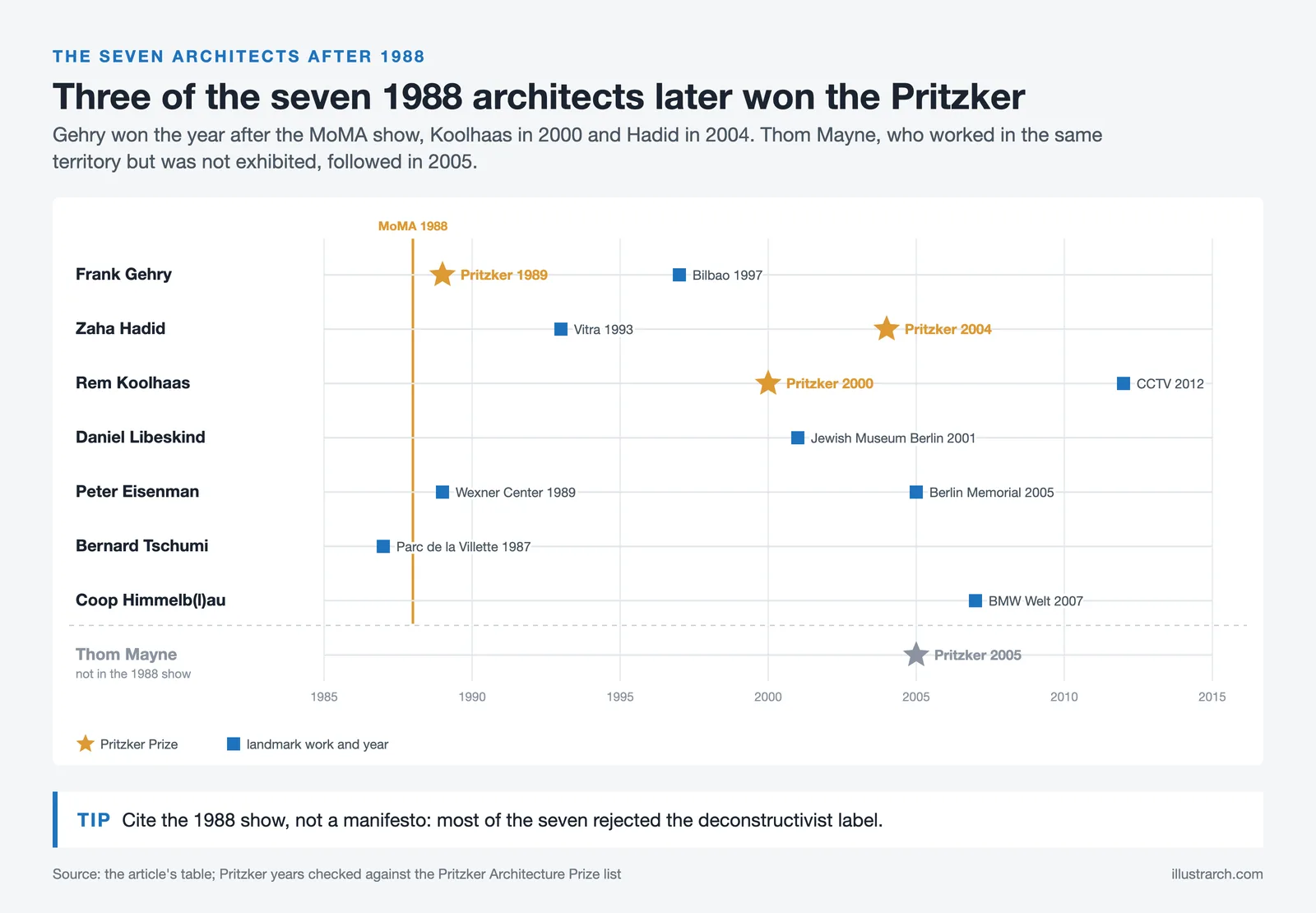
The 1988 exhibition grouped seven practices that did not consider themselves a movement and largely rejected the label. What happened to them since is the strongest evidence about whether deconstructivism was a style or a moment: three of the seven went on to win the Pritzker Prize, which is the discipline’s answer to the question.
| Architect | After 1988 | Landmark work |
|---|---|---|
| Frank Gehry | Pritzker Prize 1989, the year after the exhibition | Guggenheim Museum Bilbao, 1997 |
| Zaha Hadid | Pritzker Prize 2004, first woman to win it | Vitra Fire Station, 1993, her first built work |
| Rem Koolhaas | Pritzker Prize 2000 | OMA’s Seattle Central Library and CCTV Headquarters |
| Daniel Libeskind | Built the movement’s most argued-about building | Jewish Museum Berlin, opened 2001 |
| Peter Eisenman | Remained the most theoretical of the group | Wexner Center, 1989; Memorial to the Murdered Jews of Europe, 2005 |
| Bernard Tschumi | Moved toward event and programme rather than form | Parc de la Villette, Paris, 1987 |
| Coop Himmelb(l)au | Continued in the original vocabulary longest | BMW Welt Munich, 2007 |
Thom Mayne of Morphosis, working in the same territory without being in the 1988 show, took the 2005 Pritzker. The concentration of Pritzkers among people the exhibition grouped together is not a coincidence, and it is the reason the label stuck despite the architects themselves rejecting it.
Where to See Deconstructivist Buildings
The movement produced relatively few buildings, and the ones that matter are open to the public.
| Building | Architect | Where | Why it matters |
|---|---|---|---|
| Guggenheim Bilbao | Frank Gehry | Bilbao, Spain | The building that made the vocabulary popular and gave “the Bilbao effect” its name |
| Jewish Museum Berlin | Daniel Libeskind | Berlin, Germany | The clearest case of the formal language carrying meaning rather than only effect |
| Vitra Design Museum campus | Gehry, Hadid and others | Weil am Rhein, Germany | Gehry’s museum and Hadid’s fire station on one site |
| Parc de la Villette | Bernard Tschumi | Paris, France | Deconstructivism applied to landscape and urban programme rather than to a building |
Bilbao is the one to see if you only see one, and not because it is the best of the group. It is the building that settled the argument about whether the vocabulary could work at civic scale, and every subsequent commission in this language traces back to it.
The Legacy and Influence on Contemporary Design
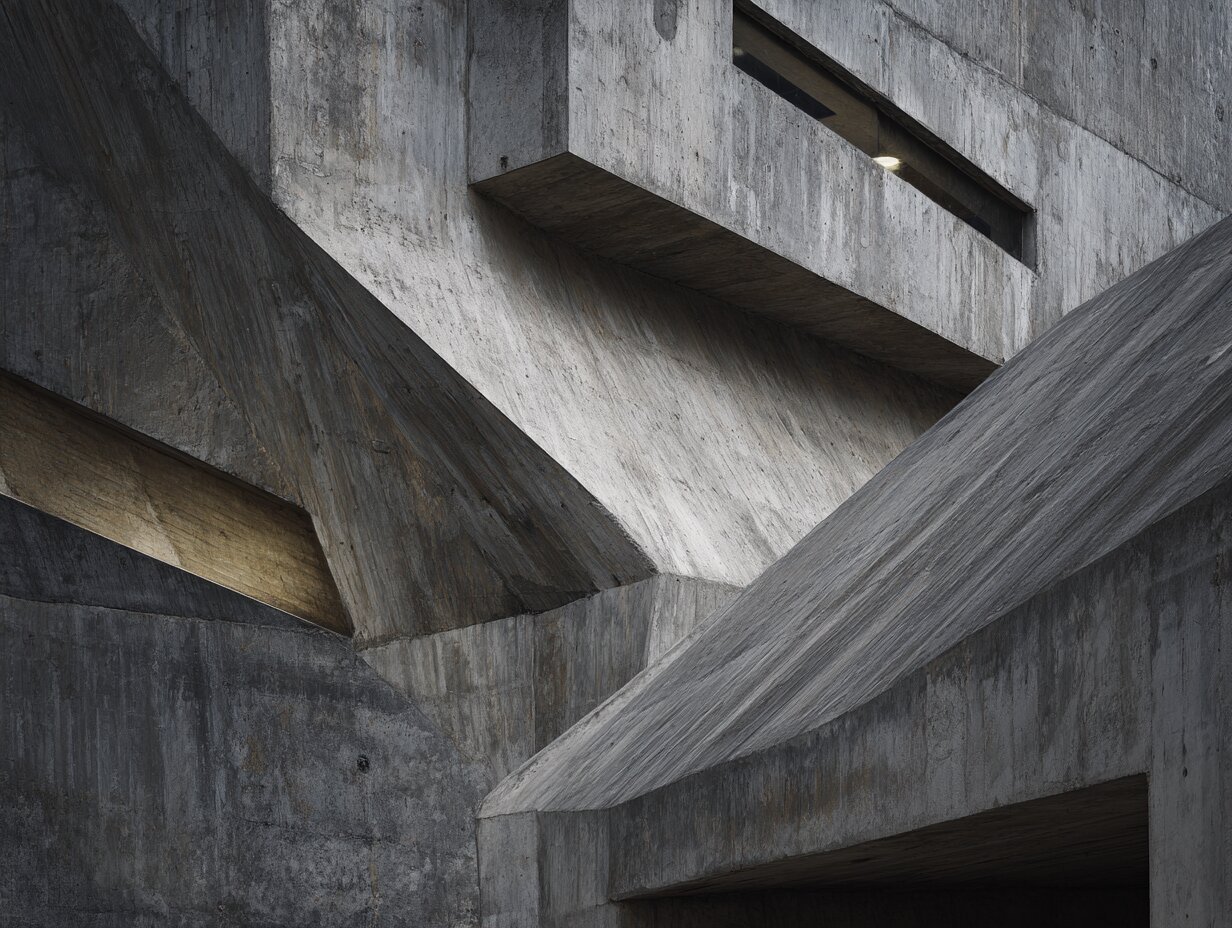
As a defined movement, deconstructivism’s peak period ran from the mid-1980s through the early 2000s. But its influence on contemporary architecture has been deep and lasting. Several of the movement’s key ideas, particularly the use of non-linear geometry, the rejection of orthogonal planning, and the treatment of buildings as dynamic rather than static objects, fed directly into the development of parametric architecture.
Patrik Schumacher, Zaha Hadid’s long-time partner and the theorist behind parametricism, explicitly positioned his work as an evolution of deconstructivism. Where deconstructivists used fragmentation and collision, parametricists use smooth, algorithmically generated forms. The underlying impulse, rejecting the primacy of the right angle and the orthogonal grid, remains the same.
💡 Pro Tip
If you are an architecture student analyzing deconstructivist buildings, avoid describing them simply as “chaotic” or “random.” Every element in a well-designed deconstructivist project is placed with intention. Look for the underlying formal logic, whether it is a distorted grid (Eisenman), a narrative program (Libeskind), or a sculptural intuition (Gehry), and your analysis will be significantly stronger.
Digital fabrication and computational design tools have also made it easier to build the kinds of complex geometries that deconstructivism pioneered. Gehry’s use of CATIA software for the Bilbao Guggenheim was a turning point; it demonstrated that non-standard forms could be precisely modeled, engineered, and constructed within conventional budgets. Today, firms routinely produce buildings with complex curved surfaces and non-repetitive panel systems, a capability that traces directly back to the problems deconstructivist architects forced the construction industry to solve.
The movement also changed the cultural role of architecture. Before the Bilbao Guggenheim, it was rare for a building to generate international media coverage on the scale of a major film release or political event. Deconstructivist buildings, with their dramatic, photogenic forms, helped establish the idea that architecture could function as cultural spectacle, attracting tourism and investment in ways that cities had not previously anticipated.
Criticism and Debate
Deconstructivism has never lacked critics. The most common objection is functional: buildings designed to look unstable or disorienting can be difficult to occupy comfortably. Tilted walls make it hard to hang artwork. Angled floors create accessibility challenges. Irregular floor plans can waste usable space. These are legitimate practical concerns, and they explain why deconstructivist forms have been more common in museums, cultural centers, and institutional buildings than in housing or offices.
A second line of criticism is philosophical. Some critics argue that deconstructivism’s intellectual framework is borrowed from literary theory and does not translate meaningfully into architecture. A building is not a text; it has structural requirements, occupants, and functional programs that a novel does not. Applying Derrida’s ideas about textual instability to physical structures, these critics argue, produces buildings that are philosophically performative but spatially problematic.
A third critique focuses on cost and constructability. Deconstructivist buildings typically require custom engineering, non-standard building components, and specialized construction techniques. These factors increase costs and limit the approach’s applicability to well-funded institutional projects. The counter-argument, advanced most forcefully by Gehry, is that digital design tools have steadily reduced the cost premium for complex geometries, and that the Bilbao Guggenheim came in under its $100 million budget.
Deconstructivism Today: Is It Still Relevant?
As a labeled movement with a founding exhibition and a defined set of architects, deconstructivism belongs to a specific historical moment. Few architects working today would describe their practice as “deconstructivist.” But the principles of deconstructivism in architecture, fragmentation, non-linearity, the questioning of structural and spatial conventions, continue to inform contemporary design in ways that are so widespread they are now taken for granted.
The current generation of computational designers, working with tools like Grasshopper and Rhino, can produce in minutes the kinds of complex geometries that Gehry’s studio spent months modeling by hand in the 1990s. The philosophical questions deconstructivism raised about order, stability, and meaning in architecture remain open and productive. And the buildings the movement produced, from Bilbao to Berlin to Beijing, continue to attract millions of visitors and generate debate about what architecture can and should do.
Deconstructivism did not replace the architecture that came before it. It expanded the range of what was considered possible. That expansion, more than any individual building or theoretical text, is its lasting contribution.
✅ Key Takeaways
- Deconstructivism in architecture is a philosophically grounded movement, not just a visual style. It draws on Jacques Derrida’s concept of deconstruction to challenge assumptions about stability and order in design.
- The 1988 MoMA exhibition organized by Philip Johnson and Mark Wigley gave the movement its name and public identity, featuring seven architects: Gehry, Libeskind, Hadid, Eisenman, Koolhaas, Tschumi, and Coop Himmelb(l)au.
- Core principles include fragmentation, non-linear geometry, controlled instability, and material tension, all executed with full structural integrity despite their visually precarious appearance.
- The Guggenheim Museum Bilbao (1997) demonstrated that deconstructivist architecture could generate massive economic and cultural impact, coining the term “Bilbao Effect.”
- Deconstructivism’s legacy lives on in parametric and computational design, where its rejection of orthogonal conventions continues to shape how architects think about form, structure, and space.
Final Thoughts
What is deconstructivism in architecture? At its core, it is a refusal to accept that buildings must look stable, ordered, and resolved. It is an argument, made in steel, concrete, titanium, and glass, that architecture becomes more honest and more powerful when it acknowledges complexity, contradiction, and instability rather than hiding them behind smooth facades and right angles.
The buildings produced by this movement are among the most photographed, debated, and visited structures of the past four decades. Whether you find them exhilarating or exhausting, they have permanently changed the conversation about what architecture can be. For architecture students and professionals, understanding the deconstructivism meaning in architecture is not optional. It is part of the essential vocabulary of contemporary design, a vocabulary that continues to expand as new generations of architects build on the foundations that Gehry, Libeskind, Hadid, and their contemporaries laid.









Florence Renaissance Architecture: How Building Became an Authored Art
Florence Renaissance architecture is usually told as a list of buildings. The...
Furkan Sen6 Mins read
Architectural Styles History: Why Some Styles Fail and Others Endure
A look at architectural styles history through the decisions that actually keep...
Furkan Sen6 Mins read
Architectural Styles: Why Some Endure and Others Fade
Some architectural styles last for centuries while others are demolished within a...
Furkan Sen5 Mins read
Postmodern Architecture vs Deconstructivism: Playful Irony or Radical Disruption?
Postmodern architecture and deconstructivism both rejected modernism but took opposite paths. This...
 Sinan Ozen5 Mins read


Leave a comment