

San Francisco’s Treasure Island with the Tallest Residential Tower by David Baker Architects
David Baker Architects completes Isle House, a 22-story residential tower that stands as the tallest building on San Francisco's Treasure Island development.
 Elif Ayse Sen5 February 20268 Mins read242
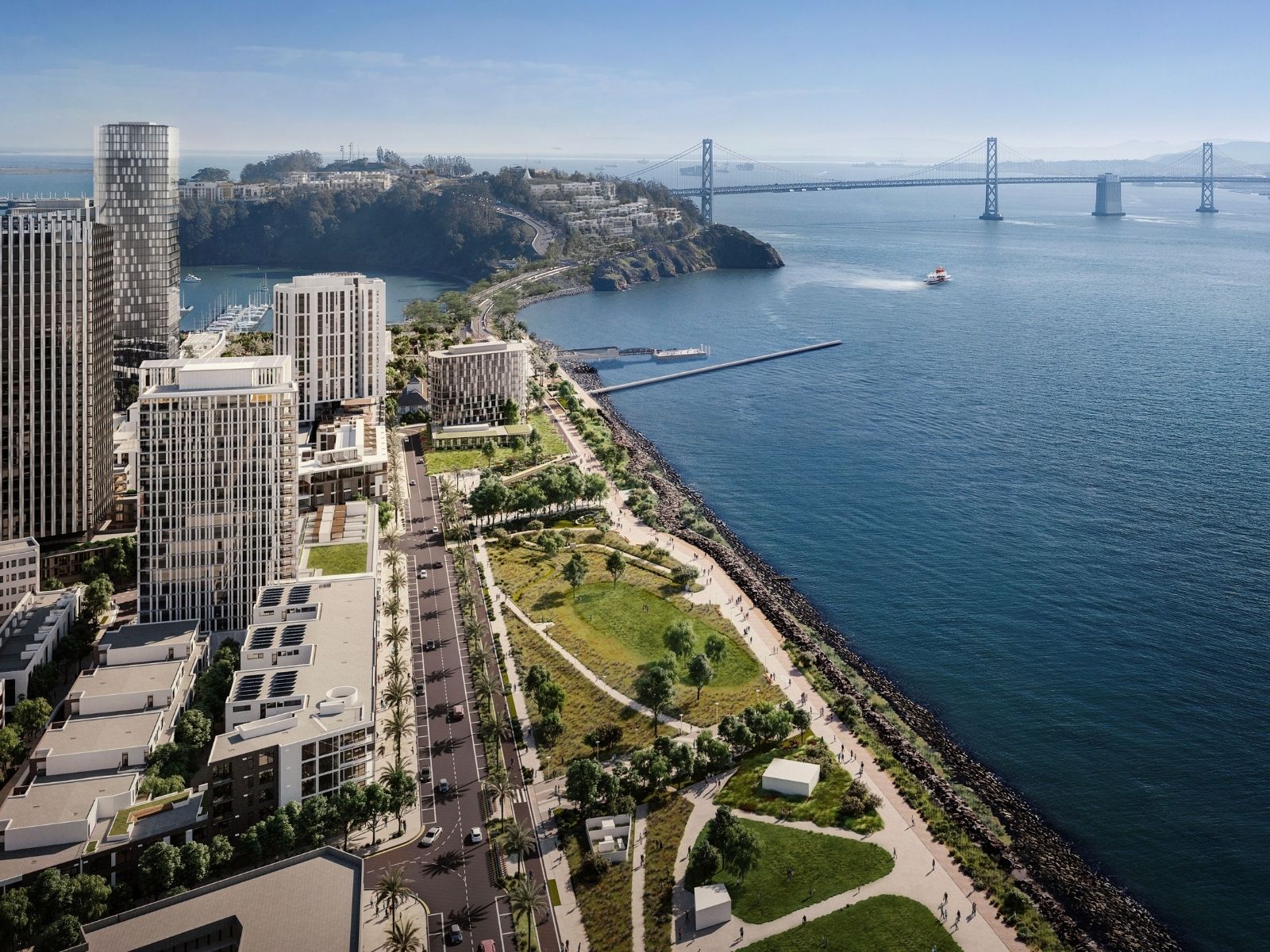


Table of Contents Show
David Baker Architects has achieved a significant milestone in urban development with the completion of Isle House, a striking 22-story residential tower that now stands as the tallest building on San Francisco’s Treasure Island. This landmark project represents not only a triumph for the renowned David Baker Architects San Francisco studio but also marks a pivotal moment in one of the most ambitious urban transformations in California’s history.
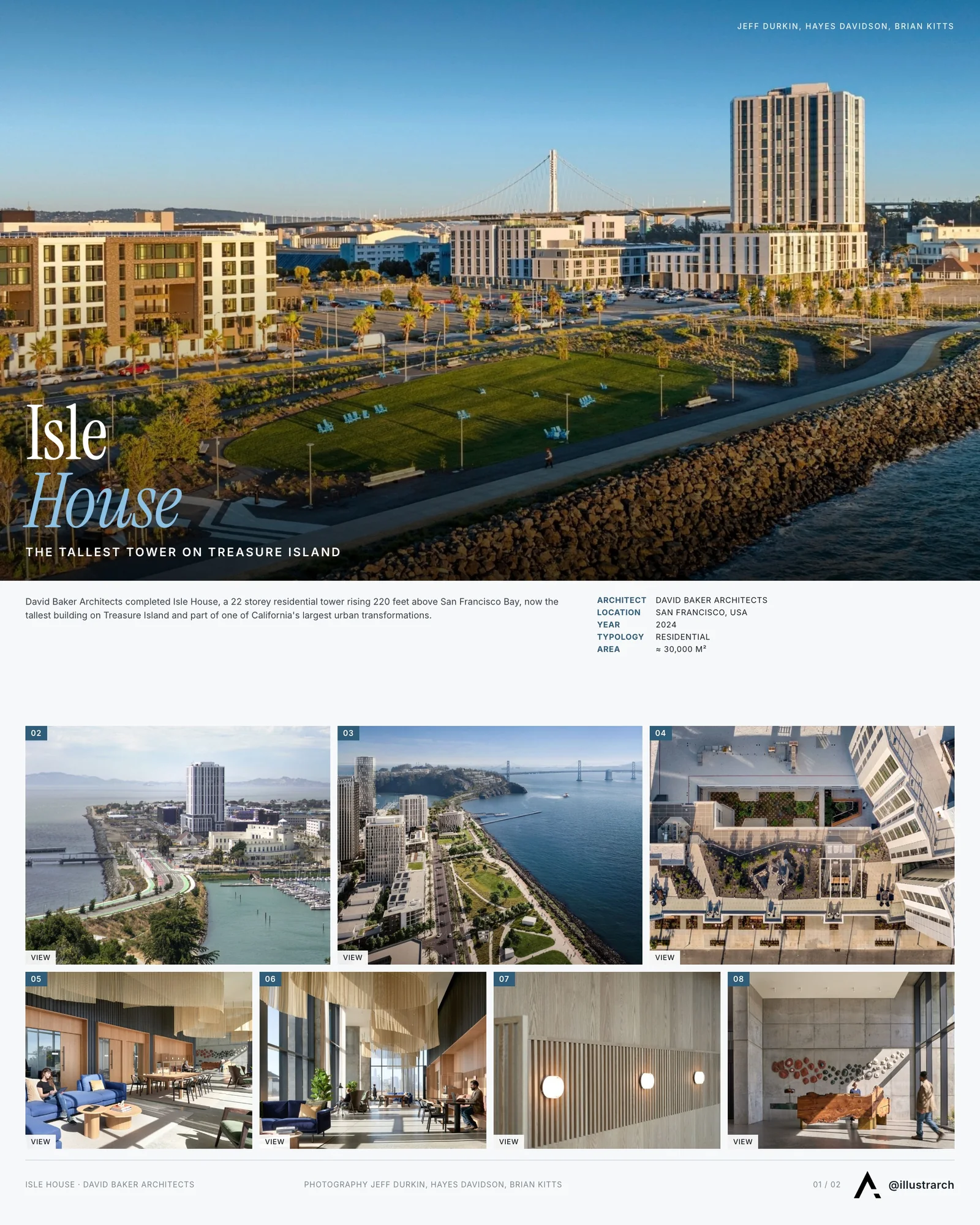
The architecture of San Francisco continues to evolve through projects like Isle House, which combines the city’s legacy of innovation with contemporary sustainable design principles. Rising 220 feet above the bay, this architectural achievement introduces a new chapter in San Francisco architectural styles, blending residential functionality with dramatic visual impact.
David Baker Architects: A Legacy of Human-Centered Design in San Francisco
Founded in 1982 by David Baker, FAIA LEED AP, David Baker Architects has grown into one of the most influential architecture firms in the San Francisco Bay Area. The firm operates from offices in San Francisco, Oakland, and Birmingham, Alabama, with a team of over 62 employees dedicated to creating buildings that serve as what they call a “multiplier of good” designs that enable and support community engagement, connection, and benefit.
The David Baker architectural studio works are characterized by a distinctive philosophy that combines social concern with signature design character. Over four decades, the firm has received more than 400 local and national architectural design awards, establishing itself as a leader in both affordable and market-rate housing, mixed-use projects, and sustainable design.
David Baker himself brings a unique perspective to architecture. Born in Grand Rapids, Michigan, and raised in a passive-solar rammed-earth house in Arizona designed by his self-educated father, Baker developed an early appreciation for environmentally conscious design. After earning his master’s degree in architecture from the University of California at Berkeley, he founded Sol-Arc, an energy consulting firm, before establishing his current practice. He was elevated to Fellow of the American Institute of Architects in 1996 and was inducted into Builder Magazine’s “Hall of Fame” in 2008.
San Francisco Architecture Styles: From Victorian Heritage to Contemporary Innovation
Understanding the architecture of San Francisco requires appreciation of its rich historical context. The city is renowned worldwide for its eclectic mix of San Francisco architecture styles, from the ornate Victorian “Painted Ladies” of Alamo Square to cutting-edge contemporary towers in SoMa and Mission Bay.
The Victorian era left an indelible mark on San Francisco’s urban fabric. An estimated 48,000 houses were built during the Victorian and Edwardian period between 1849 and 1915, featuring styles ranging from Gothic Revival and Italianate to Stick-Eastlake and Queen Anne. These homes, characterized by ornate details, bright colors, steeply pitched roofs, and elaborate bay windows, reflect the city’s rapid growth and prosperity during the Gold Rush era.
The 1906 earthquake and subsequent fire reshaped the city’s architectural landscape, leading to reconstruction that incorporated Mission Revival, Mediterranean, and eventually Modernist influences. Today, San Francisco architectural styles encompass everything from preserved Edwardian homes in Pacific Heights to glass-and-steel towers in the Financial District, creating what many consider one of the most visually diverse cityscapes in the world.
Projects like Isle House by David Baker Architects represent the latest evolution in this ongoing architectural narrative, bringing contemporary design sensibilities to new urban territories while respecting the innovative spirit that has always defined San Francisco’s built environment.
Isle House: The Tallest Building on Treasure Island
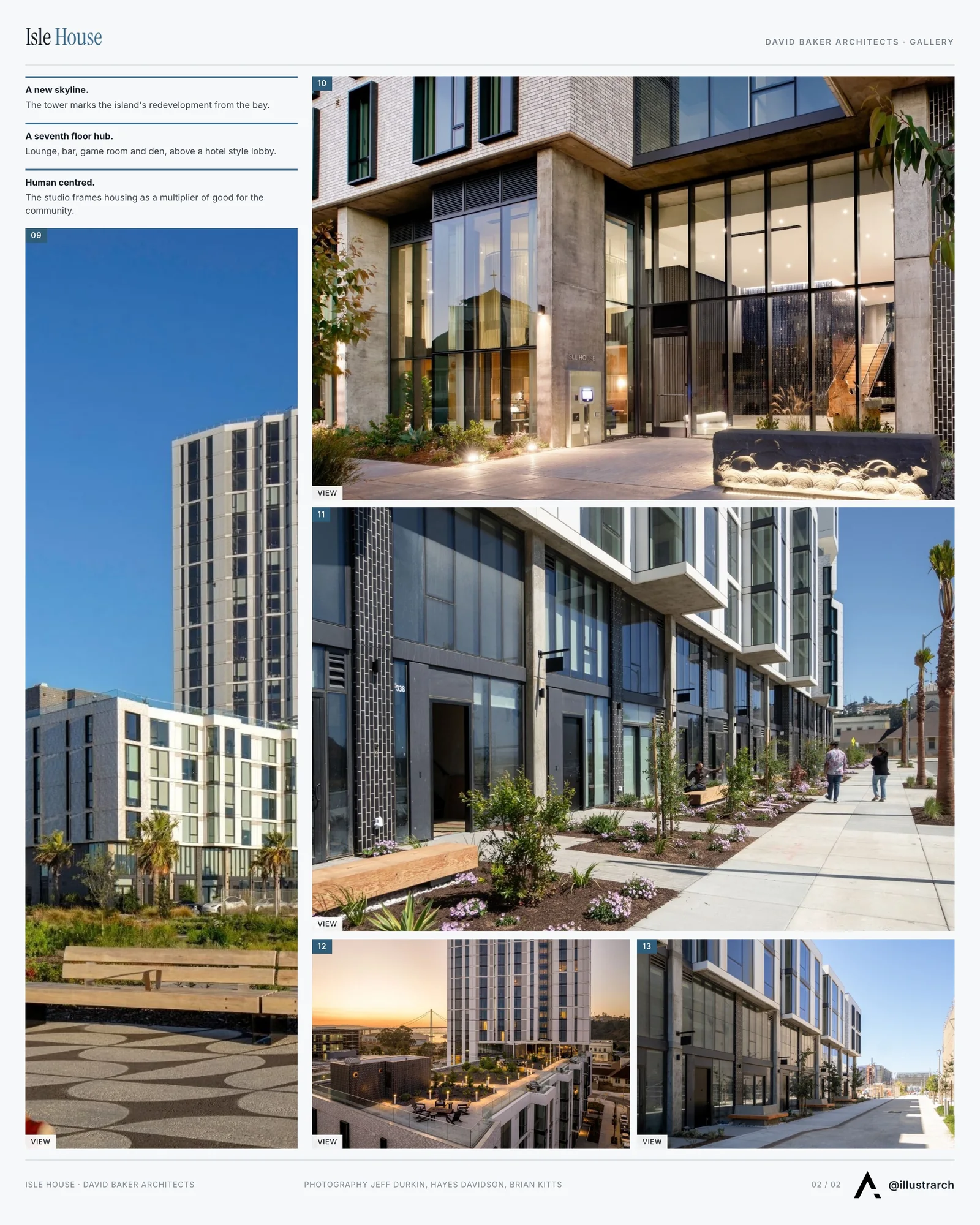
Isle House emerges as the crown jewel of Treasure Island’s transformation, a 22-story residential tower that captures 360-degree views of the San Francisco Bay, Bay Bridge, Golden Gate Bridge, and the city skyline. Designed by David Baker Architects San Francisco, the building features 250 market-rate homes ranging from studios to three-bedroom apartments, plus nine two-level live-work townhomes with private entries.
The tower’s design takes full advantage of its extraordinary island location. Principal Pedram Farashbandi of David Baker Architects described the building’s impact: “We are building a new neighborhood in San Francisco and contributing to a famous skyline.” The dramatic folded façade maximizes views of the city’s iconic bridges and bay landmarks at every turn, creating what the firm describes as a “journey” through the building, from the landscaped entry pathway through the hotel-style lobby to the glass-capped corridors that frame perfect views.
Key design features of Isle House include a hotel-style entry lobby with varied seating zones and private co-working suites, a seventh-floor amenity hub featuring an expansive lounge, bar, game room, and private den separated by a two-sided fireplace, landscaped terraced courtyards that provide sheltered green space, and a fitness studio with expansive bay views. The project also includes 1,140 square feet of street-level retail space and below-grade parking for 109 vehicles.
The Treasure Island Master Plan: Creating a New San Francisco Neighborhood
Isle House anchors what is arguably the most significant urban development in San Francisco in over half a century. The Treasure Island/Yerba Buena Island Development Project represents a 405-acre transformation that, when complete, will feature up to 8,000 new homes, with approximately 27% designated as affordable housing, along with 300 acres of parks, trails, and open space.
The master plan, originally designed by Skidmore, Owings & Merrill (SOM), proposes three compact neighborhoods organized around a town center and ferry terminal. The development prioritizes pedestrians and cyclists while encouraging sustainable transit-oriented choices. Residents can reach downtown San Francisco via an approximately eight-minute ferry ride from the new Treasure Island Ferry Terminal.
The project’s design grows from Treasure Island’s remarkable history. Originally created as a man-made landform in 1936-37 to host the 1939 Golden Gate International Exposition, the island later became a U.S. Naval Station during World War II. The military decommissioned the base in the late 1990s, and since then, San Francisco has been working to transform this unique site into a thriving residential community.
Treasure Island Community Development (TICD), a partnership between Wilson Meany, Stockbridge Capital Group, and Lennar Corporation, serves as the master developer. The roughly $6 billion redevelopment has already seen the opening of over 1,000 housing units, seven new waterfront parks including the spectacular Cityside Park, and new roads, bike lanes, and utilities.
David Baker Architectural Studio Works: Design Philosophy and Innovation
The David Baker architectural studio works portfolio demonstrates a consistent commitment to what the firm calls “9 Ways to Make Housing for People” a set of design strategies that prioritize community-oriented, human-centered sustainability. These principles have been featured at the Cooper Hewitt, Smithsonian Design Museum and presented in cities across America.
Among these strategies, “Activating the Edges” plays a crucial role in Isle House’s design. This principle emphasizes preventing dormant spots where dynamic uses should prevail, placing community amenities, courtyards, and entryways where they can engage with the public realm. At Isle House, the 220-foot high-rise is bounded to the north by Garden Walk, a dynamic shared public way designed by CMG Landscape Architecture that prioritizes pedestrians and bicyclists over cars.
The firm’s approach to sustainable architecture is evident throughout the project. Isle House incorporates numerous sustainable features aligned with Treasure Island’s award-winning LEED Platinum Neighborhood Development Masterplan. The building’s orientation and façade design maximize natural light while managing solar heat gain, contributing to energy efficiency without sacrificing the panoramic views that define the resident experience.
San Francisco County DBA: Understanding the Local Context
For those navigating the San Francisco DBA (doing business as) landscape, David Baker Architects represents a prime example of how local firms can shape their communities over decades of dedicated practice. The firm’s headquarters in San Francisco’s Clocktower Building, itself a condominium conversion Baker designed in the former factory of the Schmidt Lithography Co., once the largest printing company on the West Coast, reflects the practice’s commitment to adaptive reuse and urban revitalization.
The San Francisco County DBA requirements and business environment have supported architectural innovation for decades, enabling firms like David Baker Architects to take on ambitious projects that balance market-rate development with social responsibility. The firm’s ability to navigate complex planning processes while maintaining design excellence has made it a trusted partner for both private developers and public agencies.
Sustainable Design and Climate Resilience
One of the most significant aspects of the Treasure Island development is its approach to climate resilience. All new parkland and development sites are perched 3.5 feet above the older portions of the island, a height calibrated to long-term projections for sea level rise. This forward-thinking infrastructure work, which began in 2015, addresses both seismic concerns and climate change impacts.
David Baker Architects has long championed sustainable practices in housing design. The firm’s sustainable design director, Katie Ackerly, leads initiatives that have positioned DBA at the forefront of environmentally responsible architecture. The 2020 AIA California Firm Award recognized the firm’s consistent production of distinguished architecture that integrates sustainability principles throughout the design process.
Isle House incorporates these values through its building systems, material selections, and operational strategies. The project contributes to Treasure Island’s vision of creating a 21st-century community that demonstrates sustainable urban living is not just possible but desirable.
The Future of San Francisco’s Architectural Landscape
The completion of Isle House signals an exciting new chapter for San Francisco architecture styles and urban development. As Treasure Island continues to evolve, with plans potentially expanding to 10,800 homes, projects like this tower demonstrate how thoughtful design can create vibrant communities that respect both environmental imperatives and human needs.
David Baker summarized the significance of this moment: “After a couple of projects, I was suddenly an expert at multifamily work.” That expertise, honed over four decades, has culminated in a building that will serve as a model for residential development in challenging urban contexts worldwide.
For architecture enthusiasts, urban planners, and anyone interested in the evolution of contemporary architecture, Isle House represents a must-see destination. The building offers tours through the Center for Architecture + Design in San Francisco, providing opportunities to experience firsthand how David Baker Architects has created a landmark that honors San Francisco’s architectural heritage while pointing toward its future.
Project Details and Technical Specifications
The Isle House project involved collaboration among numerous industry leaders. Below are the key project specifications and team members that brought this vision to reality.
Building Statistics: Isle House rises 22 stories and 220 feet, containing 250 residential units with a mix of studios, one-bedroom, two-bedroom, and three-bedroom apartments. The project includes nine two-level live-work units with private entries, 1,140 square feet of street-level retail space, and parking for 109 vehicles. The total building area encompasses approximately 321,950 square feet on a 0.84-acre site.
Project Team: The development was led by Treasure Island Community Development, a joint venture of Wilson Meany, Stockbridge Capital Group, and Lennar Corporation. David Baker Architects served as the design architect, with Webcor as the general contractor. CMG Landscape Architecture designed the adjacent Garden Walk and public spaces, while GLS served as the project’s landscape architect for the building itself.
Timeline: Design for Isle House began in 2018, with construction commencing in 2022. The first piles were driven in July 2022, and the building was topped off in July 2023. Residents began moving in during August 2024, making Isle House one of the first completed residential towers in the new Treasure Island neighborhood.
Conclusion: A New Landmark for San Francisco
David Baker Architects has demonstrated once again why the firm remains at the forefront of residential design in the San Francisco Bay Area. Isle House stands as both a practical solution to the region’s housing challenges and an architectural statement about what urban living can become in the 21st century.
The architecture of San Francisco has always reflected the city’s spirit of innovation, from the Victorian experimentalism of the Gold Rush era to today’s sustainable high-rises. Isle House continues this tradition, offering residents an unparalleled living experience while contributing to the creation of an entirely new San Francisco neighborhood.
As the Treasure Island development progresses toward its projected completion in the 2040s, Isle House will serve as both anchor and inspiration, a tower that proves that thoughtful architecture can transform not just skylines, but communities.
For more information about David Baker Architects and their portfolio of residential and mixed-use projects, visit the firm’s official website at dbarchitect.com. To learn about housing opportunities on Treasure Island, visit the Treasure Island Development Authority.
Photography: Jeff Durkin, Hayes Davidson, Brian Kitts





Brussels’s €230m Kanal Museum Nears Opening as Questions Grow over Its Future Funding
Housed in a converted Citroën garage, Brussels's Kanal museum opens on 28...
 illustrarch Editoral Team1 Mins read

MoMA’s Full Disclosure Exhibition Traces Information Design from Hand-Drawn Data to AI Memories
Full Disclosure: The Edge of Information Design, curated by Paola Antonelli, is...
illustrarch Editoral Team2 Mins read
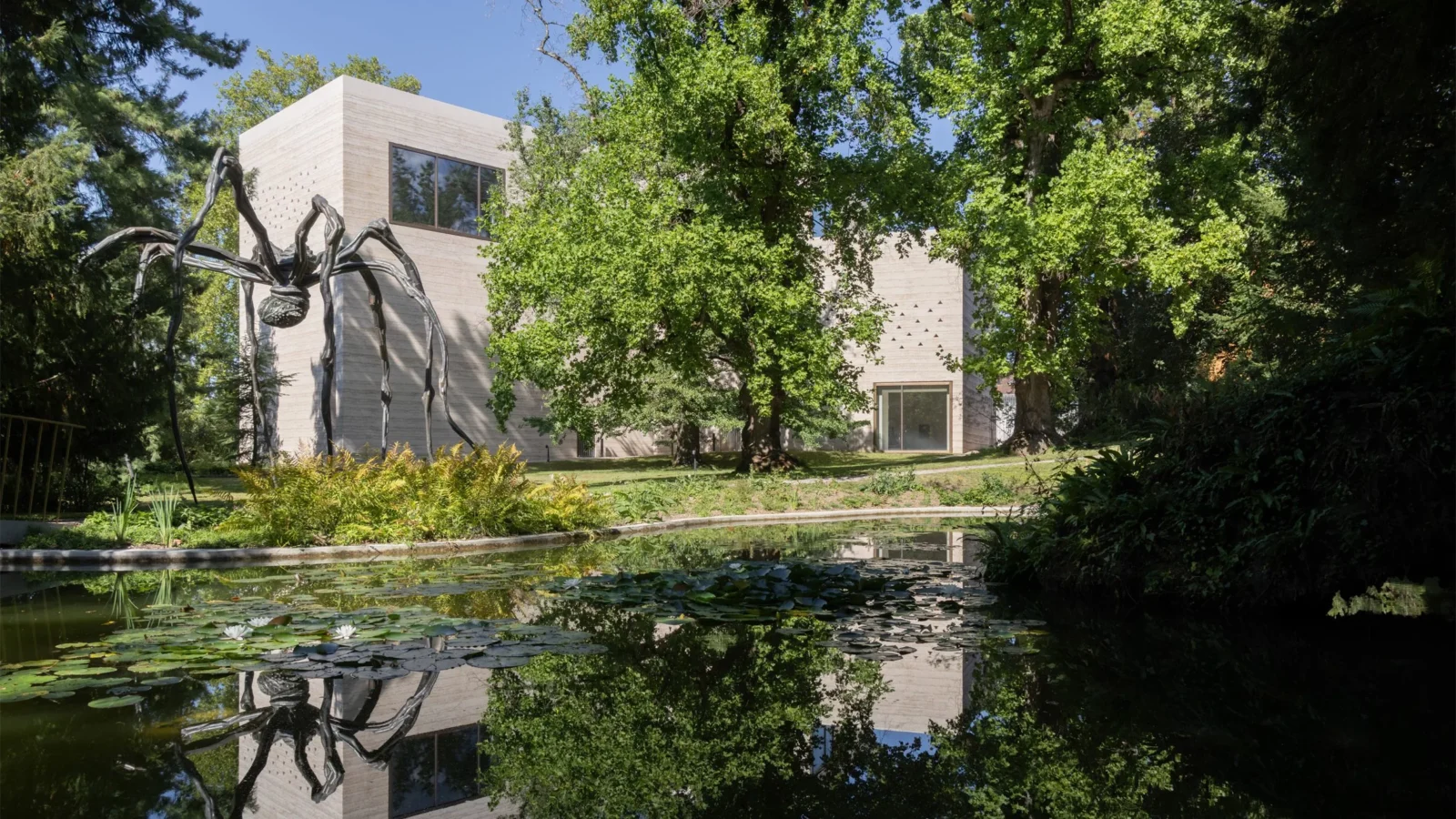
Zumthor’s Three New Buildings Open at Fondation Beyeler in Riehen
Peter Zumthor's Wyss Museum, Ammann Pavilion and Erlen Torhaus open at Fondation...
illustrarch Editoral Team4 Mins read

Benthem Crouwel Completes the Afsluitdijk Revamp with a Fish Passage and Domed Pumping Stations
The 32 km Afsluitdijk in the Netherlands has been raised, armoured and...
illustrarch Editoral Team2 Mins read


Leave a comment