

Great Pyramid of Giza: The Last Ancient Wonder Standing
Explore the Great Pyramid of Giza in Egypt, the only surviving Wonder of the Ancient World. This guide covers when and how it was built, its interior chambers including the King's Chamber and Grand Gallery, construction techniques, and recent discoveries by the ScanPyramids project.
 Furkan Sen8 March 20269 Mins read307

Table of Contents Show
The Great Pyramid of Giza is the oldest and largest of the three pyramids on the Giza Plateau, just outside modern Cairo. Built from around 2580 BC as a tomb for Pharaoh Khufu of the Fourth Dynasty, it held the title of the world’s tallest human-made structure for over 3,800 years. Of the original Seven Wonders of the Ancient World, it is the only one that has survived largely intact. Standing at a current height of 138.5 metres (454 feet), the great pyramid of giza continues to draw millions of visitors and researchers who seek to understand how ancient Egyptians achieved such extraordinary precision with limited tools.
This article walks you through the pyramid’s history, its remarkable interior layout, how it was constructed, and what modern technology has recently revealed hidden within its massive stone core.
Where Is the Great Pyramid of Giza?
The great pyramid of giza egypt sits on a rocky limestone plateau on the western bank of the Nile River, approximately 8 kilometres southwest of central Cairo. The plateau, known as the Giza Necropolis, is part of the UNESCO World Heritage Site “Memphis and its Necropolis”, designated in 1979. The site includes two other major pyramids (those of Khafre and Menkaure), the Great Sphinx, several smaller “queen” pyramids, mortuary temples, and causeways.
Choosing this location was no accident. The bedrock of the Giza Plateau consists of solid nummulitic limestone, which provided both a stable foundation and a readily available quarry for the core blocks. Archaeological research, including a 2024 study published in Nature Communications Earth & Environment, has mapped an extinct branch of the Nile (the Ahramat Branch) that once flowed close to the pyramid site. This 64-kilometre waterway, roughly 0.5 kilometres wide, was essential for transporting limestone casing stones from Tura and granite beams from Aswan, some 800 kilometres to the south.
Today, the Giza Plateau sits at the edge of Cairo’s urban sprawl. The Grand Egyptian Museum, designed by Heneghan Peng Architects and opened in 2025, stands nearby as a contemporary architectural counterpart to the ancient monuments.

When Was the Great Pyramid of Giza Built?
So when was the great pyramid of giza built? According to Egyptologists, construction began shortly after Pharaoh Khufu (also known by his Greek name, Cheops) ascended the throne, around 2580 BC. The project took approximately 20 to 26 years to complete during the Fourth Dynasty of the Old Kingdom period. Khufu’s vizier, Hemiunu, is widely believed to have served as the project’s chief architect, overseeing the logistics of quarrying, transportation, and placement of an estimated 2.3 million stone blocks.
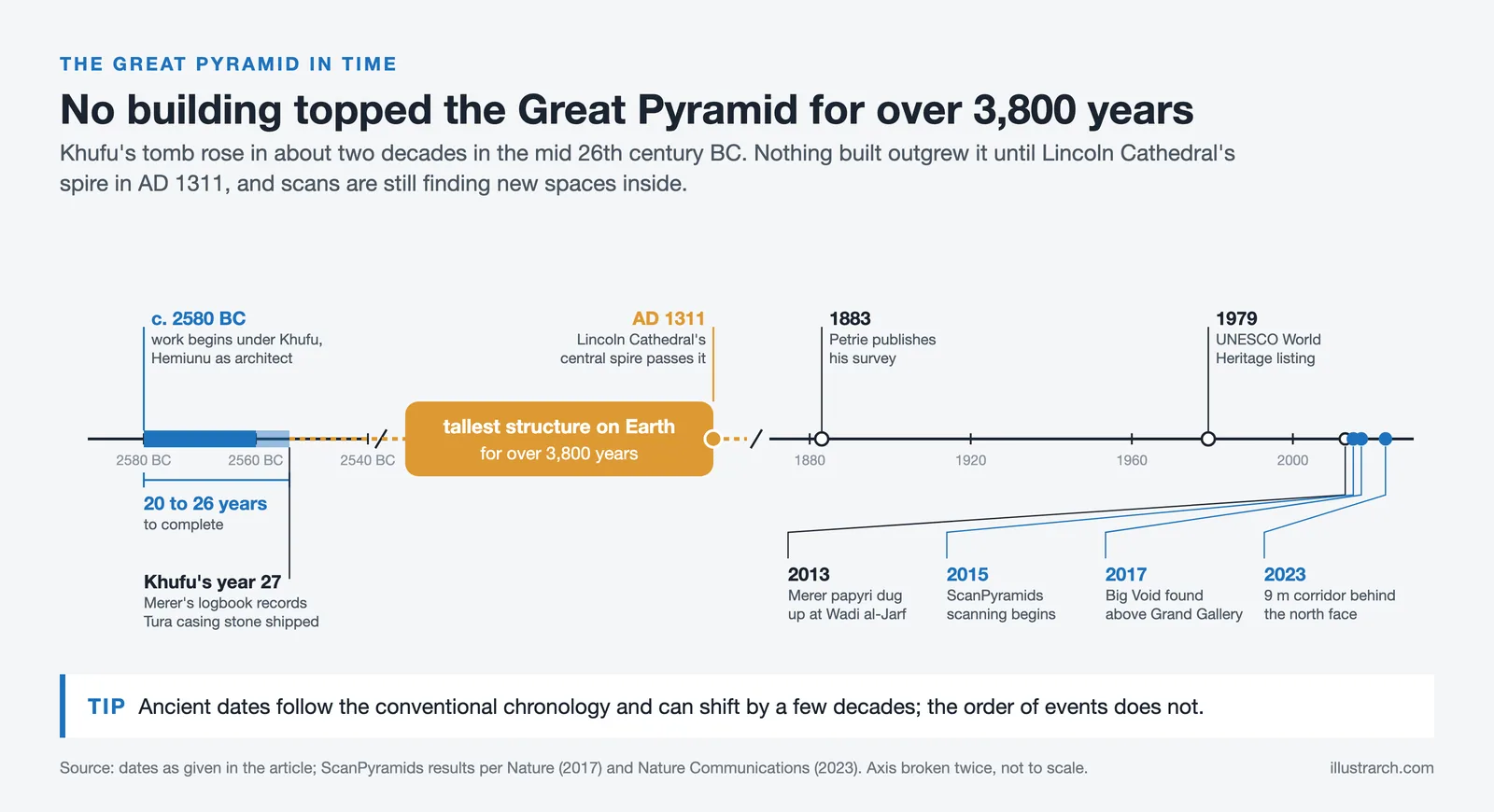
A critical piece of evidence supporting this timeline is the Diary of Merer, a collection of papyrus fragments discovered at Wadi al-Jarf near the Red Sea in 2013, during excavations Egyptologist Pierre Tallet began there in 2011. These logbooks, dating to the 27th year of Khufu’s reign, record the day-to-day activities of a work crew transporting white limestone casing blocks from the Tura quarries to the pyramid site. The papyri mention the pyramid by its ancient name, Akhet Khufu (“Horizon of Khufu”), and reference a harbour system near the construction area.
This documentary evidence, combined with radiocarbon dating of mortar samples and worker graffiti found inside the pyramid (including four instances of the name “Khufu”), firmly places construction in the mid-26th century BC. The pyramid was completed as part of a larger funerary complex that included two mortuary temples, a causeway, three smaller pyramids for Khufu’s queens, and five buried solar boats.
Dimensions and Engineering Precision
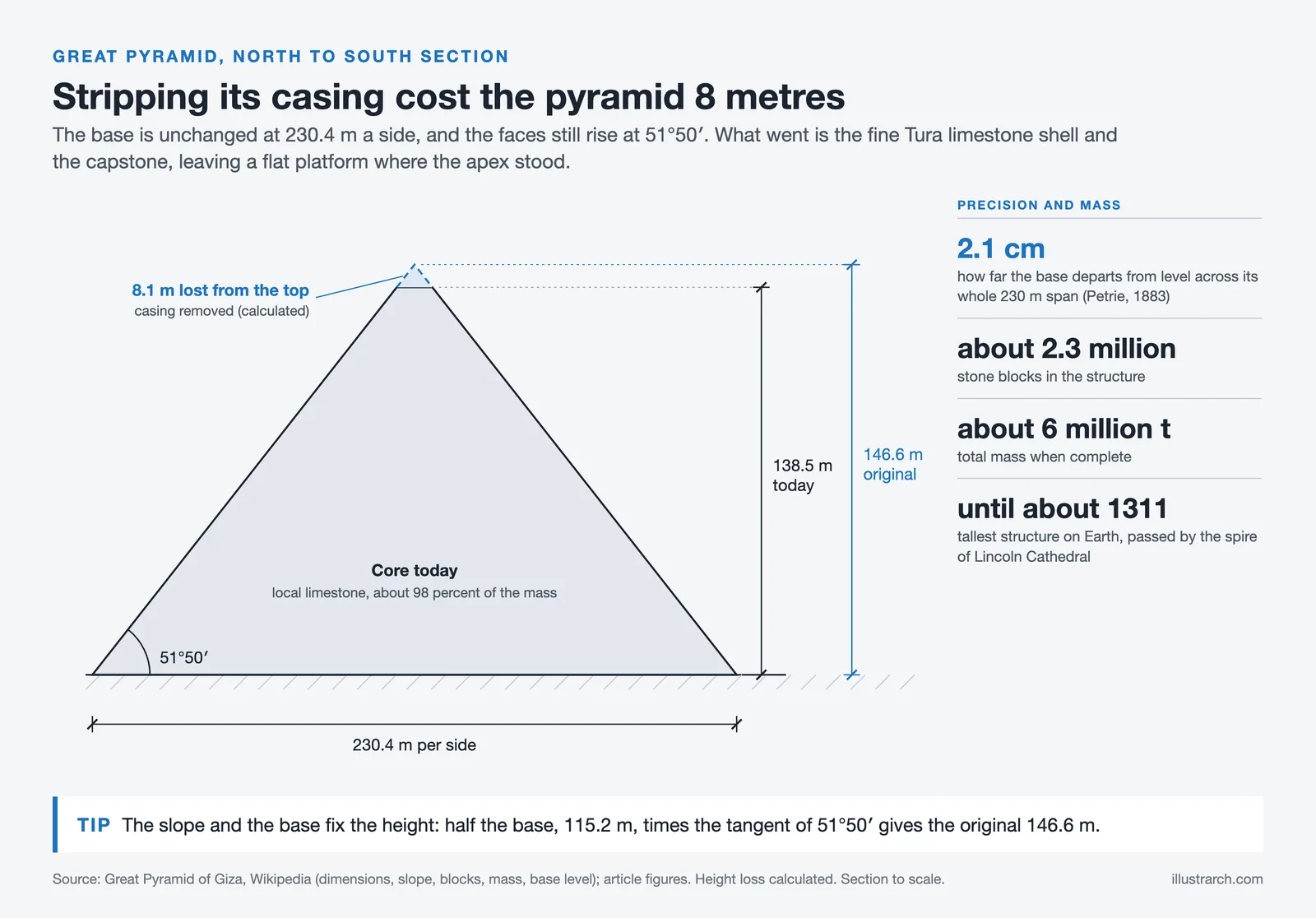
The numbers behind the Great Pyramid are staggering. Originally standing at 146.6 metres (481 feet) with a base length of 230.4 metres (756 feet) on each side, it remained the tallest structure on Earth until the completion of Lincoln Cathedral’s central spire around 1311 AD. Over the centuries, the removal of the smooth white Tura limestone casing and natural erosion reduced its height to the current 138.5 metres.
Key Dimensions at a Glance
The following table summarizes the pyramid’s principal measurements, comparing the original and current state:
| Measurement | Original | Current |
|---|---|---|
| Height | 146.6 m (481 ft) | 138.5 m (454 ft) |
| Base Length (per side) | 230.4 m (756 ft) | 230.4 m (unchanged) |
| Slope Angle | 51°50′ | 51°50′ (core visible) |
| Estimated Total Mass | ~6 million tonnes | ~5.9 million tonnes |
| Number of Stone Blocks | ~2.3 million | ~2.3 million |
| Average Block Weight | 2.5 tonnes | 2.5 tonnes |
What truly sets this structure apart is the precision of its execution. According to measurements by Flinders Petrie in 1883, the greatest difference in length among the four base sides is just 4.4 centimetres, and the base is level to within 2.1 centimetres across its entire 230-metre span. The sides are oriented to the four cardinal compass points with remarkable accuracy, likely achieved by tracking the paths of circumpolar stars and bisecting their arcs to locate true north.
Three types of stone were used: locally quarried nummulitic limestone for the core (about 98% of the total mass), fine white Tura limestone shipped across the Nile for the outer casing, and Aswan granite transported 800 kilometres downstream for the King’s Chamber’s structural elements. Some granite blocks weigh up to 80 tonnes.

Great Pyramid of Giza Interior: Chambers and Passages
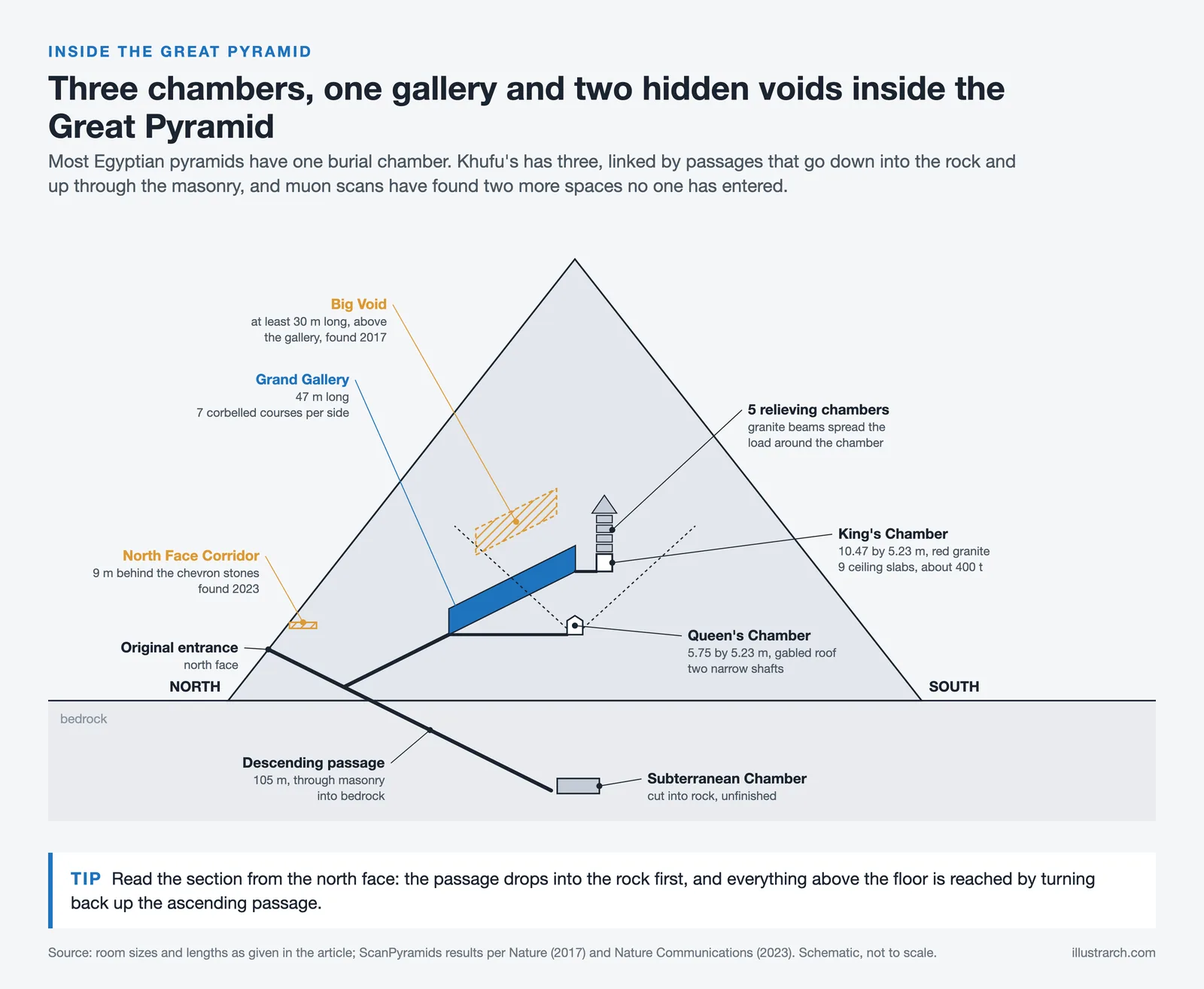
The great pyramid of giza interior is unlike any other Egyptian pyramid. While most pyramids contain a single burial chamber, Khufu’s monument includes three distinct chambers connected by a network of ascending and descending passages. Each of these spaces tells a different story about the construction process and the evolving plans of its builders.
The Subterranean Chamber
A descending passage, beginning at the original entrance about 18 metres above ground on the north face, leads 105 metres downward through the pyramid’s masonry and into the bedrock beneath. At its end lies the Subterranean Chamber, a roughly hewn room carved directly into the rock. This chamber was left unfinished, leading scholars to believe it was either an abandoned initial burial chamber or a deliberate symbolic element.
The Queen’s Chamber
Despite its name (given by Arab explorers, not ancient Egyptians), this room was almost certainly not intended for a queen. Located along a horizontal passageway that branches from the lower end of the Grand Gallery, it measures roughly 5.75 by 5.23 metres, with a pointed gable ceiling. Two narrow shafts extend from the north and south walls, though they do not reach the exterior of the pyramid. Researchers from the ScanPyramids project have used small robots to explore these shafts, but blocking stones have obscured their full length and purpose.
The Grand Gallery
The Grand Gallery is one of the most architecturally impressive interior spaces of the ancient world. Stretching 47 metres long and soaring 8.7 metres high, its corbelled walls step inward in seven courses on each side, narrowing as they rise. This technique effectively distributes the enormous weight of the stone above, preventing the passage from collapsing. Walking through this space today, visitors must crouch at the entrance before entering a corridor that opens upward with unexpected grandeur.
The King’s Chamber
At the upper end of the Grand Gallery, through a low antechamber, lies the King’s Chamber. Constructed entirely from red Aswan granite, this room measures 10.47 by 5.23 metres, with a flat ceiling of nine granite slabs weighing approximately 400 tonnes combined. Inside sits an empty granite sarcophagus, slightly wider than the ascending passage, meaning it was placed during construction rather than brought in afterward.
Above the King’s Chamber, five stress-relieving chambers were stacked, each containing massive granite beams topped by cantilevered limestone slabs forming a peaked roof. This ingenious system redirects the millions of tonnes of stone pressing down from above, protecting the burial chamber from collapse. It remains one of the finest examples of structural engineering from the ancient world.
For a deeper exploration of how ancient engineering principles continue to shape modern thinking, see our article on 7 Landmark Buildings That Defined Architectural Eras.

How Was the Great Pyramid Built?
The construction methods of the Great Pyramid remain one of archaeology’s most debated questions. No single theory has achieved universal consensus, but recent discoveries have significantly narrowed the range of plausible explanations. What is clear is that the project required extraordinary logistical coordination, a well-fed and organized workforce, and a deep understanding of materials and geometry.
Quarrying and Stone Transportation
The bulk of the pyramid’s core blocks were quarried from the Giza Plateau itself, just south of the building site. Workers used hardened copper chisels, wooden mallets, and stone hammers to cut channels around limestone blocks. A 2017 archaeological experiment at an abandoned Khufu-era quarry, led by stonemason Franck Burgos, demonstrated that replicas of these ancient tools could successfully extract a 2.5-tonne block within a practical timeframe.
For transportation, evidence increasingly points to a system of waterways, sledges, and ramps. Tomb paintings from the period depict teams of men pulling stone-laden sledges over moistened sand, a technique that, according to tribology research at the University of Amsterdam, reduces the pulling force by roughly 50%. The Diary of Merer describes boats delivering Tura limestone casing blocks to a harbour (She Akhet-Khufu) near the construction site, managed by Ankh-haf, Khufu’s half-brother, whom the papyri call a noble and overseer of the harbour; he is thought to have served as vizier later, after Hemiunu.
Ramp Theories
Most Egyptologists agree that some form of ramp was used to raise blocks to higher courses, though the exact configuration is debated. The leading proposals include straight external ramps (problematic due to their massive required size), spiral external ramps wrapping around the pyramid’s faces, and Jean-Pierre Houdin’s internal ramp theory, which suggests a spiralling passage hidden within the pyramid itself. A notch at the northeast corner of the pyramid at about 82 metres elevation lends some support to Houdin’s hypothesis, but conclusive proof awaits non-invasive verification.
The Workforce
Contrary to the popular myth of slave labour (originating from Herodotus writing 2,000 years after construction), archaeological evidence from workers’ villages excavated near the pyramids by Mark Lehner and Zahi Hawass shows that the builders were skilled Egyptian citizens. According to excavations published by Ancient Egypt Research Associates (AERA), these workers lived in organized barracks, received rations of bread, beer, and meat, and were divided into work gangs with names like “Friends of Khufu.” Estimates for the permanent workforce range from 20,000 to 25,000 workers, supplemented by seasonal agricultural labourers during the Nile’s annual flood season.
Recent Discoveries: The ScanPyramids Project
Modern technology is peeling back layers of mystery that centuries of physical exploration could not reach. The most significant recent breakthrough comes from the ScanPyramids project, a multinational collaboration between Egyptian, Japanese, and French research teams that has been using non-invasive scanning methods since 2015.
In 2017, the team announced the detection of a large void above the Grand Gallery, a cavity at least 30 metres long with a cross-section similar to the Gallery itself. Published in the journal Nature, this finding was confirmed at a five-sigma statistical confidence level using muon tomography, a technique that detects density variations by tracking subatomic particles generated when cosmic rays strike Earth’s atmosphere. The void’s purpose remains unknown. Some researchers propose it served a structural function, while others suggest it could be a previously unknown passage.
In 2023, the same team revealed a 9-metre (30-foot) corridor behind chevron-shaped stones near the pyramid’s north face entrance. Researchers used an endoscope to capture images of the space, which has a gabled ceiling and unfinished walls. According to the study in Nature Communications, this corridor likely served to redistribute weight above the main entrance, though its exact relationship to the larger “Big Void” is still under investigation.
These findings underscore how much remains hidden within this 4,500-year-old structure. For anyone interested in how ancient design principles influenced later movements, our guide to the history of architecture from ancient times to modern day provides useful context.
The Pyramid’s Legacy in Architectural History
The Great Pyramid is more than an archaeological curiosity. It represents a turning point in the history of building, demonstrating that large-scale monumental construction was achievable through organization, mathematical understanding, and material science rather than supernatural means.
Its influence extends through millennia. The Roman historian Pliny the Elder wrote about the pyramids in his Natural History. The Arab polymath Abd al-Latif al-Baghdadi studied them with scientific rigour in the 12th century. Napoleon’s expedition to Egypt in 1798 sparked a wave of Egyptomania that influenced neoclassical architecture across Europe and the Americas, from cemetery monuments to the glass pyramid at the Louvre designed by I.M. Pei.
From an engineering standpoint, several principles visible in the Great Pyramid remain relevant today: the use of a stable geometric form to distribute load, the careful selection and matching of materials to function (soft limestone for bulk, hard granite for structural stress points), and the integration of redundant safety features like the King’s Chamber’s relieving chambers. These concepts echo in modern structural design, from skyscraper foundations to seismic-resistant architecture.
If you are interested in exploring more iconic structures and their architectural significance, our article on masterpieces of architectural design covers landmark buildings across different eras, while our guide to top 10 architectural wonders around the globe provides additional context.
Dimensions and historical dates in this article are based on published measurements by Flinders Petrie (1883) and updated surveys. Construction timelines follow the conventional Egyptian chronology accepted by mainstream Egyptology. Some dates may vary by up to a few decades depending on the chronological framework used.




Restorers Uncover 16th-Century Murals Hidden by Nuns in Villa Silvestri Rivaldi
Conservators in Rome are uncovering 16th-century murals hidden for 300 years inside...
 illustrarch Editoral Team3 Mins read

A 2,500-Year-Old Solar Observatory in Puebla Is the First Group E Complex Found Outside the Maya Area
Archaeologists working for Mexico's INAH have confirmed that two platforms at Teteles...
illustrarch Editoral Team2 Mins read

Donald Insall, the Conservation Architect Who Led Windsor Castle’s Restoration, Dies at 100
Donald Insall, the British architect who turned conservation into a planning discipline...
illustrarch Editoral Team2 Mins read
New Digging Season at the Mieza Gymnasium Uncovers Alexander’s School Complex
New digs at Mieza uncover teaching halls and mosaic banquet rooms at...
illustrarch Editoral Team2 Mins read


Leave a comment