

Rise Tower Saudi Arabia: A Future Supertall Set to Redefine Global Skylines
Rise Tower is a proposed 2,000-meter megatall skyscraper in Riyadh backed by Saudi Arabia's Public Investment Fund. Designed by Foster + Partners as part of the North Pole district, this 678-floor vertical city would feature hotels, offices, observation decks, and sustainability systems including solar cladding and wind turbines, surpassing both the Burj Khalifa and Jeddah Tower.
 Sinan Ozen7 March 20266 Mins read350
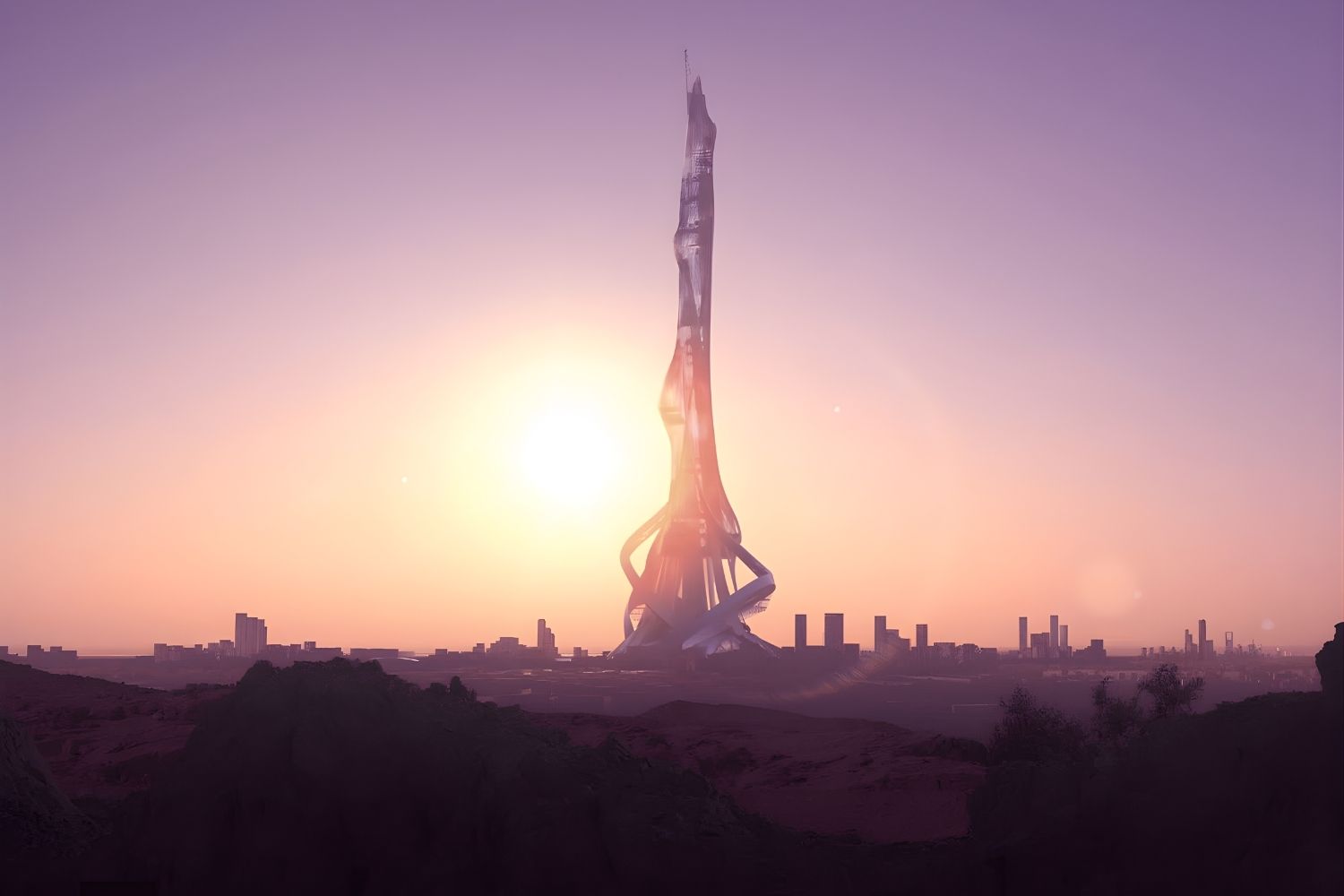
Table of Contents Show
Rise Tower is a planned 2,000-meter megatall skyscraper in Riyadh, Saudi Arabia, designed to become the world’s first two-kilometer-tall building. Backed by the Public Investment Fund (PIF) and reportedly designed by Foster + Partners, this 678-story structure would surpass both the Burj Khalifa and Jeddah Tower, serving as the centerpiece of the North Pole district under Saudi Arabia’s Vision 2030 initiative.
Saudi Arabia’s ambition to reshape global architecture has reached a new peak. The Rise Tower, proposed for the northern outskirts of Riyadh, aims to stand at a staggering 2,000 meters (6,562 feet), roughly 2.4 times the height of Dubai’s Burj Khalifa. If realized, it would not only claim the title of the tallest building in the world but fundamentally change how we think about vertical urbanization and supertall engineering.
The project emerged in late 2022 when industry publication MEED reported that the PIF was exploring plans for a record-breaking tower as part of an approximately 18 km² development in North Riyadh. By August 2023, Saudi Arabia Holding Company CEO Mohammed al-Qahtani officially unveiled the designs. In early 2025, the PIF’s Tower District Real Estate Development Company issued requests for proposals from global project management consultancy firms, including Aecom, Bechtel, Jacobs, Parsons, Turner, and Mace.
What Makes Rise Tower Saudi Arabia Unprecedented?
No building in history has attempted the two-kilometer threshold. To put the scale in perspective, Rise Tower would stand more than four times taller than the Empire State Building and roughly double the height of the Jeddah Tower, which itself has struggled through years of construction delays at approximately 1,000 meters. The proposed 678 floors would house a vertical city containing luxury hotels, residential apartments, premium offices, cultural venues, fine-dining restaurants, and panoramic observation decks positioned above the clouds.


Rise Tower vs Other Towers of Saudi Arabia and the World
The following table compares Rise Tower against other significant skyscraper projects:
| Building | Height | Location | Status | Floors |
|---|---|---|---|---|
| Rise Tower | 2,000 m (6,562 ft) | Riyadh, Saudi Arabia | Proposed / Tendering | 678 |
| Jeddah Tower | 1,000+ m (3,281+ ft) | Jeddah, Saudi Arabia | Under Construction | 157+ |
| Burj Khalifa | 828 m (2,717 ft) | Dubai, UAE | Completed (2010) | 163 |
| Makkah Royal Clock Tower | 601 m (1,972 ft) | Mecca, Saudi Arabia | Completed (2012) | 120 |
| Shanghai Tower | 632 m (2,073 ft) | Shanghai, China | Completed (2015) | 128 |
The North Pole District: A City of the Future
Rise Tower does not exist in isolation. It anchors the North Pole district, a 306-square-kilometer smart city development in North Riyadh near King Khalid International Airport. The district is planned as an integrated urban ecosystem combining residential neighborhoods, commercial hubs, cultural landmarks, educational institutions, healthcare facilities, and entertainment spaces.
Transportation within the North Pole district reflects Saudi Arabia’s push toward future city planning. Reports describe plans for air taxis, autonomous vehicles, a high-speed underground metro, and pedestrian-friendly streets with extensive bike lanes. The district’s energy systems are designed around solar power and other renewable sources, aligning with the kingdom’s broader climate commitments.
The strategic location near Expo 2030 and the New Murabba project positions Rise Tower as a focal point for international business and tourism. Saudi Arabia Holding Company CEO Mohammed Al Qahtani described the North Pole as a development that “seamlessly blends modernity with the beauty of nature, delivering a unique living experience.”

Who Designed Rise Tower?
The concept design for Rise Tower emerged from a design competition launched in late 2022, reportedly carrying a $1 million entry fee. Competition reporting and early renders attribute the winning concept to Foster + Partners, the London-based firm led by Sir Norman Foster, known for projects like the Hearst Tower and 30 St Mary Axe in London. HKS Architects has also been credited with design proposals for the project, including the “Project Rise, Lumenis” concept that received the 2025 WAFX Prize for Climate and Energy Innovation.
Among the firms linked to the early competition stages were Skidmore, Owings & Merrill (SOM) and Adrian Smith + Gordon Gill Architecture, the same firm behind the Burj Khalifa and Jeddah Tower. The involvement of such high-profile practices signals the seriousness of the proposal, even while official specifications remain unpublished.
Engineering Challenges of Saudi Arabia Skyscraper Projects at 2 km
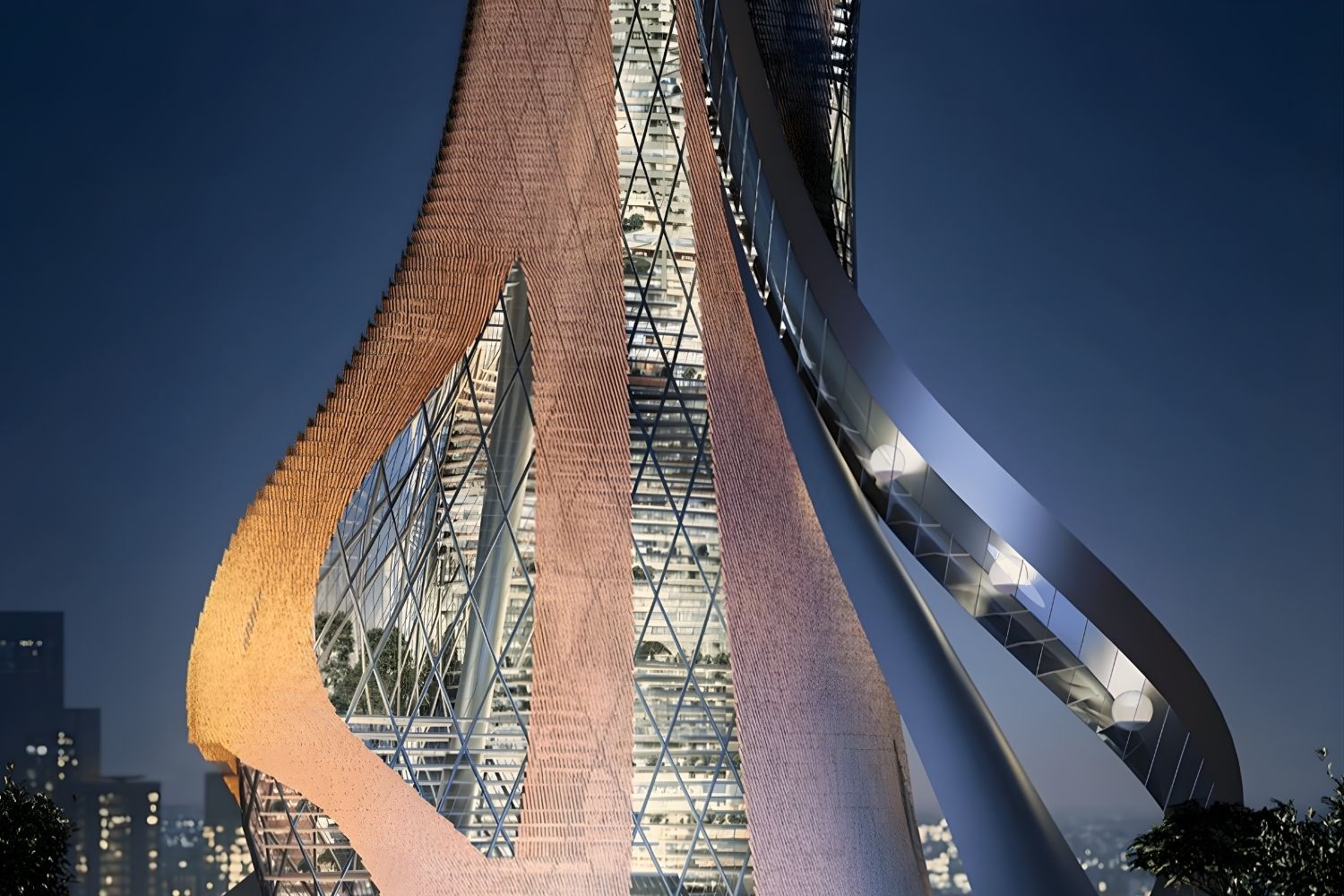
Building a tower twice the height of anything ever constructed presents engineering problems with no proven solutions at this scale. Wind forces at 2,000 meters are immense, and the structure must account for vortex shedding, oscillation, and dynamic lateral loads that grow exponentially with height. Early renders suggest a vertical cluster design with multiple interlinked legs anchored to a central core, a structural approach that distributes wind loads more effectively than a single monolithic shaft.
Foundation engineering in the Riyadh desert context adds another layer of complexity. The tower’s weight, distributed across 678 floors, demands unprecedented foundation systems capable of bearing loads far beyond anything current technology has delivered. Vertical transportation also requires rethinking: conventional elevator systems cannot efficiently serve a building this tall. Sky lobby systems, express elevators operating in pressurized shafts, and potentially even cable-less magnetic elevator technology would all need consideration.
“The best sustainable buildings are not the ones with the most technology, but the ones that work with their climate, not against it.”
Bjarke Ingels, Founder of BIG Architects
Material science is equally critical. The tower would need to integrate lightweight, high-strength materials like carbon fiber-reinforced concrete and advanced steel alloys that perform under the extreme temperature differentials of the Saudi desert, where ground-level conditions can reach 50°C while upper floors experience sub-zero temperatures.

Sustainability Features and New Towers in Saudi Arabia 2025
Rise Tower’s design integrates several sustainability strategies that reflect the broader trend among new towers in Saudi Arabia 2025 and the kingdom’s evolving climate agenda. Reports describe photovoltaic solar cladding on the building’s exterior, wind turbines embedded within sky decks, and advanced water recycling systems. The goal, according to multiple design reports, is achieving a net-zero energy footprint.
Biophilic design elements are woven throughout the concept. Sky gardens, vertical green walls, and natural ventilation systems aim to support occupant well-being across hundreds of floors. Smart building systems powered by IoT sensors would optimize energy consumption in real time, adjusting lighting, climate control, and circulation based on occupancy patterns.
The 2025 WAFX Prize recognition for Climate and Energy Innovation, awarded to the HKS “Project Rise, Lumenis” concept, validates the project’s sustainability credentials within the professional architectural community. The name “Lumenis,” derived from the Latin word for light, signals the project’s intention to position itself as a symbol of transformation within Saudi Arabia’s Vision 2030 framework.
Saudi Arabia Rise Tower Construction: Timeline and Current Status
As of February 2026, no formal groundbreaking date, contract awards, or definitive construction specifications have been announced by the developer or PIF. The Tower District Real Estate Development Company, a PIF subsidiary, issued requests for proposals for project management consultancy in early 2025, with firms like Aecom, Bechtel, Jacobs, Parsons, Turner, and Mace reportedly among the bidders.
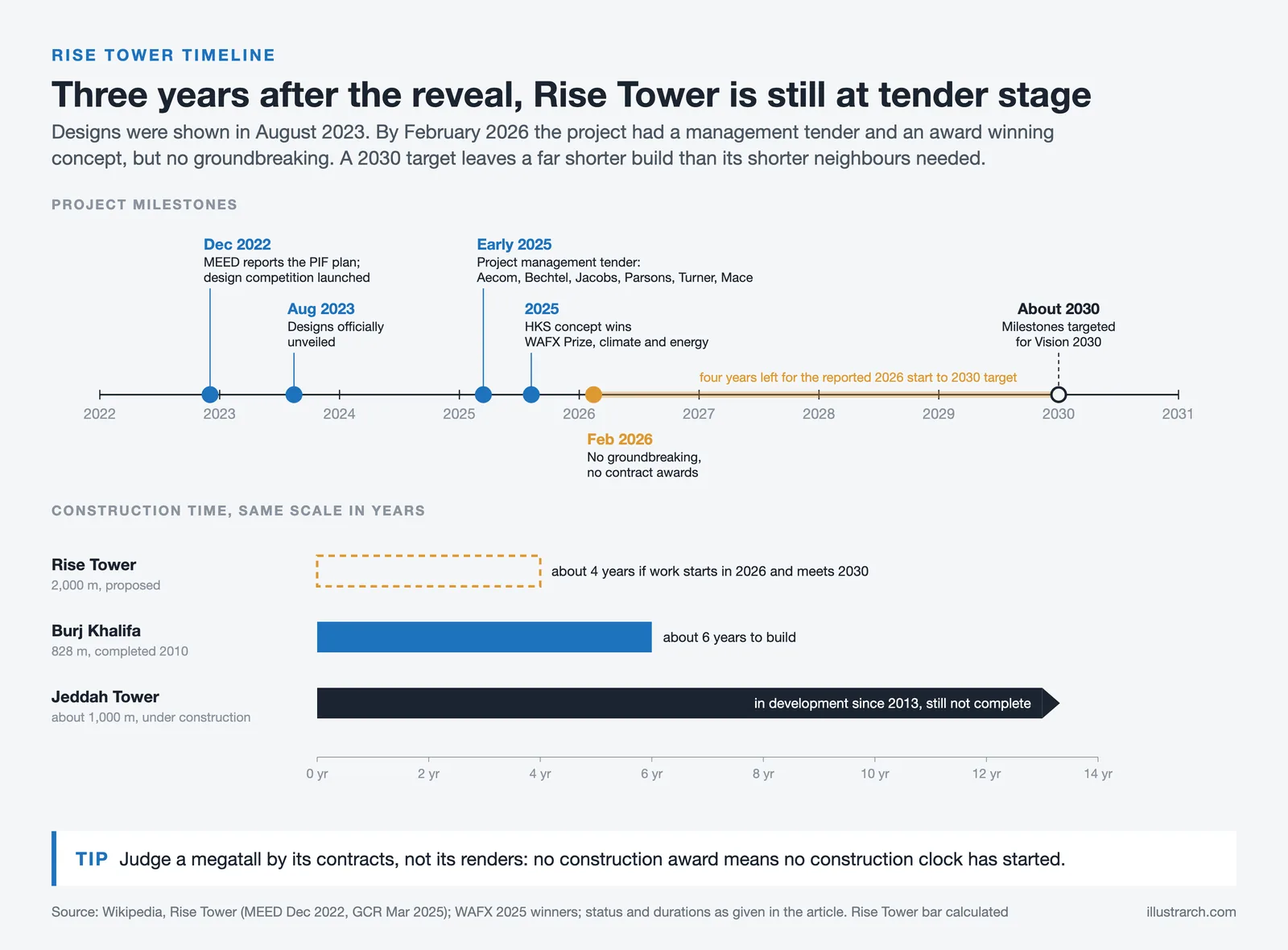
Some reports suggest construction could begin in 2026, with major milestones targeted for completion around 2030 to align with Vision 2030 objectives. However, the project’s scale makes a compressed timeline challenging. For context, the Burj Khalifa took approximately six years to build at 828 meters. The Jeddah Tower, at roughly half Rise Tower’s proposed height, has been in development since 2013 and only recently resumed active construction.
The estimated construction budget of $5 billion has drawn scrutiny from industry analysts. Some contractors in the region estimate that the actual cost could balloon significantly beyond initial projections, as the Council on Tall Buildings and Urban Habitat (CTBUH) has noted in its coverage of the project’s tendering process. Cost overruns are common in supertall construction, and a structure of this unprecedented scale carries proportionally greater financial risk.
Cost figures cited in this article are approximate estimates reported by trade publications and may vary significantly as the project progresses through design development and procurement phases.

Rise Tower’s Role in Vision 2030 and Riyadh’s Transformation
The tallest tower in Saudi Arabia currently stands in Mecca: the Makkah Royal Clock Tower at 601 meters. Riyadh’s tallest completed building, the PIF Tower, reaches 385 meters. Rise Tower would represent an extraordinary leap in vertical ambition for the capital city.
This project fits within a broader pattern of Saudi Arabia skyscraper projects designed to position the kingdom as a global hub for business, tourism, and innovation. Alongside Rise Tower, active developments include NEOM’s planned Sky Stadium, the New Murabba downtown district, and the King Salman International Airport expansion. Each of these giga-projects serves Vision 2030’s strategic goal of reducing economic dependence on oil by building world-class infrastructure that attracts foreign direct investment and global talent.
If completed, Rise Tower would likely generate the same kind of international recognition that the Burj Khalifa brought to Dubai, transforming Riyadh’s identity on the global stage. The economic ripple effects could extend well beyond tourism, stimulating growth in real estate, hospitality, technology, and professional services throughout the region.
Whether the Rise Tower ultimately reaches its full 2,000-meter ambition or undergoes revisions during development, the project already represents a significant statement about the future of architecture and the evolving limits of human engineering. The world will be watching as Riyadh reaches for the sky.





Interior Design for Commercial Spaces: Enhancing Functionality and Brand Identity
Commercial interior design has to serve brand, function and regulation at once....
 Begum Gumusel4 Mins read

Famous Buildings in Los Angeles: Icons of LA Architecture
Nine of the most famous buildings in Los Angeles profiled: architect, year,...
 illustrarch Editoral Team9 Mins read
Futuro House Production Revived in Finland After Decades-Long Hiatus
A Facebook listing for abandoned moulds led to the first new Futuro...
illustrarch Editoral Team3 Mins read
Building Your Dream Home in NSW: What You Should Know About Montgomery Homes
Montgomery Homes has been building across Sydney, Newcastle, the Hunter, Wollongong and...
illustrarch Editoral Team4 Mins read


Leave a comment