

Longest Outdoor Escalator China: Wushan Goddess Explained
China's Wushan Goddess Escalator opened in February 2026 as the world's longest outdoor escalator system. Stretching 905 meters and rising 242 meters through the mountains of Chongqing, it connects previously isolated neighborhoods while cutting a one-hour climb down to just 20 minutes.
 Elif Ayse Sen4 April 20267 Mins read240
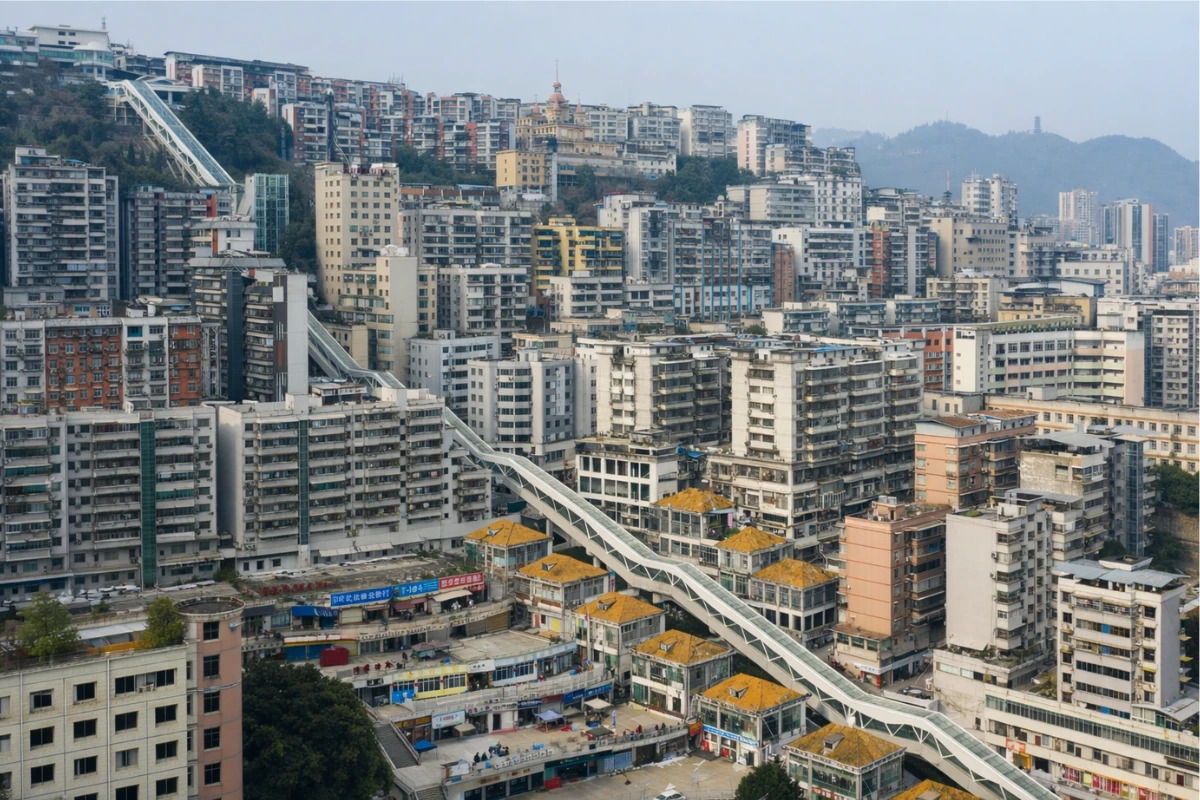
Table of Contents Show
The longest outdoor escalator China has ever built, the Wushan Goddess Escalator in Chongqing, officially opened on February 17, 2026. Stretching 905 meters and climbing 242 meters, the system links riverside neighborhoods to hilltop districts in just 20 minutes, replacing a steep one-hour trek that residents had endured for decades.
What Is the Wushan Goddess Escalator?
The Wushan Goddess Escalator, also called the Shennü Escalator, is the world’s longest outdoor escalator system. It runs through Wushan County along the vertical axis of Goddess Avenue, connecting lower riverside neighborhoods near the Yangtze River to elevated residential and civic districts in the Gaotong area of Chongqing municipality.
The project is named after the mythological goddess Yaoji, a figure closely associated with the Wu Gorge and surrounding mountain peaks visible along the route. What began as a concept in 2002 was revived in 2022 by local authorities responding to growing congestion and mobility demands, with the four-year engineering effort led by Huang Wei and the team at China Railway Eryuan Engineering Group.
📌 Did You Know?
Wushan County was originally relocated when the Three Gorges Dam was constructed, one of the world’s largest hydroelectric projects. The new escalator now stitches together the rebuilt riverside town and the older hilltop neighborhoods that survived that resettlement, giving this infrastructure project an unusually deep historical dimension.
Engineering Specifications: Scale and Complexity

The system is not a single continuous moving stairway. It is a three-dimensional vertical transport corridor composed of 21 escalators, 8 elevators, 4 moving walkways, 2 pedestrian bridges, and 2 elevated overpasses, all linked into a single continuous route. The complete ascent from bottom to top takes approximately 21 minutes.
To understand the scale: the system’s 242.14-meter vertical rise is equivalent to climbing an 80-story skyscraper. Slopes along the route average 35 percent and reach nearly 60 percent at the steepest points, a gradient that ruled out simpler transit alternatives during the planning phase.
🔢 Quick Numbers
- 905 meters total length, the world’s longest outdoor escalator system (China Railway Eryuan Engineering Group, 2026)
- 242.14 meters vertical rise, equivalent to an 80-story building (Wushan County officials, 2026)
- 21 escalators + 8 elevators + 4 moving walkways in a single linked network (iChongqing, 2026)
- Approximately 9,000 daily riders, with 450,000 rides recorded during Spring Festival 2026 (Financial Times, 2026)
The moving stairways themselves were manufactured by Swiss company Schindler at a facility near Shanghai. Schindler’s Chinese operations have supplied around 1,400 escalators to the Chongqing metro system, making the collaboration a natural fit for a project of this scale.
Mountain-Hugging Design: Why It Looks Different
Most urban escalator systems cut straight lines through space. The Goddess Escalator does the opposite. Lead engineer Huang Wei described the design as modular, with escalator segments combined “like building blocks” to follow Wushan’s fragmented terrain. The result is a system that curves and bends with the mountainside rather than slicing through it.
Glass panels enclose the route along much of its length, preserving panoramic views of the Wu Gorge and Three Gorges scenery. Viewpoints and observation platforms are integrated into the route at key intervals. The design team also built lighting installations at major nodes so that after dark the escalator becomes a ribbon of light winding through the hills, actively contributing to Wushan’s nightscape economy.
💡 Pro Tip
When designing escalator systems for extreme topography, engineers at China Railway Eryuan found that a modular block-based assembly was far more adaptable than a single rigid structure. Planning around the existing terrain rather than against it reduced both construction disruption and long-term maintenance demands, a principle increasingly relevant to urban mobility projects in mountainous regions worldwide.
Engineers also had to route the system around underground pipelines and suspended urban roads that cross the hillside. The three-dimensional layout of the route was partly dictated by these existing obstacles rather than purely by the ideal pedestrian path.
Why Chongqing? A City Built for Vertical Transit

Chongqing is frequently described as China’s “Mountain City” and sometimes nicknamed an “8D city” for the layered, multi-level quality of its urban fabric. Streets, transit lines, and residential towers coexist across radically different elevations. The city has already produced several unusual infrastructure achievements: a subway platform that ranks as the world’s deepest, and a monorail that passes through the middle floors of a residential building at Liziba Station.
This culture of adapting transit to extreme geography meant that Wushan had a ready model to draw from. The earlier Crown Grand Escalator, a 112-meter-long covered escalator connecting railway stations downtown, had been a working template since the 1990s. The Goddess Escalator surpasses it in both length and construction complexity, but the Crown Escalator proved that Chongqing’s residents were already comfortable using escalators as serious daily transit rather than novelty features.
🎓 Expert Insight
“Our goal was for infrastructure itself to become a destination. It’s not just a way to get from point A to point B, but part of the city’s experience.” — Huang Wei, Lead Engineer, China Railway Eryuan Engineering Group
This design philosophy, embedding tourism and urban experience directly into functional infrastructure, marks a broader shift in how cities with complex terrain think about transit investment. The escalator is simultaneously a commuter tool and a tourist attraction, a combination that changes the financial and civic calculus for projects of this kind.
During the planning phase, engineers evaluated cable cars, sightseeing trains, and light rail before settling on the escalator system. The deciding factors were capacity, safety, lifecycle costs, and adaptability to steep, uneven gradients where a fixed rail would require far more invasive groundwork.
Where Is the World’s Longest Outdoor Escalator System?

The world’s longest outdoor escalator system is located in Wushan County, part of Chongqing municipality in southwestern China. The system runs along Goddess Avenue in the Gaotong district, with the lower entrance near riverside roads along the Yangtze River and the upper terminus connecting to schools, hospitals, museums, and residential areas on the hilltop.
Wushan sits at the entrance to the Three Gorges region, a stretch of the Yangtze historically known for dramatic karst scenery. The gorge views visible through the escalator’s glass panels mean that the transit route itself functions as a sightseeing experience. Officials describe the project as part of Wushan’s wider positioning as a gateway destination for Three Gorges tourism.
What Problem Did It Solve?
Before the escalator opened, residents of the Gaotong neighborhood faced a choice between a one-hour walk along steep, narrow roads or a car trip that could take equally long during peak traffic. Elderly residents and those with mobility limitations had particularly restricted access to riverside services. For roughly 50,000 people living in the surrounding area, daily errands required either significant physical exertion or dependence on vehicle transport.
The Goddess Escalator cut that journey to approximately 20 minutes, regardless of physical condition or the time of day. It directly connects the riverside road network to hospitals, schools, and museums that were previously difficult to reach from lower neighborhoods without a vehicle.
⚠️ Common Mistake to Avoid
Many reports describe the Wushan Goddess Escalator as a single escalator. It is not. The system comprises 21 separate escalators linked with elevators, moving walkways, and pedestrian bridges. Understanding it as a continuous vertical transit corridor, rather than one extended moving stairway, is essential for accurately interpreting both its engineering and its operational model.
Ridership and Fare Structure
The system entered a paid trial period on February 17, 2026, following free trial rides from February 12 to 16. The trial fare was set at 3 yuan per person (approximately $0.40 USD) for a one-way trip. Local authorities stated they would review usage and performance data before announcing a permanent fare structure.
Early ridership figures suggest strong adoption. Around 9,000 people use the system daily during regular operations, and approximately 450,000 rides were recorded across the Spring Festival period. Officials say they expect ridership to grow as awareness of the system spreads among both local commuters and tourists visiting the Three Gorges region.
Can This Model Work in Other Cities?

Officials from Chongqing have said openly that they believe the Goddess Escalator model could be replicated in other mountainous regions. China has dozens of cities built across steep terrain where surface roads are congested and vertical movement remains an unsolved daily problem. The modular assembly method used in Wushan is specifically designed to adapt to varying slope angles and irregular urban footprints, which makes it more transferable than a purpose-built cable car or funicular system.
Internationally, several cities already use outdoor escalator systems for urban mobility. Medellín, Colombia operates a well-documented outdoor escalator network in its hillside neighborhoods, and Hong Kong’s Mid-Levels Escalator has served as a functional urban transit link since 1993. The Wushan system significantly surpasses both in length and vertical reach, and its documented ridership figures provide a new data point for cities considering similar investments.
🏗️ Real-World Example
Medellín Electric Urban Escalators (Medellín, Colombia, 2011): The Comunas 13 neighborhood escalator system in Medellín covers 384 meters across six sections, reducing a 35-minute uphill walk to a 6-minute ride for over 12,000 residents daily. The project became internationally recognized for combining transit infrastructure with neighborhood revitalization and is widely cited in urban planning literature as a model for hillside mobility in lower-income communities.
Broader Significance for Urban Architecture
The Goddess Escalator reflects a wider rethinking of what infrastructure can do in cities with extreme topography. Rather than flattening the terrain or routing people around it, the project equips the slope with mobility, treating vertical movement as a design challenge rather than a planning obstacle.
Architectural commentary from Domus and Parametric Architecture has described the system as part of a genealogy of projects that “transform the slope into habitable space,” consistent with Chongqing’s general approach of building with the terrain rather than against it. The glazed facades and observation platforms embedded into the route signal that the designers were thinking beyond pure transit, positioning the journey itself as an architectural experience.
For architects and urban designers working in mountainous or hilly cities, the Wushan project offers a clear template: vertical transit systems can carry both commuters and urban identity simultaneously. The escalator has already become a tourist attraction in its own right, contributing to the local economy in ways that extend well beyond reduced commute times.
💡 Pro Tip
Architects and urban planners working on hillside communities should note that the Wushan team evaluated cable cars, sightseeing trains, and rail transit before selecting the escalator system. The escalator won on lifecycle cost, weather resilience, and the ability to serve residential density rather than tourist throughput. Running a comparative transport analysis before committing to a vertical mobility solution remains one of the most underused steps in mountainous city planning.
✅ Key Takeaways
- The Wushan Goddess Escalator is the world’s longest outdoor escalator system at 905 meters, climbing 242 meters through the mountains of Chongqing, China.
- The system comprises 21 escalators, 8 elevators, 4 moving walkways, and 2 pedestrian bridges — not a single continuous stairway.
- The mountain-hugging modular design follows the natural terrain rather than cutting through it, and the glass enclosure preserves views of the Three Gorges.
- The escalator cut a one-hour commute for roughly 50,000 residents down to 20 minutes, while also functioning as a tourism and nightscape attraction.
- Engineers from China Railway Eryuan Engineering Group evaluated cable cars, trains, and rail transit before selecting escalators as the most appropriate solution for Wushan’s specific topography.
- The project points toward a replicable model for mountainous cities where vertical mobility has historically been an unsolved infrastructure problem.
For further reading on public space design and urban infrastructure, the articles on how architectural public spaces shape urban life, architecture as infrastructure, historical streets that tell architectural stories, and walkway design in urban areas offer relevant design context. The article on the architecture of mobility also provides useful background on how urban transit shapes city form.
For primary sources on the Wushan project, coverage from iChongqing, Domus, and Elevator World provides detailed engineering and urban design analysis. The Interesting Engineering report covers the operational and community impact aspects, while Parametric Architecture examines the design philosophy in depth.
- chongqing escalator china
- longest outdoor covered escalator
- longest outdoor escalator
- longest outdoor escalator in the world
- longest outdoor escalator system in the world
- where is the longest outdoor escalator system
- where is the world's longest outdoor escalator system
- world's longest outdoor escalator
- world's longest outdoor escalator system
- wushan goddess escalator



Groupwork Completes 10-Storey Loadbearing Granite Flats in London
Groupwork's Petra Heights on Finchley Road is a 10-storey block of 22...
 illustrarch Editoral Team2 Mins read
Ai Weiwei Installs 500 Cast-Iron Helmets Outside Sydney Museum
Ai Weiwei's 500 cast-iron helmets opened outside Sydney's MCA on 25 September,...
illustrarch Editoral Team2 Mins read

Isamu Noguchi at Lever House Traces Sculptor’s Decades-Long Collaboration with Bunshaft
Lever House's new exhibition pairs Noguchi sculptures with unbuilt garden designs made...
illustrarch Editoral Team2 Mins read
Relocated Maya Structures at Mexico’s Balam Tun Memory Park Face Legal Challenge
INAH archaeologists have filed a complaint against 26 officials over Balam Tun...
illustrarch Editoral Team2 Mins read


Leave a comment