

Best Architecture Schools in the US: Complete 2026 Rankings & Guide
Choosing from the best architecture schools in the US means weighing NAAB accreditation, faculty expertise, studio culture, and career outcomes. This guide covers top undergraduate and graduate programs ranked by QS, DesignIntelligence, and licensure pass rates to help you find the right fit for your architectural ambitions.
 Sinan Ozen4 April 202613 Mins read492

Table of Contents Show
The best architecture schools in the US combine rigorous studio training, NAAB accreditation, and strong career networks to shape graduates who are ready to enter one of the most demanding creative professions. Whether you are researching undergraduate programs or exploring the top architecture graduate schools in the US, the right choice depends on your design philosophy, budget, and long-term career goals.

Why NAAB Accreditation Is Your First Filter
Before comparing rankings or tuition rates, check whether a program holds accreditation from the National Architectural Accrediting Board (NAAB). NAAB is the sole agency authorized to accredit professional architecture degrees in the United States, and most state registration boards require a degree from an NAAB-accredited program before you can sit for the Architect Registration Examination (ARE).
As of 2024, there are 176 NAAB-accredited programs housed in 140 institutions across the country, enrolling a total of 33,558 students. The programs span three degree types: Bachelor of Architecture (B.Arch.), Master of Architecture (M.Arch.), and Doctor of Architecture (D.Arch.). Enrollment in accredited programs grew by 12% in one academic year, from 30,068 students in 2022-23 to 33,558 in 2023-24, reflecting strong and sustained demand for architectural education.
🔢 Quick Numbers
- 176 NAAB-accredited programs in 140 US institutions (NAAB Annual Report, 2024)
- 33,558 students enrolled in accredited architecture degree programs as of AY 2023-24 (NAAB, 2024)
- Enrollment in accredited programs grew 12% from AY 2022-23 to AY 2023-24 (NAAB Annual Report, 2024)
- 57% of enrolled students are in B.Arch. programs; 43% in M.Arch. and D.Arch. programs (NAAB, 2024)
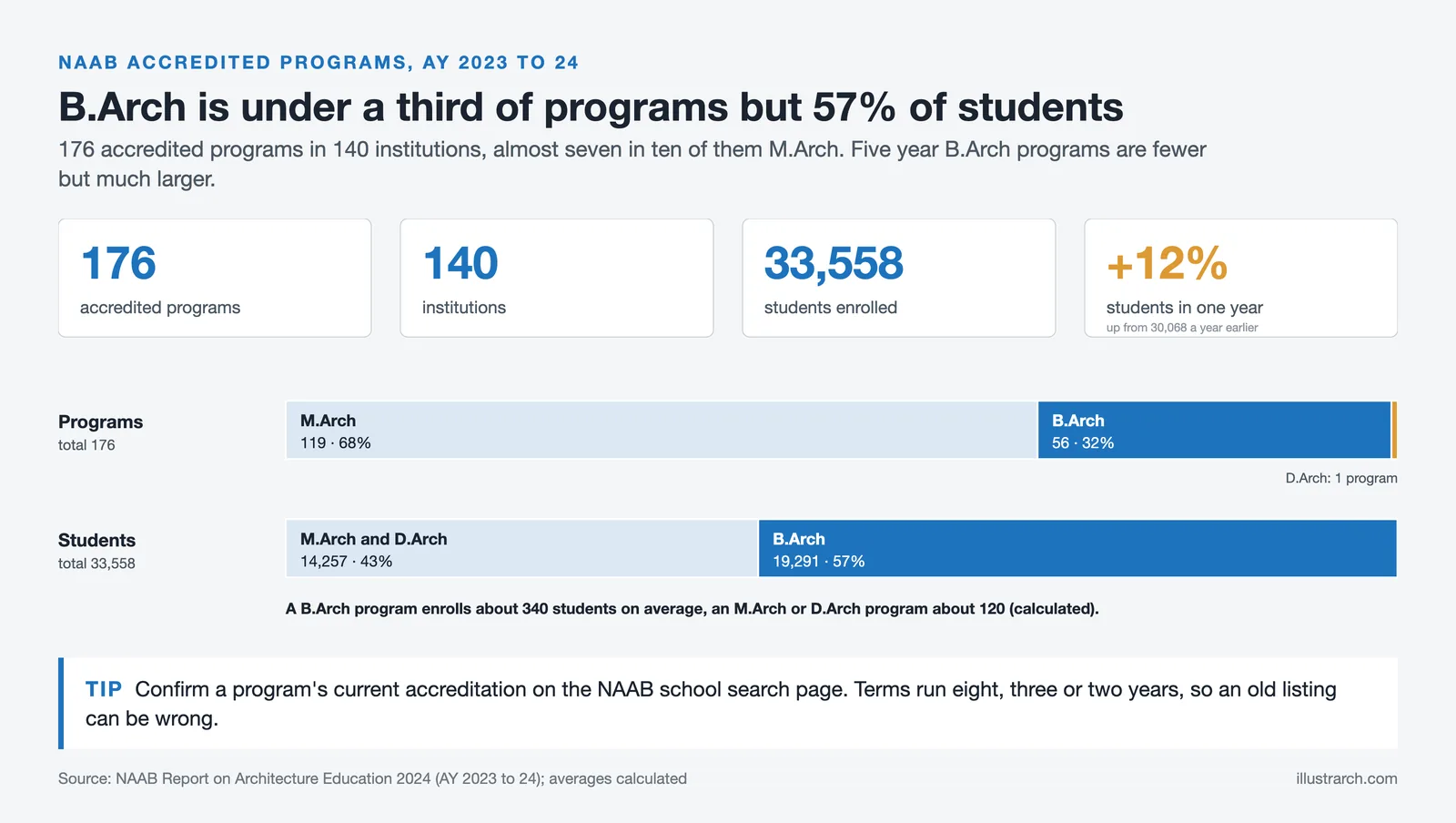
A program can receive an eight-year, three-year, or two-year accreditation term depending on how closely it meets NAAB’s educational standards. When researching any school, verify the current accreditation status directly on the NAAB school search page rather than relying on outdated listings.
⚠️ Common Mistake to Avoid
Many students confuse a pre-professional architecture degree (often a four-year B.S. or B.A. in Architecture) with a professional accredited degree. A pre-professional degree alone does not qualify you for licensure in most US states. You will still need to complete an NAAB-accredited B.Arch. or M.Arch. to meet the education requirement for the ARE. Always confirm the specific degree type and its accreditation status before enrolling.

What Are the Best Architecture Schools in the US for 2026?
Several authoritative sources rank US architecture programs, including the QS World University Rankings by Subject, DesignIntelligence, and Niche. While no single ranking tells the complete story, the schools below consistently appear at or near the top across multiple measures: faculty reputation, research output, employer surveys, and ARE licensure pass rates.
Massachusetts Institute of Technology (MIT)
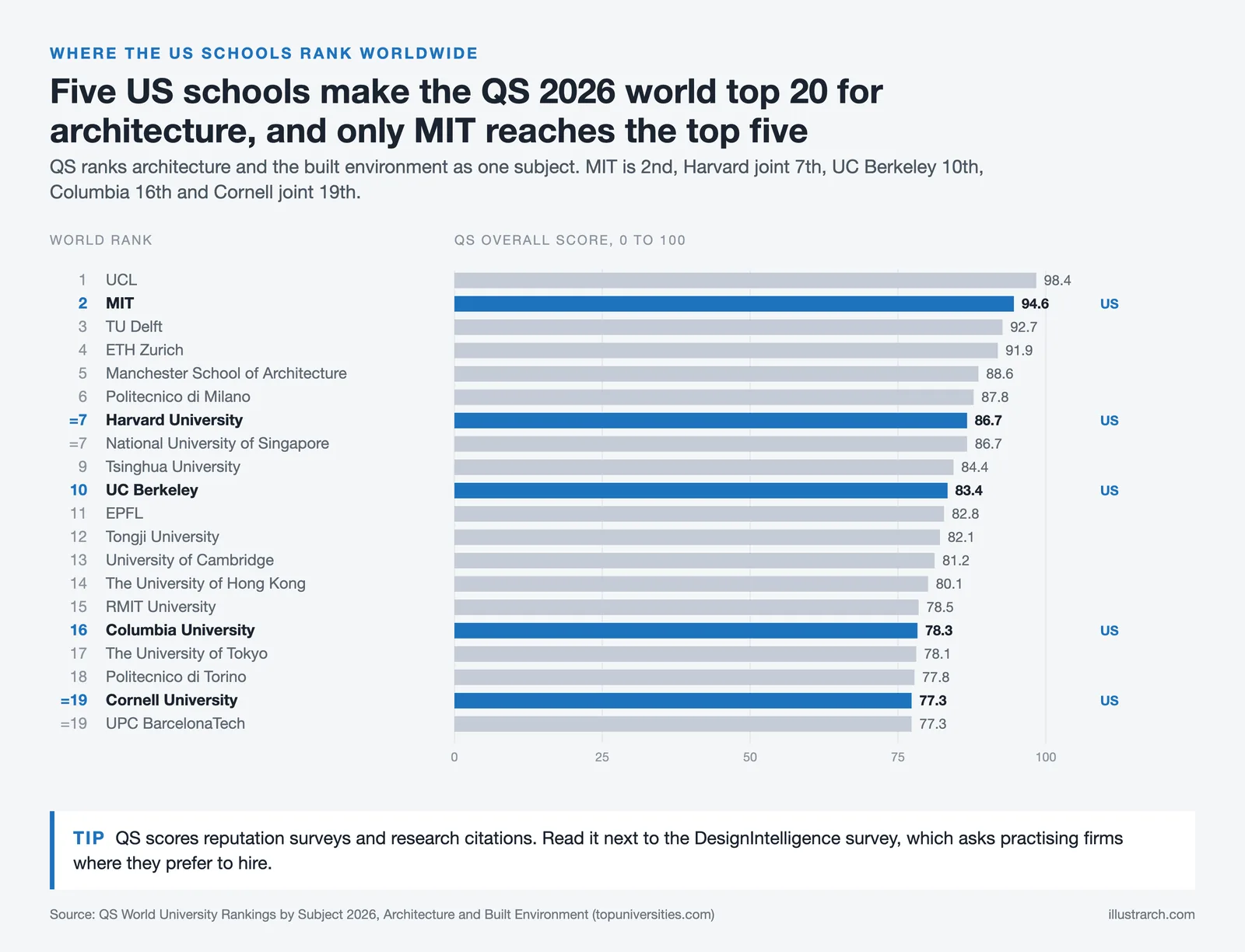
MIT ranks second globally and first in the US for architecture according to the QS World University Rankings by Subject 2026. The School of Architecture and Planning enrolled 255 undergraduates during the 2025-26 academic year and offers programs spanning architectural design, building technology, computational design, and urban studies. The school is historically significant as the site of the first official architecture curriculum offered within a university in the United States, founded by William Robert Ware. Graduates regularly place at firms including Skidmore Owings & Merrill (SOM), Gensler, and Perkins&Will.
Tuition is $64,310 per year for 2025-26 (as of October 2026). Admission is highly selective, with typical SAT scores in the 1500-1570 range and a GPA at or above 3.9.

Harvard University Graduate School of Design (GSD)
Harvard’s Graduate School of Design holds a QS ranking of joint seventh globally for architecture and is widely regarded as one of the best architecture graduate schools in the US for its interdisciplinary approach. The M.Arch. program admits roughly 100 students per year and integrates design innovation with historical analysis and sustainability research. Harvard is especially strong in landscape architecture, urban planning, and design theory. Annual tuition at the GSD falls between $60,000 and $70,000. Admission requirements are among the most competitive in the country, typically requiring a GPA of 3.8 or higher and a TOEFL score above 100 for international applicants.
🎓 Expert Insight
“Architecture should speak of its time and place, but yearn for timelessness.” — Frank Gehry, Pritzker Architecture Prize Laureate
This principle is reflected in the curricula of the best US architecture schools, which balance historical context with forward-looking studio work. Schools like Harvard GSD and Yale deliberately push students to solve contemporary problems while remaining grounded in architectural theory.
Yale School of Architecture
Yale’s architecture program is known for its strong emphasis on design innovation, rigorous critique culture, and a faculty that includes leading practitioners. The school offers a three-year M.Arch. for students without a pre-professional background, as well as a two-year M.Arch. for those with undergraduate architecture degrees. Its digital fabrication resources and the Digital Media Center for the Arts keep students at the frontier of computational design. Yale graduates are consistently ranked among the most sought-after by top-tier design firms.

Columbia University GSAPP
Columbia’s Graduate School of Architecture, Planning, and Preservation (GSAPP) sits in Manhattan, giving students direct access to one of the world’s densest and most diverse urban environments. The program places a strong emphasis on urbanism, sustainability, and architectural experimentation. The M.Arch. degree at GSAPP focuses on advanced design skills and technological proficiency, and graduates regularly join firms such as BIG (Bjarke Ingels Group), SOM, and Perkins&Will. Columbia’s QS ranking for architecture is 16th globally. Annual tuition is approximately $73,200 ($36,600 per term, as of October 2026).
University of California, Berkeley (UC Berkeley)
UC Berkeley’s College of Environmental Design holds a QS ranking of 10th globally and is recognized as one of the best undergraduate architecture schools in the US on the West Coast. The program integrates sustainable design thinking, critical theory, and environmental planning into its studio curriculum. In 2025, the college received the ACSA Creative Achievement Award and the Great Berkeley Prize, recognizing faculty and student excellence. Tuition is lower than most private programs at approximately $57,700 per year for out-of-state students (as of October 2026), and graduates place well at firms including Gensler and SOM.

Cornell University
Cornell’s College of Architecture, Art, and Planning (AAP) offers one of the oldest and most prestigious B.Arch. programs in the United States. The five-year undergraduate program includes a semester studying abroad in Rome during the third year, deepening students’ engagement with architectural history and classical precedent. The curriculum spans architectural design, theory, technology, structural systems, and professional practice. Cornell is consistently ranked among the best schools for architecture in the US by DesignIntelligence employer surveys, which reflect where practicing firms most prefer to hire.
💡 Pro Tip
When comparing the best undergraduate architecture schools in the US, look specifically at DesignIntelligence’s annual “Most Admired Architecture Schools” survey alongside QS rankings. DesignIntelligence surveys practicing architects and firm principals about where they prefer to hire, which gives you a market-facing perspective that pure research rankings do not capture. A school that scores well in both academic research rankings and employer surveys is consistently your strongest bet for career placement.
Other Top Architecture Schools Worth Considering
Beyond the most frequently cited elite programs, several other institutions consistently rank among the best architectural schools in the US for specific strengths.
SCI-Arc (Southern California Institute of Architecture) in Los Angeles is recognized for its experimental, technology-forward curriculum and strong emphasis on digital fabrication and parametric design. It attracts students interested in pushing the boundaries of what architecture can be conceptually and technically.
Rice University in Houston offers small class sizes and strong faculty mentorship in a rigorous studio environment. Its location in a city with a dynamic construction market gives students meaningful access to real-world project experience and firm connections.
Cal Poly (California Polytechnic State University) in San Luis Obispo is widely considered one of the best undergraduate architecture schools in the US for its learn-by-doing philosophy. The program’s heavy studio hours and emphasis on technical building knowledge consistently produce graduates who are practice-ready from day one.
University of Michigan Taubman College is one of the strongest programs in the Midwest, covering urban design, digital fabrication, and sustainable building technology with well-equipped research facilities including a dedicated Digital Fabrication Lab.

Undergraduate vs. Graduate Architecture Programs: Which Path Is Right for You?
One of the most common questions prospective students ask is whether to pursue a B.Arch. or an M.Arch. route. The answer depends on when you decide to study architecture and what flexibility you want in your undergraduate education.
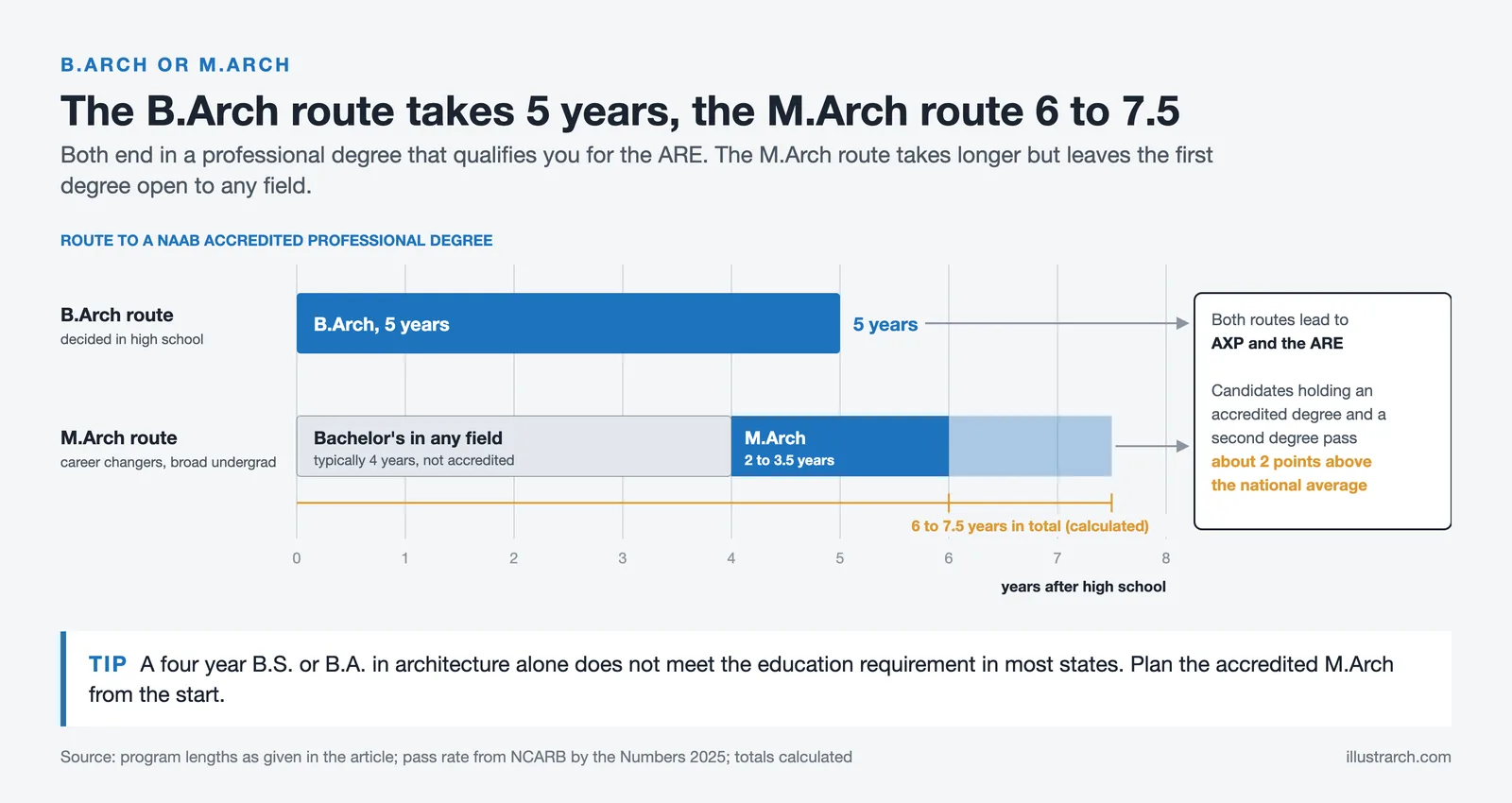
| Factor | B.Arch. (5 Years) | M.Arch. (2-3.5 Years) |
|---|---|---|
| Entry requirement | High school diploma | Bachelor’s degree (any field) |
| Program length | 5 years | 2-3.5 years |
| NAAB accreditation path | Direct professional degree | Professional degree (qualifies for ARE) |
| Flexibility | Architecture-focused throughout | Undergraduate degree can be any field |
| Typical ARE pass rate advantage | Baseline | About 2 points above the national average (NCARB, 2025) |
| Best for | Students certain about architecture from high school | Career changers or those wanting broader undergrad exposure |
According to NCARB data, candidates who hold both a non-accredited bachelor’s and an accredited degree, the usual M.Arch. route, perform about 2 percentage points above the national average on the ARE. This suggests that the M.Arch. route, while longer and often more expensive in total, may offer a slight advantage in licensure outcomes.
How to Choose: 5 Factors That Matter More Than Rankings
Rankings are a useful starting point, but the best architecture school for you is the one that aligns with how you think, what you want to design, and where you want your career to take you.
Studio culture. Architecture education is defined by the design studio. Visit or connect with current students before applying. A studio culture that rewards risk-taking suits some students; others thrive in more technically rigorous or research-driven environments.
Specialization alignment. Some schools are standout choices for specific focuses. UC Berkeley is especially strong in sustainable design. Columbia GSAPP leads in urbanism. SCI-Arc is the right home for students interested in experimental and computational design. Cal Poly produces graduates with deep technical building knowledge. Match the school’s identity to your interests.

Location and industry access. Studying in New York, Los Angeles, or Chicago puts you within reach of major firms, construction sites, cultural institutions, and potential clients. Schools in smaller markets often compensate with tighter industry relationships and more studio space per student.
Financial reality. Top private programs often cost $60,000 or more per year in tuition alone. Strong public programs like UC Berkeley and Virginia Tech offer significantly lower costs, particularly for in-state students, without sacrificing program quality. Factor in the full cost of attendance, available fellowships, and graduate assistantship opportunities before committing.
ARE licensure pass rates. NCARB publishes ARE 5.0 pass rates by school annually. This data shows how effectively each program prepares students for the licensure exam and is worth reviewing alongside reputation rankings. You can find current pass rates directly on the NCARB website.
💡 Pro Tip
When you visit a school or attend an open day, ask specifically about the average time from graduation to licensure for recent alumni. Some programs have strong mentorship structures and ARE preparation resources that dramatically shorten this timeline. Licensure speed matters because it directly affects when you can stamp drawings independently and advance your career.
What Is the Best Architecture School in the US for Graduate Study?
For graduate-level study, MIT, Harvard GSD, Yale, and Columbia consistently top the national rankings. The “best” among them depends on the experience you are looking for. MIT is the choice for students who want design deeply integrated with technology and computational research. Harvard GSD draws students interested in interdisciplinary design practice, landscape, and urban policy. Yale appeals to those who want intense studio critique culture and strong connections to the New York and New England design communities. Columbia GSAPP is ideal for students who want to be embedded in one of the world’s largest urban laboratories from day one.
Beyond these four, Princeton’s School of Architecture offers a rigorous M.Arch. that emphasizes design scholarship in a smaller, highly curated cohort. The University of Michigan Taubman College and the University of Texas at Austin are both strong mid-tier choices that offer excellent resources at more accessible price points.
📌 Did You Know?
MIT founded the first official architecture curriculum offered within a university in the United States. Established by William Robert Ware in 1865, the program predates many of the institutions that now compete with it for top rankings. This heritage is part of why MIT’s School of Architecture and Planning consistently attracts both top faculty and exceptional students more than 150 years later.

How to Check a School’s Real Numbers Yourself
Ranking sites give you an order. They rarely give you the four figures that actually decide where you apply, and all four are published free by the bodies that hold them.
| What you need | Where it is published | Why it matters |
|---|---|---|
| Accreditation status | NAAB accredited programme directory | A degree from a non-accredited programme does not lead to licensure by the standard path |
| Licensure and exam data | NCARB NBTN report | ARE pass rates and time-to-licensure by school. The only outcome data that is audited |
| Tuition, size, acceptance rate | NCES College Navigator | Federal data, free, and more reliable than any commercial ranking |
| Employer reputation | DesignIntelligence surveys | Surveys firms rather than academics. The closest thing to a hiring signal |
The check that matters most is accreditation, and it takes two minutes. NAAB accreditation runs on a cycle and a programme can be on probation or in candidacy rather than fully accredited. Search the directory for the specific degree, not the school: a university can hold accreditation for its M.Arch and not for its B.Arch.
Read the NCARB data by cohort, not by headline. A school with a high ARE pass rate and very few candidates tells you less than a school with a slightly lower rate across a large cohort. The report breaks both out.
Treat published tuition as a starting figure. Architecture programmes carry costs that other degrees do not: model materials, printing, software, and a fifth year in the B.Arch route. The federal figure covers none of that.
Top Architecture Schools in the US: What the Rankings Actually Agree On
The published rankings disagree more than people expect, because they measure different things: academic reputation, employer surveys, research output and student outcomes produce four different orders. What they do agree on is the top group rather than the exact sequence, and a school moving three places between years usually means nothing.
The practical reading: treat the rankings as a shortlist generator and then use the four sources above to separate the shortlist. Where a programme sits between 8th and 15th on any given list is noise. Whether it is NAAB accredited, what its graduates pay, and how they do at licensure is not.
Useful Resources for Researching Architecture Programs
Your research should go beyond any single ranking list. The following organizations and publications offer authoritative, updated information on architecture programs in the US:
- NAAB (National Architectural Accrediting Board) – Official accreditation status for every US program
- NCARB (National Council of Architectural Registration Boards) – ARE pass rates by school and licensure pathway information
- ACSA (Association of Collegiate Schools of Architecture) – Resources for prospective students and research on architectural education
- AIA (American Institute of Architects) – Scholarships, career resources, and professional development guidance
- ArchDaily – Coverage of schools, student work, and emerging design talent
For more guidance on what to look for when selecting a program, our article on choosing an architecture school walks through the key factors in depth. If you are already enrolled and navigating the early years of studio life, see our guide on thriving in your first year of architecture school. For a broader look at institutional options, our overview of top architecture schools in the world covers programs beyond the US, and our detailed piece on top universities to study architecture in the US offers additional program-level detail. If budget is a concern, our article on cost-effective tips for architecture school covers ways to manage expenses without compromising your education.
✅ Key Takeaways
- Always verify NAAB accreditation first. A degree from an unaccredited program will typically block your path to licensure in the US.
- MIT, Harvard GSD, Yale, Columbia, UC Berkeley, and Cornell consistently rank among the best architecture schools in the US across multiple ranking systems.
- The B.Arch. versus M.Arch. decision comes down to when you committed to architecture. Both paths lead to licensure eligibility; the M.Arch. route carries a slight ARE pass rate advantage according to NCARB data.
- Rankings are a starting point, not the final answer. Studio culture, specialization, location, and total cost are often more important in practice.
- ARE 5.0 pass rates by school, published annually by NCARB, give you an objective measure of how effectively each program prepares graduates for licensure.
Frequently Asked Questions
What is the best architecture school in the US?
By QS World University Rankings by Subject 2026, MIT is the top-ranked US architecture school globally, placed second in the world. Harvard GSD, Yale, Columbia, and UC Berkeley also consistently rank in the top tier. The best school for you personally depends on your design interests, whether you are pursuing undergraduate or graduate study, and your budget. No single school is universally “the best” for every student.
What are the best undergraduate architecture schools in the US?
Cornell, Cal Poly San Luis Obispo, Rice University, and Virginia Tech are widely considered among the best undergraduate architecture schools in the US. All offer NAAB-accredited B.Arch. programs with strong studio cultures and solid employer recognition. Cornell’s Rome program and Cal Poly’s technical focus are particularly distinctive differentiators.
What are the best architecture graduate schools in the US?
MIT, Harvard GSD, Yale School of Architecture, Columbia GSAPP, and Princeton School of Architecture are consistently cited as the best architecture grad schools in the US. For students seeking strong programs at a lower cost, the University of Michigan Taubman College and the University of Texas at Austin offer competitive M.Arch. programs with good placement outcomes.
How important is NAAB accreditation when choosing a school?
NAAB accreditation is essential if you intend to become a licensed architect in the US. Most state licensing boards require a degree from an NAAB-accredited program as a prerequisite for taking the ARE. You can confirm accreditation status for any program using the school search tool at naab.org before applying.
What should I look for beyond rankings when choosing an architecture school?
Studio culture, faculty accessibility, program specialization, location relative to industry hubs, total cost including financial aid, and ARE licensure pass rates all deserve attention beyond rankings. Visiting schools, speaking with current students, and researching where recent graduates are employed will give you a clearer picture than any ranking list alone.







What Architecture Students Should Know About Structural Glass and Guardrail Code
Glass guards look minimal, but structural behavior, safety glazing, connections and guardrail...
 illustrarch Editoral Team6 Mins read

Why Do Architecture Students Struggle With Time Management?
Architecture students rarely run out of discipline. They run out of schedule....
Sinan Ozen6 Mins read

Core Modules in an Architecture Degree: What You Actually Study
Design studio, history and theory, building technology, structures, environmental design, representation and...
Sinan Ozen6 Mins read

Why Is the Architecture Physical Model Still Taught in Schools?
Digital tools run modern architecture, yet schools still put students at the...
 Furkan Sen6 Mins read


Leave a comment