

Modernism vs Postmodernism: How Order and Ornament Shape Architectural Meaning
Modernism and Postmodernism represent two fundamentally different ways of understanding architecture's role in society. This article explores their contrasting approaches to order, ornament, context, and meaning, from the Bauhaus origins of modernist design philosophy to postmodern architecture's embrace of historical reference and cultural identity. Discover how regional expressions from Barcelona to Tokyo, Paris to Brasília enriched the modernist legacy, and why this ongoing dialogue continues to shape contemporary architectural practice.
 Sinan Ozen3 February 202610 Mins read284

Table of Contents Show
Architecture has always been more than the art of building; it is a cultural language through which societies express their values, anxieties, and aspirations. Few debates illustrate this more clearly than the long-standing tension in postmodernism vs modernism architecture. Emerging from different historical pressures yet often occupying the same urban landscapes, these two movements represent contrasting attitudes toward order, ornament, and meaning. Modernism arose with a belief in progress, rationality, and universality, promising a new architectural clarity suited to an industrialized world. Postmodernism, arriving decades later, challenged that clarity, questioning whether architecture could, or should, be stripped of symbolism, memory, and contradiction. This debate is not a closed historical chapter; it continues to shape how architects think about form, context, and communication today. By examining the philosophical foundations, spatial strategies, and cultural implications of postmodernism and modernism, we uncover why this opposition remains deeply relevant to contemporary architectural practice.

The History of Modernist Architecture: A Pursuit of Order and Universality
The history of modernist architecture is fundamentally driven by a desire for order in a rapidly changing world. In the aftermath of industrialization and global conflict, architects sought a language that felt rational, efficient, and universally applicable. This resulted in an emphasis on pure geometries, functional planning, and the rejection of historical styles. Buildings were conceived as systems rather than symbols, designed to serve human needs through clarity of structure and honest expression of materials. The Modernist belief was that form should follow function, and that by eliminating ornament and subjective expression, architecture could achieve a kind of moral and social purity.
The design philosophy that had a profound influence on modernist architecture was rooted in the teachings of the Bauhaus school, founded by Walter Gropius in 1919. Bauhaus principles unified art, craft, and technology, establishing a framework where every architectural element served a clear purpose. Pioneers like Le Corbusier, Ludwig Mies van der Rohe, and Walter Gropius translated these ideals into built form, creating landmarks that still define how we understand modern design. This pursuit of order mattered because it aligned architecture with broader ideals of progress and social reform, positioning the architect as a problem-solver rather than a stylist. Yet, in striving for universality, Modernism often overlooked the emotional, cultural, and contextual nuances that give spaces their deeper meaning.

Postmodernism in Architecture: Ornament as Cultural Memory
One of the most visible fault lines between Modernism and postmodernism in architecture lies in their opposing views on ornament. Modernist thinkers famously denounced ornament as unnecessary or even regressive, associating it with wasted labor and outdated traditions. Smooth surfaces, minimal detailing, and abstraction became symbols of a forward-looking society. Postmodernism, however, reintroduced ornament not merely as decoration but as a carrier of meaning and cultural memory. Architects began to use historical references, symbolic forms, and playful details to communicate ideas and engage users emotionally.
This shift was significant because it reframed architecture as a communicative act rather than a purely functional object. Among the most recognizable postmodern architecture examples are the Portland Building by Michael Graves, the Piazza d’Italia in New Orleans by Charles Moore, and Philip Johnson’s AT&T Building (now 550 Madison Avenue). These structures used color, historical quotation, and irony to challenge the austerity of the International Style. Ornament, in the Postmodern sense, became a way to acknowledge context, history, and human perception, suggesting that buildings could speak in multiple layers of meaning rather than a single, rational voice.
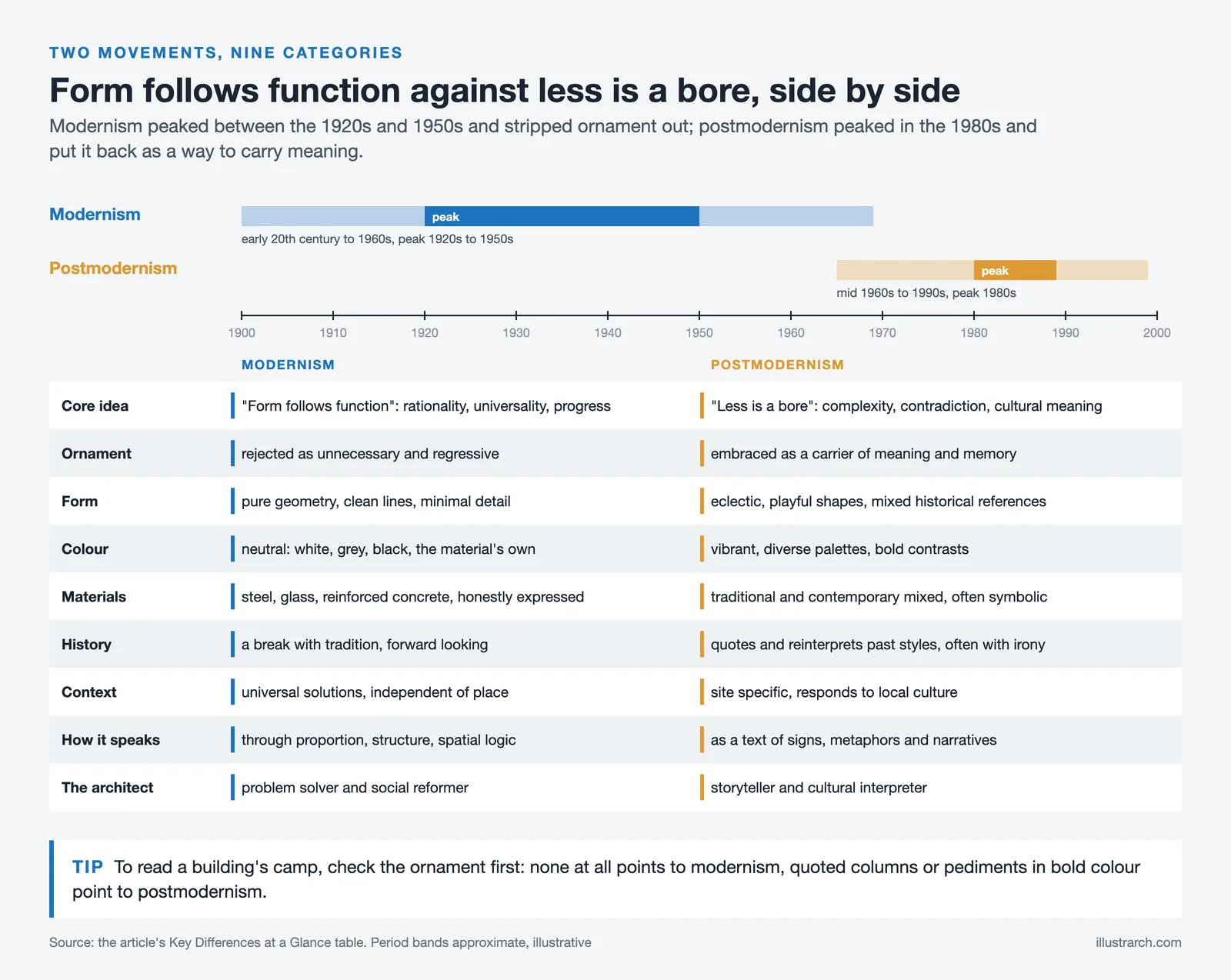
| Category | Modernism | Postmodernism |
|---|---|---|
| Time Period | Early 20th century, 1960s (peak: 1920s-1950s) | Mid-1960s-1990s (peak: 1980s) |
| Core Philosophy | “Form follows function” rationality, universality, and progress | “Less is a bore” complexity, contradiction, and cultural meaning |
| Ornament | Rejected as unnecessary and regressive | Embraced as a carrier of meaning and cultural memory |
| Form & Geometry | Pure geometric forms, clean lines, minimal detailing | Eclectic forms, playful shapes, mixed historical references |
| Color Palette | Neutral tones: white, gray, black, exposed material colors | Vibrant and diverse color palettes, bold contrasts |
| Materials | Steel, glass, reinforced concrete, honestly expressed | Mixed materials including traditional and contemporary, often used symbolically |
| Relationship to History | Break with tradition; forward-looking, anti-historical | Reinterpretation and quotation of historical styles, often with irony |
| Context & Place | Universal solutions; place-independent design | Site-specific; responsive to local culture and urban context |
| Communication | Buildings communicate through proportion, structure, and spatial logic | Buildings treated as texts: filled with signs, metaphors, and narratives |
| Role of the Architect | Problem-solver; social reformer | Storyteller; cultural interpreter |
| Key Theoretical Text | Towards a New Architecture: Le Corbusier (1923) | Complexity and Contradiction in Architecture: Robert Venturi (1966) |
Postmodern Architecture Definition: Language, Signs, and Expression
To arrive at a clear postmodern architecture definition, we must first understand how Postmodernism treated buildings as texts. Modernist architecture often aspired to a kind of disciplined silence, where buildings communicated through proportion, structure, and spatial logic rather than overt symbolism. The ideal was an architecture that did not impose narratives but allowed users to experience space directly and objectively.
Postmodernism challenged this restraint by treating architecture explicitly as a language filled with signs, references, and metaphors. Facades became texts, forms became quotations, and buildings openly engaged in dialogue with their surroundings and cultural histories. Robert Venturi’s influential 1966 book Complexity and Contradiction in Architecture became the theoretical backbone of the movement, arguing that architecture should embrace ambiguity rather than purity. The key postmodernism in architecture characteristics include eclecticism, irony, playful historical references, bold color, and a rejection of the notion that one universal style can serve all contexts. This difference matters because it reflects contrasting beliefs about how people interact with space. While Modernism trusted users to find meaning through function and clarity, Postmodernism acknowledged that people naturally read buildings through cultural associations and shared memories. The debate between silence and expression continues to influence how architects balance clarity with storytelling in contemporary design.

Modernist Architecture Around the World: Regional Expressions of a Universal Ideal
Although Modernism championed a universal design language, its application varied remarkably across regions, producing distinct local traditions that enriched the movement’s global legacy.
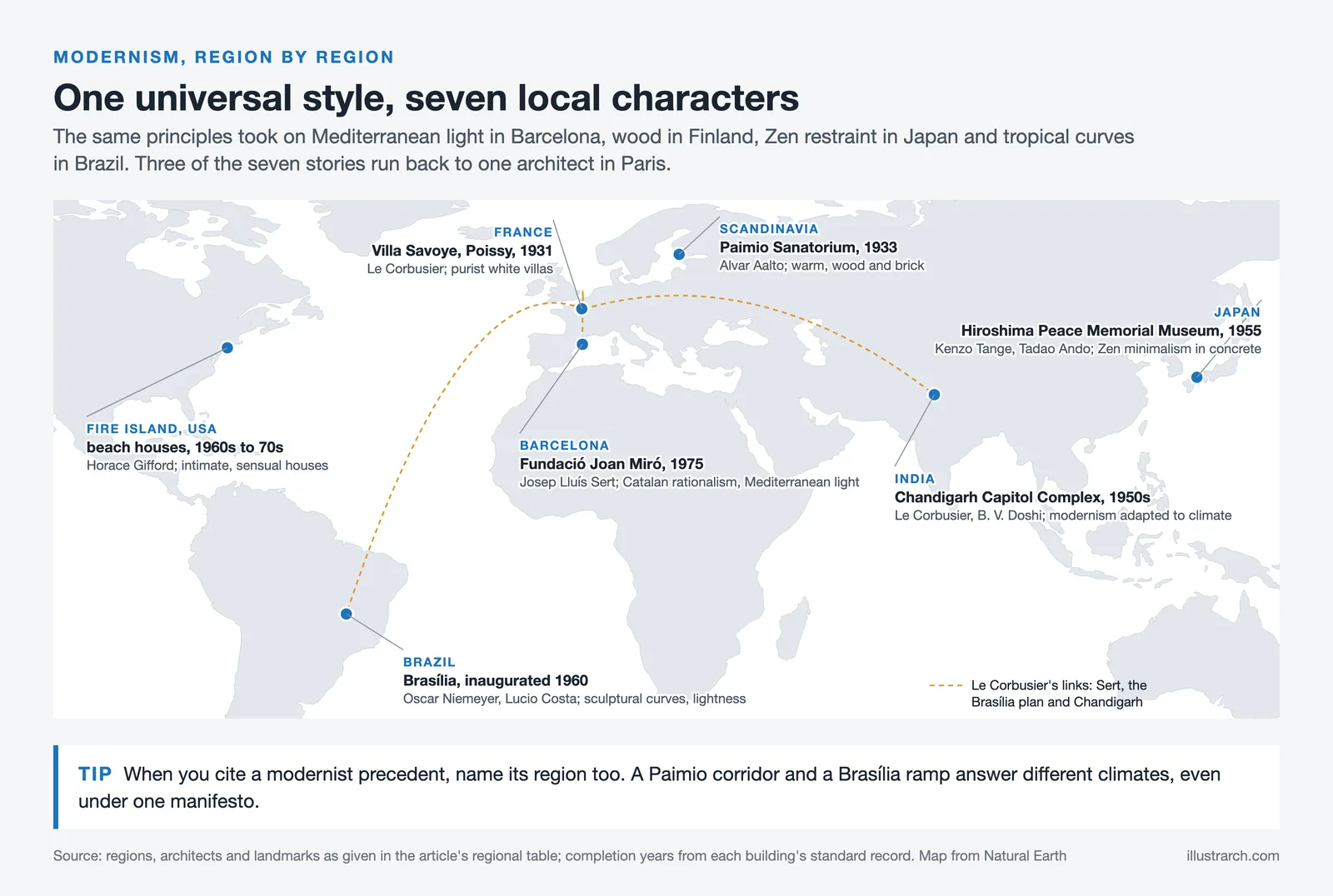
Modernist architecture in Barcelona took on a uniquely Catalan character. While Antoni Gaudí’s earlier Modernisme movement predated International Style Modernism, the city later embraced rationalist and mid-century modernist principles through architects like Josep Lluís Sert, who studied under Le Corbusier. Barcelona modernist architecture blends Mediterranean light, urban density, and a tradition of craft that sets it apart from the glass-and-steel towers of Northern Europe and America.
French modernist architecture is inseparable from Le Corbusier’s legacy. From the Villa Savoye in Poissy to the Unité d’Habitation in Marseille, France produced some of the most iconic works that shaped the history of modernist architecture. Modernist architecture in Paris includes landmarks like the Centre Pompidou, a late modernist and high-tech hybrid designed by Renzo Piano and Richard Rogers, which redefined what a cultural institution could look like.
Scandinavian modernist architecture offered a warmer, more humanistic interpretation of modernist ideals. Finnish architect Alvar Aalto combined functionalist planning with natural materials like wood and brick, creating buildings that felt approachable and connected to the Nordic landscape. This tradition influenced later generations of architects throughout Denmark, Sweden, and Norway, emphasizing sustainability and human comfort long before these became global priorities.

Modernist Japanese architecture represents one of the most compelling fusions of Eastern philosophy and Western modernist principles. Architects like Kenzo Tange and Tadao Ando merged Zen-inspired minimalism with concrete and steel, producing structures that resonate with silence, light, and spatial precision. The tradition of late modernist architecture in Japan extended through the Metabolist movement of the 1960s, which proposed radical visions for urban growth and adaptability.
Brazilian modernist architecture, championed by Oscar Niemeyer and Lucio Costa, brought curves, lightness, and tropical sensibility to modernist forms. The planned capital city of Brasília stands as one of the most ambitious modernist urban projects ever realized, combining sculptural government buildings with Le Corbusier, inspired urban planning.
Indian modernist architecture found its defining expression in Le Corbusier’s master plan for Chandigarh, as well as in the work of Balkrishna Doshi, who adapted modernist principles to Indian climate, culture, and social conditions. Doshi’s Aranya Low-Cost Housing project demonstrated that modernist architecture could serve local communities rather than impose foreign ideals.
Even niche explorations like Fire Island modernist architecture, documented in the work chronicling Horace Gifford and the architecture of seduction, show how the modernist ethos could produce intimate, site-specific residential design. Gifford’s beach houses on Fire Island combined open plans, natural materials, and a deep sensitivity to landscape, proving that modernist architecture interiors could be sensual and context-driven, not merely austere.
| Region | Key Architect(s) | Landmark Building(s) | Distinctive Character | Local Influence |
|---|---|---|---|---|
| Barcelona, Spain | Josep Lluís Sert | Fundació Joan Miró, Casa Bloc | Catalan rationalism blended with Mediterranean light | Gaudí’s Modernisme legacy, craft tradition, urban density |
| France | Le Corbusier, Renzo Piano & Richard Rogers | Villa Savoye, Unité d’Habitation, Centre Pompidou | Purist white villas, bold social housing, high-tech hybrids | Le Corbusier’s Five Points of Architecture, CIAM movement |
| Scandinavia | Alvar Aalto | Paimio Sanatorium, Finlandia Hall | Warm, humanistic modernism with natural materials | Nordic landscape, wood and brick tradition, early sustainability focus |
| Japan | Kenzo Tange, Tadao Ando | Hiroshima Peace Memorial Museum, Church of the Light | Zen minimalism fused with concrete and steel | Metabolist movement, spatial precision, silence and light |
| Brazil | Oscar Niemeyer, Lucio Costa | Brasília (National Congress, Cathedral), Museum of Contemporary Art Niterói | Sculptural curves, lightness, tropical sensibility | Le Corbusier: inspired urban planning adapted to Brazilian culture |
| India | Le Corbusier, Balkrishna Doshi | Chandigarh Capitol Complex, Aranya Low-Cost Housing | Modernism adapted to local climate and social conditions | Post-independence nation-building, community-oriented design |
| Fire Island, USA | Horace Gifford | Various beach houses (1960s-70s) | Intimate, sensual residential modernism | Open plans, natural materials, deep landscape sensitivity |
Context, Place, and the Question of Identity
Modernism’s universal principles often resulted in buildings that could be placed almost anywhere, reinforcing the idea of a global architectural language. While this allowed for efficiency and coherence, it sometimes produced environments that felt detached from local identity. Post modernist architecture responded by reasserting the importance of context, embracing regional references, urban narratives, and site-specific symbolism.
This renewed attention to place was not simply nostalgic; it was a critique of homogenization in the built environment. By emphasizing identity and difference, postmodern architecture highlighted architecture’s role in shaping collective memory and belonging. In terms of postmodern architecture AP human geography frameworks, this movement illustrates how architectural style connects to broader patterns of cultural globalization versus localization, a concept explored in academic discussions about how the built environment reflects power, identity, and cultural exchange at the urban scale.
This shift remains crucial today, as architects grapple with globalization, cultural diversity, and the need to design spaces that resonate with local communities while still engaging global conversations. For a deeper exploration of how major architecture firms balance global reach with local identity, the tension between modernist universality and postmodern contextuality continues to be a defining challenge.

Postmodernism and Architecture: Relevance in Contemporary Practice
Although often framed as opposing historical movements, postmodernism and architecture today coexist in contemporary practice alongside modernist strategies, influencing design strategies in subtle and overt ways. Many current practices draw on Modernist clarity and technological optimism while also embracing Postmodern sensitivity to meaning, narrative, and context.
The ongoing relevance of this debate lies in its ability to frame critical questions: Should architecture prioritize efficiency or expression? Can buildings be both rational and symbolic? How do designers balance global standards with local identity? By understanding the tensions between Modernist order and Postmodern plurality, architects gain a richer toolkit for navigating today’s complex social, cultural, and environmental challenges. The evolution of modern architecture from Bauhaus to Brutalism and beyond demonstrates that these categories are not rigid boundaries but fluid positions within an ongoing dialogue.
Rather than choosing sides, contemporary architecture increasingly operates in the space between these two philosophies, acknowledging that meaning in architecture is never singular but layered, contested, and continuously evolving. Firms like OMA and Herzog & de Meuron exemplify this synthesis, combining modernist rigor with postmodern sensitivity to cultural narrative and material storytelling. For those interested in how these philosophical tensions play out across different building types, our comprehensive comparison of postmodernism vs modernism architecture offers a detailed breakdown of key differences and their lasting impact.
Key Examples of Postmodern and Modernist Landmarks
Understanding the debate between postmodernism and modernism becomes clearer through specific examples of postmodern architecture and their modernist counterparts. On the modernist side, Le Corbusier’s Villa Savoye (1931) embodies the five points of modern architecture: pilotis, free plan, free facade, ribbon windows, and roof garden. Mies van der Rohe’s Barcelona Pavilion (1929) distills space to its essence with open planes of marble, glass, and chrome.
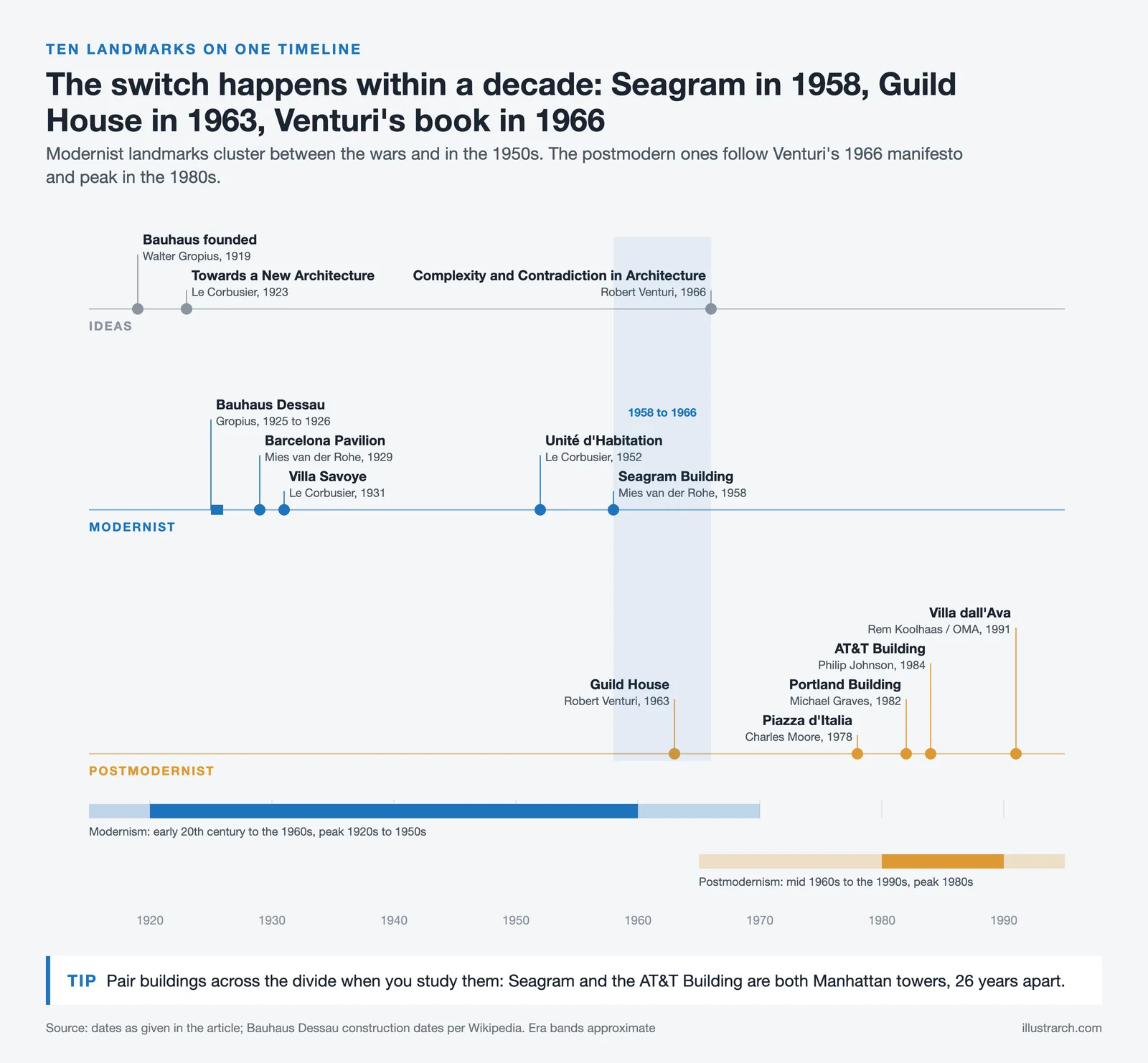
On the postmodern side, Robert Venturi’s Guild House (1963) introduced subtle irony and historical reference into social housing. Philip Johnson‘s AT&T Building (1984) shocked the architectural establishment with its Chippendale-inspired pediment atop a Manhattan skyscraper. Charles Moore’s Piazza d’Italia (1978) in New Orleans playfully deconstructed classical Italian motifs, while Rem Koolhaas’s Villa dall’Ava in Paris pushed postmodern residential design into deconstructivist territory.
| Movement | Building | Architect | Year | Location | Significance |
|---|---|---|---|---|---|
| Modernist | Barcelona Pavilion | Mies van der Rohe | 1929 | Barcelona, Spain | Distilled space to open planes of marble, glass, and chrome; icon of “less is more” |
| Villa Savoye | Le Corbusier | 1931 | Poissy, France | Embodies the Five Points of Architecture: pilotis, free plan, free facade, ribbon windows, roof garden | |
| Bauhaus Dessau | Walter Gropius | 1925 to 1926 | Dessau, Germany | The Bauhaus manifesto in built form; unified art, craft, and technology in a single campus | |
| Unité d’Habitation | Le Corbusier | 1952 | Marseille, France | Pioneered “vertical city” concept with integrated living, shopping, and recreational spaces | |
| Seagram Building | Mies van der Rohe | 1958 | New York, USA | Defined the International Style skyscraper with bronze and glass curtain wall | |
| Postmodernist | Guild House | Robert Venturi | 1963 | Philadelphia, USA | Introduced subtle irony and historical reference into social housing design |
| Piazza d’Italia | Charles Moore | 1978 | New Orleans, USA | Playfully deconstructed classical Italian motifs with neon-lit columns and bold color | |
| Portland Building | Michael Graves | 1982 | Portland, USA | One of the first major postmodern public buildings; combined geometric forms with colorful ornamentation | |
| AT&T Building (550 Madison) | Philip Johnson | 1984 | New York, USA | Shocked the establishment with a Chippendale-inspired pediment atop a Manhattan skyscraper | |
| Villa dall’Ava | Rem Koolhaas / OMA | 1991 | Paris, France | Pushed postmodern residential design into deconstructivist territory |
| Movement | Architect / Theorist | Nationality | Key Contribution | Famous Motto / Idea |
|---|---|---|---|---|
| Modernist | Walter Gropius | German-American | Founded the Bauhaus school (1919); unified art, craft, and technology | Architecture as a total work of art (Gesamtkunstwerk) |
| Le Corbusier | Swiss-French | Five Points of Architecture; pioneered purist villas and urban planning theory | “A house is a machine for living in” | |
| Ludwig Mies van der Rohe | German-American | Minimalist clarity; glass curtain wall skyscrapers; last Bauhaus director | “Less is more” | |
| Frank Lloyd Wright | American | Organic architecture; integration of buildings with nature | “Form and function are one” | |
| Alvar Aalto | Finnish | Humanistic modernism with natural materials and user comfort | Architecture that serves human emotion, not just function | |
| Post-modernist | Robert Venturi | American | Wrote Complexity and Contradiction in Architecture (1966); theoretical backbone of postmodernism | “Less is a bore” |
| Michael Graves | American | Portland Building; brought bold color and ornamentation to public architecture | Architecture as a communicative, symbolic act | |
| Charles Moore | American | Piazza d’Italia; playful deconstruction of classical motifs | Architecture as celebration, humor, and cultural dialogue | |
| Philip Johnson | American | AT&T Building; transitioned from modernist champion to postmodernist icon | Bridged International Style and postmodern irony | |
| Rem Koolhaas | Dutch | Founded OMA; blended postmodern theory with deconstructivist practice | “Architecture is a hazardous mixture of power and impotence” |
Together, these landmarks illustrate how postmodernism vs modernism architecture is not merely a theoretical debate but a living record of how societies have imagined, built, and contested meaning in the built environment across the twentieth and twenty-first centuries.



2 Comments

Interior Design for Commercial Spaces: Enhancing Functionality and Brand Identity
Commercial interior design has to serve brand, function and regulation at once....
 Begum Gumusel4 Mins read

Overlapping Concrete Walls and One Roof Shape a House in Okinawa
IGArchitects built Overlapping Spaces in Okinawa from reinforced concrete walls, columns and...
 illustrarch Editoral Team1 Mins read
Futuro House Production Revived in Finland After Decades-Long Hiatus
A Facebook listing for abandoned moulds led to the first new Futuro...
illustrarch Editoral Team3 Mins read

Building Your Dream Home in NSW: What You Should Know About Montgomery Homes
Montgomery Homes has been building across Sydney, Newcastle, the Hunter, Wollongong and...
illustrarch Editoral Team4 Mins read


I think the article talks about different styles of architecture. It seems like Modernism and Postmodernism are important but also very different. They both have good points, and I guess they can still be used today.
I found the discussion on how modernism emphasized functional design really interesting. It’s fascinating to think about how architects like Le Corbusier and Frank Lloyd Wright believed that form should follow function. I wonder, though, if this focus on efficiency sometimes made buildings feel a bit cold or impersonal? It seems postmodernism brings back warmth with ornament and historical references, which could make spaces feel more inviting.