

3D Construction Explained: Techniques, Tools, and Trends Shaping the Industry
Learn how 3 dimensional construction techniques like 3D printing, BIM, drone scanning, and AI-driven tools are transforming the building industry. Covers real-world examples, cost savings, sustainability benefits, and emerging trends for 2026 and beyond.
 Furkan Sen27 March 20246 Mins read547
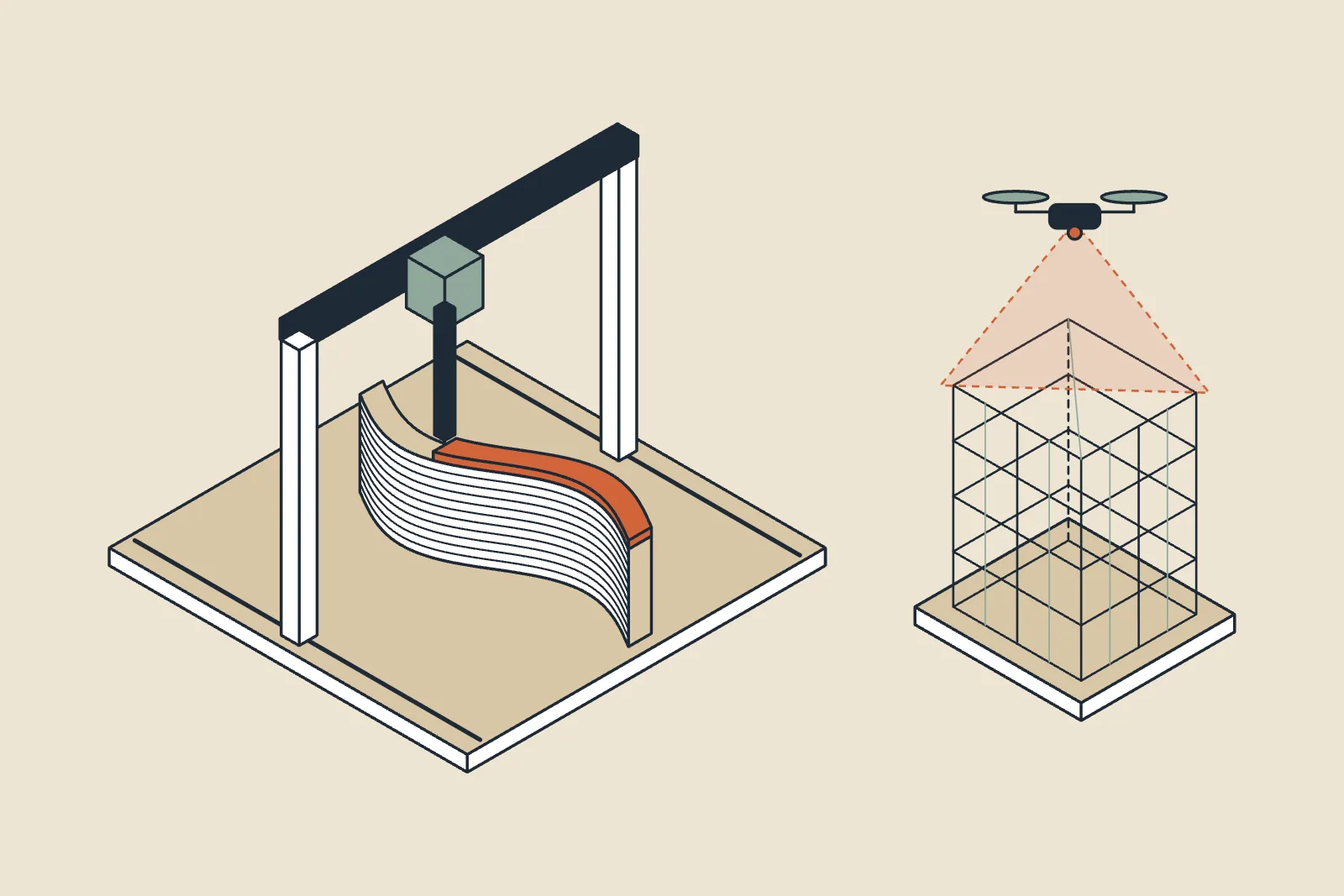
Table of Contents Show
3D construction uses digital technologies such as 3D printing, Building Information Modeling (BIM), and robotic automation to design and build structures with less waste, lower labor demand, and faster timelines. The approach turns digital models directly into physical buildings, layer by layer, on real job sites.
The building industry is shifting as 3D construction methods move from research labs into active job sites worldwide. Whether you call it 3 dimensional construction, construction 3D, or simply 3 d construction, the goal stays the same: faster builds, lower costs, and greener outcomes. This guide covers the techniques driving the change, the tools professionals rely on, and the trends shaping the sector through 2026 and beyond. For broader context, see our overview of innovative construction techniques.

3D Printing in Construction
3D printing, also called additive manufacturing, sits at the center of 3D construction. It builds components and even whole structures layer by layer using concrete, metal, or polymers. The method gives designers freedom to produce curves and forms that are hard to achieve with formwork, while cutting material waste and shortening the build cycle.
Companies like COBOD (Denmark), ICON (USA), and WASP (Italy) lead the field. COBOD’s BOD2 printer moves at speeds up to 1,000 mm/s and needs only three or four operators. ICON’s Phoenix system pairs an industrial robotic arm with a concrete boom, opening multi-story and commercial printing at scale. These machines read digital blueprints and produce physical walls on-site, removing the need for traditional formwork and large crews.
🔢 Quick Numbers
- The global 3D construction printing market was valued at roughly $391.8 million in 2024 (Grand View Research).
- COBOD reports up to 30% lower project cost and 50% faster delivery on its construction printing systems (cobod.com).
- Extrusion-based systems account for about 63% of construction 3D printing activity, pushing a cement mix through a nozzle in stacked layers.
Key 3D Printing Methods
Several distinct approaches exist within construction 3D printing, each suited to different project types:
- Extrusion (concrete or cement): the most common method. A nozzle deposits mortar in layers along a CAD toolpath, ideal for walls, foundations, and house shells.
- Powder bonding: sand or powder layers fused with a binding agent, well suited to detailed architectural elements and freeform shapes.
- Additive welding: metal deposited through robotic welding, useful for structural steel, bridges, and reinforcement.
- Robotic arm systems: mobile arms reach further than gantry printers and handle complex geometries without repositioning.
📐 Technical Note
Extrusion print quality depends on the rheology of the mix. The concrete must be fluid enough to pump yet stiff enough to hold its shape immediately after deposition, a balance known as buildability. Layer height typically runs between 10 mm and 40 mm, and inter-layer timing controls bond strength between courses.
For a closer look at finished projects, see our coverage of the future of 3D printed buildings.
Building Information Modeling: A Pillar of 3D Construction
BIM is the second cornerstone of 3 dimensional construction. It is a digital representation of a building’s physical and functional traits that goes beyond 2D drafting, adding time (4D), cost (5D), and sustainability (6D) layers. The model lets architects, engineers, and contractors work from a single source of truth.
On platforms like Autodesk Revit or Archicad, a change in one area updates related components across the model. Clash detection catches conflicts between structural, mechanical, and electrical systems before ground is broken. When paired with 3D printing, BIM data feeds straight into the printer software, keeping the digital model and the physical output aligned to millimeter accuracy. For the fundamentals, read our article on BIM’s impact on the construction industry.

3D Construction Methods Compared
Seeing how 3 d construction methods stack up against conventional building helps you judge where the technology fits your next project. The table below highlights the key differences.
| Factor | Traditional Construction | 3D Printing Construction | BIM-Integrated Workflow |
|---|---|---|---|
| Build speed | Months to years | Days to weeks for shell | Timelines reduced 20-30% |
| Labor requirement | Large skilled crews | 3 to 4 printer operators | Smaller cross-functional teams |
| Material waste | High, up to 30% | Near zero | Optimized through simulation |
| Design flexibility | Limited by formwork | Freeform curves, complex shapes | Data-rich parametric design |
| Sustainability | Significant CO2 emissions | Less waste, eco-material options | Energy analysis in design phase |
Tools and Software Behind 3D Construction
Software is the quiet driver behind 3D construction adoption. CAD programs handle detailed design, simulation tools predict building performance, and drones with laser scanning supply accurate site surveys that flow back into BIM for real-time updates. The common tools in construction 3D workflows include:
- Autodesk Revit and BIM 360 for collaborative modeling and project management
- Rhino with Grasshopper for parametric and freeform design
- Slicer software from each printer maker that converts CAD models into printable toolpaths
- Point cloud processing for drone and LiDAR survey data
- Energy simulation plugins that test thermal performance before the build starts
Together these form a closed loop: architects design in BIM, engineers validate, and the printer executes with little manual input. For a wider view, see our overview of digital tools in architecture.
💡 Pro Tip
Plan for hybrid workflows on your first print. Wall systems and foundations are the most mature applications, while roofing, plumbing, and electrical still rely on conventional trades. Sequencing those trades around the print schedule early prevents costly idle time once the printer leaves the site.
Sustainable Building Through 3 Dimensional Construction
Sustainability is a core reason firms test 3D construction. Precise material placement cuts waste, and the same precision produces structures that are quicker to build and easier to make energy efficient. New materials push the picture further. Geopolymer concrete, biodegradable polymers, and locally sourced clay offer lower-carbon options than standard Portland cement.
ICON reports that the embodied carbon of its 3D printed homes is comparable to conventional stick-framed homes over a 100-year period, helped by its CarbonX formulation and the near-zero waste of robotic printing. Traditional home construction generates roughly four tons of waste per house, while a printer lays down only what the design calls for. These gains make 3 dimensional construction attractive for developers chasing green architecture targets.
📌 Did You Know?
The TECLA house near Bologna, Italy, built by Mario Cucinella Architects and WASP, was printed from local riverbed clay. Around 200 hours of print time produced a 538-square-foot eco-habitat from roughly 350 layers, showing that raw earth can serve as a viable printing material.

Real-World 3D Construction Projects
The move from prototype to production is well underway. A few projects show how construction 3D techniques perform in practice.
In Georgetown, Texas, ICON built the Wolf Ranch community of 100 3D-printed homes between 2022 and 2024. These two-to-four-bedroom residences use ICON’s Lavacrete material, are designed for winds up to 200 mph, and several reached Zero Energy Ready Home certification. In Kilifi, Kenya, the 14Trees venture (backed by Holcim and British International Investment) printed the walls of 10 houses in 10 weeks with a single COBOD BOD2 printer, earning EDGE Advanced certification from the World Bank’s IFC.
The Mense-Korte house in Beckum, Germany, became the first 3D printed building to receive full certification under a national building code. India’s Larsen & Toubro completed the country’s first 3D printed two-story building using a COBOD printer and a local concrete mix that complies with national codes and uses conventional reinforcement bars, bridging new printing with proven structural engineering.
🏗️ Real-World Example
Wolf Ranch (Georgetown, Texas, 2022-2024): described by ICON as the world’s first 3D-printed community, with 100 homes designed by BIG and printed using the Vulcan system. The project proved that printed housing can be delivered at neighborhood scale rather than as one-off demonstrations.

Trends Shaping Construction 3D
The next wave of 3D construction goes past simple concrete extrusion. COBOD’s BOD3 printer uses ground-based track modules that let it move between buildings on one site with no setup time, and its Universal X-Carriage is designed to accept future tools like insulation sprayers and casting equipment. ICON’s Phoenix printer, with its robotic arm and concrete boom, has been announced at $25 per square foot for walls and $80 per square foot for a full shell, figures that compete with conventional costs in many U.S. markets.
AI and machine learning are entering the workflow too, feeding predictive analytics into BIM and print planning. Autonomous drone swarms that deposit cement structures have been demonstrated in peer-reviewed research, and underwater concrete printing drew a DARPA grant in 2025. As the pairing of AI in building design with construction robots matures, expect printing to reach bridges, reservoirs, and marine structures, with building codes evolving alongside.
Looking Ahead
3D construction is no longer a lab curiosity. The real test now is regulation and supply chains rather than whether a printer can stack concrete reliably. For architects, the opportunity is to treat the printer as one more tool in a digital pipeline that begins in BIM, not as a replacement for design judgment. The firms that learn to detail for the nozzle today will set the standards everyone else follows tomorrow.


1 Comment




Architecture Beneath the Surface: The Crucial Role of Structural Mechanics and Geotechnical Analysis in Groundwork Design
Bold architecture depends on the ground beneath it. How numerical geotechnical analysis...
 illustrarch Editoral Team1 Mins read
Designing Renovation Projects Around Debris Flow and Site Logistics
Effective renovation planning must prioritize debris flow management. Learn how to integrate...
illustrarch Editoral Team4 Mins read

How Long Does a Building Warranty Typically Last? Coverage Periods Explained
Building warranty cover is layered, not uniform: one year for finishes, two...
 Sinan Ozen5 Mins read

What Is an Architect’s Certificate of Practical Completion?
A practical breakdown of the architect's certificate of practical completion: who issues...
Sinan Ozen6 Mins read


I love how this article highlights the benefits of 3D printing in construction! It’s amazing to think that entire structures can be built layer by layer, which really cuts down on waste. The flexibility in design is something I hadn’t considered before. It makes me excited about the future of building!