

Gabrielle-Roy Library by Saucier + Perrotte architects & GLCRM architectes
The Gabrielle-Roy Library extension by Saucier + Perrotte and GLCRM reimagines the urban library as a layered civic landscape, blending reading, culture, and community life across interconnected floors in Québec City’s Saint-Roch district.
 Begum Gumusel21 January 20264 Mins read194


Table of Contents Show
The extension and renovation of the Gabrielle-Roy Library represents a profound rethinking of what a contemporary public library can be within the dense and evolving fabric of the city. Designed by Saucier + Perrotte architectes in collaboration with GLCRM architectes, the project responds to a rapidly growing and diversifying audience in Québec City’s Saint-Roch neighborhood. More than a functional upgrade, the intervention transforms the library into a multi-layered civic environment, where learning, culture, and social life unfold across a rich sequence of spatial strata.
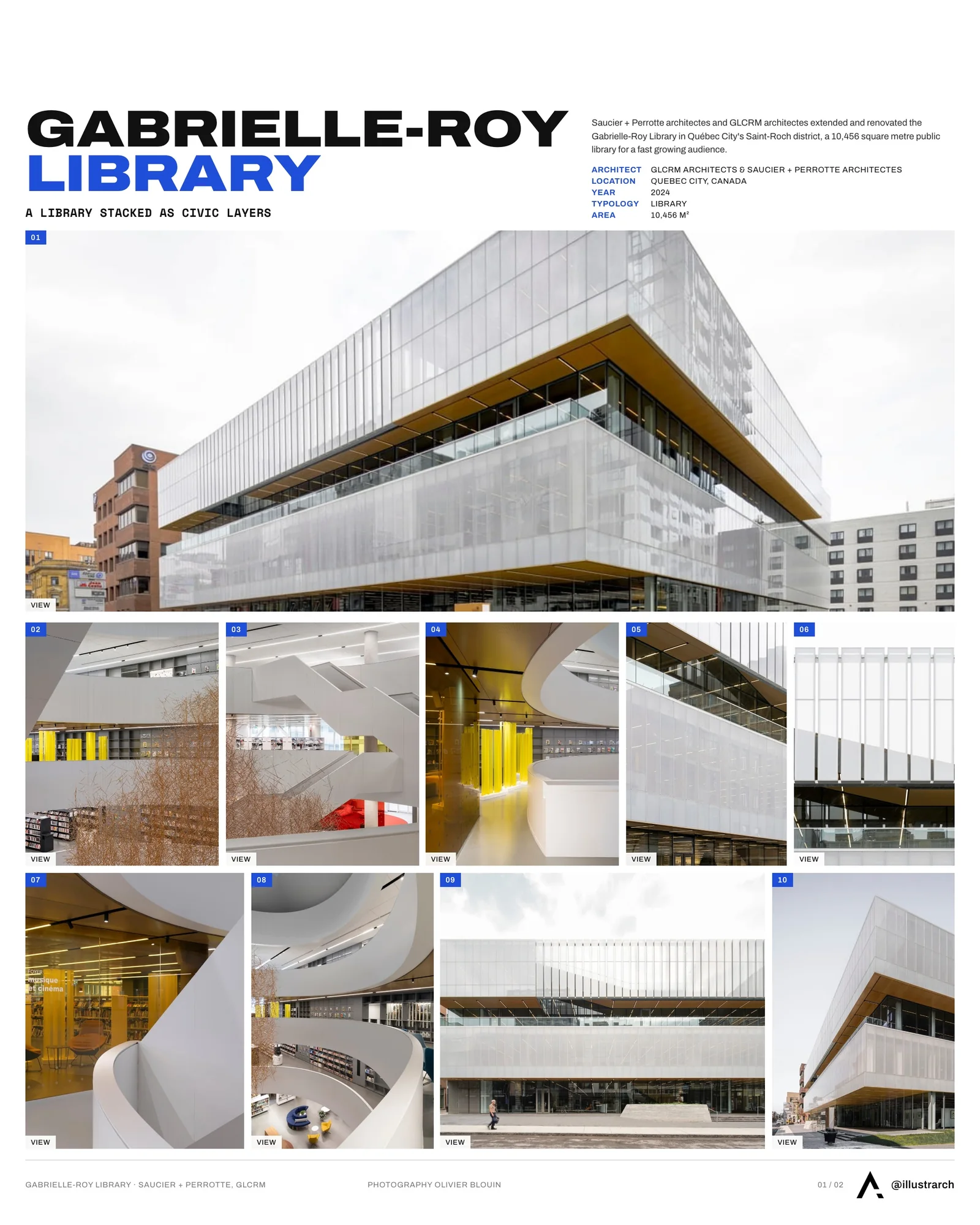
Rather than concentrating public activity on a single level, the design deliberately distributes programs vertically, encouraging users to inhabit the building in motion. Each floor establishes a distinct relationship with both the collections and the surrounding city, creating an experience that oscillates between openness and introspection, projection and retreat. The result is a library that functions not only as a repository of knowledge, but as a dynamic urban interior, responsive, inclusive, and deeply connected to its context.
A Library Rooted in the Saint-Roch Neighborhood
Located at the heart of Saint-Roch, one of Québec City’s most vibrant cultural and economic districts, Gabrielle-Roy Library serves a community defined by diversity, creativity, and constant transformation. Over recent years, the number of users has increased significantly, reflecting both population growth and changing expectations of public institutions. This social reality became a driving force behind the project’s architectural strategy.
The architects understood the library not as an isolated civic monument, but as an active participant in neighborhood life. Strengthening the connection between the building and its urban surroundings was therefore fundamental. This ambition materializes most clearly at ground level, where architecture and public space merge into a continuous urban landscape that invites engagement from passersby as much as from regular users.
The Ground Floor as Urban Living Room
At street level, the library opens itself generously to the city. A large outdoor forecourt extends the public realm into the building, giving the institution a distinctly urban character. Visual and physical continuity with adjacent public spaces dissolves the traditional threshold between inside and outside, encouraging spontaneous encounters and informal use.
This ground floor is conceived as a space of civic life. It accommodates highly public functions such as reception areas, a kitchen designed for culinary workshops, and a small amphitheater that supports talks, performances, and community events. Collections dedicated to children, civic life, newspapers, and periodicals further reinforce the level’s accessibility and inclusivity. Families, students, and local residents are all equally addressed, making this floor a shared platform for everyday urban culture.
Seen as a whole, the ground floor and its surrounding public spaces form a collective living room for the neighborhood, an environment where social exchange, learning, and leisure coexist naturally.
Vertical Stratification of Knowledge and Experience
Ascending through the building, the atmosphere gradually shifts. Levels 01 and 03 are dedicated primarily to reading, study, and reflection. Here, the architectural language becomes calmer and more introverted, supporting focused engagement with knowledge. Collections covering literature, history, philosophy, geography, science, and technology are arranged around a central atrium, ensuring generous access to natural light and visual continuity across levels.
A fritted glass envelope wraps these floors, acting as a diaphanous filter that softens daylight while maintaining outward views. This translucent skin creates an environment conducive to concentration, balancing openness with protection. Users remain connected to the city without being overwhelmed by it, a subtle architectural response to the dual nature of reading as both inward and outward-looking activity.
Level 02 reintroduces a more extroverted character. Defined by a clear glass façade and a distinctive mesh ceiling, this floor hosts collections related to music, cinema, arts, and travel. The transparency of the envelope reinforces the public nature of the program, signaling creativity and movement both from within and from the street.
From Library to Cultural Platform
Beyond its traditional collections, Gabrielle-Roy Library embraces a broad spectrum of cultural and creative activities. Adjacent to the main amphitheater, users gain access to a music studio, rehearsal and practice rooms, a projection room, a fab lab, and an arts workshop. These spaces expand the library’s role from a place of quiet study to a productive cultural hub, where making, experimenting, and sharing are actively encouraged.
This diversity of programs reflects the evolving identity of contemporary libraries as “third places” spaces that exist beyond home and work, fostering community interaction and lifelong learning. By accommodating both silence and sound, contemplation and collaboration, the project acknowledges that knowledge today is produced as much through dialogue and creativity as through reading alone.
A Fluid Spatial Journey
Circulation plays a crucial role in shaping the library’s experience. Rather than functioning as a neutral connective system, stairs, atriums, and visual openings are designed as spatial events. Movement through the building becomes a continuous journey, marked by changing perspectives, light conditions, and degrees of openness.
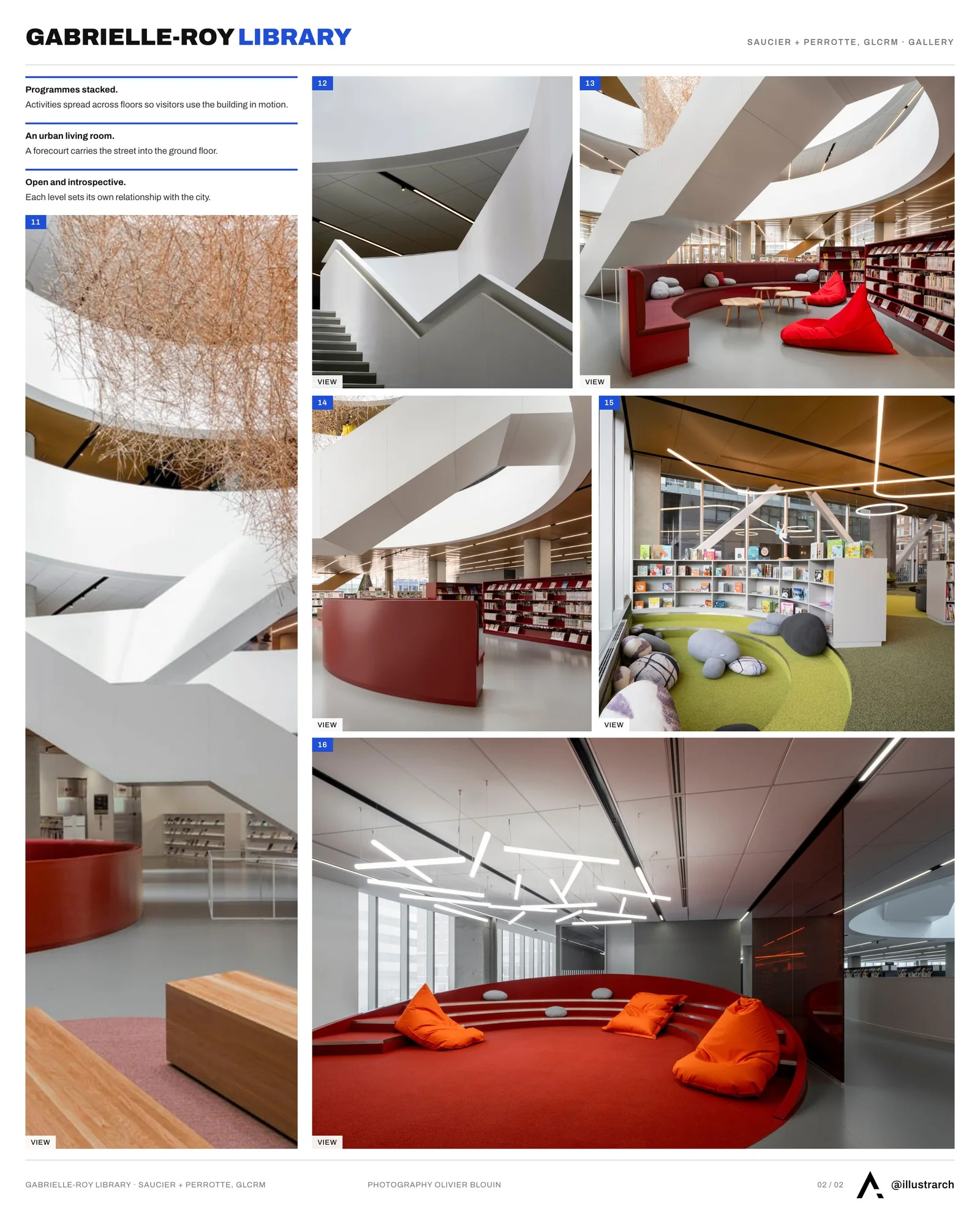
This layered sequence allows users to choose how they inhabit the library: whether as a place for brief encounters, extended study sessions, or creative exploration. The architecture does not prescribe a single mode of use; instead, it offers a flexible framework that adapts to the needs of a diverse and evolving community.
A Civic Institution for a Changing City
Through its extension and renovation, Gabrielle-Roy Library redefines the role of a public library in the contemporary city. By embracing verticality, urban connectivity, and programmatic richness, the project positions the library as both cultural infrastructure and social catalyst.
Rather than standing apart from its surroundings, the building engages in constant dialogue with Saint-Roch, contributing to the neighborhood’s vitality while offering spaces of refuge, learning, and expression. It is a library that reflects its users, open, plural, and in motion, demonstrating how architecture can support new forms of collective life in the city.
Photography: Olivier Blouin




National Archives of Sweden by Tengbom
On a hill above Harnosand, Tengbom pairs a concrete archive dug into...
 illustrarch Editoral Team2 Mins read
James Baldwin Media Library and Refugee House by associer
In Paris’s 19th arrondissement, Atelier Associer has reimagined a 1970s secondary school...
 Elif Ayse Sen3 Mins read

Library Design for Creating Community Spaces That Thrive
Explore how people-first library design turns libraries into civic living rooms. Learn...
 Sinan Ozen5 Mins read

SMVIT Library by Cadence Architects
SMVIT Library by Cadence Architects in India creates a porous, student-centered hub,...
Begum Gumusel3 Mins read


Leave a comment