

Architecture Meets Technology: Inside the Digital Construction Workflow
As architecture enters an era shaped by data, simulation, and digital collaboration, the construction workflow is being fundamentally redefined. This article explores how digitisation is transforming architectural authorship, coordination, craft, and long-term responsibility within the built environment.
 Sinan Ozen12 January 202614 Mins read294

Table of Contents Show
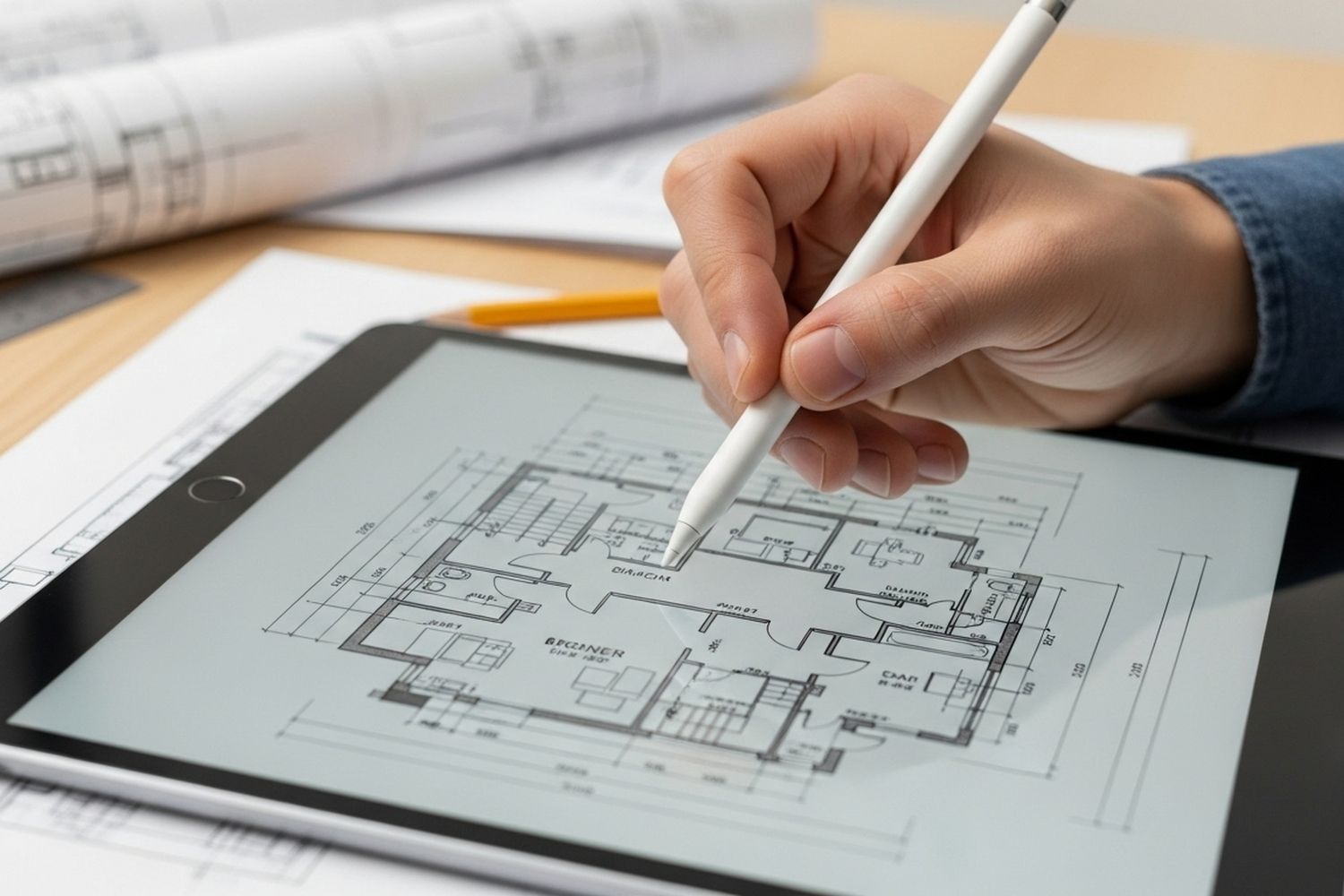
Architecture has always evolved through its tools. From the compass and straightedge to industrialized construction and computer-aided drafting, each technological shift has quietly reshaped how architects think, draw, and build. Today, however, the digitisation of the construction workflow marks a deeper transformation—one that extends far beyond representation or efficiency. It is not merely about faster drawings or smarter machines, but about how information moves, decisions are made, and responsibilities are shared across increasingly complex building processes. In an era defined by climate urgency, economic pressure, and accelerated urban change, digital workflows have become a central arena where architectural intent, technical precision, and ethical accountability intersect. Rather than replacing architectural judgment, technology is reconfiguring the conditions under which architecture is conceived, coordinated, and realized.
📊 Industry Data
The global BIM market is projected to grow from $4.69 billion in 2025 to approximately $5.42 billion by 2026, reflecting accelerating demand for integrated, data-driven processes across the AEC industry. Meanwhile, 68% of AEC professionals have already adopted BIM into their design practices, and 65% of those adopters report that BIM delivers the highest return on investment to their firm.
From Drawing to Data: The Shift in Architectural Representation
The transition from drawings as static artifacts to models as dynamic data environments represents a fundamental change in architectural thinking. Traditional construction documents once acted as final instructions, frozen at the moment of issue; today, digital models remain active throughout the building lifecycle. Building Information Modeling has transformed representation into a living system where geometry, material performance, cost, and time coexist within a single framework. This shift matters because it alters authorship and responsibility: architects no longer merely describe a building, but structure the information that allows it to be simulated, analyzed, and constructed. In this context, design becomes less about isolated moments of creativity and more about curating relationships between data, disciplines, and decisions—placing architects at the center of an informational ecosystem rather than at the end of a linear process.
| Aspect | Traditional Workflow | Digital (BIM-Based) Workflow |
|---|---|---|
| Representation | 2D drawings and physical scale models | 3D parametric models with embedded data (geometry, cost, time, material) |
| Documentation | Paper-based, static documents frozen at issue | Dynamic digital models active throughout building lifecycle |
| Collaboration | Sequential, siloed disciplines working independently | Simultaneous, real-time collaboration on shared cloud platforms |
| Clash Detection | Manual, visual review during coordination meetings | Automated detection and resolution in virtual environment |
| Cost Estimation | Manual quantity takeoffs, prone to human error | Automated quantity takeoffs and 5D cost estimation from the model |
| Design Modification | Time-consuming redrawing across multiple sheets | Changes propagate automatically across all views and documents |
| Architect’s Role | Author of final construction instructions | Curator of an informational ecosystem across the full building lifecycle |
| Post-Construction | Limited involvement; building handed over with as-built drawings | Digital twins and asset management enable continuous monitoring and adaptation |
💡 Expert Insight
The shift from 2D documentation to BIM is not simply a software upgrade—it is an epistemological change. When architects work within data-rich models rather than static drawings, they move from describing buildings to programming them. This fundamentally redefines the boundary between design intent and construction execution, making the architect both designer and information architect. The 2018 publication of the ISO 19650 standard—defining principles for managing project information across the asset lifecycle within BIM—marked a turning point where this new paradigm became an internationally recognized professional standard.

Coordination as Design: Digital Collaboration Across Disciplines
Digitised workflows have reframed coordination from a technical necessity into a design act in itself. Cloud-based platforms allow architects, engineers, contractors, and fabricators to work simultaneously within shared environments, collapsing traditional boundaries between phases and professions. This constant exchange reduces conflicts and errors, but more importantly, it reshapes how architectural ideas are negotiated and refined. Design intent is no longer transmitted through layers of interpretation; it is embedded directly into coordinated models that respond to structural, mechanical, and environmental logic in real time. For architecture, this means that clarity, precision, and adaptability become core design values. The ability to communicate spatial ideas through interoperable systems is now as critical as formal composition, redefining professional competence in collaborative terms.

| BIM Dimension | Focus | Description | Key Benefit |
|---|---|---|---|
| 3D | Visualization | Three-dimensional parametric modeling of building geometry | Enhanced spatial understanding and clash detection |
| 4D | Time / Scheduling | Construction sequencing linked to model elements | Optimized project timelines and logistics planning |
| 5D | Cost | Real-time cost estimation and budget tracking from model data | Accurate financial forecasting and reduced cost overruns |
| 6D | Sustainability | Energy analysis, environmental impact, and lifecycle assessment | Informed sustainable design decisions from early stages |
| 7D | Facility Management | Operations, maintenance, and asset management data for post-occupancy | Extended building lifecycle performance and stewardship |
⚡ Pro Tip
Interoperability is the silent backbone of digital collaboration. Open standards like IFC (Industry Foundation Classes), BCF (BIM Collaboration Format), and IDS (Information Delivery Specification) act as universal languages for project information—covering geometry, materials, costs, and compliance data. When selecting BIM tools for a multi-disciplinary project, prioritizing open-standard compatibility ensures seamless data flow regardless of which software each team member uses. Without interoperability, even the most advanced BIM model becomes a data silo.
Automation and Craft: Rethinking Making in the Digital Age
Automation in construction—through CNC fabrication, robotic assembly, and parametric workflows—has reopened long-standing questions about craft, authorship, and material intelligence. Far from eliminating craftsmanship, digital fabrication often demands a deeper understanding of materials, tolerances, and assembly logic. Architects who engage with these tools are required to think simultaneously at the scale of detail and system, aligning design decisions with fabrication constraints from the outset. This matters because it reconnects design with making, a relationship that industrial modernism had partially severed. Digitisation allows architects to regain agency over how buildings are assembled, enabling new forms of customization and precision while challenging the profession to redefine what craft means when code, machine, and material operate together.
| Technology | Process Type | How It Works | Architectural Application | Notable Example |
|---|---|---|---|---|
| 3D Printing (Additive Manufacturing) | Additive | Layer-by-layer material deposition from a digital model | Custom components, prototypes, entire building structures | ICON 3D-printed homes; DFAB House, Switzerland |
| CNC Milling | Subtractive | Computer-controlled cutting/carving from solid blocks | Complex façade panels, timber joints, ornamental details | Elbphilharmonie, Hamburg — algorithmically designed glass facade |
| Laser Cutting | Subtractive | High-powered laser beam slices or engraves material precisely | Intricate metalwork, decorative screens, perforated panels | Louvre Abu Dhabi — ~8,000 unique perforated metal stars |
| Robotic Assembly | Automated Assembly | Programmable robotic arms perform bricklaying, welding, and assembly | Complex geometries, modular construction, hazardous site tasks | ETH Zurich DFAB House — robotic timber and concrete fabrication |
| Parametric Design | Computational | Algorithm-driven form generation based on variable parameters | Adaptive facades, optimized structures, mass customization | Guggenheim Bilbao — Frank Gehry’s CATIA-driven design |
🔬 Expert Insight
Digital fabrication does not eliminate the craftsperson—it redefines the craft. As MIT’s research on robotic assembly demonstrates, the direct link between digital models and CNC equipment removes the on-site adjustment traditionally performed by skilled workers. To compensate, craft knowledge must be embedded into the design model itself. This means architects must codify material behavior, tool capabilities, and assembly logic into computational parameters—transforming tacit, hands-on knowledge into explicit design data. The result is a new form of authorship where design, fabrication, and assembly constraints are integrated from the very beginning rather than resolved sequentially.

Simulation, Performance, and Predictive Design
One of the most significant impacts of digitising the construction workflow lies in the ability to simulate performance before building begins. Environmental analysis, structural behavior, energy consumption, and lifecycle impacts can now be tested and adjusted during early design stages. This predictive capacity shifts sustainability from a post-rationalized goal to an integral design driver. For architecture, this is not simply a technical advantage but a cultural one: it embeds responsibility into the design process itself. When performance data informs spatial decisions, architecture moves closer to an ethics of evidence—where intuition and creativity are balanced by measurable consequences. In a time when buildings must respond to planetary limits, such integration is no longer optional.
| Simulation Type | What It Analyzes | Design Stage | Impact on Architecture |
|---|---|---|---|
| Energy Performance | Heating, cooling loads, HVAC efficiency, energy consumption patterns | Concept → Detailed Design | Optimizes envelope design and reduces operational carbon footprint |
| Structural Analysis | Load-bearing behavior, stress distribution, seismic response | Schematic → Construction | Enables material optimization and innovative structural forms |
| Daylighting & Solar | Natural light distribution, solar gain, glare control | Concept → Detailed Design | Informs window placement, shading strategies, and spatial orientation |
| Computational Fluid Dynamics (CFD) | Airflow patterns, natural ventilation, thermal comfort | Schematic → Detailed Design | Shapes spatial layouts and opening configurations for occupant comfort |
| Lifecycle Assessment (LCA) | Embodied carbon, material sourcing, end-of-life environmental impact | Concept → Post-Occupancy | Drives material selection toward lower environmental impact over full lifecycle |
| Construction Sequencing (4D) | Build order, phasing, logistics, site operations over time | Detailed Design → Construction | Reduces scheduling conflicts and improves on-site coordination |
⚡ Pro Tip
Performance simulation delivers its greatest value when integrated at the concept stage, not retroactively during detailed design. Running energy and daylighting analyses on early massing options—before committing to formal decisions—allows architects to eliminate underperforming configurations quickly. This “fail fast” approach saves both design hours and construction costs, and ensures that sustainability is a design driver rather than a post-rationalized justification. Approaching climate targets like the AIA 2030 Commitment and the RIBA 2030 Climate Challenge requires this kind of early-stage, evidence-based decision-making.
Construction as a Continuum, Not an Endpoint
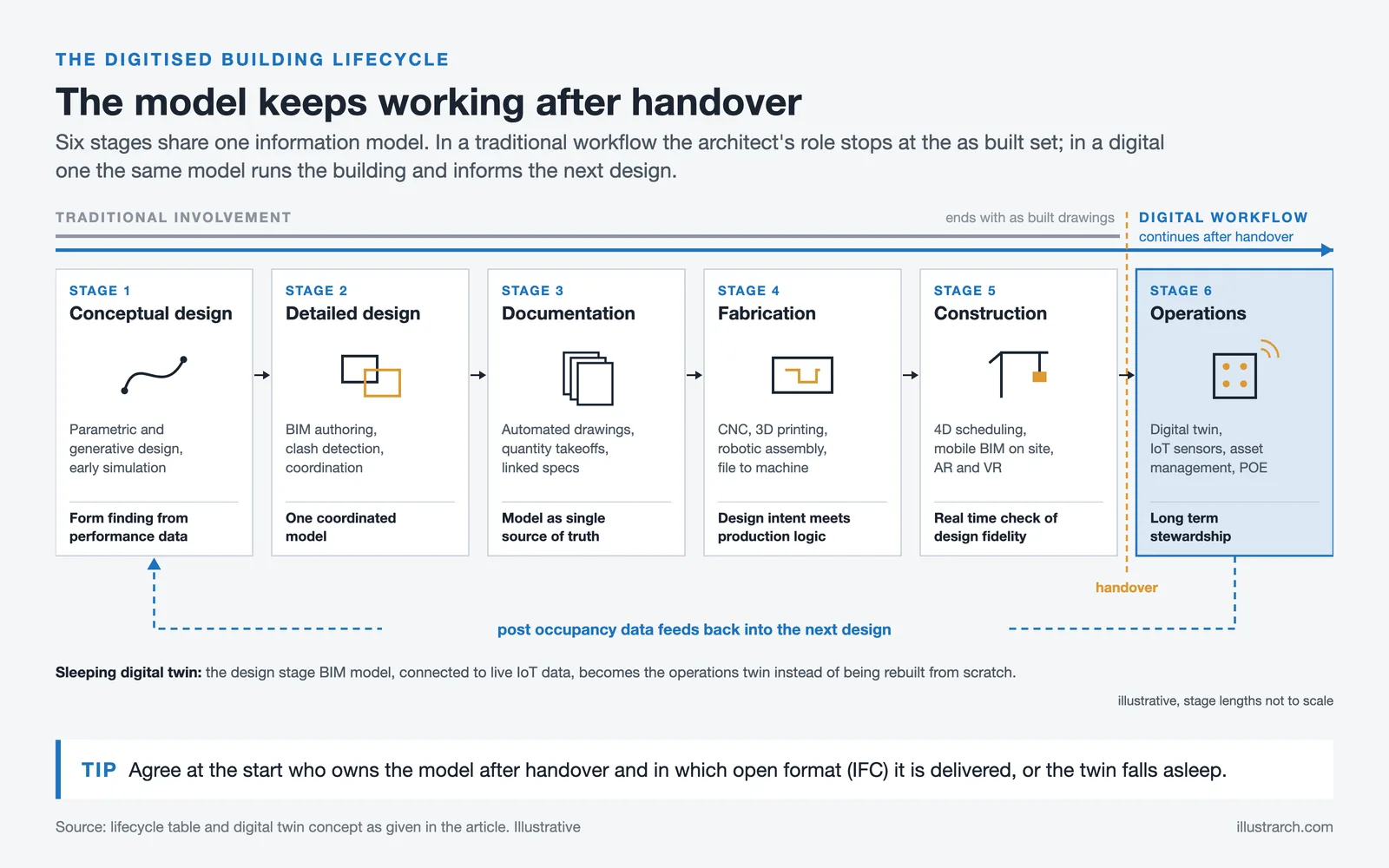
Digitised workflows extend architectural relevance beyond completion, reframing construction as part of a continuous process rather than a final act. Digital twins, asset management systems, and post-occupancy data allow buildings to be monitored, adapted, and maintained with unprecedented precision. This continuity matters because it challenges the profession’s traditional detachment from long-term building performance. Architects are increasingly positioned to contribute to how spaces age, respond to use, and evolve over time. In doing so, digitisation aligns architecture more closely with stewardship than spectacle, emphasizing durability, adaptability, and long-term value over short-term formal impact.
| Lifecycle Stage | Digital Technologies Used | Architect’s Evolving Role |
|---|---|---|
| Conceptual Design | Parametric modeling, generative design, early-stage simulations | Form-finding informed by performance data and constraints |
| Detailed Design | BIM authoring, clash detection, multi-disciplinary coordination | Integrating structural, MEP, and sustainability into a coordinated model |
| Documentation | Automated drawing generation, quantity takeoffs, specification linking | Ensuring model accuracy as the single source of truth for all outputs |
| Fabrication | CNC machining, 3D printing, robotic assembly, digital-to-physical file transfer | Bridging design intent with material constraints and production logic |
| Construction | 4D scheduling, on-site mobile BIM access, AR/VR visualization | Real-time oversight of design fidelity during build execution |
| Operations & Maintenance | Digital twins, IoT sensors, asset management systems, post-occupancy evaluation | Long-term stewardship — monitoring, adapting, and optimizing building performance |
📊 Digital Twin Data
Research indicates that digital twins in building operations have delivered energy consumption reductions of up to 17%, improvements of up to 40% in chiller Coefficient of Performance (COP), and 15% energy reductions post-retrofitting. A survey of 167 AEC practitioners found that 90% see clear value in using energy models during building operations—with the top cited benefits being closing the performance gap, achieving sustainability goals, and improving operational performance.
💡 Expert Insight — The “Sleeping Digital Twin” Concept
Most buildings already contain dormant digital assets—3D design models, energy compliance calculations, or BIM models created during the design stage—that are rarely used after construction is complete. The emerging concept of “Sleeping Digital Twins” proposes awakening these dormant models and transforming them into live performance digital twins by connecting them to real-time IoT data. This approach avoids building digital twins from scratch and instead leverages existing investments. For architects, this represents an opportunity to extend their influence well beyond project delivery—using the same models they authored to optimize building performance, support in-use certifications like NABERS, BREEAM, and LEED for O+M, and contribute to long-term decarbonization goals.

Conclusion
The digitisation of the construction workflow is not a technological trend to be adopted or resisted; it is a structural condition reshaping architectural practice and culture. Its true significance lies not in software or machines, but in how it reorganizes relationships—between design and construction, intention and execution, creativity and accountability. For architectural education, this demands a recalibration of skills, where critical thinking, systems literacy, and ethical awareness are taught alongside formal exploration. For practice, it requires architects to engage proactively with technology as a medium of authorship rather than a neutral tool. As architecture continues to navigate complex global challenges, digitised workflows offer not a solution, but a framework—one that, if approached thoughtfully, can reinforce architecture’s capacity to act responsibly, collaboratively, and meaningfully within the built environment.
| Benefit Area | Improvement | How Digitisation Enables It |
|---|---|---|
| Project Delivery Speed | Up to 20% faster | Parallel workflows, automated documentation, and 4D scheduling |
| Design Error Reduction | Up to 30% fewer errors | Automated clash detection and real-time multi-disciplinary coordination |
| Cost Savings | Up to 15–20% reduction | Optimized procurement, reduced rework, and accurate quantity takeoffs |
| Material Waste | Significantly reduced | Precise fabrication from digital models and prefabrication workflows |
| Stakeholder Collaboration | Dramatically improved | Cloud-based shared models as single source of truth across all disciplines |
| Lifecycle Management | Extended architect involvement | Digital twins and IoT-enabled post-occupancy monitoring and adaptation |
The Role of AI in the Evolving Digital Construction Workflow
Artificial intelligence is rapidly becoming the next transformative layer within the digitised construction workflow. While BIM restructured how buildings are modeled and coordinated, AI is now reshaping how that data is interpreted, optimized, and acted upon. In 2026, AI is no longer confined to experimental pilots—it is embedded in real project delivery. According to industry reports, 74% of AEC firms are already using AI in at least one project phase, and the global AI-in-construction market is projected to grow from $4.86 billion in 2025 to $22.68 billion by 2032. For architects, AI’s integration into BIM environments introduces capabilities that were previously impossible: generative design algorithms that explore thousands of spatial configurations in hours, automated clash detection that learns from past project data, and predictive scheduling tools that flag risks before they materialize on site.
Perhaps most significantly, the emergence of agentic AI systems—autonomous tools that can observe, plan, and refine their strategies over time—signals a deeper shift. Networks of AI agents are beginning to operate across design, engineering, and construction in connected ecosystems, streamlining processes from design optimization to resource management. For the architectural profession, this does not diminish the role of human judgment; rather, it amplifies it. AI handles the computational burden of data analysis, pattern recognition, and optimization, while architects focus on the qualitative dimensions of space, culture, and meaning that remain fundamentally human. The challenge for 2026 and beyond is not whether to adopt AI, but how to integrate it in ways that reinforce architectural values rather than reduce design to algorithmic outputs.
🤖 Expert Insight — AI + BIM Convergence
AI workflows are only as powerful as the data they consume—and BIM provides the structured, information-rich foundation AI needs to function effectively. In 2026, the relationship between AI and BIM is becoming reciprocal: AI enhances BIM by automating quantity takeoffs, generating coordination reports, and providing on-demand explanations of design constraints; meanwhile, BIM feeds AI the contextualized building data required for meaningful predictions. The key insight for architects is that investing in clean, well-structured BIM data today is investing in AI-readiness tomorrow. Firms that treat BIM as mere 3D modeling will find themselves unable to leverage the AI tools rapidly becoming standard in the industry.
Key Challenges in Adopting Digitised Construction Workflows
While the benefits of digitisation are well-documented, the path to full adoption is neither simple nor uniform. The construction industry—historically one of the slowest sectors to embrace digital transformation—faces a unique set of barriers that extend far beyond software procurement. Understanding these challenges is essential for architects and firms seeking to navigate the transition thoughtfully rather than reactively.
Cultural resistance remains one of the most persistent obstacles. Teams comfortable with established methods often resist workflow changes, particularly when learning curves temporarily reduce productivity. This resistance is compounded by the significant upfront investment required—not only in software licenses and hardware, but in the training infrastructure needed to develop proficiency in collaborative BIM workflows rather than just isolated tool use. Interoperability, despite advances in open standards, continues to create friction between different software ecosystems, requiring periodic quality checks and format conversions that slow down the very workflows digitisation promises to accelerate. Additionally, BIM and digital workflows frontload effort into the design phases, demanding more detailed planning and coordination before construction than traditional approaches require—a shift that can feel counterintuitive for firms accustomed to resolving details on site.
| Challenge | Impact | Mitigation Strategy |
|---|---|---|
| Cultural Resistance | Teams revert to familiar methods, undermining collaborative workflows | Phased training programs with early-win pilot projects to demonstrate tangible value |
| High Upfront Investment | Budget strain from software, hardware, and training costs before ROI is realized | Scalable cloud-based SaaS models; start with core tools and expand incrementally |
| Interoperability Gaps | Data loss and friction during file exchanges between different software platforms | Prioritize open standards (IFC, BCF, IDS); establish data exchange protocols early |
| Frontloaded Design Effort | More time and coordination needed in early phases than traditional methods | Reframe as investment: early-stage effort reduces costly late-stage rework and RFIs |
| Skills Gap & Labor Shortage | Shortage of professionals proficient in BIM, AI, and digital fabrication tools | Invest in continuous professional development; integrate digital literacy into architecture curricula |
| Legacy System Integration | Outdated ERP and CAD systems create data silos that resist modernization | Conduct technology stack audits; adopt middleware or APIs for gradual integration |
| Data Security & Ownership | Shared cloud environments raise questions about data access, ownership, and liability | Establish clear data governance protocols and contractual frameworks at project outset |
⚡ Pro Tip — Overcoming Cultural Resistance
The most effective approach to digital adoption is not company-wide mandates, but small, visible wins. Start with a single pilot project where BIM coordination prevents a real clash or a simulation saves a measurable amount of rework. Document the time and cost saved, then share the results internally. When team members see concrete evidence—not abstract promises—resistance gives way to curiosity. The construction industry will need to attract nearly half a million new workers in 2026 alone to meet demand; firms that deploy the latest technology will gain a competitive advantage by optimizing productivity and attracting younger, digitally-native talent.
Looking Ahead: The Digitised Construction Landscape in 2026 and Beyond
As the construction industry enters a pivotal phase of digital maturity, several converging trends are reshaping the horizon for architectural practice. The transition is no longer about individual technologies in isolation, but about how they interconnect to form a unified, data-driven project delivery ecosystem. Understanding these trajectories allows architects to position themselves not as passive adopters of technology, but as active shapers of how the built environment is conceived, delivered, and managed.
Cloud-native platforms are becoming the operational backbone of construction projects, enabling distributed teams to work from a single source of truth regardless of geographic location. Modular and prefabricated construction is accelerating as owners demand faster schedules and stronger cost certainty, with digital fabrication enabling the precision required for off-site production. Reality capture technologies—including 3D laser scanning and drone surveying—are feeding increasingly accurate as-built data directly into BIM models, reducing the gap between digital intent and physical reality. Meanwhile, the convergence of digital twins with AI-powered analytics promises to transform buildings from static assets into responsive, self-optimizing systems that learn from occupant behavior and environmental conditions in real time.
📊 2026 Industry Outlook
74% of AEC firms are already using AI in at least one project phase. The global AI-in-construction market is projected to grow from $4.86B (2025) to $22.68B by 2032. The 3D scanning market reached an estimated $5.7 billion in 2025 and continues to grow as scan-to-BIM workflows mature. The construction industry will need to attract approximately 500,000 new workers in 2026 alone just to meet demand—making digital productivity tools not optional, but essential for industry survival.
| Technology | Current Status (2026) | Impact on Architecture | Key Consideration |
|---|---|---|---|
| Agentic AI Systems | Moving from pilots to real-world deployments | Autonomous scheduling, clash resolution, progress tracking, and resource optimization | Requires structured BIM data and clear governance protocols |
| Scan-to-BIM (Reality Capture) | Rapidly improving with AI-assisted object classification | Accurate as-built documentation; bridges physical conditions with digital models | Especially valuable for renovation and retrofitting of existing building stock |
| Digital Twin + IoT Networks | Becoming mainstream for large-scale commercial buildings | Continuous building performance monitoring, predictive maintenance, and occupant comfort optimization | Plan for digital twin integration early; use open data standards for IoT interoperability |
| Modular & Prefab Construction | Accelerating adoption driven by cost and schedule pressure | Offsite fabrication of standardized components with digital precision reduces waste and build time | Requires tight BIM-to-fabrication data pipelines and design-for-manufacture thinking |
| AI-Powered Generative Design | Expanding rapidly into architectural workflows | Rapidly generates and evaluates thousands of design alternatives based on constraints | Architect’s role shifts to curating and refining AI-generated options, not producing them from scratch |
| AR/VR for On-Site Coordination | Increasingly used for field verification and client walkthroughs | Overlays BIM data onto physical site for installation verification and spatial comprehension | Most effective when integrated with live BIM models rather than static snapshots |
🏗️ Expert Insight — The Architect’s Position in 2026
The construction industry is undergoing its most significant transformation since industrialization. For architects, this moment demands a strategic response: digital literacy is no longer a specialization—it is a core professional competency. Firms that treat technology as a support function will find it increasingly difficult to compete with those that have embedded digital thinking into their design culture. The architects who will thrive in this landscape are not necessarily the best coders or software operators, but those who understand how to leverage digital ecosystems—BIM, AI, simulation, and digital twins—as instruments of design intention, ethical responsibility, and collaborative stewardship. The tool has changed; the purpose of architecture has not.
📋 Quick Reference: Key Standards & Frameworks for Digitised Construction
| ISO 19650 | International standard for information management across the building lifecycle using BIM |
| IFC (Industry Foundation Classes) | Open data standard for BIM interoperability across software platforms |
| BCF (BIM Collaboration Format) | Open standard for issue tracking and coordination between BIM tools |
| IDS (Information Delivery Specification) | Machine-readable format for defining BIM data requirements |
| AIA 2030 Commitment | Professional target for carbon-neutral buildings by 2030 |
| RIBA 2030 Climate Challenge | UK-based framework for reducing embodied and operational carbon in architecture |
| NABERS / BREEAM / LEED for O+M | In-use performance certifications supporting post-occupancy building optimization |
- 3D modeling in construction
- architecture and technology integration
- BIM technology in construction
- construction technology solutions
- digital architecture solutions
- digital construction workflow
- digital transformation in construction
- modern construction techniques
- sustainable construction technology
- Virtual Reality Architecture





Foster + Partners to Test Robot Swarms Building Timber from the Top Down
Foster + Partners wins €4m EU grant to build robot and drone...
 illustrarch Editoral Team2 Mins read
PLNAR Review: Does AR Measurement Hold Up on a Real Site Visit?
PLNAR began as a consumer AR tape measure and now runs as...
Sinan Ozen5 Mins read
ArchiSnapper Review: Is This Field Report App Worth It for Architects?
A hands-on look at Deltek ArchiSnapper, the mobile app built for field...
Sinan Ozen5 Mins read

Gross Internal Area and Net Internal Area: What’s the Difference?
The difference between Gross Internal Area and Net Internal Area shapes how...
Sinan Ozen5 Mins read


Leave a comment