

10+ Best Tiny Home Communities in Colorado: The Complete Guide
Explore tiny home communities in Colorado. Mountain living, off-grid options, and progressive zoning laws. Compare costs and communities across CO.
 Bahattin Duran6 April 202621 Mins read233

Table of Contents Show
Colorado stands at the forefront of the tiny home movement, driven by a combination of progressive housing policies, a deeply ingrained outdoor lifestyle culture, and the practical reality that traditional housing costs in cities like Denver and Boulder have pushed many residents to explore creative alternatives. For anyone searching for tiny home communities in Colorado, the state delivers some of the most established and well-known options in the country, from purpose-built villages along the Front Range to off-grid mountain retreats near ski towns.
Colorado was also one of the first states to adopt Appendix Q of the International Residential Code, which specifically addresses tiny homes on foundations. This guide covers the best communities, the evolving legal landscape, high-altitude building considerations, and the real costs of tiny home living in the Centennial State. For a broader look at communities across the country, see our guide to the top tiny house communities to consider in the USA.
Watch: Tiny Home Communities in Colorado
What Are the Zoning and Legal Requirements for Tiny Homes in Colorado?
Tiny homes are legal in Colorado, but zoning rules vary by county and municipality. Colorado adopted Appendix Q of the IRC in 2018, providing a framework for tiny homes on foundations under 400 square feet. However, each local jurisdiction decides independently whether to enforce Appendix Q, and rules for tiny homes on wheels (THOWs) differ from those for foundation-built homes. Denver, Fort Collins, and Durango are among the most permissive cities, while counties like Weld and Teller maintain stricter minimum square footage requirements.
Understanding Colorado’s zoning landscape is the first step before committing to a tiny home purchase or community membership. Unlike many states that treat tiny homes as a regulatory afterthought, Colorado has taken measurable steps toward accommodation, though regulations remain highly localized at the county and municipal level.
What Is Appendix Q and How Does Colorado Use It?
Appendix Q is a section of the International Residential Code (IRC) that sets building standards for tiny homes on permanent foundations under 400 square feet. It covers ceiling heights (minimum 6 feet 8 inches in lofts), loft access methods (ladders, alternating tread devices, or stairs), and emergency escape requirements. Colorado adopted Appendix Q in 2018, making it one of the earliest states to do so.
You can read the full text of Appendix Q on the ICC Digital Codes website. However, adoption at the state level does not automatically enforce it in every jurisdiction. Individual counties and municipalities must choose to incorporate Appendix Q into their local building codes.
The Colorado Division of Housing, Building Codes and Standards oversees the design review and inspection of factory-built tiny homes statewide. Their Tiny Homes FAQ page is a valuable resource for understanding the state-level regulatory framework. Several Colorado municipalities have embraced these provisions while others continue to operate under traditional minimum square footage requirements that effectively exclude tiny homes. The table below breaks down the current status across key counties.
Colorado Tiny Home Zoning by County
| County / Municipality | Min. Square Footage | Appendix Q Adopted | THOWs Allowed | ADUs Allowed | Notes |
|---|---|---|---|---|---|
| Denver County | None (removed) | Yes | Limited zones | Yes | ADU-friendly since 2020; specific tiny home zones emerging |
| El Paso County (Colorado Springs) | 600 sq ft (varies) | Partial | RV parks only | Yes | Unincorporated areas more flexible |
| Larimer County (Fort Collins) | None (removed) | Yes | Designated areas | Yes | Fort Collins eliminated min sq ft in 2018 |
| La Plata County (Durango) | None | Yes | Yes (permitted areas) | Yes | Home to Escalante Village; progressive zoning |
| Weld County | 600 sq ft | No | No | Limited | Traditional zoning; limited tiny home options |
| Park County | 600 sq ft (varies) | No | Limited | Limited | Mountain area; stricter codes |
| Teller County | 600 sq ft | No | No | No | Near Pikes Peak; restrictive |
| Otero County (La Junta) | None | Yes | Yes | Yes | Home to Sprout Tiny Homes community |
| Boulder County | Varies by zone | Partial | Limited | Yes | ADU expansion underway; tiny homes in accessory structures |
| Summit County | Varies | Partial | Seasonal only | Limited | Ski area workforce housing discussions ongoing |
Disclaimer: Zoning regulations change frequently. Always verify current rules directly with the relevant county planning department before purchasing land or placing a tiny home. For jurisdictions without building departments, the Division of Housing maintains a reference list.
Best Tiny Home Communities in Colorado: Top 10 Compared

The best tiny home communities in Colorado include Sprout Tiny Homes in La Junta (most affordable, from $45,000), Escalante Village in Durango (best mountain-town lifestyle), WeeCasa in Lyons (best try-before-you-buy experience), and several Front Range communities near Denver, Colorado Springs, and Fort Collins with monthly lot rents ranging from $550 to $900. The following table compares all ten notable communities across the state.
| Community | Location | Type | Lot/Rent Cost | Home Size Range | Amenities | Best For |
|---|---|---|---|---|---|---|
| Sprout Tiny Homes Village | La Junta, CO | Ownership | $45,000-$85,000 (home + lot) | 200-400 sq ft | Community garden, shared workshop, water/sewer | Affordable full-time living |
| Escalante Village | Durango, CO | Ownership | $125,000-$200,000 | 200-600 sq ft | Community center, shared outdoor spaces, utilities | Mountain lifestyle, community focus |
| WeeCasa Tiny House Resort | Lyons, CO | Nightly rental / Experience | $150-$300/night | 120-400 sq ft | Riverside setting, variety of tiny home styles | Try-before-you-buy experience |
| Denver Tiny Home Village | Denver, CO | Transitional housing | Subsidized | 150-250 sq ft | Case management, community kitchen, shared bathrooms | Transitional/supportive housing |
| Beloved Community Village | Denver, CO | Community land trust | Income-based | 150-200 sq ft | Shared kitchen, community governance, support services | Community-driven affordable housing |
| River Run Tiny Homes | Salida, CO | Rental lots | $500-$800/month (lot) | 200-400 sq ft | River access, mountain views, utility hookups | Outdoor enthusiasts, remote workers |
| Colorado Springs Tiny Home Community | Colorado Springs, CO | Mixed (own/rent) | $600-$900/month | 200-500 sq ft | Mountain views, community events, pet-friendly | Front Range accessibility |
| Rocky Mountain Tiny Houses | Durango area, CO | Builder + community | $65,000-$120,000 (home) | 150-350 sq ft | Custom builds, off-grid capable | Custom tiny home buyers |
| Tiny Home Estates | Fort Collins, CO | Lot rental | $550-$750/month | 200-400 sq ft | Full hookups, laundry, community room | Fort Collins urban living |
| San Luis Valley Tiny Community | San Luis Valley, CO | Off-grid ownership | $15,000-$40,000 (land) | 150-400 sq ft | Off-grid, minimal restrictions, open space | Off-grid pioneers, budget buyers |
Community Spotlight: Sprout Tiny Homes, La Junta
Sprout Tiny Homes in La Junta is Colorado’s most affordable tiny home community, with complete home-and-lot packages starting around $45,000. Located on the southeastern plains about two hours from Colorado Springs, the community features individually owned SIP-built tiny homes (200-400 sq ft) with full utility connections, a shared workshop, and a community garden.
Founded with a mission to provide affordable, dignified housing in a region where traditional real estate options are limited, Sprout has grown into a full-fledged community that challenges assumptions about what tiny living looks like outside the Instagram aesthetic.
What sets Sprout apart is its focus on community infrastructure. Residents share a community garden, a workshop space for projects and repairs, and a central gathering area. The village operates under a homeowners’ association that manages common areas and enforces basic community standards without the restrictive covenants typical of traditional HOAs.
La Junta itself is a small agricultural town with a cost of living dramatically lower than anywhere along the Front Range, though residents trade urban amenities for a quieter, more rural pace of life. For remote workers or retirees looking for ultra-affordable Colorado living, Sprout represents one of the most compelling options in the state.
Community Spotlight: Escalante Village, Durango

Escalante Village is Durango’s first tiny home community, offering 24 riverfront tiny home spaces along the Animas River. The community features a mix of individually owned homes and a limited number of long-term rentals, with home sizes ranging from 200 to 600 square feet. Pricing runs well below Durango’s median home price of $600,000+, making it the top option for affordable mountain-town living in southwestern Colorado.
The community layout emphasizes walkability and shared spaces. A central community building serves as a hub for events, meetings, and socializing. Outdoor spaces include shared gardens, fire pit areas, and pathways that connect to local trail networks. The design intentionally reduces private yard space in favor of larger, better-maintained communal areas. Prospective residents can check availability and learn more on the Escalante Village resources page.
Durango’s location near the San Juan Mountains gives residents access to world-class skiing at Purgatory Resort, mountain biking on hundreds of miles of trails, and the Animas River for fishing and paddling. La Plata County’s progressive zoning has been instrumental in allowing Escalante to operate, making Durango one of the most tiny-home-friendly municipalities in Colorado.
Best Tiny Home Options in Denver, Colorado Springs, and Fort Collins

The Front Range corridor offers the most tiny home options of any region in Colorado, though each city takes a different regulatory approach. Denver leads with no minimum square footage and strong ADU support. Fort Collins eliminated minimum square footage in 2018. Colorado Springs is catching up, with more flexibility in unincorporated El Paso County areas. Monthly lot rents along the Front Range typically run $550-$900.
The Front Range corridor, home to most of Colorado’s population, presents both the greatest demand for tiny homes and the most complex regulatory environment. Each major city along the I-25 corridor has taken a slightly different approach to accommodating the tiny home movement.
Tiny Homes in Denver
Denver has emerged as one of Colorado’s most progressive cities for tiny home communities Denver Colorado residents can access. The city removed minimum square footage requirements for new construction and has actively supported tiny home villages as part of its broader affordable housing strategy. Several transitional tiny home villages, including the Beloved Community Village, have operated successfully within city limits.
Denver’s ADU (Accessory Dwelling Unit) ordinance allows property owners to build small secondary units on existing lots, effectively opening the door for backyard tiny homes in many residential neighborhoods. The City of Denver’s ADU zoning page provides details on eligible zones and requirements. The permitting process is more streamlined than in most Colorado cities, though costs for Denver lots and permitting still run higher than rural alternatives.
Tiny Homes in Colorado Springs
Colorado Springs lags slightly behind Denver in tiny home accommodation, but the city has made notable progress. Tiny home communities Colorado Springs residents are watching include several planned developments in the unincorporated areas of El Paso County, where zoning is more flexible. Within city limits, tiny homes on foundations can be permitted in certain zones, while THOWs face more restrictions and are generally limited to designated RV parks.
The city’s lower cost of living compared to Denver, combined with proximity to Pikes Peak and Garden of the Gods, makes it an attractive base for tiny home enthusiasts who want mountain access without mountain prices.
Tiny Homes in Fort Collins
Tiny homes Fort Collins Colorado options benefit from the city’s early elimination of minimum square footage requirements in 2018. Fort Collins has been a leader in flexible housing policy, partly driven by demand from Colorado State University-connected residents and a culture that values sustainability and innovation.
Several lot-rental tiny home communities operate in and around Fort Collins, with monthly lot fees ranging from $550 to $750. The city’s bike-friendly infrastructure, craft brewery scene, and access to Horsetooth Reservoir and Rocky Mountain National Park make it one of the most desirable small cities in Colorado for tiny living.
What Is Mountain Tiny Home Living Like Near Colorado Ski Resorts?

Mountain tiny home living in Colorado means access to world-class skiing and outdoor recreation, but it comes with unique challenges: snow loads exceeding 100 psf, temperatures dropping well below zero, and home prices in resort towns often exceeding $1 million. Durango and Salida currently offer the most established tiny home options for year-round mountain living, while seasonal options exist near Summit County and Eagle County ski areas.
Colorado’s mountain towns face a severe housing affordability crisis, which has created a natural opening for mountain tiny homes Colorado residents and seasonal workers increasingly consider as viable alternatives.
Communities in and around Summit County, Eagle County (Vail), and Pitkin County (Aspen) have begun exploring tiny home developments as workforce housing solutions. While full-time tiny home communities in these areas remain limited, the conversation is advancing rapidly as resort towns struggle to house the workers who keep their economies running.
Seasonal vs. Full-Time Mountain Tiny Living
Seasonal tiny home living (typically November through April for ski season, or June through September for summer recreation) is more widely available than year-round options. Several RV parks and campgrounds near ski areas accommodate tiny homes on wheels during peak seasons, though year-round occupancy is not always permitted.
For full-time mountain living in a tiny home, Durango and Salida currently offer the most established options. Both towns have altitude-appropriate building communities and zoning that accommodates smaller structures. Telluride, Crested Butte, and Breckenridge are in earlier stages of exploring tiny home accommodations, primarily through workforce housing initiatives.
Key Considerations for Mountain Tiny Homes
Living in a tiny home above 7,000 feet presents unique challenges that lowland tiny home dwellers do not face. Snow loads, extreme temperature swings, wildfire risk, and limited access during winter storms all demand specific design and material choices. These considerations are covered in detail in the high-altitude building section below.
How Much Does It Cost to Live in a Tiny Home Community in Colorado?

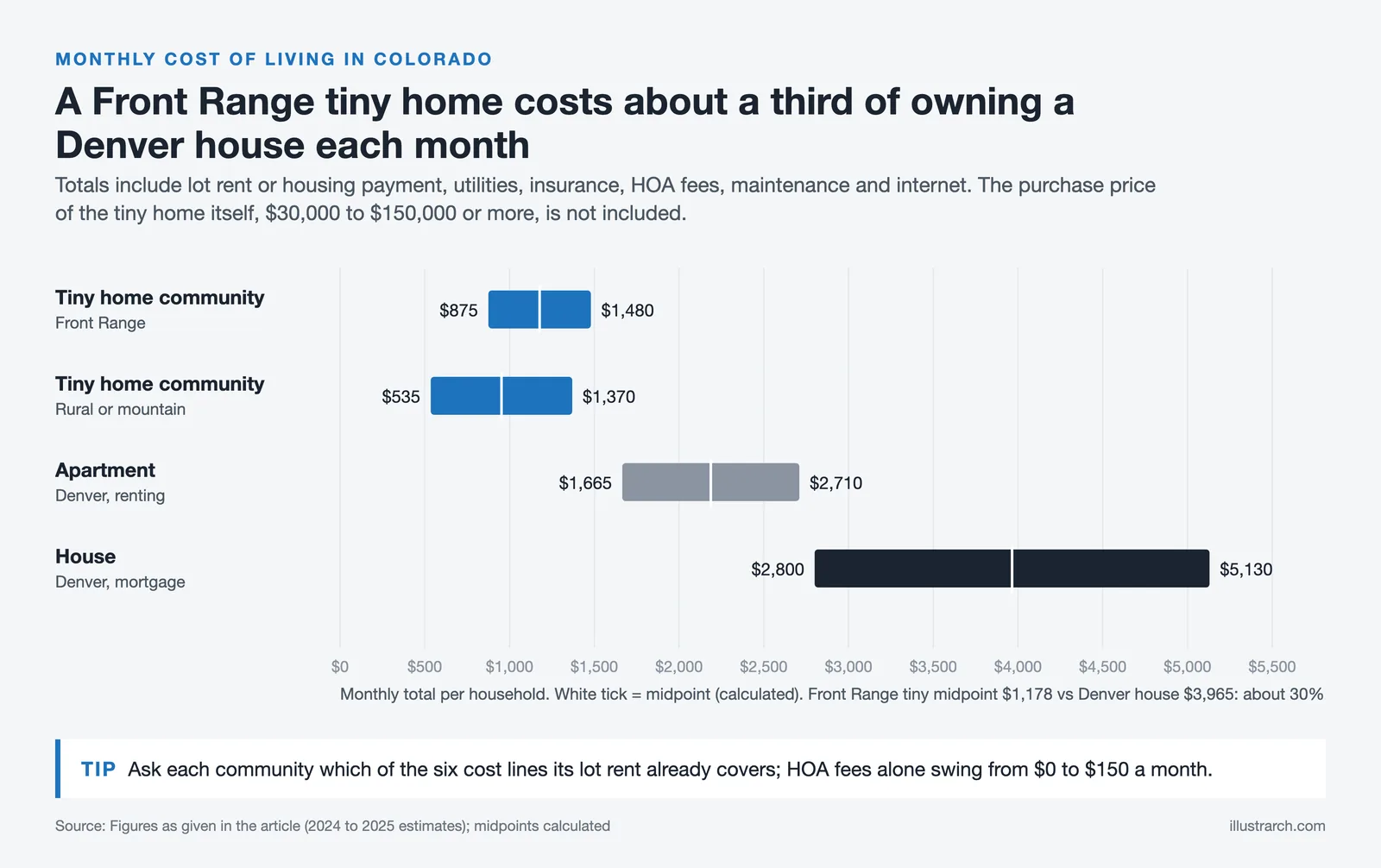
The total monthly cost of living in a tiny home community in Colorado ranges from $535 to $1,480 depending on location. Rural and mountain communities cost $535-$1,370 per month, while Front Range communities near Denver or Fort Collins run $875-$1,480. These figures include lot rent, utilities, insurance, HOA fees, maintenance, and internet. They do not include the initial home purchase price, which ranges from $30,000 to $150,000+.
| Expense Category | Tiny Home Community (Front Range) | Tiny Home Community (Rural/Mountain) | Traditional Apartment (Denver) | Traditional Home (Denver) |
|---|---|---|---|---|
| Housing Payment / Lot Rent | $600-$900/month | $300-$700/month | $1,500-$2,200/month | $2,200-$3,500/month (mortgage) |
| Utilities (Electric, Water, Gas) | $75-$150/month | $50-$200/month | $100-$200/month | $200-$400/month |
| Insurance | $50-$100/month | $50-$100/month | $15-$30/month (renter’s) | $150-$300/month |
| HOA / Community Fees | $50-$150/month | $0-$100/month | $0-$200/month | $0-$350/month |
| Maintenance | $50-$100/month | $75-$150/month | $0 (landlord covers) | $200-$500/month |
| Internet | $50-$80/month | $60-$120/month (satellite/rural) | $50-$80/month | $50-$80/month |
| Estimated Monthly Total | $875-$1,480 | $535-$1,370 | $1,665-$2,710 | $2,800-$5,130 |
Disclaimer: These figures are estimates based on 2024-2025 averages and vary significantly by specific location, community, and individual usage patterns. Tiny home ownership costs do not include the initial purchase price of the home itself, which can range from $30,000 to $150,000+ depending on size, customization, and builder.
The cost advantage of tiny home living is most dramatic when compared to traditional homeownership along the Front Range. A tiny home community resident in the Denver area can expect to spend roughly two thirds less per month than a traditional homeowner, even after accounting for lot rent and community fees.
What Are the High-Altitude Building Requirements for Tiny Homes in Colorado?

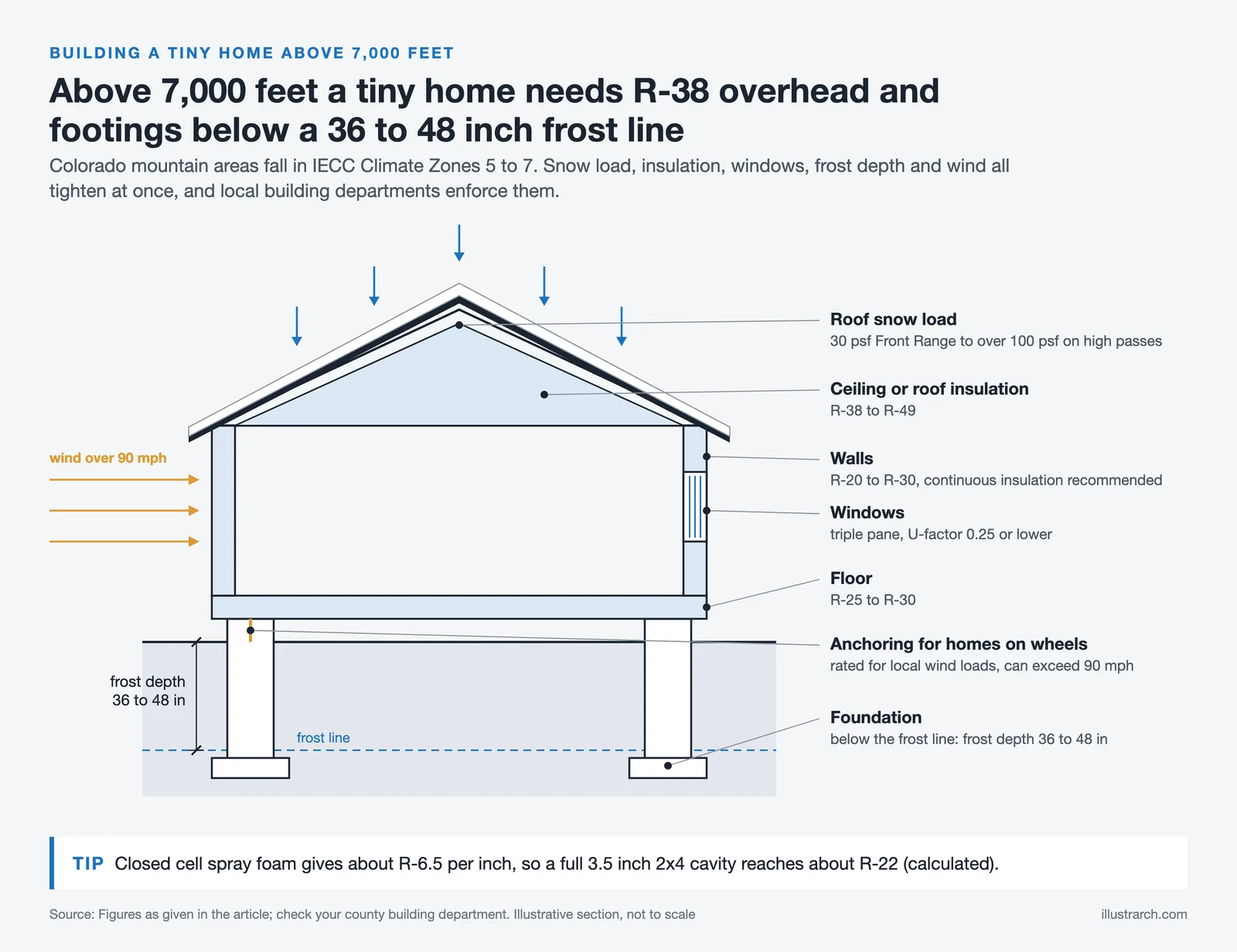
Tiny homes above 7,000 feet in Colorado must meet strict building requirements: roof snow loads of 30-100+ psf, wall insulation of R-20 to R-30, ceiling insulation of R-38 to R-49, triple-pane windows (U-factor 0.25 or lower), and foundations extending below a frost depth of 36 to 48 inches. These requirements fall under IECC Climate Zones 5, 6, and 7 and are enforced by local building departments.
Building and living in a tiny home above 5,000 feet (and especially above 7,000 feet) in Colorado introduces engineering and comfort challenges that require specific attention. High altitude tiny homes Colorado residents occupy must contend with factors that are irrelevant at lower elevations. The Colorado Division of Housing’s local building department guide outlines how geographic and climatic conditions like snow loads and wind shear are factored into state-level reviews.
Snow Load Requirements
Colorado’s mountain regions experience significant snow accumulation, and local building codes require roofs to handle specific ground snow loads. These range from 30 pounds per square foot (psf) along the Front Range to over 100 psf in high-altitude mountain passes. Tiny homes, with their smaller roof footprint, still must meet these structural requirements. A standard tiny home roof designed for lowland use will likely fail inspection in mountain jurisdictions.
Insulation Standards for Colorado Mountain Tiny Homes
Colorado spans IECC Climate Zones 5, 6, and 7, with mountain areas falling into the most demanding categories. Minimum insulation values for high-altitude tiny homes should meet or exceed the following: walls at R-20 to R-30 (continuous insulation recommended), ceiling/roof at R-38 to R-49, floor at R-25 to R-30, and windows should be triple-pane with a U-factor of 0.25 or lower.
Spray foam insulation is the most common choice for tiny homes in Colorado’s mountains due to its high R-value per inch and ability to seal air gaps in small, complex wall cavities. Closed-cell spray foam provides approximately R-6.5 per inch, allowing builders to reach about R-22 in a full 3.5 inch 2×4 wall cavity, with supplemental exterior insulation for higher targets.
Best Heating Systems for High-Altitude Tiny Homes
Tiny homes in Colorado’s mountains require efficient, reliable heating systems. Popular options include mini-split heat pumps (effective down to approximately -15F with cold-climate models), propane wall heaters, and small wood-burning stoves. At elevations above 8,000 feet, combustion-based heaters may lose efficiency due to lower oxygen density, making electric or heat pump systems increasingly attractive despite higher electricity costs.
Foundation and Anchoring
Frost depth in Colorado mountains ranges from 36 to 48 inches, requiring foundations that extend below the frost line to prevent heaving. Tiny homes on permanent foundations must meet these depth requirements. Homes on wheels require robust anchoring systems rated for local wind loads, which can exceed 90 mph in exposed mountain locations.
Disclaimer: High-altitude building requirements vary by jurisdiction and elevation. Always consult a licensed engineer and the local building department before constructing or placing a tiny home above 7,000 feet in Colorado.
Best Off-Grid Tiny Home Options in Colorado

The best region for off-grid tiny home living in Colorado is the San Luis Valley, where 5-acre parcels start at $5,000-$15,000 with minimal building restrictions. Colorado averages over 300 days of sunshine per year (5.5-6.5 peak sun hours daily), making solar energy highly viable. The main legal challenge is water: Colorado limits rainwater collection to 110 gallons per household, and well drilling costs $15,000-$30,000.
Colorado’s vast rural landscapes and abundant sunshine make it one of the most practical states for off-grid tiny homes Colorado living.
Solar Energy Potential in Colorado
A typical off-grid tiny home in Colorado requires a 2-4 kW solar array paired with a 10-20 kWh battery bank to cover basic electrical needs year-round. Colorado’s solar irradiance averages 5.5-6.5 peak sun hours per day, among the highest in the nation. Even in winter months, most Colorado locations receive enough sunlight to maintain an off-grid system with proper battery storage.
Costs for a complete off-grid solar setup for a tiny home range from $8,000 to $20,000 depending on system size, battery type (lithium iron phosphate is now the standard), and installation complexity. Colorado’s net metering laws do not directly apply to off-grid systems, but the state does offer some tax incentives for renewable energy installations.
Water Rights and Access for Off-Grid Living
Water is perhaps the most legally complex aspect of off-grid living in Colorado. The state operates under the prior appropriation doctrine, meaning all water (including rainwater, in certain interpretations) belongs to existing rights holders. Colorado passed legislation in 2016 allowing residential rainwater collection of up to 110 gallons per household, but this remains one of the most restrictive rainwater policies in the western United States.
Off-grid tiny home owners typically rely on well water (requires a well permit and can cost $15,000-$30,000 to drill), hauled water (delivered by truck to on-site storage tanks), or a combination of permitted rainwater collection and hauled water. The San Luis Valley and parts of southeastern Colorado offer the most affordable land with relatively accessible groundwater.
Best Areas for Off-Grid Tiny Living in Colorado
The San Luis Valley remains the most popular region for off-grid tiny home living in Colorado, offering large, affordable parcels (5-acre lots for $5,000-$15,000) with minimal building restrictions. Huerfano County, Costilla County, and parts of Saguache County all have relatively permissive codes for off-grid structures. However, buyers should be aware that some of these parcels lack road access, cell service, and readily available utilities, making due diligence essential before purchase.
How to Move to a Tiny Home Community in Colorado

Moving to a tiny home community in Colorado requires eight key steps: defining priorities, researching zoning, visiting communities, evaluating the home, securing financing, arranging insurance, planning the physical move, and connecting with the community. The process takes longer than a typical move due to specialized financing, zoning verification, and community application requirements.
- Define Your Priorities. Decide whether you prioritize cost savings, mountain access, urban amenities, community size, or off-grid independence. Colorado offers options across all of these spectrums, but no single community excels at everything.
- Research Zoning. Use the county zoning table above as a starting point, then contact the specific county or municipal planning department to verify current regulations. Ask about Appendix Q status, THOW classifications, and any pending zoning changes. The Colorado Division of Local Government’s ADU page is a helpful resource for understanding statewide ADU rules.
- Visit Communities in Person. Photos and websites only tell part of the story. Visit at least two or three communities during different seasons if possible. Talk to current residents about their experience with management, neighbors, maintenance, and any unexpected costs.
- Evaluate the Home Itself. If purchasing a pre-built tiny home, inspect it thoroughly or hire an inspector familiar with tiny construction. For THOWs, verify RVIA (Recreational Vehicle Industry Association) certification, which is often required for financing and insurance. For homes on foundations, confirm compliance with local building codes and Appendix Q if applicable.
- Secure Financing. Traditional mortgages rarely cover tiny homes. Common financing options include personal loans, RV loans (for RVIA-certified THOWs), chattel loans, and builder financing. Interest rates are typically higher than traditional mortgages, ranging from 5% to 12% depending on the loan type and borrower qualifications.
- Arrange Insurance. Tiny home insurance is a specialized market. Companies like Strategic Insurance Agency, Foremost, and American Modern offer policies for tiny homes, but coverage options and costs vary significantly based on whether the home is on wheels or a foundation, its location, and its value.
- Plan the Move. If moving a THOW, you will need an appropriately rated tow vehicle (minimum 1-ton truck for most tiny homes), proper trailer lighting and braking, and potentially an oversized load permit depending on the home’s width and height. Many tiny home builders Colorado based companies offer delivery services as part of the purchase.
- Connect with the Community. Most tiny home communities have an application or screening process. Engage early, attend community events if possible before moving in, and review all community agreements, rules, and fee structures in detail before committing.
Frequently Asked Questions

Are tiny homes legal in Colorado?
Yes, tiny homes are legal in Colorado, but regulations vary significantly by county and municipality. Colorado adopted Appendix Q of the IRC in 2018, which provides a framework for tiny homes on foundations. However, each jurisdiction decides independently whether to enforce Appendix Q, and rules for tiny homes on wheels (THOWs) differ from those for foundation-built tiny homes. Always check with your specific county planning department before purchasing or placing a tiny home.
How much does it cost to live in a tiny home community in Colorado?
Monthly costs range from approximately $535 to $1,480 depending on location, community type, and lifestyle. Rural communities like Sprout Tiny Homes in La Junta can cost as little as $500-$700 per month total, while Front Range communities near Denver or Fort Collins typically run $875-$1,480 per month including lot rent, utilities, and community fees. This does not include the initial home purchase, which ranges from $30,000 to $150,000+.
What is Appendix Q and why does it matter?
Appendix Q is a section of the International Residential Code (IRC) that establishes building standards specifically for tiny homes on permanent foundations under 400 square feet. It addresses ceiling heights, loft access, emergency escape requirements, and other safety standards. Colorado was one of the first states to adopt it, making it easier for builders and homeowners to construct code-compliant tiny homes without seeking costly variances. The Tiny Home Industry Association maintains a detailed overview of Appendix Q adoption across the country.
Can I put a tiny home on wheels anywhere in Colorado?
No. Tiny homes on wheels (THOWs) are generally classified as recreational vehicles in Colorado, which restricts where they can be used as primary residences. Most jurisdictions limit full-time THOW occupancy to designated RV parks, tiny home communities, or properties with specific use permits. Some rural counties in southeastern Colorado have more relaxed enforcement, but technically, living full-time in a THOW outside of a designated area is not legal in most Colorado jurisdictions.
What are the best areas for off-grid tiny living in Colorado?
The San Luis Valley (Costilla, Saguache, and Alamosa counties) offers the most affordable land with minimal building restrictions, making it the most popular off-grid tiny home area in the state. Huerfano County and parts of Otero County also offer relatively permissive environments. These areas provide ample sunshine for solar power but come with challenges including limited water access, remote locations, and extreme temperature ranges.
Do tiny homes hold their value in Colorado?
Tiny homes on permanent foundations in established communities have shown moderate appreciation in line with local real estate trends. THOWs tend to depreciate more like vehicles, losing value over time unless they are in high-demand areas. Custom-built tiny homes from reputable Colorado builders like Sprout Tiny Homes tend to retain value better than mass-produced or DIY units.
What insulation do I need for a tiny home in Colorado mountains?
Mountain tiny homes in Colorado (above 7,000 feet) should have wall insulation of R-20 to R-30, ceiling insulation of R-38 to R-49, floor insulation of R-25 to R-30, and triple-pane windows with a U-factor of 0.25 or lower. Closed-cell spray foam is the most common choice due to its high R-value per inch and air-sealing properties. These specifications fall within IECC Climate Zones 6 and 7, which cover most of Colorado’s mountain regions.
Can I collect rainwater for my off-grid tiny home in Colorado?
Yes, but with strict limitations. Colorado law allows residential rainwater collection of up to 110 gallons per household using no more than two rain barrels. This is one of the most restrictive rainwater policies in the western U.S. due to the state’s prior appropriation water rights doctrine. Most off-grid tiny home residents supplement rainwater with well water (where permitted) or hauled water delivery services.
How do I finance a tiny home in Colorado?
Traditional mortgages generally do not cover tiny homes. Common options include personal loans from banks or credit unions, RV loans for RVIA-certified homes on wheels, chattel loans for homes not attached to land, and direct builder financing. Interest rates typically range from 5% to 12%, higher than conventional mortgages. Some Colorado-based credit unions, including Elevations Credit Union and Canvas Credit Union, have begun offering tiny home-specific loan products.
What is the minimum square footage for a home in Colorado?
There is no statewide minimum square footage in Colorado. Minimum size requirements are set at the county and municipal level. Several jurisdictions, including Denver and Fort Collins, have removed minimum square footage requirements entirely. Others, particularly in more rural or conservative counties, maintain minimums of 600 square feet or more. Appendix Q specifically addresses homes under 400 square feet, providing a building code framework for tiny homes in jurisdictions that have adopted it.

Final Thoughts
Colorado remains one of the most viable states in the country for tiny home living, offering a combination of progressive zoning policies, diverse community options, and landscapes that range from urban Front Range neighborhoods to remote off-grid mountain parcels. The best tiny home communities Colorado offers cater to a wide range of budgets, lifestyles, and priorities.
Whether you are drawn to the affordable community-focused model of Sprout Tiny Homes in La Junta, the mountain-town lifestyle of Escalante Village in Durango, or the independence of an off-grid parcel in the San Luis Valley, the key to success is thorough research into local zoning, realistic cost planning, and a clear understanding of the building requirements specific to your chosen location. Start by contacting the relevant county planning department, visiting communities in person, and connecting with established tiny home residents who can share unfiltered insights about daily life in Colorado’s tiny home communities.
Related reading: For a broader overview of tiny home communities nationwide, see our comprehensive guide to the top tiny house communities to consider in the USA.





Tiny House Water Systems: Your Complete Guide to Plumbing, Rainwater Harvesting and Off-Grid Solutions
A practical guide to designing a tiny house water system, covering PEX...
Bahattin Duran14 Mins read
Off-Grid Tiny House Living: Complete Setup Guide for Beginners
This guide walks you through every stage of setting up an off-grid...
Bahattin Duran15 Mins read
Tiny House with Loft: Design Ideas, Plans and Building Tips for Vertical Living
A complete guide to designing and building a tiny house with loft,...
Bahattin Duran15 Mins read
8+ Best Tiny Home Communities in Michigan: Great Lakes Tiny Living Guide
Explore tiny home communities in Michigan. Great Lakes lifestyle, affordable land, and...
Bahattin Duran18 Mins read


Leave a comment