

Jean Nouvel: The French Architect Who Paints with Light and Shadow
Jean Nouvel is a Pritzker Prize-winning French architect whose buildings are defined by the masterful use of light, shadow, and site-specific context. This article explores his architectural philosophy, most iconic projects by Ateliers Jean Nouvel, and why his approach continues to influence contemporary architecture worldwide.
 Sinan Ozen7 April 202610 Mins read236
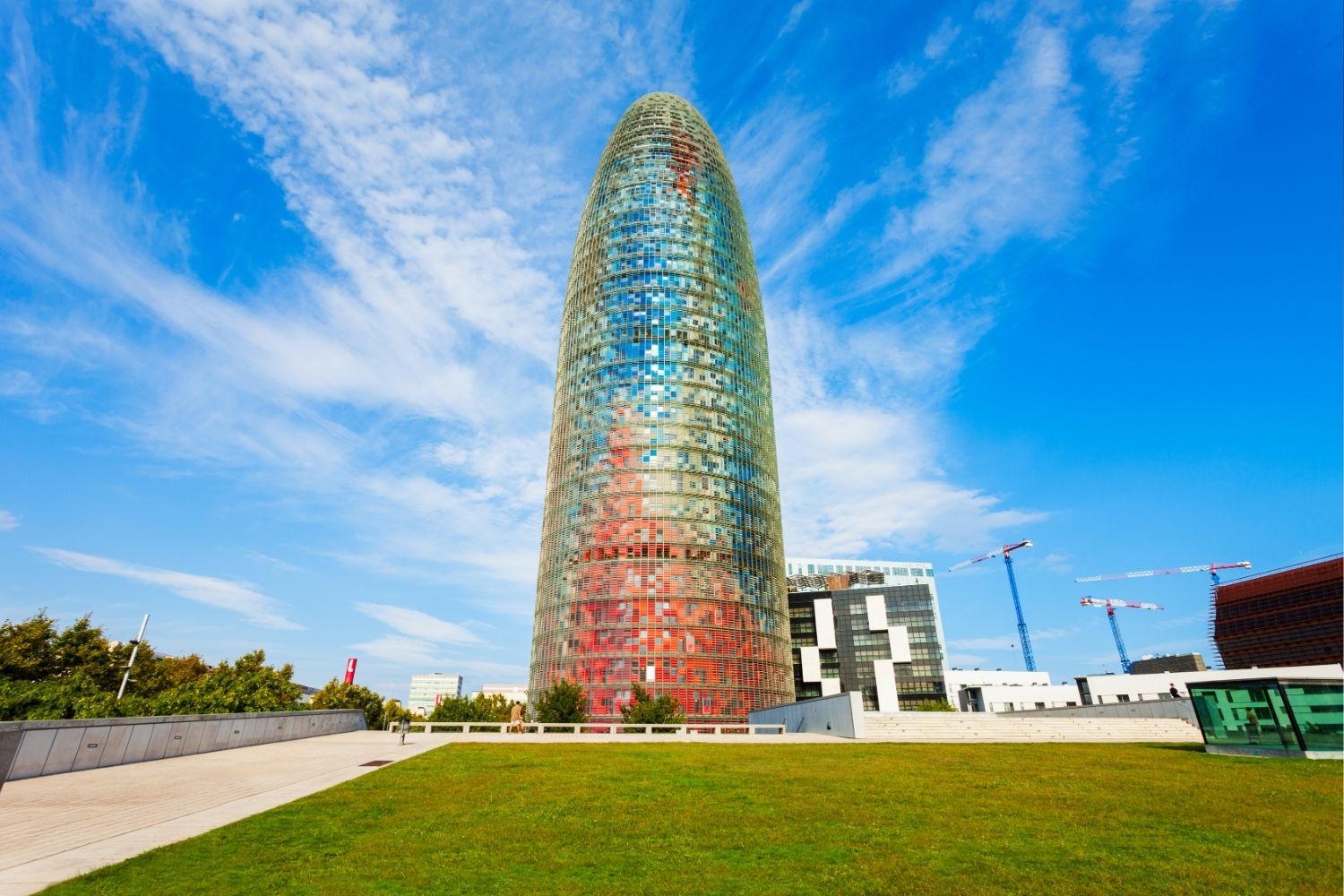
Table of Contents Show
Jean Nouvel is a French architect born in 1945 whose work consistently treats light and shadow not as byproducts of construction but as primary building materials. Winner of the 2008 Pritzker Prize, Nouvel has designed over 200 projects across five decades, each one refusing to repeat the last. His studio, Ateliers Jean Nouvel, operates from Paris and remains one of the most recognized architectural practices in the world.
What Is Jean Nouvel’s Architecture Philosophy?
Jean Nouvel’s architecture philosophy is rooted in the idea that every building must grow from its specific place, culture, and moment in time. He has described himself as a “contextual architect,” but his definition of context goes well beyond the physical site: for Nouvel, context means the wider historical memory, the cultural identity, and the lived experiences of the people who will inhabit or pass through a building. A structure, in his view, always has roots. It cannot simply be transplanted from one city to another without losing its meaning entirely.
This philosophy explains why Jean Nouvel architecture style resists easy categorization. He has explicitly rejected labels like “French high-tech” and refuses to repeat a signature formal vocabulary across projects. Each commission is treated as a problem unique to its location and program. As a result, his body of work looks strikingly heterogeneous at first glance, ranging from delicate glass facades to massive earthen forms, from urban cultural centers to desert resort complexes carved into sandstone.
🎓 Expert Insight
“I’m a contextual architect, but for me, the context isn’t only the site. It’s above all a wider historical context, a cultural context. Each time, a building is trying to continue a history, and to take part in this history.”
Jean Nouvel
This statement, made during a 2014 interview with the Louisiana Museum of Modern Art, captures the core of what sets Nouvel apart: the refusal to treat architecture as a neutral or universal discipline. For him, designing in Abu Dhabi demands a fundamentally different response than designing in Paris or Minneapolis.
Alongside this contextual grounding, light occupies a central role in the Jean Nouvel architecture philosophy. Across his career, from the photo-responsive mechanical facade of the Institut du Monde Arabe in 1987 to the layered steel dome of the Louvre Abu Dhabi in 2017, Nouvel has returned again and again to the manipulation of natural light as both an aesthetic and cultural tool. Light, for him, is not decorative. It carries meaning, reflects tradition, and transforms space over the course of a day in ways that no static material can replicate.
How Jean Nouvel Came to Architecture
Nouvel was born in Fumel, a small town in southwest France, in 1945. His parents were teachers who encouraged him toward mathematics and languages, but at sixteen a drawing teacher ignited a passion for visual art that redirected his ambitions entirely. He sat the entrance exam for the École des Beaux-Arts in Bordeaux and failed. Undeterred, he entered a national competition for a place at the prestigious École Nationale Supérieure des Beaux-Arts in Paris and won, arriving in the late 1960s at a moment of intense intellectual and political ferment.
The Paris of 1968 left a clear mark on how Nouvel thought about architecture’s purpose and responsibilities. He studied under Claude Parent and Paul Virilio, whose ideas about oblique space and the relationship between architecture and culture were deeply influential. He co-founded France’s first labor union for architects, the Syndicat de l’Architecture, and was a founding member of the Mars 1976 movement, which challenged the generic urbanism then being imposed on French cities. From the very beginning of his career, Nouvel understood architecture as inseparable from politics, identity, and time. For a wider view of the generation of architects working through these same tensions, illustrarch’s overview of the 15 most influential architects of the 20th century places Nouvel’s formation in broader context.
Key Projects That Define the Architecture of Jean Nouvel
Institut du Monde Arabe, Paris (1987)
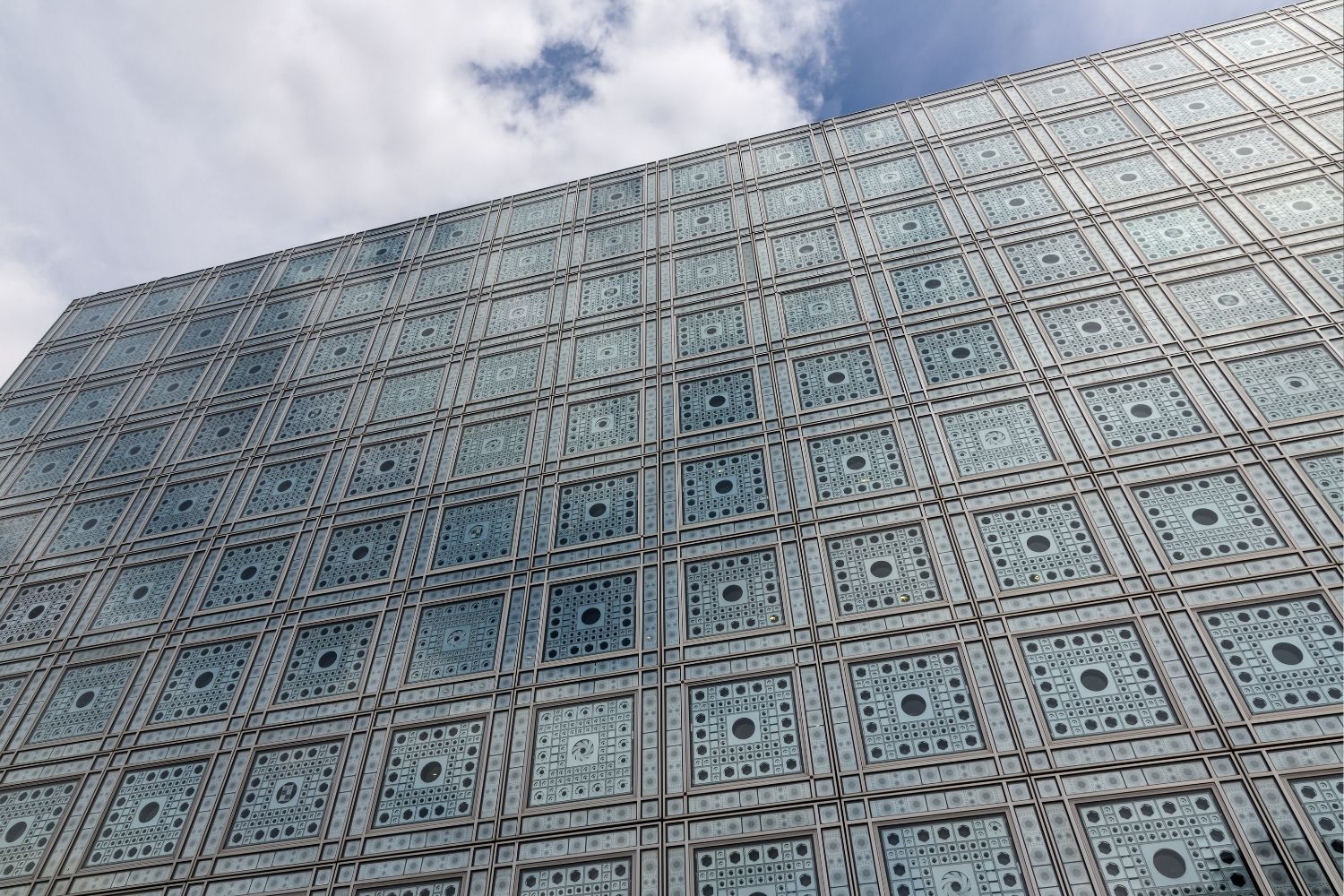
The project that launched Jean Nouvel onto the international stage was the Institut du Monde Arabe, completed in Paris in 1987. Designed with Architecture-Studio, the building was conceived as a cultural bridge between France and the Arab world. Its south facade became one of the most discussed architectural surfaces of its generation: a grid of 240 motorized diaphragms modeled on the traditional mashrabiya, the carved latticework screens found in Islamic architecture. These mechanical lenses open and close in response to exterior light levels, controlling the intensity of light entering the interior while recreating the patterned shadows associated with centuries of Arab architectural tradition.
🏗️ Real-World Example
Institut du Monde Arabe (Paris, 1987): The south facade features 240 high-tech diaphragms that respond to changing exterior light levels, opening and closing automatically to regulate interior brightness. The 1989 Aga Khan Award jury cited this building as an exemplary case of technology deployed in the service of cultural dialogue rather than novelty for its own sake.
The building sits along the Seine, at a point where the historic Marais meets the Left Bank. Its form acknowledges both the curved street line following the river and the geometric orthogonality of the Ile Saint-Louis directly across the water. The Institut won Nouvel the 1989 Aga Khan Award for Architecture and remains one of the most visited cultural institutions in Paris. It is also the clearest early demonstration of his conviction that high technology and cultural tradition are not opposites.
Fondation Cartier pour l’Art Contemporain, Paris (1994)
The Fondation Cartier commission gave Nouvel the opportunity to experiment with glass, reflection, and perceptual uncertainty in the heart of Paris. The building occupies a site on Boulevard Raspail and deploys two parallel planes of floor-to-ceiling glass, one set at the property line and one forming the actual building envelope, creating a layering effect in which the reflected sky, the surrounding cedars planted by Chateaubriand, and the interior of the gallery space seem to interpenetrate. Depending on the time of day and the angle of observation, the building alternately appears solid and transparent, present and dissolved into its surroundings.
Nouvel described this approach as a form of architectural eroticism, the deliberate play of concealment and revelation. Architecture for him must maintain mystery. When everything is legible at once, nothing happens; when depth and ambiguity are preserved, the building continues to generate new experiences over time. The Fondation Cartier brought him the Royal Gold Medal from RIBA in 2001 and remains a beloved fixture of the 14th arrondissement. For a comparison with another architect who built a career on transparency and material lightness, see illustrarch’s deep-dive into the design philosophy of Renzo Piano.
Torre Agbar, Barcelona (2005)
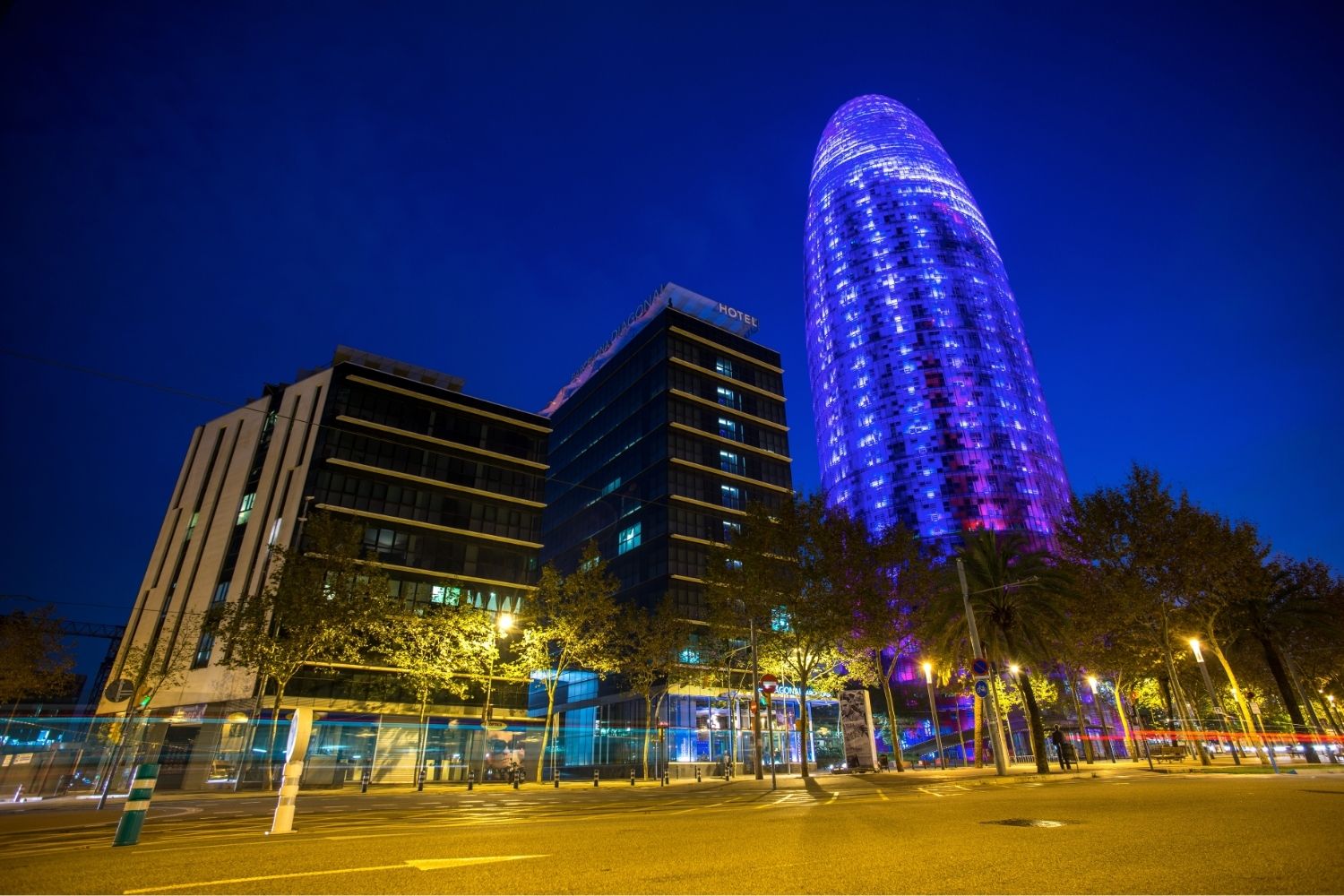
The Torre Agbar in Barcelona introduced a very different formal vocabulary. This 142-meter cylindrical tower rises from the Plaça de les Glòries Catalanes with a bullet-shaped profile that references both the forms of Catalan architect Antoni Gaudí and the topography of Montserrat, the mountain sacred to Catalonia. Its double-skin facade is clad in 4,400 aluminum louvres in 25 shades, and the glass layer beneath is composed of 59,000 panes in reds, oranges, and blues. At night, 4,500 LED lights bring the tower alive as a shifting color field visible across the city.
💡 Pro Tip
When studying Nouvel’s use of facades as performative surfaces, pay close attention to the layering strategy rather than the final visual effect. In both the Torre Agbar and the Institut du Monde Arabe, the key move is the introduction of a second skin that modulates perception of the building without being purely decorative. This double-skin logic recurs across his career and is worth isolating as a transferable design principle.
Musée du Quai Branly, Paris (2006)
The Musée du Quai Branly, dedicated to the arts of Africa, Asia, Oceania, and the Americas, is one of the most contextually complex projects in the Jean Nouvel architecture portfolio. Commissioned by President Jacques Chirac as a museum that would take seriously the cultures it displayed, the building sits beside the Seine in the shadow of the Eiffel Tower. Nouvel’s response was to embed the structure in a dense screen of vegetation designed by botanist Patrick Blanc, creating a living wall that softens the boundary between building and parkland and anchors the museum in the landscape rather than imposing upon it.
The architecture draws heavily on concepts of shadow, depth, and concealment. The elevated box of the main galleries hovers on pilotis above a semi-wild garden, its facades punctuated by colored glass boxes that project outward, each one the private space of an individual curator’s collection. Light is controlled throughout the interior to create the contemplative dimness appropriate for objects that were not made to be displayed under museum lighting. The Pritzker jury cited the Quai Branly as a key work when awarding Nouvel the prize two years later.
National Museum of Qatar, Doha (2019)
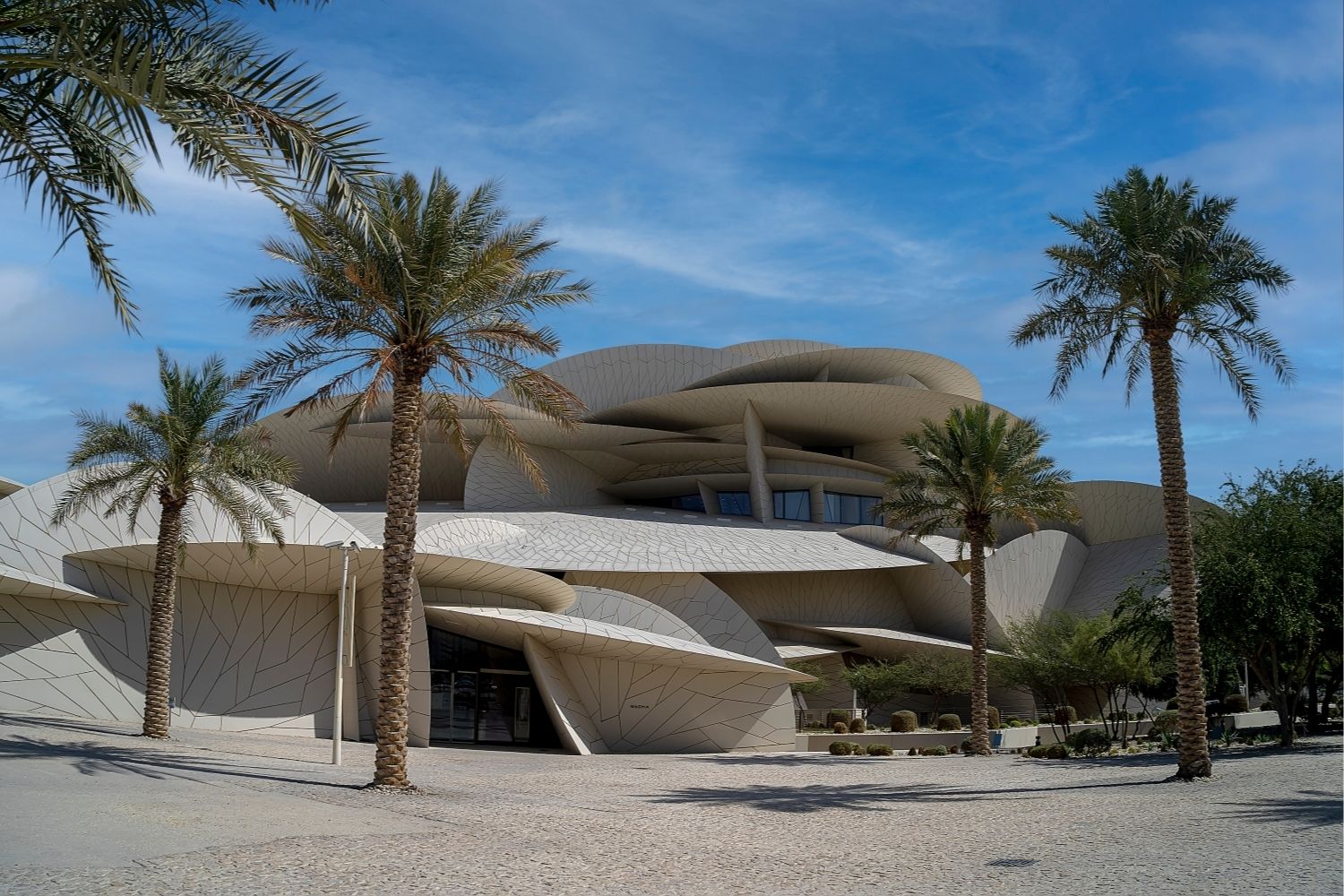
The National Museum of Qatar, which opened in 2019, shows Nouvel operating at his most geologically inspired. The building takes its form from the desert rose, a crystalline mineral formation found in the Qatari desert produced by the evaporation of saltwater. The museum is composed of 539 interlocking disc-shaped elements of varying sizes and angles, clad in prefabricated glass-fiber-reinforced concrete panels in sand-toned shades. The result reads as a geological eruption from the ground rather than a building placed upon it, a distinction Nouvel regards as fundamental.
Architecture Jean Nouvel, as expressed at the National Museum, is not about imposing a building’s identity onto a landscape but about discovering and amplifying what is already latent in the ground, the culture, and the light of a particular place. The discs create deep, sun-shading overhangs throughout the building, and the interior circulation flows through galleries arranged to reveal and frame the desert landscape through precisely oriented openings. Illustrarch’s article on the five key architects who changed the course of history provides useful framing for understanding how this site-specific approach positions Nouvel within the longer arc of architectural thought.
Louvre Abu Dhabi, UAE (2017)
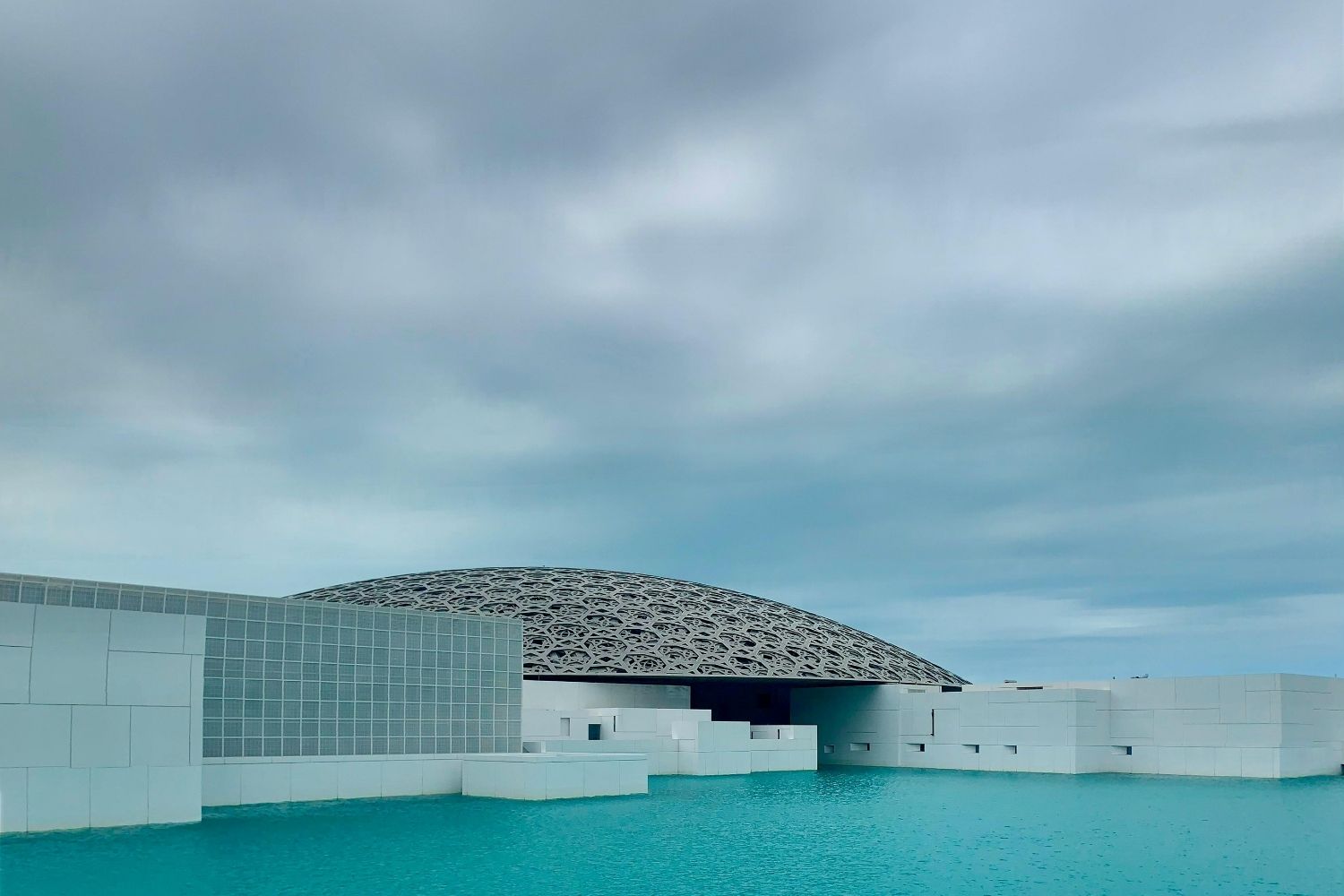
The Louvre Abu Dhabi is perhaps the most fully realized expression of the architecture Jean Nouvel has developed across his career. Commissioned as the Arab world’s first universal museum, the building organizes 55 individual structures, including 26 galleries, into a museum city on a reclaimed island off Saadiyat Island in Abu Dhabi. A dome 180 meters in diameter and weighing approximately 7,500 tonnes covers the entire complex, supported on just four pillars.
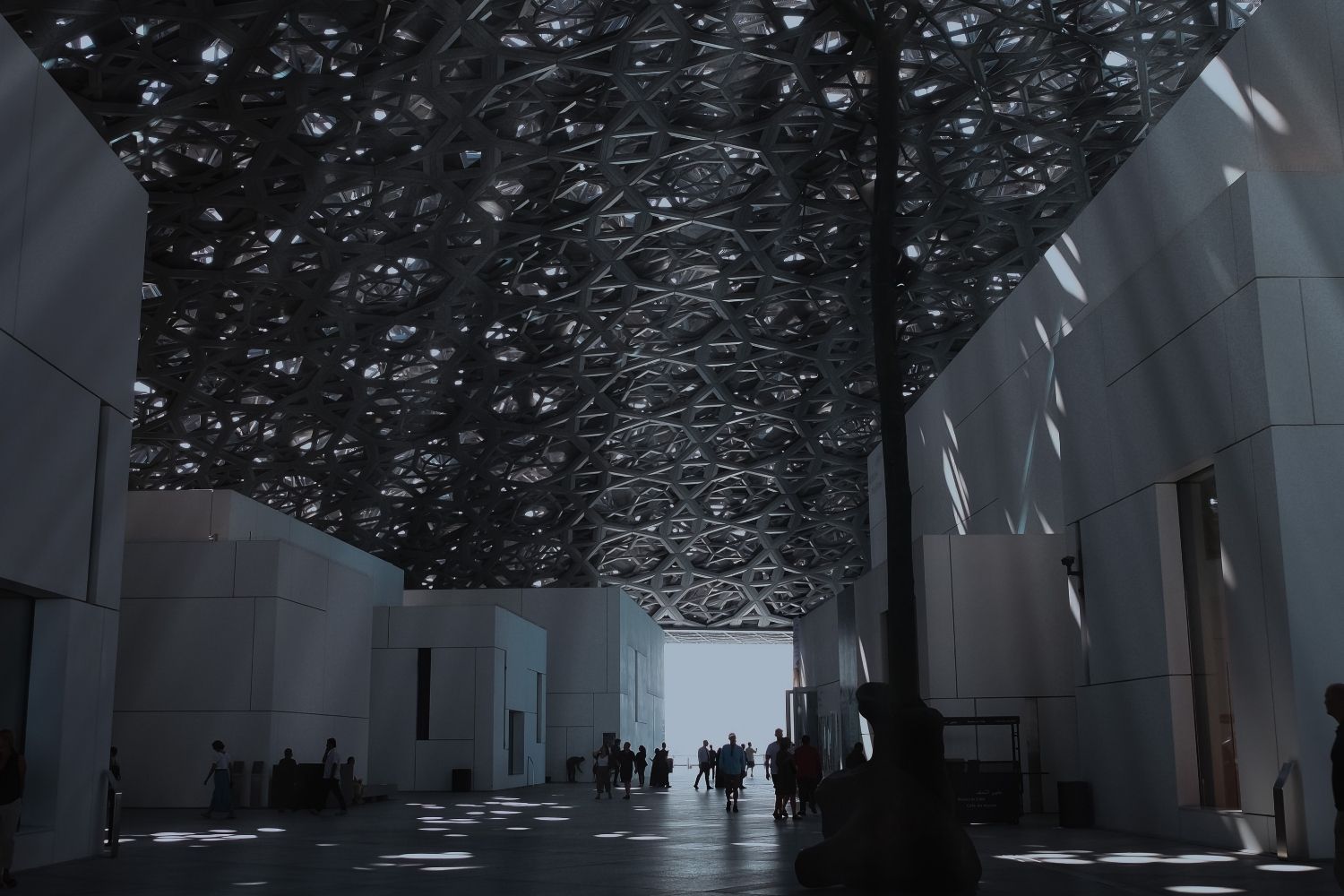
The dome’s design takes direct inspiration from traditional Islamic geometry. Eight layers of aluminum and stainless steel, each slightly offset from the others, are perforated with star-shaped apertures that produce what Nouvel called a “rain of light”: a constantly shifting pattern of dappled sunlight that moves across the white buildings and water channels below as the sun travels overhead. This effect consciously references the way palm fronds filter the desert sun in Arabian settlements, translating a vernacular observation into a monumental structural system.
📌 Did You Know?
The Louvre Abu Dhabi dome weighs approximately 7,500 tonnes, comparable to the weight of the Eiffel Tower in Paris. Its eight layers of patterned steel create 7,850 individual star-shaped perforations at varying angles, ensuring that no two moments of the “rain of light” effect are ever quite the same. The dome’s passive cooling properties also help the buildings beneath maintain comfortable temperatures in Abu Dhabi’s extreme summer heat, earning the complex a Three Pearl Estidama Design Rating and Silver LEED status.
What Makes Ateliers Jean Nouvel’s Design Approach Distinct?
Several consistent principles run through the work of Ateliers Jean Nouvel even when its buildings look nothing alike from project to project.
The first is the refusal of a signature style. Nouvel has said that he finds the repetition of forms across different cultural contexts a form of architectural dishonesty. Where other architects of his stature have developed instantly recognizable vocabularies, Nouvel treats each commission as a conceptual problem specific to its location, program, and moment.
The second is the treatment of facades as dynamic, performative surfaces rather than static envelopes. Whether through mechanical diaphragms, layered glass, perforated metal, or crystalline concrete, Ateliers Jean Nouvel architecture consistently uses the building skin to modulate light, manage perception, and create a dialogue between interior and exterior that changes throughout the day and across seasons.
The third is a deep engagement with the cultures in which his buildings are situated. Nouvel has spoken at length about the architect’s responsibility to listen before designing, to understand the historical and aesthetic traditions of a place, and to find ways to translate those traditions into contemporary form without resorting to mere pastiche.
💡 Pro Tip
Students analyzing Jean Nouvel architecture projects often focus on the visual drama of facades, but the more instructive study is how he handles the threshold between inside and outside. In building after building, the boundary dissolves through glass, vegetation, water, or shadow. Understanding how he manages the transition from public to private space reveals more about his design thinking than any surface treatment.
Awards, Recognition, and Influence
Jean Nouvel has received virtually every major distinction available in architecture. The 2008 Pritzker Prize, awarded for more than 200 completed projects, was accompanied by jury commentary noting his willingness to take risks and his resistance to repeating himself. The Pritzker Architecture Prize jury citation from that year remains one of the sharpest short analyses of what makes his architecture distinctive. Before the Pritzker, he had already received the Aga Khan Award for Architecture (1989), the Wolf Prize in Arts (2005), the Praemium Imperiale from the Japan Art Association (2001), and the Royal Gold Medal from RIBA (2001). A Golden Lion from the Venice Biennale in 2000 acknowledged his standing as a thinker within the discipline as much as a practitioner.
Frank Gehry, one of the few architects of comparable stature, offered a characteristically direct assessment: Nouvel tries things, not everything works, but his willingness to experiment and take on difficult problems is itself a form of creative courage that few architects sustain over a full career.
His influence on contemporary architecture is most visible in how subsequent generations have approached the facade as a cultural and performative surface, the growing acceptance of site-specific rather than universal design approaches, and the integration of digital fabrication into complex perforated and double-skin systems that were pioneered in buildings like the Institut du Monde Arabe long before they became technically straightforward to produce. Further coverage of his complete portfolio is available on ArchDaily’s Jean Nouvel Spotlight, and his studio’s current projects are documented on the official Ateliers Jean Nouvel website.
✅ Key Takeaways
- Jean Nouvel’s architecture philosophy treats light and shadow as primary building materials, not decorative effects. This runs consistently from his first major building in 1987 to his most recent completed work.
- Each project by Ateliers Jean Nouvel is developed as a site-specific cultural response. He rejects repeating a formal vocabulary across different contexts and explicitly refuses the label of any single architectural school.
- His most iconic buildings, including the Institut du Monde Arabe, Fondation Cartier, Torre Agbar, Louvre Abu Dhabi, and National Museum of Qatar, each demonstrate a different material and formal strategy in the service of the same underlying philosophy.
- The performative facade is a consistent tool across his work: double-skin glass, mechanical diaphragms, perforated metal, and crystalline concrete each serve to modulate perception and create a building that changes with time of day, season, and angle of view.
- Nouvel’s career offers architecture students a model of how conceptual consistency and formal variety can coexist: the discipline is philosophical rather than stylistic.





Interior Design for Commercial Spaces: Enhancing Functionality and Brand Identity
Commercial interior design has to serve brand, function and regulation at once....
 Begum Gumusel4 Mins read
Futuro House Production Revived in Finland After Decades-Long Hiatus
A Facebook listing for abandoned moulds led to the first new Futuro...
 illustrarch Editoral Team3 Mins read
Building Your Dream Home in NSW: What You Should Know About Montgomery Homes
Montgomery Homes has been building across Sydney, Newcastle, the Hunter, Wollongong and...
illustrarch Editoral Team4 Mins read
Designing a Home Theater: Where Drapery Fits Into the Plan
In a media room the curtains are a performance layer, not decoration....
illustrarch Editoral Team3 Mins read


Leave a comment