



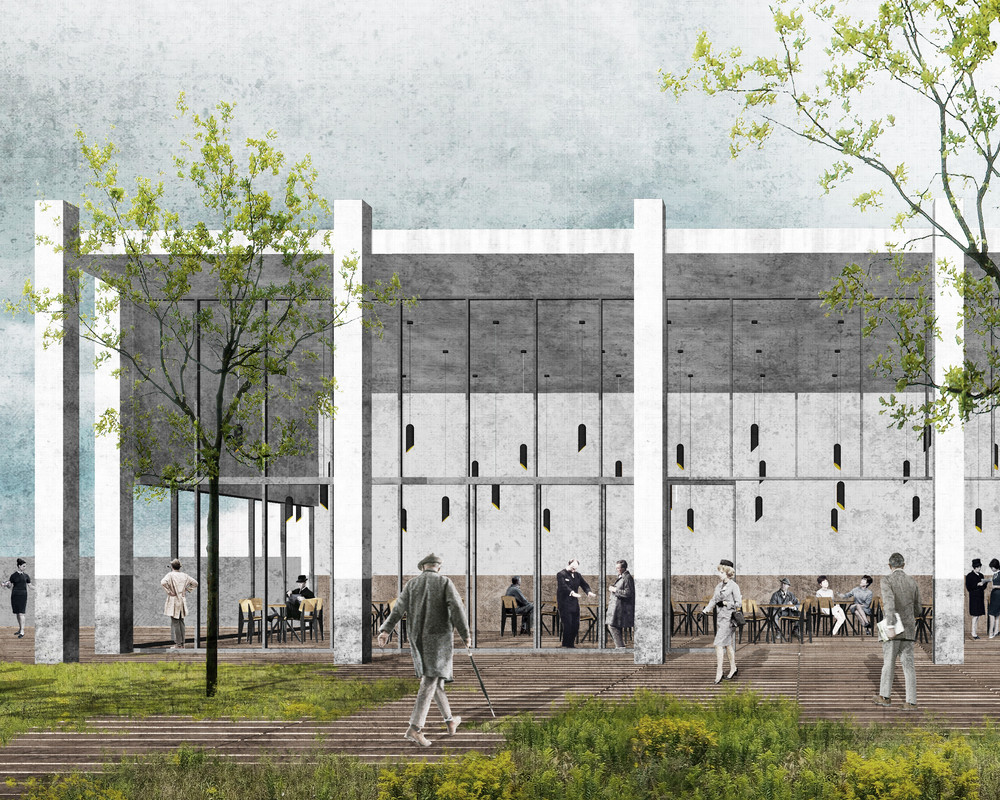
Designed by architect Valentina Scarton in 2019, “A Space to Attach Memories” reimagines care architecture as a setting that meets the fragmented reality lived by people with dementia. People with dementia hold a very fragmented perception of reality, linked to confused memories of what they live and have lived, which affects both the perception of space and the way of orienting oneself inside buildings. The project takes this condition as its starting point rather than treating it as a problem to be corrected.
The building as a single unit is totally questioned here. Everything that is normally a symbol of stability and stiffness loses meaning, and the breaking of the grid that holds a project together in our mind leads to perceiving space in a non-unitary way. It decomposes into visions, into fragments, held together by multiple and undefinable paths. Scarton answers this with a project that is itself a bond of fragments: between pre-existing and new buildings, between past and present, between memory and loss.
A ribbon of architectural episodes
The complex manifests itself as a ribbon that gathers together several architectural episodes, making the whole read as a single large building. Each area gives way to another, identified naturally by a fragment of the whole, a pre-existence, a color, or a garden, which stimulate a memory. It is a building to be discovered while crossing it, where no path is required or defined in advance, leaving free will to those who live in it. The result is a sensitive container rather than a fixed route.
This approach echoes wider thinking in the design of care environments. Spaces for people with dementia often rely on legible cues, varied courtyards, and short looping circulation so that residents can wander safely and recognize where they are. The discipline of healthcare architecture increasingly draws on this kind of person-centred reasoning, where atmosphere, light, and the comfort of familiar fragments matter as much as efficient plans. By weaving memory and orientation into the experience of moving through the building, the work treats architecture as a companion to perception.
What emerges is a quiet argument that buildings for fragile minds can hold meaning precisely by letting go of rigid order, offering instead a gentle landscape of cues to be rediscovered each day.






Renaatus Irumathi
Project Architect Spaces Inc Location 🇲🇻 Hulumale' Maldives Year 2024 Instagram @spaces.inc...
 illustrarch Editoral Team2 Mins read

White Khamovniki
Project Architect Valentina Scarton Year 2019 Instagram @valentina.scarton White Khamovniki treats a...
illustrarch Editoral Team1 Mins read

Millennium Horizon
Project Architect Tanevoo Location 🇦🇪 Abu Dhabi Central Capital District, UAE Year...
illustrarch Editoral Team2 Mins read

Wuto Space
Project Architect Valentina Scarton Year 2019 Instagram @valentina.scarton A two-bedroom, one-living room...
illustrarch Editoral Team1 Mins read


Leave a comment